

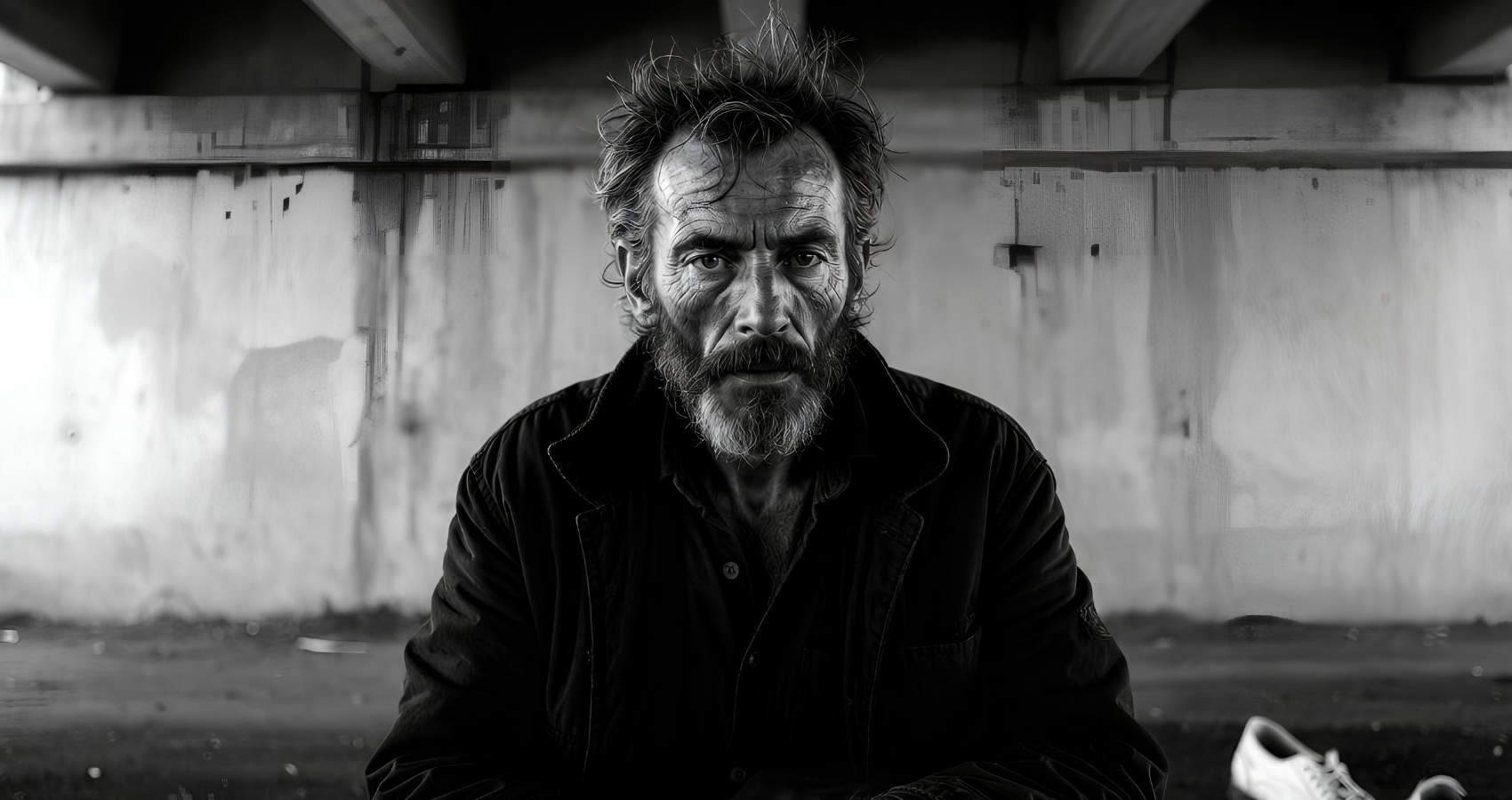
Borrowed Shoes
written by: Mina Beckett
The rain had stopped, but the sidewalk still held its memory in the dark patches that would steam when the sun returned, if it returned. Silas pressed his shoulder against the brick wall behind the Methodist church, feeling the cold seep through his jacket. Three layers, none of them his originally. The donation bin stood ten feet away, its metal mouth agape.
He had been watching it for an hour.
Not watching, exactly. Existing near it. The way he existed near most things now. Close enough to matter, far enough to remain unseen. A pigeon picked at something near his feet, its head jerking in that mechanical way pigeons have, as if they were broken clockwork toys someone had wound too tight.
The shoes appeared just after noon.
A woman in a camel-colored coat had approached the bin with a plastic bag, the kind department stores give you when you buy something expensive. Her movements were efficient, apologetic. She glanced around, not at Silas, because people like her had trained themselves not to see people like him, before lifting the bag and shaking its contents into the metal mouth.
The shoes tumbled out last. They were white leather and barely scuffed. The kind of pristine that spoke of good intentions and minor guilt. Maybe a gift that never quite fit. Maybe a reminder of someone who no longer needed them.
Silas’s own feet were wrapped in what had once been work boots. The sole had separated from the left one months ago, and he’d been nursing the gap with a roll of duct tape he’d found outside an office supply store. When it rained, which it did often in this city that seemed to exist under a permanent shroud of gray, the water found every weakness.
Mama always said shoes could tell you everything about a person, he thought, and then pushed the memory away before it could settle. Some doors were better left closed.
The pigeon flew away. A bus wheezed past, its windows fogged with breath and heat. Silas counted thirteen people inside, each one warm, each one going somewhere. The shoes sat in the bin like an invitation he wasn’t sure he was meant to receive.
He remembered being seven, maybe eight, standing in the doorway of his grandmother’s kitchen while she cooked Sunday dinner. She wore slippers. They were pink ones with little bows that had belonged to his grandfather’s first wife. Nothing wrong with secondhand, she’d said, stirring the pot of greens. Sometimes things need a second chance to be what they’re supposed to be.
The shoes were a size ten. His size, though he hadn’t thought about his size in years. When you’re invisible, details like that become luxuries you can’t afford.
He waited until the street was empty before approaching the bin. His fingers, stiff from cold, fumbled with the laces of his boots. The right one came off easily. The left fought him, the broken sole catching on his heel. When he finally freed his feet, they looked pale and strange in the afternoon light, like something that had been living underground.
The new shoes slid on like they’d been waiting.
***
The change was immediate, but subtle. Like tuning a radio from static to music.
The first thing Silas noticed was the door attendant at the Marriott. For three years, Silas had walked past that glass entrance twice daily, in the morning, when he left the park bench, he’d claimed as territory, and evening, when he returned. The doorman had never acknowledged his existence. Today, the man in the burgundy uniform nodded. Just once, barely perceptible, but unmistakably there.
Silas almost stumbled.
At the corner market, the salesclerk looked up from her register when he passed the window. Her eyes met his for the space of a heartbeat before she returned to counting bills, but it was enough. He’d been seen.
The shoes carried him past the fountain where teenagers gathered to smoke and pretend they weren’t afraid of the world. One of them, a girl with blonde streaks in her hair, glanced at his feet and then at his face. She didn’t look away quickly. She didn’t look away at all.
What is this? Silas thought, but he already knew. He’d worn good shoes before, in what felt like another life. He remembered how differently people moved around you when you looked like you belonged somewhere. How eye contact became possible. How small courtesies, a door held open, a spot in line respected, transformed from privileges into expectations.
The shoes were magic, but not the kind found in fairy tales. This was the everyday magic of assumption, of first impressions, of the thousand tiny calculations people made about worth and worthiness based on what they could see.
He found himself walking taller. Not consciously. His body simply remembered what it felt like to take up space in the world without apology.
At the coffee shop on Fifth Street, the one with the warm yellow lights and the smell of cinnamon that had tortured him on cold mornings, the barista smiled when he approached the window. She actually smiled, showing teeth.
“Can I help you?”
Silas opened his mouth, but no sound came. When was the last time someone had asked if they could help him? Asked like he might need something that could be given, something that didn’t require pity or judgment in equal measure.
“Just looking,” he managed, and his voice sounded rusty, like a door that hadn’t been opened in months.
The barista, a young man with kind eyes and flour on her hands, nodded and returned to his work. He didn’t watch Silas with suspicion. He didn’t position himself between Silas and the register. He simply went back to what he’d been doing, the way you do when someone belongs.
Silas stood there for ten minutes, breathing in the warmth and the ordinary human bustle, before he forced himself to leave.
***
Memory is a country with unreliable borders.
Walking in the shoes, Silas found himself slipping between now and then without warning. The rhythm of his steps on the sidewalk became the rhythm of his younger self walking to job interviews, to dates, to a life that had seemed solid and predictable and his.
He remembered the apartment on Elm Street. The way morning light fell across the kitchen table where he’d eaten cereal and read the sports section. The weight of keys in his pocket. The simple certainty of having somewhere to go.
He remembered Sarah. Not her face, exactly, that had blurred at the edges like a photograph left too long in sunlight, but the way she laughed at movies, covering her mouth with her hand as if joy were something to be apologized for. The way she folded towels, sharp creases and perfect corners. The way she’d said his name when the drinking became too much, became the only thing.
Silas.
Not angry. Not sad. Just tired. The way his own voice sounded now when he talked to himself in the long hours before dawn.
The shoes carried him past the library where he spent his days when the weather turned cruel. The librarian who usually watched him with the weary patience of someone whose kindness had been tested too often, waved from behind the circulation desk. Waved like he was a person she was happy to see.
Past the park where he sometimes found day-old sandwiches in the garbage cans near the playground. A mother pushing her child on the swings caught sight of him and didn’t immediately gather her purse closer to her body. The child, a boy with grass-stained knees, waved at Silas the way children wave at strangers before they learn not to.
Silas waved back.
***
The barefoot man sat beneath the overpass like a fading shadow, like someone holding onto life with nothing but the thin thread of breath still moving in and out of his chest.
Silas had been walking for hours, drunk on visibility, when he saw him. Huddled against the concrete support, knees drawn up, arms wrapped around his shins. His feet were white with cold, the soles dark with city dirt and something worse.
Silas stopped.
The man was younger than him, maybe thirty, with hollow cheeks and the familiar stillness that come from conserving energy for survival. His eyes followed Silas’s approach with the wary alertness of prey.
“Evening,” Silas said, his voice carrying better now, less rust in the hinges.
The man nodded but didn’t speak.
Silas looked down at the shoes. They gleamed in the sodium light of the streetlamp, alien and perfect against the gritty pavement. He thought about the doorman’s nod, the barista’s smile, the mother who hadn’t clutched her purse. He thought about his grandmother’s pink slippers and second chances.
He thought about the weight of being seen.
And then, like a stone settling in still water, he understood what he had always known would come. The shoes had been borrowed time, borrowed dignity. They were never meant to be kept, only carried forward. The recognition hit him with the dull ache of inevitable loss. To hold onto them would be to break something essential about what they were meant to do.
His feet, warm for the first time in months, seemed to pulse with protest. Every step today had been a small resurrection. Every nod, every smile, every moment of simple human acknowledgment had rebuilt something in him he’d thought was gone forever. To give that up, to return to the cold pavement and averted eyes, felt like choosing to die a little.
But the man’s bare feet were blue-white in the harsh light.
Silas closed his eyes and felt his grandmother’s hands on his shoulders, smelled the Sunday greens and heard her voice: Sometimes the blessing ain’t in the keeping, baby. Sometimes it’s in the passing on.
“These yours?” Silas asked, though they both knew they weren’t. His voice carried the finality of surrender, of a choice already made but not yet acted upon.
The barefoot man’s eyes moved from Silas’s face to the shoes and back again. In that glance, Silas saw understanding. Not hope, that was a luxury neither of them could afford, but rather recognition. The shoes were like the overpass above them. They represented something tangible and solid, a bridge that could be crossed in either direction.
The knowledge that he would give them up sat heavily in Silas’s heart, but it was a good heaviness. The kind that came from carrying something important to where it needed to go.
He sat down on the concrete, ignoring the cold that immediately began seeping through his pants. He unlaced the shoes slowly, his fingers stiff but deliberate, each pull of the laces like letting go of a piece of himself. The white leather felt warm against his palms, and for a moment, he held them there, memorizing the weight, the possibility they represented.
“Size ten,” he said, setting them carefully beside the younger man, and felt something shifting inside of him. It was the peculiar lightness that comes when you discover you are larger than your hunger.
For a moment, neither of them moved. The shoes sat between them like an offering, like a prayer made in desperation when there was nothing else left.
Silas stood, feeling the familiar bite of pavement through his threadbare socks. The city looked different from down here. It was sharper, less forgiving. But not unfamiliar. He’d lived at this height before. He would live here again, and somehow, in the choosing, he had become someone who could.
He walked away without looking back, carrying the memory of the young man’s face as he’d reached for the shoes. Not gratitude, exactly. Something more complicated than that. Something that recognized the currency of small kindnesses and the weight of what could not be repaid.
Behind him, footsteps began to echo against the concrete walls of the underpass. They sounded different than his own: lighter, more confident. The sound of someone who had somewhere to go.
Silas smiled and kept walking, his sock-covered feet silent against the sidewalk, invisible again and somehow, for the first time in years, exactly where he belonged.
The rain began to fall, and the city bent its shoulders against the weather. But beneath the overpass, a young man with hollow cheeks and pristine shoes took his first steps toward doors that might open, eyes that might meet his, and the dangerous, necessary magic of being seen.
***
In the morning, Silas would find another pair of shoes in the donation bin. Worn sneakers this time, practical and unassuming. They would be a size too small, but he would wear them anyway, and they would carry him through another day of small invisibilities and smaller graces.
But he would remember the gift of perfect fit. The way the world had changed its posture around him. The moment when he’d chosen to pass that power on, and how it had felt like the most important thing he’d ever done.
Shoes, his grandmother had said, could tell you everything about a person.
What they didn’t tell you was how much a person could tell about themselves, simply by deciding who deserved to walk in comfort, and who deserved to choose.

- Borrowed Shoes - December 30, 2025