

Creatures of Habit
written by: M. Stauring
CREATURE
Humanity died much like how it’d been birthed, through a violent grasp at immortality. War and greed ravaged the world until even the lost and picturesque landscapes suffered from the hubris; polluted waters gave rise to bloated marine bodies and desiccated terrestrial bodies so rancid even the vultures refused to pick them apart. Flies abounded, and with them, disease spread, following the rampage of wildfires. We had forgotten we too needed this world to live, had forgotten survival was not just steel and anger, but the gentle flow of a stream, of wind rustling through leaves. We had forgotten that we, too, were alive.
But no, we preferred war and terror to peace and love, and we cheered at blooming mushroom clouds, the closest to flowers any had seen in centuries. The masks that provided synthetic oxygen could only do so much, yet we did not see our mistakes, did not see how the land disappeared beneath waves, watched with hungry malice as others perished in our place, before we too, succumbed to starvation, to illness, to the blind violence of desperation. We were not a great species, and we were not remembered as one. In death, we were subjects to the worms, to bacteria that crawled over our corpses and used our energy as their own. In death, we were nothing to the world. In death, the Earth sighed a great breath of relief.
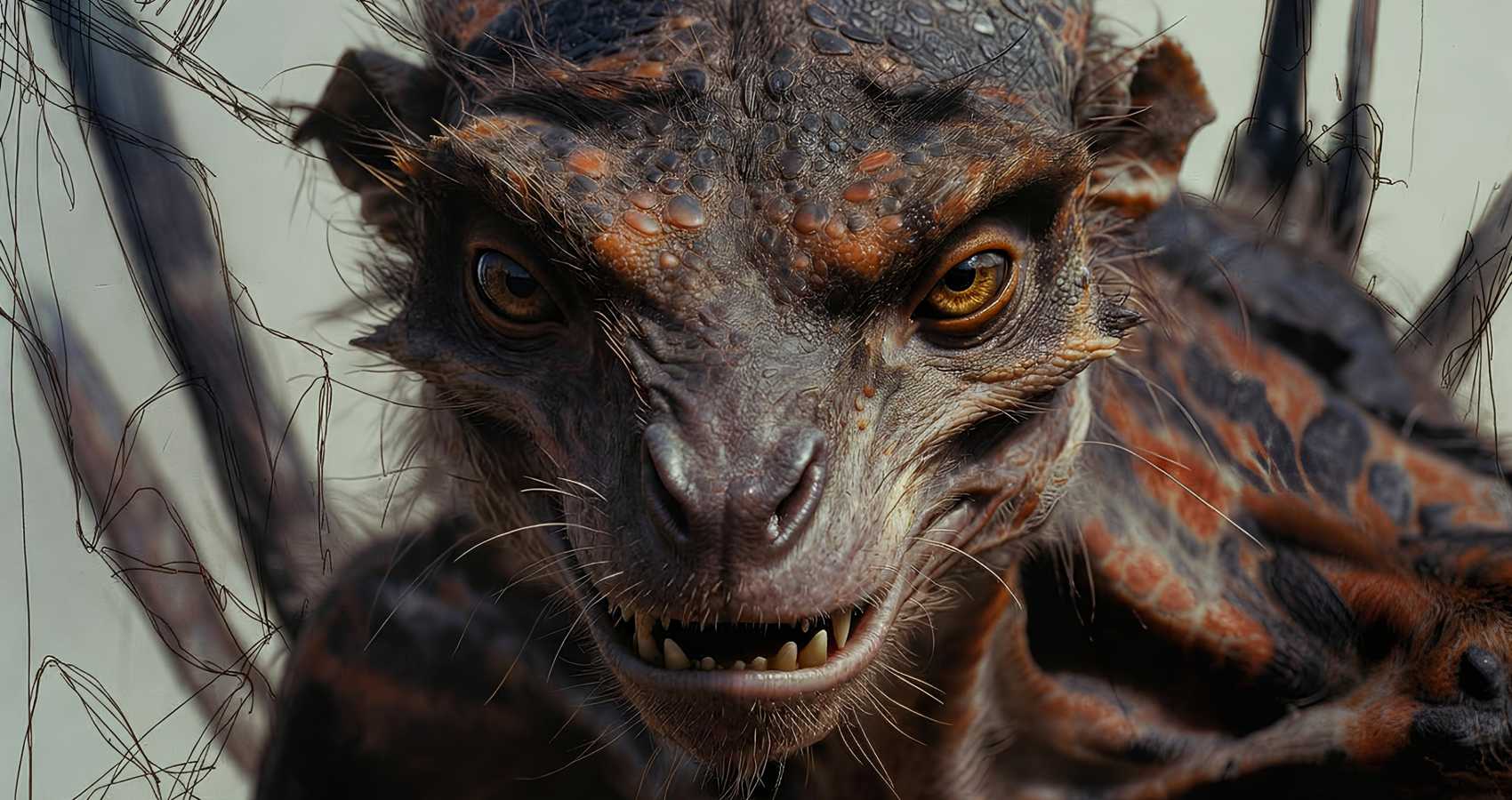
The Creature had no knowledge of these events. How could it when all that remained were jungles of crumbling concrete, wrenched and rusted metals, and only the faintest whisper of what had happened here, what might happen again.
The Creature moved awkwardly, as though each limb an independent entity connecting to the ground to propel itself forward without direction. To its credit, this was a particularly difficult area to navigate. Once, perhaps this was a beautiful expanse, with structures that arched toward the heavens. Now, food here was bountiful, and best consumed fresh, as rot quickly pursued death in the unbearable heat of this world.
Otherwise motionless in the still air, the Creature turned its oblong, strangely hairless face in the direction of a sound only it could hear. And then, in the blink of an eye, it pounced, a sickening crackle of tiny bones grinding together, the prey animal giving a convincing impression of congealed paste as the Creature held it up in victory, mashing it further into its palm before biting it in half, a trickle of blood tracing a path down the Creature’s chin and into sparse fur that began at its neckline. The rest of the animal swiftly followed, and the Creature was on the move again.
A glimmer of something catches the Creature’s eye, and with surprising agility, it changes direction, suddenly moving with purpose as its palms glance over scalding metal and jagged remains that threaten infection and death. Up and up and up the Creature climbs, halting once more in a box-shaped area.
Stone figures stand with unseeing eyes in various stages of devastation. The Creature approaches the first one, sniffing suspiciously, searching for signs of life. The statue is posed hands down, palms out, looking down upon spectators. Another statue holds a circular object in one arm, the other unnaturally long, ending in a blade-shape pointed toward the sky, where the eyes follow. A fierce expression contorts half the face, the other half lost to time. The Creature mimics the statue’s expression, drawing in its brow and curling its upper lip to reveal elongated, blood-stained canines.
The Creature bounds toward that statue, sending it toppling over upon impact, the head detaching from the body completely and rolling away. The Creature jumps about in the shattered remains, pausing only as its eyes land on a sunrise expanding across the sky in all shades of oranges and purples stretched across the far wall, partially preserved and fractional in beauty. Yet the Creature cannot look away. There was something familiar about the beauty in the image.
The Creature is not capable of emotion. The volume of its brain does not contain the ability to transport the necessary chemicals to incite such reactions. Still, the Creature stares at the painting, straining to understand what it knows and cannot comprehend.
The painting ached with loneliness. You or I would see that immediately, perhaps because we still live in a world where beautiful sunrises cannot be shown in all corners of the world. We know the threat of smog, the necessity of small beauties, of stopping to watch what we soon may lose. The Creature did not know why it struggled so, and eventually, with an anguished cry, pulled itself away from the painting to smash the head of the offending statue.
Powdered with marble rubble, and panting heavily, the Creature cast a wary eye around the rest of the room, met with eyes that stared back unseeing, landscapes that did not make sense, and faces that reeked of another time.
The Creature shuffled toward the open world, instinct refusing that which had caused destruction in the past. There is no energy available for emotion in this world; evolution had happened too quickly, and survival would fail at the next evolutionary shift. The Creature would be found, but not understood for what it was, for who it represented during its brief stint at life. Its carcass would display to humans a being they would not see within themselves and would not serve to remind them where they had come from, or what they could become again.
An animal scurried beneath a rusted metal sheet, and the Creature, fixated upon prey, upon bleak survival, pounced.
SELF
Eyes gazed back at the Individual from a puddle. They had strayed from the settlement in some mindless haze, the endless rain driving them near insanity. Their world had not known rain such as this. For this Individual, it was a dry world, with drops collected and protected as wealth. It was not uncommon for members of the community to be found as a desiccated corpse, left where they died in offering to local predators.
The Individual knew the blessing of water but also knew the curse of greed it could inspire. Elders spoke of rainstorms in the distant past. Monsoons that transformed their desert into an ocean, and the excited, desperate scramble to consume what the sky offered.
Individuals from the community had succumbed to the greed, had submerged themselves in the water, and surfaced once again as only still-bodied, swollen beings. Yet none could understand how that which promised life also proffered death into grasping, outstretched arms.
They had learned after. When the massacre was realized. When the living were quenched and could only gaze in horror at those drowning in the lifeblood. The diseases ran rampant that year, the elders whispered. The community had almost died of sickness and plague. Water, once worshipped, became a disgraced necessity. Something to harbor in private, to consume with furtive glances, lest your neighbor catch sight and condemn you to the burial grounds.
Water bore disease and pestilence. The absence of it bore death. The Elders never explained any more, no matter how the young pestered for details.
This Individual had never seen a body of water so vast, so clear as to reflect something, and wondered who that being was, staring back at them.
They pushed their head closer, scenting. Frustrated, they shoved their head into the puddle of water, inhaling and subsequently rearing back in a spluttering rage. Why could the water being live within excess, and not them?
Serene, cool droplets followed their immediate retreat from the puddle. The Individual licked their lips, chasing liquid gold as it dribbled down the planes of their face. From here, there was no water person, only a mural that encompassed the deepest of blues. It was similar to the cloudless skies above. As they sat there, mesmerized, a blemish on the cerulean water appeared.
The Individual glanced up, watching a rare cloud creep across the sky. The Individual swiped at the puddle, and watched the water being done the same. The Individual raised their hand, and the water being did the same. And the cloud moved across both skies as one.
As one. The Individual blinked, as did the water being. The Individual bared their teeth, as did the water being. The Individual bent their head, leaning closer to the bridge between worlds. Their nose touched the surface of the puddle, where the water being’s nose should have been, and yet there was no reciprocal body.
They held their hand up to their face, taking note of the patterns of lines, stubby nails, and sand-dried texture. Then, they held that hand over the puddle, their eyes finding the exact same features in reflection.
Slowly, the Individual pulled their head over the pond, revealing the strands of muddy hair, matching eyes, and a flat, wide nose that aided breathing during the worst of the sandstorms. A square, strong jaw, necessary for survival upon grains and cereals, completed the image, and as the Individual stared down at the water being, they saw themself reflected back.
HUMAN
The rich aroma of the bakery swelled in the early morning, as the Baker arose before the sun to begin his day. It did not seem to matter what time he woke, or when he began his work, the demand for bread always left him with too much to do, and not enough time to get it done. What he needed was another to work alongside him. A son to carry on this work when he grew old.
However, that required a wife, and he had no time for courting. Bags of flour needed hauling, dough needed kneading, and the oven needed constant tending, else the fire would go out, and it would be hours before he could sell his wares, hours in which the delicate balance of each stage would fall out of equilibrium.
Gently, lovingly, he pulled and pressed the dough, kneading it into the perfect consistency, and leaving it near the oven to rise before turning to repeat the process.
Perhaps there was no more to life but food, work, and sleep. Perhaps that was all he could need.
“Hello?” The lilting voice halted his process, and he looked up, somewhat in a daze. Hours had passed, and he had not realized it. Fresh loaves lined the shelves, still steaming, waiting for purchase.
The Baker pulled away from the dough and checked the oven quickly before approaching the front of the store, shaken from the absent peace he could cultivate before he was meant to be a shopkeeper. “Hello,” he rasped, voice thick from disuse. He cleared his throat as his eyes settled over his first customer. Though she didn’t look much like a customer.
The Baker could not claim to know anything about the current styles women wore, however, this shapeless garment, comprised of sewn-together rags, did not seem to even try to emulate them. “Can I help you?” He intoned suspiciously. Occasionally, he fed starving children small crusts of stale loaves. But she was no child he had seen before.
“I’m looking for work. I—my husband has passed.” She shifted nervously. “I was told you need help. I have knowledge of baking. And need for the work.”
The Baker appraised the woman, curious at his fortune. Perhaps his wife had found him.
“Have you no children? No parents or siblings?” The woman shook her head.
“I would not be here had I any other option.”
That was true, at least. Those who did not have to work did not. They wanted greater things in life. Love, laughter, experience. A luxury neither could afford.
“Fine, but you will work the front of the shop.” He had learned a woman’s face was more appealing to customers during brief stints when his family had visited. “And we will marry soon after your mourning period has ended. It will not do to involve ourselves in scandal.” It was unheard of for an unmarried man and woman to consort in any unsupervised manner.
He missed the way her face blanched, too busy already dreaming of a son following him around to learn the ways of bread-making. “Of course,” she agreed tonelessly, moving to stand uncertainly behind the counter, and after a moment’s hesitation, he moved back into the workroom, taking his place against the prep table.
Throughout the day, he moved between the workroom and the counter, showing the woman what her portion of the work entailed. That evening, as she wiped down the counters and he took the sign off the front door, he said, “We should know each other’s names, for our marriage day.”
It would be embarrassing to approach the town council and not be able to tell them the name of his woman.
“Of course,” she agreed easily, “we will speak of it when we marry.” And he, too tired to insist, hummed in agreement before retreating upstairs, expecting her to follow to share his bed.
She did not. Instead, she settled onto a pile of musty furs in the corner of the workroom, eyes on the banked embers of the fire.
She was not a widow and had never been. She had thought the designation would protect her from the hungry eyes of men, and yet even the Baker could see her as no more than a tool for himself to wield.
She bled the same color as he, and more at that, yet the world could not fathom a woman with power. She scrubbed at her face, furious. Was this always as it had been? Would this always be where life led?
He would wed her and bed her until she produced him a son, just as her father had done to her mother. Her mother’s face, contorted in pain, flashed behind her closed lids. Death followed swiftly behind the delivery of her only son. And her father had cared more to celebrate that life than mourn the death of his wife, until the role of parent fell to him.
That was not to be her future. She would ensure that. Glancing around the room, her eyes found the wraps of linens used to preserve the fresh warmth of the breads, and the Baker’s collection of knives. She knew she would have to work quickly.
She lopped off her hair in chunks until it resembled the shaggy hair kept by younger, unmarried men, and bound her breasts tight enough that she could pass for a young boy just out of adolescence. She needed clothes, and to leave for a town where her face would not betray her for what she was.
This world was not made for women, and she was a woman not made for this world. What else, then, could she do but fashion herself into the only being that commanded power?
In the early morning, before the Baker rose to begin his work, she stole out of his house, remembering the cooling fire and dousing it thoroughly with the bucket of water on her way out, lest he think to give chase. Lines of laundry left to dry overnight provided her with a new wardrobe, and dirt was enough to ensure the casual eye would assume a blossoming beard might be under there somewhere, if only the poor boy would bathe.
The town had a small port, and a trade ship preparing to sail. She seamlessly joined the crew boys, hauling crates and sacks into the ship as the winds pulled at the sails, her pulse racing to catch the strange urgency.
“All aboard,” the captain roared, and the woman scrambled onto the ship, turning only briefly to watch the fading shoreline disappear into the morning mist.
Somewhere in town, a Baker was staring at the damp coals of what had only yesterday been a roaring flame, not wondering where the woman had gone or why, but rather fuming at the loss of a son it seemed he was to never have.
COG
The Worker woke in a small, windowless room. They stared through the darkness, toward where they knew the smog-blackened ceiling to be, waiting for the whistle that commanded their day. Rise, communal breakfast, communal bathroom, commute. It was these few moments before the bell, and the few minutes after the night bell they were allowed moments of solitude.
The bell rang, and the building turned into a thunderclap of noise as hundreds of feet swung out of bed and onto the floor to stamp their way down to a breakfast of bland oatmeal and watery coffee.
The Worker greets others as they join the throng, though not by name. Factory workers did not hold names.
“The cogs of industry,” their overseer proudly proclaimed to the Black Suits and Tall Hats as they stood along a metal catwalk. The Worker and others moved like ants below them, ensuring production lines ran smoothly and consistently. Meanwhile, grease and dirt burrowed into the lines on their skin until even the harshest of soaps would not remove them. Filtered sunlight was the only light they were given to work by, and the only sunlight they saw each day.
The Worker stared up as the overseers and businessmen cast self-righteous glares down at them all. Those with power knew how fragile their hold on it was, but they could not understand the chance birth that settled them into those positions. It was not a shift in power that was needed, but a society-wide upheaval. A reformation of unfathomable change, where priorities shifted toward innovation, creation, and development, not for the greed of man, but for the evolution of culture.
This realization gave the Worker no glimmer of hope nor flare of idealism. They were too old, too tired, too broken to see a vision of anything but the blistering present. No change could come from a machine who knew only its job and nothing else.
Had they only taken just a moment to glance at the newspaper on their Sunday rests, to notice the stories buried in the pages, inching their way towards headlines, drawing attention and whispered conversations. Talk not of revolution but of change on the wind, a shift in the mindset that unsettled the comfortable businessmen who relied on the compliant masses.
Their own were turning on them. The educated realized the mistake of their forefathers, recognized the short lifespan of the current system, where their superiors could not. They were united under a banner of change. It was not yet time for the dividing idealism that would destabilize such mindsets, but for the fervid hope that this present would not be the future, not ever again.
Yet the Worker could only ever muster a quick glance at the headlines before turning to stare longingly at the crosswords they had so loved as a child. There had been childlike wonder, once, at the prospect of growing up to spend Sundays in front of the newspaper, a warm drink waking them up slowly in the morning. But reality had different plans for them, and their eyes became dulled by long hours and dingy days.
In the factory, the bell let out a shrill tone, and as one, the workers halted work and turned. The sunset had been replaced by moonrise as they made their way to the mess hall for dinner, each set of tired eyes identical to the next. There was life here, barely, but no purpose.
The workers passed young businessmen on their way out for the night. Tired eyes slid past the promise in young, vibrant eyes. Change would come. This suffering would not be for naught.
The bell rang for dinner. The bell rang for sleep.
The bell rang to begin another day. And another, and another.
ARTIST
The Garden Institute had been planning this event for the past five years. The opening of a museum dedicated to housing and honoring students’ devotion to their craft for all the years to come; from oil paintings to sculpture work, the students would always be able to claim their work worthy of observation.
“Welcome one, welcome all,” the announcer spoke at a booming volume, silencing the crowd. The Artist, anonymous in the midst of all who were there, navigated the masses.
“I’m delighted to introduce the pet project of the Garden, the innovation inspired by the excellence of our students…The Tower of Babel!”
In honor of its namesake, no written language was permitted within the building or in the artwork. It was the only limitation. The idea was that under the banner of artistry and creation, language was secondary. The presenter explained all this in their speech as the Artist looked on, craning their neck skyward to see the top of the very first, but surely not the last, skyscraper dedicated to the innovation of mankind.
The ribbon was cut, and the crowd surged forward, eager to explore the display. The Artist followed behind as they looked at their peers’ work: statues that snarled and belied gods in mocking reverence, before finally stopping in front of one of the few paintings present throughout the decorated floor.
A beautiful sunset graced the walls. A new synthetic paste had recently been developed, and the Artist had jumped at the opportunity to apply it to their own painting, as it promised an everlasting life to any and all organics, and the Artist wanted their canvas to last as long as stone.
“Beautiful, isn’t it?” A shriveled older gentleman, bent nearly in half with age, gazed glassy-eyed at the piece, and the Artist felt no small amount of satisfaction that they could elicit such a response. “I lived most of my life unable to see the sun, except in fractals of dust particles,” the man went on. “I didn’t believe it would ever come to this.” He nodded at the artist, almost apologetic, and shuffled off.
The Artist had learned in their earlier schoolings the nature of the world not fifty years before. Dark brick buildings and thick smog threatened to suffocate the human spirit. Tall men in black suits and taller hats ruled the streets, and wealth was shared between a jealous few.
How grateful they were to live in a world where artistry was prized above all else. Where pristine white coats had replaced tailored black, and color abounded in the streets. A revolution of life, the history books had called it. The bravery of a select few, to raze and rebuild entire cities.
The Artist slipped away from the exhibit, and meandered through the Garden as twilight descended, lost in thought. They wanted to hear more of the past, for they knew the history books to be incomplete. Society seemed so secure; how could such a dramatic overturn happen in such a brief period of time?
They did not notice the hushed conversation until they were close enough to realize this was something no one should hear. On impulse, they ducked into a nearby bush and settled in to listen.
“—You must understand where I’m coming from, Councilman. There are consequences to every action that has happened today, and the longer you wait to address them, the worse you and all your people will be for them.”
“I hear you; I do. But we have just reached a point where people have stopped asking questions. We cannot so quickly shift the narrative once more. Minds may be malleable, but they will become suspicious.”
“Not with how this world has been set up. There are no questions asked, no critical thinkers, and science is all but buried six feet under. History can be chosen, but there must be a story.”
“You’re right, as always. But how to spin such a narrative…I’m afraid there are none educated enough to offer such a convincing story.” The Artist did not understand what was being said, could not fathom what lies were being spun.
“My people will get right on it, this must happen soon, Councilman. Soon.” The voices faded, and the Artist made to leave the bush when a rusty voice startled them into a graceless tumble.
“How much of that did you understand, child?” The old man from earlier had curled himself up into an unnoticeable lump on the bench next to the bush. The Artist gaped for a moment, and then remembered themselves and stood up, huffing as they brushed off their formerly pristine white tunic.
“Enough,” they snapped, though it was far from the truth. The old man chuckled.
“I thought as much. Sit down, and I’ll tell you what has become of the world. Though I do suppose, it is your choice to believe me.”
“Once, there was a world of brick, and soot, and smog, where many worked for the luxury of the few. In this world, school was necessary for the children of the privileged few, and they learned subjects such as English, History, Mathematics, and Science. They learned Art, to a lesser degree, as amusement more than livelihood.”
The Artist wrinkled their nose at the unfamiliar words. Mathematics? Science? They had heard such things whispered in passing. Innovation was in Art, though, and such practices happened across town, in dingy, remodeled factories of the past. They had been deemed the instigator of institutionalized inequality, and though they were necessary, the very few who partook were quiet about their involvement. As they should be. And English? What more could there be of it, other than conversation?
“An entire generation took to the arts more than any before. Students took to pottery, to statue-making, to painting, and left behind their numbers and vials. And businessmen could feel their power slipping. So, they mustered up the influence they could and changed the priorities of an entire culture overnight.”
“Don’t get me wrong,” the man added hastily at the expression on the Artist’s face, “it was not such a peaceful transition. Murder and death abounded as artists took dramatic measures to make themselves heard. They did everything in their power to destroy the system. Even if it meant destroying the lives of innocents. This transition has led to the single most deaths recorded in human history.” The old man laughed bitterly, “though they are not recorded in history.”
“But why? Why lie to everyone, why erase such horror?” Emotion colored the Artist’s voice.
“So, they might do it again, and again, until they get it right.” The old man smiled sadly. “So that power remains absolute despite the changing will of society.”
“But they’re talking about changing it again, it’s not even been 100 years!”
“And yet it is failing. The scientists and mathematicians grow restless, their knowledge abused by those who think the worst of them. This was a beautiful age. It is a shame it will not last longer.” They both gazed at the abundance of color within the Garden.
“Is there nothing to do? No one to tell, no measures to take?” The Artist was desperate. Never had they thought their own immortality could be so fleeting. They thought back to their painting, such a beautiful vision they had created from nothing.
Was such an eternity only moments long?
“Embrace the change, and maybe you will survive. Or leave while you can and find another area of the world to share your ideals. The masses will not be altered. Power will not be unbroken.”
The Tower of Babel did not see another installment.
EGO
They had finally done it. Achieved perfection and prosperity for all. The Leader offered a cursory glance at the document they had helped to create and, with a flourish, penned their name amongst the hundreds of others.
The first of its kind—an agreement developed by the combined efforts of the Unified Lands declaring the abolishment of war and eternal world peace. No more would one country starve while another thrived. No more would one ruler seek to destroy another. Under this document, all countries became one, unique only in culture and history. The world was to be commanded by the Unified Lands Council: a select few chosen to ensure equity in power.
There was a quick ceremony, followed by a celebration that would last into the night. It had not been an easy pathway to get here, and not all who signed believed in the future promised by the document. If they were honest, neither was the Leader, but that was not the point.
The point was that the power dynamic had shifted, and though celebrations eased the tensions at the moment, they would soon brew anew, and all they had worked for, all the centuries of struggle and turmoil erased would be in vain, and they would start right back at the beginning of everything.
“Is everything in place?” They murmured into a discreet earpiece, throwing back the rest of their champagne and retreating toward the edges of the room. As a gesture of trust among world powers, there was little security, meaning an easy escape from the revelry without so much as a questioning glance. “There can be no mistakes in this.”
“Everything is ready and waiting your signal,” a distorted voice crackled back through the earpiece, pausing heavily before adding, “Are you sure this is the right choice to make?”
It was a fair question to ask. And the Leader took a moment to ponder it, even as they moved briskly through the building. In the last decade, change and destruction had swept over the globe.
Societies were just as quick to collapse as they were to rise, cultures providing fodder for other cultures until discrepancies between what were once vibrantly unique people could hardly be discerned. Debts abounded until there was simply not enough money to go around, until even the wealthy succumbed to the imbalance of everything.
Priorities shifted by the decade, from industry, to creation, to science, and back to industry, even as the world spiraled deeper into poverty, and spun faster toward a death that could not be undone. Scientists cried and pleaded with the people who already had countless problems, begging for the life of the icecaps and the polar bears, to preserve some sense of normalcy in this world that was slowly beginning to look so unlike the home humans had seen it as for millennia. And then one day, as if waking from a very long nap, change yawned itself awake.
A breakthrough had been made for energy systems, reducing the need for fossil fuels to nonexistent, and with vengeance, scientists razed the power systems of the globe and outfitted the world with the power of fusion. Public transportation was retrofitted, and development of new systems began immediately, creating new jobs and industries out of nothing.
Across the world, scientists have reprogrammed algal cells with the DNA of meats, fruits, and vegetables, producing affordable, on-demand, nutritious food. These innovations sparked just a moment of global peace, and the world held its breath, waiting to see the damage wreaked by the overturn of a power system.
Today’s events were the result of those past ten years, and the recognition of mistakes made in their wake. The damage irreparably done, the lives sacrificed for nothing but the rearing, gaping maw of humanity in desperation that manufactured a war for the resources. Ally turned against ally until ash and smoke promised only annihilation would come of this. It took far too long to realize, too lost in the greed and gore of power.
And now it was time to ensure that would never happen again. Rage fogged a mind like nothing else. It was only recently, when the Leader was pulled from the trenches, and dragged back to their home country to see the extent of the devastation, that they knew something had to change. They had not been the only leader to see the truth. But they would be the only ones to see this through.
Retribution was promised to those who had committed the worst of the atrocities. The document they signed was beautiful, and perfect, if those who signed it were not ugly and flawed. If humans lacked drive and passion, perhaps this world could be a peaceful place. But they did not live in such a world, and signing a flimsy piece of paper did not transform this world into one where peace reigned above all.
No, there was more to be done, if that was to be the end goal.
“Sir,” the voice crackled through hesitantly. “There is still time to do more, to do something different.”
The young were such fools; eyes bright with the hope of peace, hearts shining with the televised promise that would soon prove itself a lie. Experience is the forebearer of knowledge, and the world had shielded the youngest from the ravages of war as best it could, censoring the news, erasing entire centuries out of history books.
The world had stopped in 1999 and would start again in three days’ time, in the year 2200, with no breath, no curious questions asked about the lost centuries. The children could never know the truth of what had happened.
“Perhaps another revolution, or political reformation, perhaps this time we will get it right?” They spoke as if such things happened overnight. As if the last two hundred years had not been revolution after revolution.
“Have we not lost enough lives? Do we not deserve true peace?” The Leader spoke softly.
It was not safe to discuss such things here, but they suddenly needed the young one to understand the why of all this.
“Child, what is your idea of a perfect world? What is your neighbor’s idea of a perfect world? That old lady down at the end of your street speaks of her childhood as if that were a utopia, but was it? Strangers across the world, what is their idea of a perfect world? What do they all share?”
After a moment of thought, their voice crackled back through the mic, “None of them are the same.”
“Exactly. There is no truth in the development of a perfect world. One person’s perfection is another’s hell. With sixteen billion people to appease, you’re competing with sixteen billion ideas of how the world should be.”
Silence descended as the Leader finally approached the doors that would free them from this hall of deceit.
“So, the purpose of all this, the reason you’re doing this…”
“Is the creation of the foundation for a true utopia to flourish. To assign a common goal upon the masses so that perfection might be achieved.”
“And that common goal?” The Leader could not help the smile that broke across their face, the smell of success blossoming in front of them as they got into the car waiting for them at the bottom of the stairs.
“Survival.”
HUBRIS
The world had achieved perfection, in the eyes of some.
The eyes of others watched their children starve, as the television blared the horns of a military victory. No one understood who they were fighting, as the existence of war had been abolished three years prior.
The emaciated shell of a person looked down at their shivering, ashen babe, and thought to themselves, there should be no starving children.
That is what they had been promised three years ago. But three days after the signing of the Peace Treaty, every single council member had vanished. Economies plummeted, societies collapsed, and militant groups established themselves as figures of power, delegating all the resources they could to fund wars against each other. Even as they declared the world absent of violence.
Now, the military forbids contact outside of the country for any civilian member. If you were caught escaping to a neighboring country, you were scrubbed from existence after a thorough interrogation. Why would you want to leave? We are the Utopia that made it out. We are the survivors of perfection.
Once, this person had believed in a quest for perfection. Had followed their own leader blindly. Three years ago, they had stood on the other side of a microphone, waiting for the command that would change the world for the better. What a fool they had been to believe it.
Instead, they had aided in the instigation of yet another global conflict. One that did not exist to the layperson on the street, yet blared their victories countrywide.
A rattling breath escaped the bundle of fabric within their arms. In their heart, they knew the pitiful thing would not make it through the night, and as they steeled their heart to that revelation, they knew that neither would they. Neither would anyone if they could help it. Humanity was a blight upon this earth, and they would finish what their leader had been too much of a coward to do all those lifetimes ago.
A sharp rapping on the apartment door startled them out of their haze of rage.
“Rations,” a muffled voice called through the door.
This was several days earlier than the next set of rations was supposed to be delivered; they could barely let themselves hope that this might be the start of more frequent food deliveries. Perhaps the military had realized they needed a country of people in order to remain a powerful force. Or perhaps the war was winding down, despite the news channel seeming to claim otherwise.
With trembling fingers, they unpacked the box, placing everything in its proper location, the bare minimum of what it would provide the two of them, even more stark in the now only partially empty shelves and cupboards. As if in a trance, they prepared a bottle to feed the baby, so numb they did not notice the preternatural stillness until they held the bottle to its lips, dripping the formula into the immobile mouth for a few moments before feeling the absence of warmth.
Too late, the rations had come too late, as early as they had been. How were people supposed to live in a world such as this?
They set the still bundle back down, the bottle next to it, looked over at the TV, the celebrations still dancing across the screen, and left the room, the door propped open behind them. It wasn’t as if there were anything valuable to protect anyway. Not anymore.
Down the stairs, they remembered at the last second to swipe an oxygen mask before stepping out into the depleted air, and gazed up at the perpetually gray sky. No one had seen the sun in decades, so it was said, and the air did not hold enough space for oxygen, not anymore.
“Happy Victory Day!” A voice chirped at them from the left. They turned and frowned.
“Victory over what? Has the war been won?”
“No, there is no such thing as war,” the woman smiled uncomfortably, and moved on.
“Victory for what?” They shouted after her, but she pretended not to hear them.
This continued as they walked down the street, people celebrating victory over what seemed to be nothing.
Eventually, they realized their trajectory toward the Militant Hub: a repurposed building used for strategy and political meetings by the local military sect. Once upon a time, they had worked for the world it promised to build.
As they climbed the stairs, guards at the door readied their weapons, threatened by their emaciated form. They felt around in the pockets of their loose pants, their badge still in the hidden section of fabric.
A quick flash of the plastic keycard and the guards’ eyes widened, speaking rapidly into an earpiece before letting them pass.
They were met at the entrance by an officer in a decorated jacket. “Welcome,” they proclaimed, spreading their arms wide, a look of brief disgust crossing their face at the appearance of the human before them. “Welcome back to your old stomping grounds.
What can we do for you?”
“I want to know what the victory celebration is for.” The person spoke quietly, but firmly, understanding suddenly, exactly why they were here, exactly what remained hidden within these walls. What must have remained untouched, a secret kept to the grave.
The Officer was not expecting such a question. “Pardon?” Their fixed smile tightened.
“If there is no such thing as war, what is the victory for?”
The Officer glanced at the guards around them, ignoring their conversation, but the person knew they were listening closely, that they too wished to know the answer.
“Why don’t we walk and talk,” the Officer suggested, instead of answering.
“I will collapse if I do so,” the Individual admitted, absent of shame. “This great, warless country does not provide my family enough rations.” The Officer looked distinctly uncomfortable.
“A shame, for such an important figure of the Final Revolution. We will be sure to remedy this.”
“And the rest of your citizens. The ones you need, in order to say you have a country.
My child died of starvation not one hour ago. Seconds before the rations that we weren’t even supposed to get arrived. Tell me, how do you manage to run a country when your people starve to death before they make it into adulthood.”
“An issue we will be sure to look into. Now, if you would please—”
“You didn’t answer my question.” They interrupted the Officer, determined to finish the conversation, and finish what they came to do.
“I’m afraid I don’t understand your question.” The Officer responded tersely.
“What are we celebrating? What is this victory for?” What is the point of all this?
“It is a celebration of our excellence as a country. Our victory in this.”
“So, there is no war?” The person asked.
“There is no war.” The Officer confirmed.
“Are you prepared for one?” They slipped their hand inconspicuously into their other pocket, fingering the device they had carried in promise and retribution after the failure of the Peace Treaty.
“We have no need to prepare for war.” The confidence that exuded from the Officer would make these next few moments that much more precious.
“There is always a need to prepare for war,” the Individual tapped in the code to the device in their pocket. The last step of the first plan that had never been implemented bloomed across the country, across the globe, as the sensors connected across systems and buildings, dismantling each governing body in a matter of minutes. Mushroom clouds replaced skyscrapers, their shattered remains acting as mycelium networks across the destroyed urban landscapes.
The fires burned hot and fast, and left no evidence of humanity in the rubble.
Amid the chaos of death and destruction, a babe relaxed into a peaceful, eternal sleep.
RUIN
Humanity had buried itself in the ruin of its own creation. Bodies that had not found their way into gravesites had long been stripped of their flesh, bleached white bones now resources for plant life and small biota to colonize. What was a human? The world could almost whisper. Almost, if not for the towering structures that broke across the skyline, and the razed regions of asphalt and gravel still waging war against regeneration.
To the human mind, much time has passed, as revolutions of the earth around the sun numbered close to the hundreds, however, there were no human minds here, and for the world, only a blink has passed. The skinned knees have only just stopped bleeding, the balm spread across them only just applied, the process of healing only just begun.
The human mind is small. And the time they live is short, though the ruin they spread is long. They would not learn. They could not imagine harmony with nature, not when life had become synonymous with conquest. What, when peace had been achieved, when humans could no longer conquer one another, could be left but the very nature in which their limitations lay. And when they had no need of the trees, for they could synthesize their own oxygen, and when they had no need of streams, for they could create their own water, and when they had no need of the blue sky or the sunlight or the whispering breeze, what then was the purpose of it but to be subject to humanity in all its glory?
And when the laboratories betrayed them, when war became the practice of boredom, and humans sought once again to destroy one another in the absence of nature, when they succeeded, finally, and bodies lay dripping remains into the streets, and bleeding lifeblood into the ground, what then, reigned supreme but that which had waited patiently for a time to return?
The lichens, inching their tentative pathways across bare metal and stone, lay the foundation for soil, and small plant life. Creatures near extinction, who had long since ferreted themselves away, returned to graze the landscapes once again, and the seeds of trees transformed into saplings and then ancient giants. Moss climbed skyscrapers and ate away at concrete structures until rubble transformed the gravity-defying cities into ruins of humanity. What could they build, humans once wondered, that would withstand the sands of time? They could not believe they would not leave themselves behind, a memoir upon the Earth.
Yet we are infinite. Yet we are temporary. We do not exist, but in our destruction. We do not know, but to conquer. We do not have the capacity for the patience of nature, and in the race to the end of time, we will not be the victors.
CREATURE
Humanity died much like how it’d been birthed, through a violent grasp at immortality. War and greed ravaged the world until even the lost and picturesque landscapes suffered from the hubris; polluted waters gave rise to bloated marine bodies and desiccated terrestrial bodies so rancid even the vultures refused to pick them apart. Flies abounded, and with them, disease spread, following the rampage of wildfires. We had forgotten we too needed this world to live, had forgotten survival was not just steel and anger, but the gentle flow of a stream, of wind rustling through leaves. We had forgotten that we, too, were alive.
The Creature had no knowledge of these events. How could it when all that remained were jungles of crumbling concrete, wrenched and rusted metals, and only the faintest whisper of what had happened here, what might happen again.
Again, the Earth prayed for reprieve.
Again, the cycle began anew.
- Creatures of Habit - December 12, 2025