

Fading Sun
written by: George Ro
Customer service representative Toby Sun has never left a client dissatisfied. Whether on a rough morning or a cruel night shift, he cuts through an endless list of tasks the size of an Amazon forest without breaking a sweat. He has five-star ratings, thumbs-ups, and smileys under his belt and is Employee of the Month every single day—an invaluable asset to Dondonblo for two decades, back when Windows 95 was still a thing.
Nobody has ever spoken poorly of his work. In fact, nobody ever speaks of him, especially outside of work, where he feels elusive, like a shadow, but without the mystery. This is what he thinks of himself when Friday night comes, as he unwinds with a bottle of classic soju in hand. On all the other days, he feels just transparent, like a ghost, and that’s exactly his desire.
“Of course, dear Momo. We’ll make sure you get a new keyboard. Don’t worry,” Toby says. “We appreciate your kind words. At Dondonblo, we can fix everything, including a broken heart.”
The final sentence is a motto—a corporate lie, a make-believe—and Toby finds it both amusing and sad. He understands the words but cannot truly feel them.
“Thank you,” he says.
This is the last call of the week, another star on Toby’s employee profile. Now, he can call it a day, but first, he must come to terms with leaving the office.
He glances up from his desk and spots his colleagues outside on the large balcony, behind the soundproof windows. They clocked out much earlier—like they usually do on Fridays—and are now smoking, chatting, and laughing. Toby can’t hear them, but he knows what they’re discussing.
“Another exciting, snowy Friday night out for you and another cold Friday for me,” Toby says to himself.
Going out as part of this tightly-knit pack would make him nervous. He would rather jump into a different dimension, get spaghettified, and avoid everything and everyone altogether than exchange another good night, good weekend, or good whatever. He doesn’t want that. What he truly wants is to sneak out of the office, go home, and rest in his brown armchair, where he can release the dammed-up wave of anxiety and finally breathe.
Toby logs off and shuts down his computer; his weary eyes fade into the blackness of the screen. His lips are now a thin, straight line stapled in his jaw, sealing his tongue—the double-edged sword—until Monday, when he’ll be a seated warrior again.
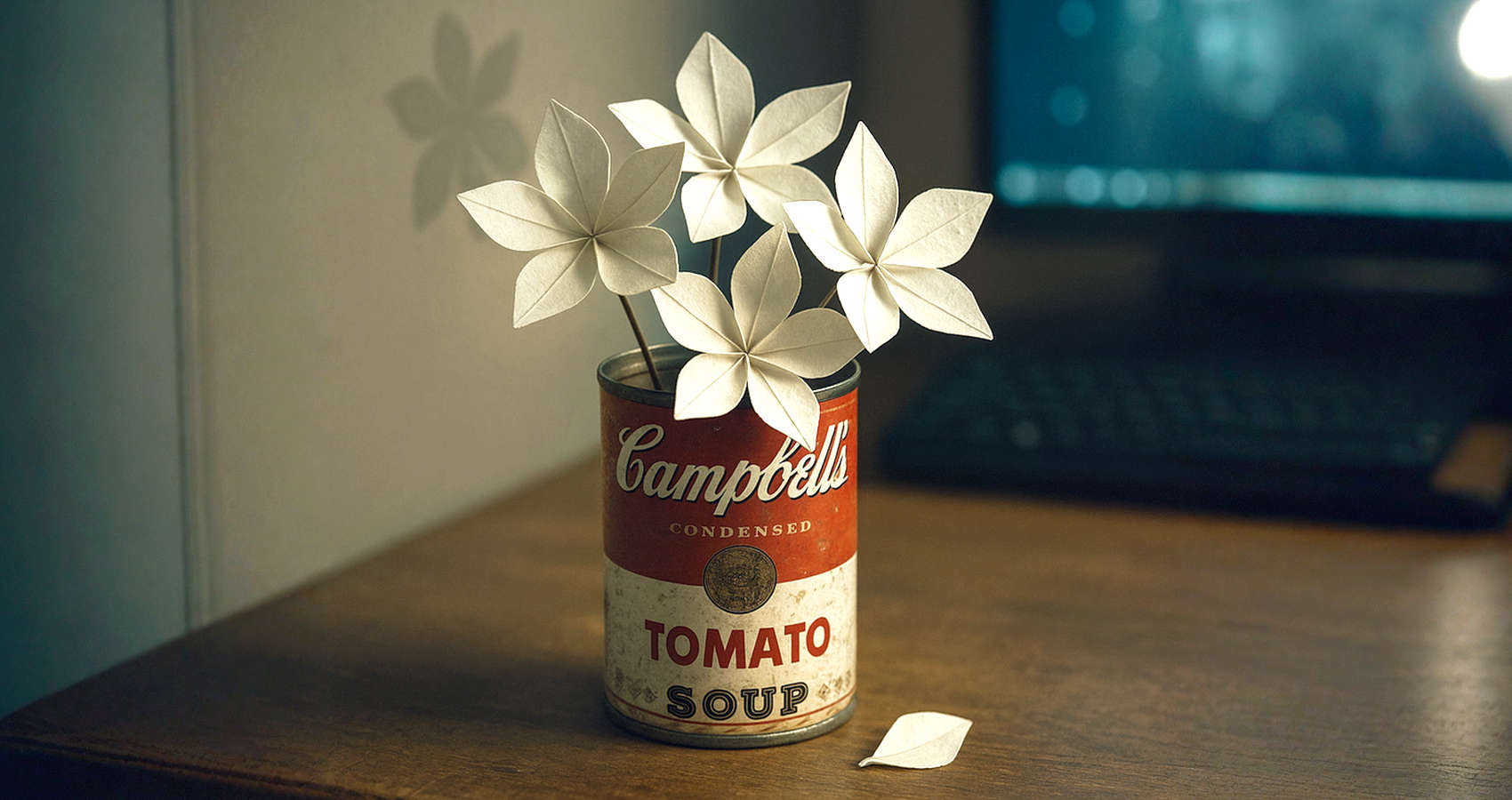
On his desk, in an empty Campbell’s Tomato Soup can, sits a white origami flower. He has been folding paper into flowers since he was a young boy, ever since he lost his father. It’s a weekly cathartic ritual that ferries him through the five stages of grief in no time.
“One flower a week. Five petals to pluck. Four flowers a month. Twenty paper cuts on my skin and twenty petals in the bin,” he says.
He picks up the origami and plucks the last petal. Petal number twenty joins the other nineteen.
November is over.
“Time to leave,” he says.
He checks on his colleagues one last time. They are still outside, having the time of their lives. Linda, the petite lead accountant, cannot hide her passion for Tyson, the new intern—her latest prey. She wants to mold her lips on his. They have slept together. They are having a good, little, dirty affair. The others around them are smoking, pretending not to know. Toby knows better than anyone. After all these years at the call center, he has witnessed ships sinking and eyes foundering at the sight of the box and the pink slip.
“The Titanic without the romance is just an old skiff,” he says. “Why do you all insist on bringing your baggage to work? Wait, I know. Because you’ve never had real problems.”
He takes a surprisingly slow breath and forgets about it. He has no interest in maritime matters whatsoever, and romance has never been his forte. He lifts his bag by the worn leather handles; brown flakes of cracked leather peel off and adhere to his skin. Then, he sticks a finger into his right ear—the one he uses for calls—and scoops out the wax. This ear always makes him dizzy and causes the tinnitus he hates so much. After that, he disconnects his feet from the footstool and attempts to stand, straining his muscles to their limits. The last thing he wants is a sneaky return of his persistent sciatica. Just thinking of the throbbing pain in his right leg sends shivers down his spine. Fortunately, the pain isn’t present, and he feels alright. Then, he shifts his focus to the next issue, which he calls the elevator problem.
For Toby, riding the elevator is an emergency in slow motion. The chime is a death warrant to his ears. He thinks people act differently when they step inside an elevator. There is something about limited space, that enhances formal boundaries in an unorthodox way, to the point where scripted pleasantries like the well-known “how-are-you-doing-today-yes-I’m-fine-thanks” mantra feel more like: to-hell-with-you-and-your-stupid-face. Whenever Toby hears the looping salute, he feels like giving up on life. He can’t take it anymore. When momentum catches him off guard, he attempts to decipher the meaning behind those words and ponders whether he should reply or remain silent. He has never had a perfect answer.
At Dondonblo, only the janitor, Sergey, a military veteran, takes the stairs, except in emergencies.
Toby believes he would have felt less miserable and been in much better shape if he could have taken the stairs at least once a week, but with a janitor so ancient and cranky, the pain—though of a different kind—would have been just as bad, if not worse. Sergey would never let him take the stairs alone. He would trail closely behind, recounting the shameful life he had in his youth before enlisting in the army, along with a bundle of stories Toby wouldn’t want to hear, no matter how good.
The chime echoes, reverberating down his spine.
The elevator is here.
Toby’s face, empty of emotion, shifts to a dark and gloomy expression as if someone flipped a switch. He lowers his head, and as soon as the door slides open, he is a different man. He steps inside quickly and turns around to face the exit. Before descending, he stands by the button panel, his thumb hovering over zero, waiting for someone to request a floor. But the elevator is dead silent, and he still has no idea it is empty.
Toby looks down and then over his shoulder. In the large mirror behind him, he sees nothing but his own reflection. His relief is profound. He is in the elevator for the first time without inhaling someone’s scent or seeing sneakers and high heels.
He presses zero, and his descent begins.
***
Toby is a champion. Today, stepping out of the elevator feels like crossing the finish line in the Olympics, like a mental ribbon breaking against his sucked-in stomach.
“I defeated you,” he says, glaring at the elevator’s sliding panels as they close, which look like a monster’s mouth that has just lost its teeth from his punch.
Toby feels lucky. He plans to treat himself by brewing a flat white from the vending machine to calm his excitement. He taps his pockets in search of spare change, but instead of coins clinking, he hears a crinkle, and the image of Abraham Lincoln comes to his mind first thing. It’s the five-dollar bill he discovered a few days ago in the snow in the parking lot outside Dondonblo.
“It’s time to make good use of you again, Mr. Lincoln,” he says.
Toby walks into the lounge, holding the bill. He smooths out the creases on Abraham’s face with a gentle touch. After placing an order, he feeds the bill to the machine.
“Thank you,” the vending machine says.
Toby has never heard a vending machine speak before, but he hasn’t had a coffee at Dondonblo in a while, so he couldn’t tell if he misheard or if machines have evolved to that extent.
The machine beeps, and a message pops up on the screen: Your coffee will be ready in three minutes.
“Alright, that’s good to know,” he says.
At 9 pm, Toby will press his lips to the cup. The first sip will scald his lips and possibly his tongue, but the warmth in his hands will comfort him.
“Maybe for once,” he says, “I should do what everyone else does.”
***
Toby sits on the arm of the couch by the window, watching the snowfall dress the city’s noisy environment in homogeneous white, giving the lights a bokeh effect and bringing a gentle smile to his face. His upper lip carries a broad blush for a mustache, and his gray stubble now lies under a layer of caffeine.
For a full five minutes, he had the lounge entirely to himself. The moment felt unusually calm, like taking a deep sigh of relief in a forest while lying on fresh grass, surrounded by large stumps and mystical ponds. It felt surreal and calmed his troubled mind, keeping it free of unsolicited thoughts—until now.
The elevator chimes, pulling Toby’s thoughts back to reality and bringing an early winter to his forest. His colleagues are nearby, talking loudly. They don’t know when to stop, unintentionally letting him know they will have dinner at Gangnam 72, a Korean restaurant down the street known for its top-quality jjajangmyeon, pork belly, and soju.
Toby thinks they will likely avoid him because he’s a recluse, and he is right. Some greet him with a nod, while others look straight ahead, ignoring him. They may be far from perfect, but in the end, he doesn’t do much better as a human being. He knows he is the one out of the ordinary. That’s why he thinks it’s his responsibility to give a more sociable Toby some space if he wants to break the ice; after all, who is he to judge others?
“Have a good time,” Toby says. “Drink something for me, too.”
His colleagues freeze in surprise. They cannot quite believe it.
Toby expects nothing in return—not even a formal greeting—as he has always steered clear of everything and everyone.
“You want to come along?” Linda asks.
The words echo in Toby’s head, catching him off guard. Now, he feels conflicted about the idea of going out with them. It not only confuses him; he thinks it’s the worst idea ever, but there’s a seed in his brain, tickling his tongue and urging him to say, “Yes, let’s do this, goddammit.”
The thrill causes Toby to twitch the wrong hand, spilling the hot, flat white coffee on his white shirt, face, and wire-rimmed glasses. The scalding drink reveals aspects of himself he has never shown before. He is malleable now, like metal at forging heat. He wants to hurry and find a snowbank and bury his head inside to temper his fragmented soul and harden his delicate mind. The butterflies in his stomach turn into wasps, stinging and biting at his flesh.
He takes this as a sign, a bad omen. Social Toby was a mistake.
He rushes out into the cold, the snow crunching beneath his feet, and tosses the coffee away. The stirrer flies out of the bin and lands in the snow, leaving a trail of coffee drops that, under the lights, take on a reddish hue resembling blood.
Toby jumps into his car and yanks the seatbelt, pulling it to the point of strangulation.
“No coffee, no matter how warm or sweet, can soften someone as pitiful as you, Toby,” he says to himself.
He stomps the accelerator, flooring it as the car roars through the city. The tires scrape against the streets, and he grinds his teeth. The engine roars like a beast now. The limit of 25 mph leaves him unmoved, as he has already reached three times that speed.
Taking his foot off the accelerator could be fatal. He can’t look back now; recent, unwelcome memories might catch up and hijack his mind. Social Toby may hunt him from Dondonblo and rip him apart. They are like two strangers. Toby should never have invited him. He should never have relaxed. He should never have spoken. It was a terrible mistake. He thinks there’s no room for second thoughts in a cold city. He thinks it’s too late for him and that he can’t change his miserable existence. Social Toby must die forever, he thinks.
“You’d better find a hole and hide inside,” he says.
The long rearview mirror, double the size of what is standard in most cars, reflects nothing but his eyes, which he no longer recognizes as his own. The hatred he feels for those eyes drains his life out.
He squints, his eyes narrowing like blades slicing through his soul.
“Who are you?” he asks. “The ignorant look isn’t yours.”
His emotions now outrun common sense more than ever. The engine thrusts sinister vibrations through his body, fueling his anger and saturating everything in crimson. His thoughts rebel against him, taking shape and shifting into a shadowy figure he wishes he could forget.
“Rom,” he says.
That name holds power over him, injecting his body with fear that traps his mind, binds his tongue, freezes his feet, and entangles his fingers.
“You’re the reason for the paper,” he says. “My origami, my obsessions, my career—it’s all you, father.”
Toby fixes his eyes on the rearview mirror, and tears slip away.
“Your plants numbered twenty-four. I watered them and cleaned each leaf every morning before school with a wet cotton pad. You were a strict and ruthless man. A single speck on a leaf could cost me my dinner. I had cold soup countless times, and the days I slept on an empty stomach were innumerable. Just thinking about it now makes my stomach rumble,” Toby says. “I wanted to be someone you can rely on. I thought maybe someday you’ll be alright again. But I was wrong. You faced no struggle, and the night she bloomed, you forgot everything. That precious Queen of the Night of yours hypnotized you. All the other flowers, and even I, were nothing compared to her; we were artificial. That night, you killed yourself because you had seen her come and go. A switch flipped in your head. You couldn’t lose her, too. I understand. Then your phone rang in the morning, and I woke up. I saw your wilted corpse on the floor. You had the Queen’s flower in your mouth. Your face was white like paper, and the flower was drenched in blood. And I couldn’t answer the phone. I was afraid. What could I say?”
***
Toby’s relentless run ends with a bang. His car is halfway in the crosswalk, and he can’t tell why—he has no clue he nearly hit someone. His face is flushed, mirroring the glow from the traffic light. Next to his car, there’s a red tote bag and a woman in Louboutins shouting at him.
“Are you crazy?” she asks. “Shame on you. You nearly killed me, you idiot.”
Her face is very red, and she approaches Toby’s car and taps nervously on the window.
He lowers the window, and the cold air from outside fogs his glasses, adding a brooding quality to his menacing face. Without a second thought, he spits on her shoes, and the spit freezes in seconds, dulling the glitter and strass, sucking all the glamor from her face. Then she falls back onto the ground as if he has pushed her, crying out loudly. Her cries bring Toby back to his senses.
“What am I doing?” Toby says.
The traffic lights turn green, bouncing off Toby’s face. He’s ready to apologize and express how sorry he is, but as he opens his mouth, the words become distorted with all the honking and frustration of the other drivers. The apology still sounds like “I’m sorry,” but feels more like “screw you.”
She grabs her bag and rushes to the sidewalk with the pair of Louboutins in hand, and Toby heads to the nearby 7-Eleven, saying nothing more.
***
The refrigerator is full of soju. There are many flavors to choose from—plum, grapefruit, peach, strawberry, and more—but Toby doesn’t bother, decisively grabbing two bottles of the classic soju, known for its strong flavor of pure alcohol with a hint of fermented rice. Strangely, the bottles feel lukewarm to the touch. He holds them in his hands for a few moments, then returns them to the fridge and picks up two different bottles, which are also lukewarm, and he doesn’t understand why.
He goes to the cashier.
“Do you have any cold bottles of soju?” He asks.
The cashier is on a phone call and is in a terrible mood. He speaks while pressing the dial buttons, his words barely understandable as he talks through clenched teeth.
“In the fridge,” the cashier says.
He puts the phone back to his ear, tapping his fingers on the table as he turns away from Toby.
“I’ve just come from the fridge, and I’ve got nothing,” Toby says. “Maybe your fridge is broken. Maybe the fuse is short, I don’t know. Your bottles are like hot soup. Go and check for yourself.”
With a heavy sigh, the cashier walks to the fridge and pulls out a bottle of soju.
“These are all cold,” he says. “Nearly frozen. Stop wasting my time already.”
He slams the fridge door shut and then returns to his work—the bottles inside clink and waddle on the icy sludge like penguins. As a customer service representative, Toby finds the cashier’s attitude sickening.
Toby returns to the fridge, clasping his hands together to steady them. He can’t feel his fingers; they’re ice cold. No wonder the bottles felt warm in his hands.
“It’s because I drove here with the window open,” he says to himself. “I’m so stupid. How could I do that?”
Just as he decides to pay, he hears the cashier shouting in despair.
“I’ve been trying to reach you all day, you fools,” the cashier says. “Remind me of your name again, and I’ll let everyone know that you’re irresponsible jerks.”
The cashier pauses for a moment, grinding his teeth. Toby can hear the grind.
“I’ve told you a million times,” the cashier says. “The keyboard had faulty RGB lighting straight out of the box, and you keep insisting it’s my fault. Are you calling me a liar? Is that it? Well, I hope you all lose your jobs to machines. You useless bastards. Customer support, my ass.”
The last sentence echoes in Toby’s mind. He is certain it will haunt him for nights to come. Two bottles of soju won’t be enough to water down something like this. He needs at least two more bottles and has no intention of paying for them.
Toby crams two bottles into the inner pockets of his jacket, slips two into the outer pockets, and holds two more in his hands.
A moment later, he stands before the cashier.
“Card or cash?” the cashier asks.
“Poor customer service compensation,” Toby says.
He storms out of the store and jumps back into his car. The cashier chases after him, pistol in hand, threatening to shoot. Toby doesn’t care; he’s already hit rock bottom. Now, all that’s left is to flush down his bitterness.
***
On his way home, Toby watches for strobe lights and sirens but sees nothing alarming. He encounters no other cars or pedestrians. The streets are untrodden and empty, and the snow ahead is still fresh.
When Toby arrives at the parking lot, he stretches his arm out and passes the card. The barrier beeps and rises, and before driving in, he smells wood and resin in the ice-cold air. He takes a deep breath.
“Where is the usual smog that fills the air?” he asks. “Where does this sweet, earthy scent come from?”
Toby drives through the parking lot and parks in minus three, which he believes is the best of all the minuses because it is always empty, and the chance of running into someone there is nearly zero.
As he brakes and parks the car, the bottles of soju clink, stirring his desire for one right now. He wants to seize the quiet moment before heading to his apartment, as who knows what might happen before or after he unlocks his door?
He puts on his favorite album, Brian Eno’s “Music for Airports,” then opens a bottle and starts drinking. The soju flows into his body, and Toby loses control.
The alcohol in his blood accelerates time.
After six bottles, Toby falls out of the car onto his face, losing a tooth; his left cheek is now resting against a small puddle of drool. A drop of blood sits in the puddle. A thin line of what could be pus or frothy saliva trails from the tooth, the tooth resembling a sperm ready to merge with the droplet of blood.
Toby’s eyes shut.
***
Around midnight, Toby is alert again. His body feels heavy, and his head refuses to cooperate, throwing him off balance as he tries to crawl back into his car. He believes he will be safer there; he can’t lose his balance while seated.
“You’ve crossed the line today,” he says to himself. “You’re pathetic, Toby.”
He shakes his head and eventually feels well enough to walk again. He exits the car and locks it. The alarm echoes in the parking lot, where silence grows to ceremonial proportions.
He heads to the elevator and readies his thumb to call it, but on second thought, he takes the stairs.
“Take the stairs, Toby,” he says to himself.
He smells his shirt.
“You reek of alcohol and have had a hefty dose of social interaction today,” he says. “That’s enough.”
He turns right toward the emergency exit. The running figure on the exit sign has no head as if it were shot.
“That’s exactly how I feel,” he says.
He pushes open the heavy door. It’s pitch black inside, and he can’t see a thing. He fumbles in the darkness and hits a switch. The switch is hard and sharp, like a shard of glass, digging under his nail and stabbing a nerve. He feels the warm blood trickling down his finger, but he doesn’t feel any pain. He puts his thumb in his mouth and sucks it clean, then looks around to see if the light switch has done any good.
There’s light, but it comes from an unexpected source: a vending machine.
Unlike the company’s vending machine, this one offers a variety of unusual products. There is no flat white or latte available; there are only emojis. Some have a flat smile, while others wear a sullen expression, but no emoji displays a smiley face.
Toby pushes his back against the emergency door, but no matter how hard he tries, it doesn’t move an inch.
“Enough with that bullshit,” he says. “Everything is a mess. There’s no order in my life anymore.”
“Order received,” the vending machine says.
The automated voice is monotonous, but somehow calms Toby’s urge to flee.
“Order received?” he asks.
He can hear his voice changing, syncing with the vending machine’s tone.
“What is happening to me?” he asks.
Once again, his voice comes out digitized. He touches his lips to verify that his mouth is talking.
The vending machine whirs, clanks, beeps, and grinds.
“Your order is ready,” it says.
With an unsteady step, Toby moves closer. He opens the hatch and reaches inside, but finds nothing.
“What damn order?” he asks.
Toby pushes the vending machine. The lights on the screen flicker wildly, and all the emojis flash with a sad face. Still, nothing happens. He then rubs his fist and throws a punch.
“Now I’m going to break you,” he says. “And I’ll keep punching you all night long.”
He throws another punch, and then another, but his strikes fail him miserably. His bones shatter, and his spirit breaks into pieces, but the machine remains standing.
“Do you need assistance?” the machine asks. “I can tell you need support, Toby.”
It takes Toby a moment to suppress his tears and control his despair.
“Yes,” he says. “I need support.”
The vending machine’s screen glows with a bright, vibrant red light. The front panel goes up, revealing a set of stairs that invite Toby inside.
As he steps into the vending machine, he hears a phone ringing. The call is for him, and deep down, he knows he has to answer it this time.
***
The stairs are far behind. Toby is in a forest, deep in the woods, with his feet resting on the grass. Here, the air is colder than it was outside—colder than a morgue. His skin is freezing, and the cold spreads to his heart, but he can’t feel it—he has no heartbeat. He observes the trees and listens to the lovely chirps and peeps, the gentle lapping and rippling of the river as it slithers through broken branches, strips of bark, and sturdy trunks, its waters brightening nearby flowers and sweetening the buzz of bees and beetles.
The stubborn knot in Toby’s stomach has loosened, making the air lighter. As he reflects on his day—and his life—he realizes that the pressure he felt all along was just a really bad idea and nothing more. His job, colleagues, city, and father are now distant memories, and the Queen of the Night flower feels insignificant.
The phone rings again. He must find the courage to answer one last call, one last time. He can see the phone on a large stump not far from him. He walks over. White flowers surround the stump. They look like his father’s last love, the Queen of the Night, but are grainy to the touch, uncanny, like origami, and never wilt.
He sighs and answers the call.
“How can I help myself?” Toby asks.
“Toby,” a soft voice says, “Just let go.”

- Fading Sun - July 13, 2025