


He’s No St. Nick
written by: Lisa Rabasca Roepe
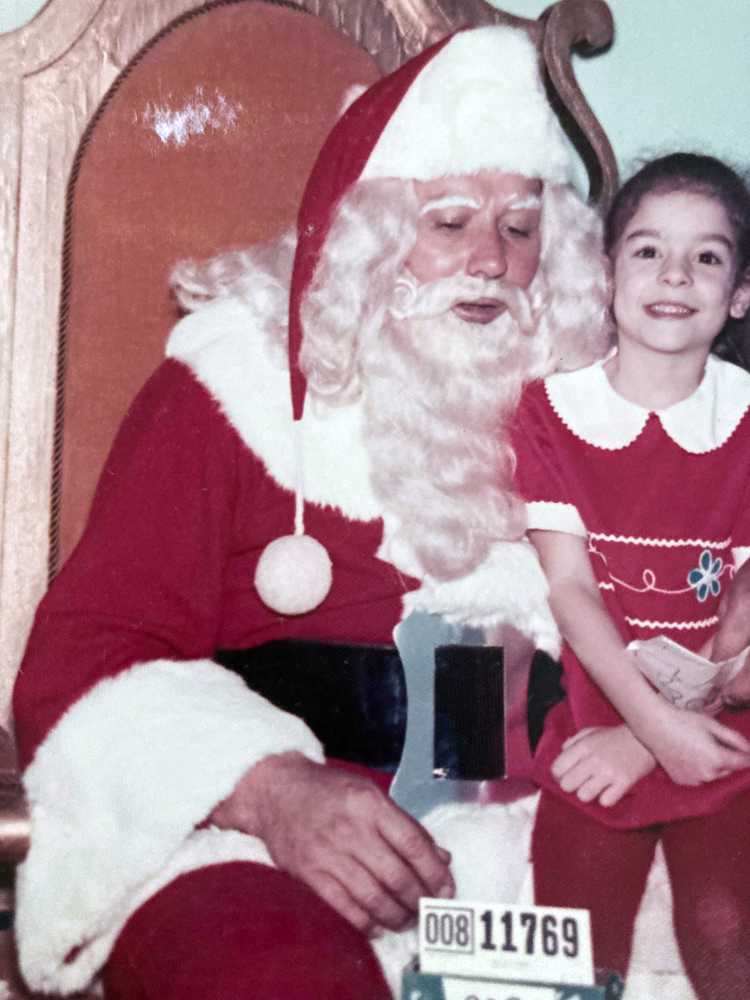 The conversation between the 5-year-old girl and Santa started off as expected.
“Do you want a Cabbage Patch Doll?” Santa asked. “Or how about a Barbie doll? How many dolls do you already have?”
The girl, dressed in pink from head to toe, giggled and counted five dolls on her chubby fingers. Santa gave her a squeeze and proceeded to ask questions.
“Should I bring you some makeup and high-heeled shoes too?”
Alarm bells went off in my head, and I immediately looked for the girl’s parents to see if they had any reaction, but they were too busy taking photos. I wasn’t even sure they heard Santa.
It was 1987 and the Saturday after Thanksgiving in a small town in upstate New York, where I worked as a daily newspaper reporter 360 miles from where I grew up on Long Island.
I was eavesdropping on Santa so I could write a quaint holiday article.
Even though it was my day off, I agreed to write the article because it reminded me of all the times my mother took me to see Santa when I was a little girl. My mother would dress me in green or red, and I’d carry my wish list written in crayon. We’d made our way through the maze of Christmas trees and large wrapped boxes, and I’d anticipated my turn to see Santa.
I had promised my boss, Bob, that I’d stay an hour, just long enough to capture some endearing dialogue between Santa and the kids.
Instead, in the middle of Santa’s Village at the local toy store, I witnessed Santa ever so slightly lifting the 5-year-old girl’s taffeta skirt. “What about underwear?” he asked. “What type of underwear do you have on? I bet it’s pink and frilly.”
My eyes widened as I looked at the parents, waiting for them to knock over the oversized wrapped packages, the Christmas trees with twinkling lights, and Santa’s friendly helper so they could rescue their daughter from Santa’s grasp.
But they just kept taking photos.
I had sensed something was off about Santa when I first saw him sitting in his oversized gold and red chair. He was drug-addict thin, not round and jolly, and I thought I glimpsed a tattoo peeking out from under his white fur cuff. Back then, tattoos were often associated with serving time in prison rather than being viewed as a form of art.
Santa’s first few visitors had been boys. A 6-year-old asked Santa for a truck and a train set, and then paused and asked if it was OK to ask for two toys. Santa said he was in a generous mood, and he’d see what he could do. Another boy, slightly older, asked for a new bike with training wheels.
Santa didn’t get creepy until the little girl in pink taffeta showed up. Now she was sitting on Santa’s lap, pushing her skirt down and his hand away. She jumped off his lap just as eagerly as she had jumped on it five minutes ago and made a beeline for her parents, who were still oblivious.
“I got some cute photos of you and Santa,” her dad said when she ran to him.
I wondered if when the photos were developed and they eagerly took the prints out of the Kodak envelope, her parents would notice Santa’s roaming hands.
I stayed for another 30 minutes. Six more kids climbed onto Santa’s lap, a mix of boys and girls. Santa’s dialogue with the girls was alarmingly like the one I had just heard with the girl in pink taffeta.
None of the parents seemed to notice.
I wasn’t a parent myself, so I wasn’t sure what to do about it: Do I tell the store manager, warn the parents waiting in line with their daughters to go home, or do I call the police and report Santa?
I left shaken, wondering how I would write the feel-good Christmas story my editor was expecting from me, and what my responsibility was to report what I saw.
At 24, I was the youngest reporter in the newsroom and one of only three women on staff. In the 1980s, being a woman in the newsroom was a liability. You were expected to write all the feature articles about children, fashion, food, and crafts—topics that editors deemed were mainly interesting to women.
Yet, somehow, I had landed the plum job of county government reporter, so I also wrote about landfills and bond issues. It was a coveted position because the county board met during the day while most other local governing bodies met at night. A male coworker once commented that it was unfair for a young girl with no husband or children to be the county government reporter. Instead, he insisted, I should be the one sent to all the evening school board and zoning board meetings because I didn’t have any family obligations.
My boss, Bob, was a mere five years older than me, married, with a child on the way. He was also the government county reporter before me, before he was promoted to managing editor.
When I was hired, I didn’t realize how difficult it would be to work for the person who had once held my exact job. He would read my articles and make comments like, “How did you get a quote from the county board chair? He never called me back.” And then follow it up with a snide remark like, “I bet he calls you back because you wear short skirts.”
I wanted to say, “Maybe it’s because I’m a better reporter than you are. Maybe it’s because I’m not a jerk.” But I usually just kept quiet and shrugged my shoulders. I wasn’t a vixen. In 1987, every woman under the age of 30 was wearing short skirts with tights or leggings—a style popularized by Madonna.
In the office on Monday, my boss asked how Saturday with Santa went.
“Interesting,” I said.
He laughed. “I knew you were sentimental enough to enjoy it.”
I struggled to explain how uncomfortable the exchanges between Santa and the girls made me feel, how I wondered if Santa had an arrest record, how I worried that he might be a pedophile. As I stumbled over the words, my boss became increasingly annoyed with me.
When I asked if I should do some digging to see if I could find anything odd in the guy’s background, my editor told me to stick with the feature story I was supposed to write and reminded me that I had only an hour to file the story.
I explained it was more than a hunch; Santa was creepy.
What I couldn’t say was there’s no sex offender registry yet to prevent the local toy store from hiring a pedophile to play Santa Claus. The national registry for sex offenders wouldn’t be created until nine years later and I didn’t know how to explain to my boss that sometimes bad people try to gain access to young girls, and society needs to protect young children.
“What about the parents? How did they react?” my boss asked. “Did they look uncomfortable?”
“No,” I said, “but parents are often oblivious. These parents were all too focused on getting the perfect photo.”
“Just give me a heart-warming story and leave out the drama,” my boss said.
Before he could dismiss me, I suggested we ask Tom, the police beat reporter, to at least check if this guy had an arrest record. “I have his name,” I said, almost pleading. “What if this guy is going around posing as Santa to get access to little girls?”
For some reason, my boss felt that comment crossed a line. “Just do your job,” Bob bellowed.
I wrote the story. I left out the sketchy dialogue and leaned into the interactions between Santa and the boys.
At lunchtime, I overheard my boss gossiping about me with my male colleagues. “She was ranting about how Santa was a real creep. She’s worried he might be a pedophile. But if the parents didn’t seem concerned, why is she? She’s such a downer. Sounds to me that she might be after your job as cops reporter, Tom.”
I spent the next few weeks wondering if I should have spoken with the police or talked with Tom about my concerns. It didn’t help that at the last county board meeting before the winter holiday break, several of the older, white male board members stopped me and a male reporter from the competing newspaper in the hallway to wish us a Merry Christmas. One asked if he could give me a kiss for Christmas. “Only if you also kiss John,” I said, pointing to the other reporter. That shut him up and gave his colleagues a laugh. But it reminded me how vulnerable women are, especially when, like young girls, they can’t stand up for themselves.
Six months later, Tom rolled another chair up to my desk after his daily morning visit to the police station to find out who had been arrested overnight. “Hey, do you remember that Santa fella who gave you the heebie-jeebies?”
I nodded.
Tom handed me a police report with Santa’s name on it. He had been charged with sexually abusing a 6-year-old girl. I looked across the newsroom at Bob and shook my head.
Tom started to get up, but then paused, “There’s more. He did have a record.”
Bob and I never discussed Santa’s arrest. I left the newspaper three months later for job at a larger newspaper. For years, I wondered if I could have done more to stop this rogue Santa from touching these unsuspecting little girls.
The next time I visited my parents, I looked for the childhood photos of me sitting on Santa’s lap. Each photo showed a different level of comfort or, in some cases, discomfort. I look uncertain in many of the photos. I don’t remember if, as a child, I wanted to sit on Santa’s lap or if I did it because I thought it was expected of me.
Decades later, I reluctantly brought my own son to visit Santa. A friend who had been pregnant at the same time as I suggested we bring our babies to see the Jolly Old Elf. In the photo, we are standing on either side of St. Nick holding our babies in our arms.
As my son grew up, I wanted him to believe in the magic of Christmas at least for a little while, so I continued to take him to see Santa, but I let my son know he could stand next to him or sit on the floor in front of him. He wasn’t obligated to sit on Santa’s lap.
One of my most cherished Christmas memories happened at our local nature center, where one Saturday each December, families are invited to spend five minutes with Mr. Claus and his helpers in a log cabin. In the photo, my son and Santa are sitting next to each in front of a fireplace, chatting about Pokémon.
What strikes me about the photo is how comfortable my son looks. Santa’s magic was still there, and perhaps even more so, because rather than awkwardly sitting on a stranger’s lap, my son is having a genuine conversation with the mythical figure who makes dreams come true.

- He’s No St. Nick - December 17, 2025