

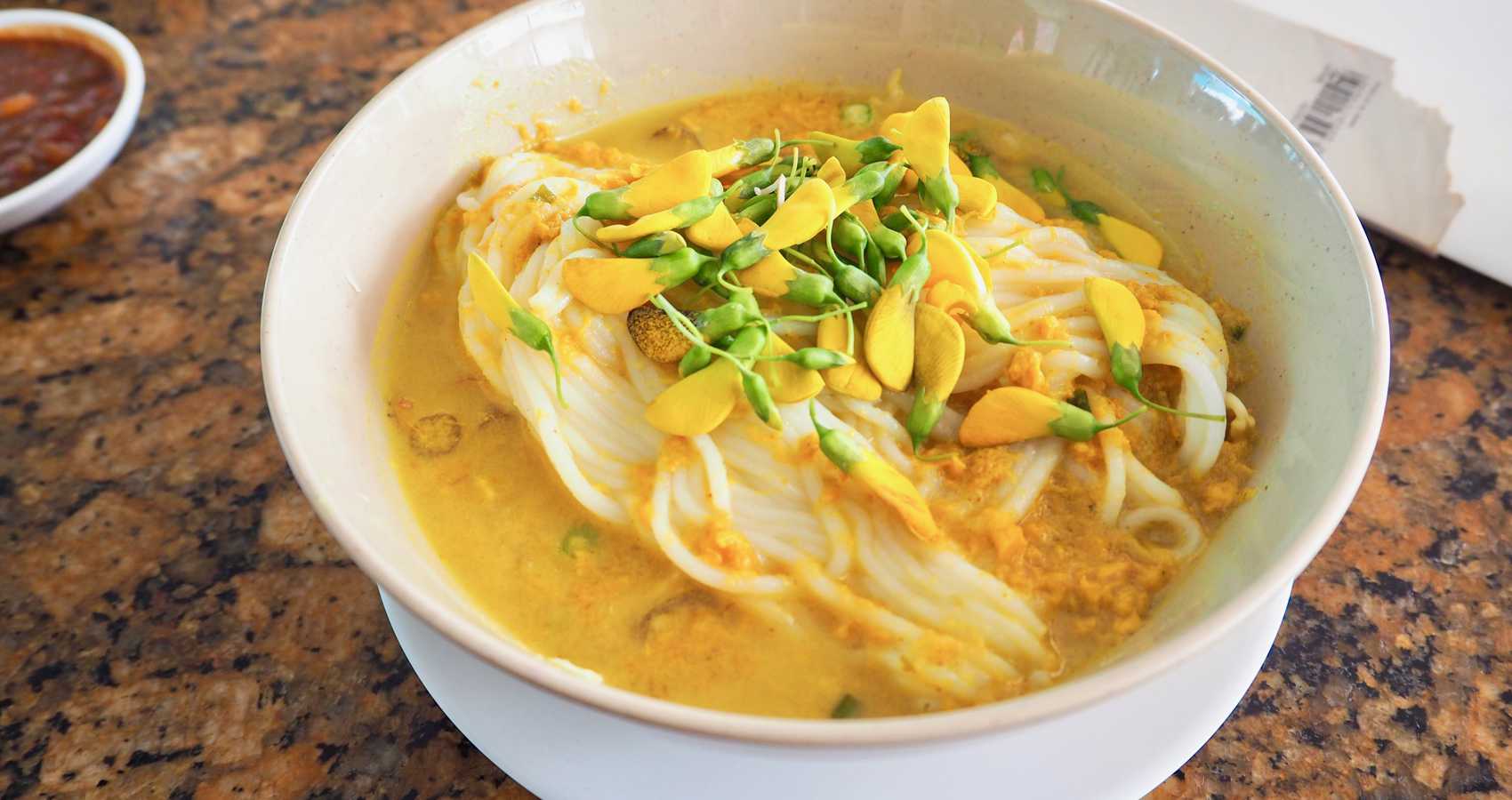
Nom Bánh Chok
written by: Gary Syck
The best food comes with a story. The story gives a dish something beyond its ingredients and preparation that nourishes the spirit as well as the body. This is the story of Nom Báhn Chok, a national dish from Cambodia. The next time you are served Cambodian food, think of this story and taste it in the dish.
The story begins in a village in the Cambodian countryside. Every year, the Mekong River floods the fields where the villagers plant their long-grain rice. It is a good rice and it grows well in the river water. The people of the village grew enough rice to feed themselves and to sell a little excess to merchants from Phnom Penh. The young farmers of the village were happy people and quite satisfied with the rice and their community.
For older villagers, the rice was less satisfying. It was a hard kind of rice that was difficult to digest. The villagers were fond of their older people and worked tirelessly to come up with a way to feed them so they could be as happy and healthy as the young people. One woman experimented with processing the rice by soaking it in water and letting it ferment a bit. Then she ground the fermented rice into a paste that she hung in a cloth bag until most of the water drained out. The paste formed long strings when the woman squeezed it through small holes in a piece of metal. She put the strings into a pot of boiling water to make noodles.
Perhaps these were the first noodles. Perhaps some other old woman in some other village invented noodles. That is not important to the people from the village in this story. They know that being first has nothing to do with being happy and well-fed. Wherever they were invented, the villagers filled their bellies with the old woman’s noodles until they were happy and nourished.
One day, a young boy from the village brought the old woman one of the fish that the Mekong delivered to the rice fields along with the water. The fish live with the rice while it grows and fertilize it with their waste. When the fields are drained to harvest the rice, the fish flop in the mud and are gathered in woven baskets. The young boy was proud of how many fish overflowed his basket and happily shared a fish with the old woman.
The old woman cleaned the fish and put it in a giant soup pot. She added some vegetables from her garden and seasoned them with the curry that she and her husband loved very much. When the broth was ready, she poured it over some noodles and served it to her husband. He loved the old woman and loved the food she prepared. What a treat, he thought, and took in a deep lungful of the steam that rose from the dish. Enchanted with the love for his wife and the wonderful aroma, he grabbed a handful of noodles. The hot broth burned his fingers. He put his fingers in his mouth, where the delicious broth made him forget about the pain. He wanted more, but the old woman talked him into going for a walk first and let the noodles cool.
They visited their neighbors, where the old man bragged about his wife’s cleverness and the noodles that were waiting for them back home. The neighbors were intrigued by his review of his wife’s cooking and joined them in their walk, hoping to get a taste. Before long, the entire village followed them back to the old couple’s table.
The old woman was glad that she had used her biggest pot for the broth. There was enough for the whole village to share. She brought the pot out into the yard and invited the villagers to sit in a huge circle. The boy who brought the fish, took the pot, and walked around the circle, letting each villager take a handful of noodles.
The first time around, each villager took a small sample to try. The second time around, they knew how good it was and took a bigger portion, making sure to get some fish and vegetables. Broth slopped from the pot, some making it into the villagers’ mouths and some staining their clothes. Life was good.
One day, the prince stopped by on one of his regular tours of the country. When he got to the village, he was intrigued by the scene of everyone sitting in a circle, eating with their hands and laughing while they made a mess. He went home and reported the phenomenon to the court. One of the court wisemen got the idea that they should have the noodles at court. The king sent a soldier out to get the recipe and any ingredients that were needed. The story does not include any information about how he accomplished the cultural appropriation from the village. Maybe the villagers loved their prince so much that they proudly handed over their secrets. Maybe the soldier kidnapped all the village children and refused to give them up until the villagers forked over the recipe, some rice and fish, and all their loose money to pay the soldier for his efforts.
However, he got the goods, the soldier returned and was rewarded by the king for his successful mission. The palace chefs reviewed the recipe, gathered the tools they would need, and prepared the dish. The whole palace was filled with enticing smells of fish and curry. The prince waited impatiently at his ostentatious dining table until it was ready. Entranced by the aroma, he reached towards the bowl, but before he got a handful, the powerful fist of his father knocked his hand away. No prince of Cambodia can eat with his hands! The Chinese ambassador was a tireless gossip and would take the news to the rest of the world, making Cambodia a laughing stock. The prince held back tears of disappointment. It hurt him to be on the edge of enjoying these wonderful noodles, only to be denied by custom and good manners.
Seeing the distress of the prince, the king’s heart melted just a bit. He offered the prince a pair of golden chopsticks. The prince refused. There was more to the dish than just eating, the prince explained. He thought of the happy faces of the villagers eating together. He pushed the chopsticks away and folded his arms petulantly. The king, like any father, ached for his son. Nothing would upset the boy if he had anything to say about it. And, he was the king, he had plenty to say. He snapped his fingers and ordered a footman to run to the treasure room and bring back the gifts that a European trader had given the royal family. In the box was the strange tool the trader had called a, “Fork.” The king offered it to his son, but the prince was in a full pout and refused the strange item. He had no idea how to work the thing anyway.
The prince insisted that the only way to eat the noodles was by hand. The king thought hard for a solution to the problem. It was a dilemma. How could the prince eat the noodles when he was forbidden by custom to let food touch his hands? He called the palace wisemen into a meeting and set the problem before them. They debated various ideas. Perhaps they could fashion a glove for the prince. Maybe, if he wore a bib to keep the broth from staining his clothes. What if they strained the broth away so that the noodles were not so sloppy. Each idea was met with opposition, and each opposing idea was scoffed at.
Voices were raised as each wiseman argued for his favorite idea. The king dropped his face into his hands and braced himself for the difficult task of telling the prince that there just was no way for him to eat the noodles. The arguments of the wisemen got intolerably loud until the king rose to his feet. Knowing the king’s temper, the wisemen instantly shut up and lowered their heads. The king considered having them killed on the spot. Let them live for a little longer, he thought, enjoying their shivering fear. As amusing as it was to see them quake, he had to deliver bad news to the prince. Cursing the burdens of royalty, the king pulled his robes around himself and forced himself to walk to his son’s table with confidence that he did not feel.
The king stopped short at the entrance to the dining room. The prince was smiling and chewing a mouthful of noodles. “Father!” the prince exclaimed around a mouthful of food. “You have to try these noodles! It’s the best thing I’ve ever eaten!”
The king squeezed his eyes closed, around flames of anger steaming his brain. His son had never defied him like this before, and he would come up with a punishment that would prevent ever doing it in the future.
“Look what the maid has done, Father!” whispered the prince. His voice trembled. He had never seen his father’s face so red or his fists so tightly clenched. The king opened his eyes and noticed the young maid at the prince’s side.
She was beautiful, as were all the maids at the palace. Each year, he scoured the country, taking all the most perfect girl children he could find. They were brought to the palace and given the best food, groomed by the best artists, and trained by the best teachers to make perfect servants. The maid kept her eyes down and waited for the king to wave his hand, giving her permission to continue her performance. She reached her pure white right hand into the bowl and stirred until a small ball of noodles collected between her fingers. She lifted the noodle ball slowly, letting the broth drain away. When it was done dripping, the maid placed the ball in the prince’s mouth. His face split into a smile as the flavors spread out on his palate. He closed his eyes to focus all his attention on the flavors, smells, and textures. He chewed slowly to draw every bit of goodness out. The maid placed her right hand on a linen napkin and looked down while she waited for the prince to enjoy his bite.
The king stared at the pleasant scene. He made a mental note to have his wisemen executed and replaced with new men who would not overlook such simple solutions to problems. “Enjoy your dish, my son,” he commanded and swirled around to return to the weighty responsibilities of running the kingdom.
Several months later, the ambassador from China arrived at the palace. He made his obeisance by pointing at the three wagon loads of gifts he brought and kowtowing until the king was satisfied with the deference he was paid. The ambassador hid a condescending smirk that might have given away the fact that the gifts were a trifle compared to the great wealth of the middle kingdom. He kept his head bowed to let the king imagine himself to be a great and magnanimous ruler.
“What boon would you have from the king of Cambodia,” demanded the king in his most royal voice.
“This humble emissary has but one small request,” answered the ambassador. “Far away in China, we have heard a legend that there is a dish in Cambodia that is the most divine food ever served.”
The king leaned towards his new gaggle of wise men. They whispered among themselves before the bravest of them approached the king and reminded him of the noodles that the prince ate each morning for breakfast.
“Ah, you mean the feeding noodles!” declared the king. He silently weighed the pros and cons of giving in to the Chinese. He knew that he was the greatest king in Asia, but he also knew that staying that way depended on keeping the Chinese happy. He told the ambassador that his cook would return to China with him and teach the dish to the Chinese.
Of course, the delightful dish was a hit with the Chinese, and who could blame them for making it their own and claiming to have invented noodles. The prince returned to the village many times. He enjoyed the noodles, but he could never uncover the secret of why the people in the village were so happy.

- Nom Bánh Chok - August 2, 2025