

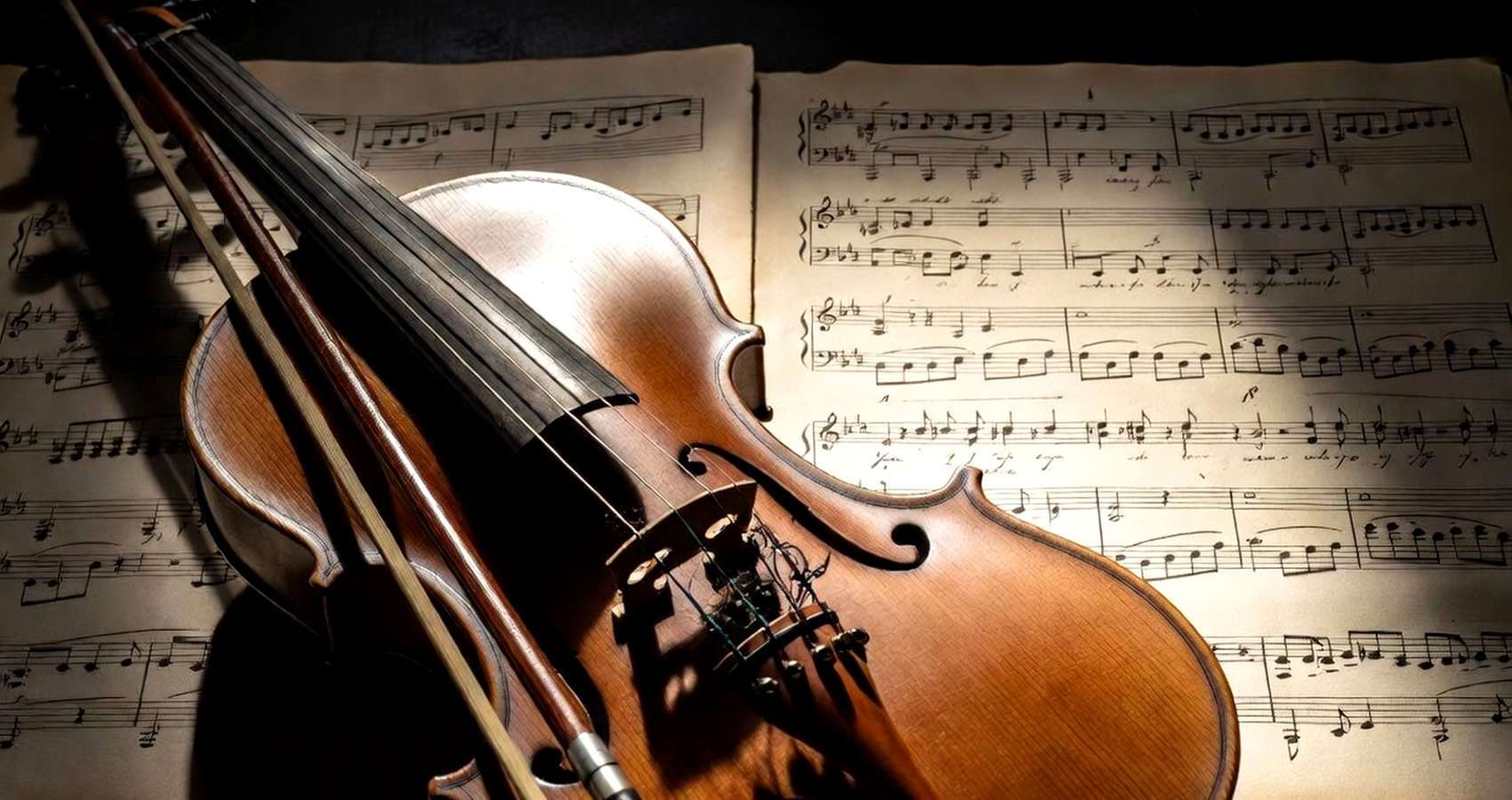
Second Voice
written by: Vivek Subramanian
The conductor raised his baton.
The hall tightened around the silence before the first note, that strange communal stillness in which hundreds of people seemed to forget, for a second, that they had bodies. Bows hovered. Hands waited. A cough was swallowed somewhere in the dark. Then the orchestra entered, and the air changed.
Elena stood under the lights without moving.
At twenty, she had already learned one thing illness teaches very quickly: people watch your face for clues. They watched the way you stood, the way you breathed, whether you looked tired, whether you looked brave, whether you looked like someone they could admire without feeling too frightened for you. So she had stopped giving them anything. She stood with the violin under her chin and her shoulders level, the black fabric of her dress falling straight to the floor. Only up close would anyone have noticed the slight swelling of skin above her collarbone where the port sat beneath it, a hard little fact under the softness of the body.
She did not look at the audience.
She looked at the fingerboard, at the place where her hand already knew it would have to go.
When the first phrase of Bach came out of her instrument, it did not sound fragile. It sounded inevitable.
Years ago, before her father became a man who checked locks three times and stared too long at corners of rooms, before he began writing numbers on scraps of paper and carrying them in his shirt pocket like evidence from a trial no one else had attended, he used to tell her that Bach was the nearest thing human beings had come to proving that order was real.
He had been a mathematician then, or close enough to one that the distinction hardly mattered to a child. Their apartment had been full of graph paper, sharpened pencils, journals with thin columns of print, and impossible-looking symbols. He liked things aligned. Books flush with the edge of shelves. Plates stacked by size. Shoes placed side by side as if waiting for inspection.
At first, his habits seemed almost funny to Elena. He would straighten a frame by half an inch while talking. He would stop in the middle of dinner to wipe a drop of water from the table. He could not bear cabinet doors left open. But after a while, the need underneath those gestures began to show itself. If a chair had been moved, he moved it back immediately. If her mother misplaced the scissors, he went silent in a way that made the kitchen unlivable.
“You don’t understand,” he once said, not angry exactly, but with a kind of exhausted conviction. “One thing becomes another thing.”
Elena was seven. She did not know what he meant. She only knew the room had changed.
At night, she would sometimes wake and hear him in the hallway. Not walking. Waiting. Or maybe listening. Once she opened her eyes and found him standing in her doorway with a page in his hand covered in numbers written so hard the pencil had nearly torn the paper.
He looked at her, then past her, then down at the page.
“What time is it?” she whispered.
He did not answer. In the morning, he was back at the table with tea and toast, his face composed, as though the man in the doorway had been a rumor that had passed through the apartment and gone elsewhere before dawn.
Her mother never called it an illness in front of her. She called it strain, pressure, a difficult period. She said your father is tired in a voice that carried too much intention to be believed. Then she would put a hand between Elena’s shoulder blades and steer her gently toward the bedroom where the violin waited on its stand.
“Practice for a while,” she would say.
So Elena practiced.
At first, because she was told to, later because the act itself made something inside her settle. Scales. Arpeggios. The same measure ten times, fifteen, twenty, until the notes lost all personality and became a path her fingers could walk in the dark. Sometimes, beyond the half-closed door, she could hear her father speaking too loudly in the kitchen, his voice rising with the thin, metallic edge that meant her mother would answer softly, trying not to let the sound travel.
Over it all, the metronome ticked.
Years later, she would think that the metronome had saved her a little. Not by comforting her. It was too stern for that. But because it asked for nothing except continuation.
On stage, she moved into the second phrase, then the third, and let the line widen. The orchestra held back under her, giving her room.
She had always loved Bach most when he refused sentiment. There was nowhere to hide in that music. No place to pour emotion like syrup over weakness and call it depth. If you were frightened, you were frightened in time. If your hands trembled, they trembled in tune, or they did not. The line continued either way.
When she was eight, her mother sent her next door with a screwdriver.
“Just give it to Mr. Varga and come back,” she said, still kneeling beside the broken chair, one hand pressing two loose pieces of wood together.
The afternoon was ordinary enough to be forgotten in every other respect. There had been sunlight on the landing. Someone downstairs was frying onions. A radio was playing faintly behind a wall.
Mr. Varga opened the door in his undershirt and smiled when he saw her.
“Ah, perfect,” he said. “Come in a second.”
She remembered the smell first, though she would not remember it fully until years later: cigarettes, machine oil, something sour beneath both. She remembered a workbench near the window with small tools laid out on a towel. She remembered standing just inside the door because children are often trained not to cross too far into adult space unless invited further.
Then the door shut. After that, the memory broke into pieces. Not darkness exactly. Not blankness. Pieces.
The feel of the screwdriver still in her hand longer than it should have been. The scrape of wood somewhere. Her own breath going shallow. A wall with a crack in the paint, branching like a river on a map.
The overwhelming need not to make anything worse by moving incorrectly. When she came home, she was still holding the screwdriver.
Her mother looked up from the chair.
“Didn’t he take it?”
Elena stared at the tool in her hand as though seeing it for the first time.
“I forgot,” she said.
Her mother frowned, then laughed a little, distracted, and held out her hand for it. “You and your daydreaming.”
Elena gave it to her. That was the first moment she understood how easily a lie could enter a room and sit down like furniture.
She did not tell her mother. She did not tell anyone. Not that day, not that week, not for years.
Partly it was because she had no words. The body knows before language does, but what it knows is brute and useless. Wrong. Danger. Don’t go back. It does not arrive in sentences. It arrives in heat, in nausea, in the sudden impossibility of being touched without warning.
But there was another reason too, one she would only admit much later. The house already felt too full.
Her father had begun checking the stove repeatedly before bed. He stood at the windows at night and touched the latches as if expecting something to test them from the other side. Once, when her mother asked him a simple question, he turned on her with such wild suspicion in his face that Elena felt the floor tilt under her. Nothing happened after that, not in the dramatic sense. No shattered plates. No police. Just her mother going very still, then resuming what she had been doing in a different silence.
Elena understood, with the pitiless intelligence children sometimes have, that there was no spare room inside the family for another catastrophe.
So she said nothing.
That evening, she practiced.
Her left hand felt stiff. Her shoulder ached. She missed the same shift twice, then again. She wanted to throw the violin across the room, not because she hated it, but because it remained itself when everything else had changed. The metronome clicked on. The page stayed open. Outside the room, she could hear one of her father’s drawers opening and closing, opening and closing, as if he were searching for a document that would explain his own mind back to him.
She began again from the top.
Something happened to Bach after that afternoon. Or maybe something happened to her inside Bach.
Before, the music had seemed like law. Severe, clean, almost cold. Afterward, she heard another thing in it: not kindness, exactly, but coexistence. One line entered. Then another against it. Not to cancel it. Not to heal it. Just to continue beside it, making a shape large enough for tension to remain alive without destroying the whole.
She did not have those thoughts then. She was eight. What she had was only sensation: that the music did not ask her to be unhurt before it would take her in.
The applause did not exist yet. The hall, the stage, the conductor, all of that would come later. First there were years.
School.
Competitions.
Her father was worsening by increments small enough to deny and large enough to alter the weather of the apartment.
Her mother’s face growing thinner.
The secret sealing itself not because it was safe, but because time hardens silence into habit.
There were good years, too, or good evenings. Her father was not a monster. That would have made life simpler. Sometimes he sat beside the record player with his eyes closed and spoke to Elena with grave tenderness about counterpoint, about how a fugue was not chaos disciplined from above but a kind of difficult citizenship among independent voices.
“Listen,” he said once, lifting one finger in the air as though tracing the line only he could hear. “It isn’t obedience. It only sounds like obedience to people who are not listening.”
She remembered that sentence because it startled her. It felt too wise for the man who, an hour earlier, had accused her mother of moving his papers when they were under his own arm.
She learned early that people do not arrive as single truths.
The diagnosis came in winter.
Even now, she could remember the office more clearly than the doctor’s face: the fake wood grain of the desk, the anatomical poster curling slightly at the corners, the blue pen laid exactly parallel to a pad of paper. The doctor spoke carefully. Young patients made doctors careful. He used words like aggressive, promising, and protocol. He did not say afraid, though everyone in the room was.
Her mother gripped her own handbag in both hands as though resisting the urge to tear it open.
Elena listened. Asked two questions. Nodded once.
Inside, something old and cold lifted its head.
Not surprise. Recognition.
The body had known panic before. The body said: yes, this again.
Treatment reduced life to function. Blood counts. Timetables. Metallic tastes in the mouth. Plastic chairs. The smell of antiseptic that no amount of fresh air could fully erase from the skin. She lost weight. Then hair. Then the patience people praised in her as though it had been chosen, as though endurance were a virtue instead of often just a lack of alternatives.
One night, during the second cycle, she lay awake in the ward with nausea rolling through her in intervals so exact they might have been scored.
A nurse named Dara sat with her.
Dara was not warm in the theatrical sense. She did not speak in soft, false music or tell Elena she was strong. She brought ice chips, adjusted the blanket, checked the line, and sat down. There was mercy in her refusal to decorate suffering.
Elena stared at the ceiling.
There were forty-two acoustic tiles visible from the bed.
She counted them. Then counted the spaces between the fluorescent fixtures. Then counted her breathing in groups of four, though the fourth count often failed. When the next wave came, she watched for its shape instead of fighting its arrival. Rise. Crest. Break. Empty interval. Then again.
Dara noticed none of this, or noticed and respected it enough not to mention it.
At some point, Elena thought, absurdly, of practicing as a child while her father moved through the apartment like bad weather and the metronome marked out an order neither of them could fully believe in. The memory did not comfort her. But it did something almost as useful. It made the night legible.
By morning, she was still sick. Still afraid. Still there.
But morning had come.
On stage, the final movement approached.
Her right arm was tiring now. Not visibly, not to the audience, but she could feel the minute betrayal in muscle and tendon, the slight delay between intention and execution. She adjusted pressure, gave up amplitude for accuracy. There were passages in which a healthier player might have chosen splendor. Elena chose truth.
The anxiety rose exactly where it always rose: in the chest first, then the throat, then the fine trembling under the sternum that made breathing feel like an action one had to remember to continue. It had visited her in childhood hallways, in clinic rooms, in backstage shadows, in the seconds before difficult entrances.
She had never defeated it.
That language belonged to people who liked victory narratives. She distrusted them.
What she knew was narrower and more practical: anxiety could accompany you without being allowed to conduct.
The orchestra moved beneath her and around her, a field of held structures. She could feel the cellos through the floorboards. The oboe line crossed briefly under her own and was gone. The conductor’s left hand opened, asking for breadth, and she gave it what breadth she could. Not generosity. Exactness.
Then came the long closing phrase.
Something in her stilled.
Not healed. Not redeemed. Stilled.
She thought, though not in words, of all the voices that had traveled with her to this point: her father’s numbers and sudden tenderness, her mother’s weary competence, the sealed room in the neighbor’s apartment, the hospital ward at four in the morning, Dara in the chair beside the bed, the child practicing while the house held itself together by strain and habit and unspoken bargains.
None of it had left.
But for these few bars, it stood in relation.
That was enough.
The final note hung in the hall and thinned into silence.
Elena did not move immediately. The bow remained on the string, her wrist soft, her chin still resting on the violin as though the music might yet have one more sentence to add.
Then she lifted the bow.
For a second, the hall remained quiet.
Not polite, quiet. Struck quiet.
Then applause broke over her in a single force.
She lowered the violin and looked out.
The audience was mostly darkness beyond the lamps, faces blurred into one breathing shape. Still, she could feel the fact of them: all that attention, all that projection, all those private reasons for being moved. Some would see courage. Some tragedy. Some transcendence. People always preferred clean stories when they could get them.
She did not bow deeply. She had no taste for performance after performance.
The conductor touched her shoulder. The orchestra stood.
She inclined her head once.
Then, before turning to leave, she brought the bow back to the strings and touched them lightly, almost inaudibly, a private contact more than a note. The gesture was so small some in the audience may have thought they imagined it.
But she felt it.
Wood. String. Resistance. Reply.
Then she walked offstage.

- Second Voice - March 31, 2026
- The Bite - November 8, 2025
- 100 Foot Valley - August 6, 2025