

The Bite
written by: Vivek Subramanian
Snow hung heavy in the air, each flake drifting like whispered secrets. The world lay muffled and white, as if the mountains themselves were holding their breath. I brewed my coffee, its warmth rising in soft curls, and my eyes fell upon the photograph of my foster grandfather, mounted proudly on his horse, his great mustache bristling, posed with his Springfield rifle, a valiant figure poised for war in North Carolina. The light from the morning window touched the glass, and for a moment, it seemed he might ride out of the frame alive again, steady and proud, a man of dust, leather, and iron.
Rabies was dreaded in those days, for its bite carried a slow, merciless doom. A healthy man could be turned into a raving shadow of himself, seized by spasms, saliva spilling from his mouth, haunted by visions, and driven mad by the very sight of water. On farms and battlefields alike, the whisper of a rabid dog or wild beast struck fear deeper than bullets; no cure was known, and once the sickness took hold, it ended only in death.
It was said that during those restless war years, while riding through the Carolina pines, he was bitten by a wild dog—an omen as much as a wound. The animal had lunged from the underbrush, eyes fever-bright, body thin as wire. He shot it dead, tied his bandanna tight around the bleeding flesh, and rode on toward camp, dismissing it as nothing more than a scratch.
But the scratch festered. Days later, his laughter began to change—too loud, echoing into the silence of the campfire. He could not drink water without trembling; he spat it out as though it burned. His horse shied from him, and his fellow soldiers whispered. The fever took him under a sky full of cannon smoke, and though he lived long enough to see the war’s bitter end, they said his mind had already wandered into some wild place from which no man returned.
Now, more than a century later, his photograph hangs in my kitchen, framed in quiet defiance of time. I sip my coffee and wonder: was it the war that unmade him, or the bite of that forgotten beast in the forest?
The story passed down through our family like a contagion of its own. My parents told it in hushed tones, always ending with the same decree: no animals, not even pet dogs, were allowed in our home. As a child, I would have cried for a dog of my own, but such comforts were denied. Home-schooling, strict parenting, and the shadow of that distant bite taught us restraint. Over the years, it seemed almost fated—we grew up allergic to dogs as well, our longing and our bodies conspiring together to ensure the family’s rule was kept.
I thought I had escaped the curse by simply accepting it. I kept my distance from dogs, crossed streets to avoid them, lived my life in the careful margins my family had drawn. But fate has its cruel humor.
I was twenty-three when it happened. A Tuesday afternoon in early spring, the air is still cool but promising warmth. I was walking to the market, my mind on nothing more urgent than what to make for dinner. The dog came from nowhere—a medium-sized mutt, mottled brown and white, with wild eyes and foam flecking its jaws.
I remember the sound first: the scramble of claws on pavement, a guttural snarl that seemed to tear the peaceful afternoon in half. Then pain—white-hot, electric pain as teeth sank into my thigh. I screamed, flailing, and the dog released me only to lunge again. Someone shouted. A car horn blared. The world narrowed to teeth and blood and the horrible certainty that the old family story had found me at last.
The dog was pulled off by a stranger with a baseball bat. It ran, disappearing into an alley, never to be found. I collapsed on the sidewalk, my jeans darkening with blood, my hands shaking so violently I couldn’t hold them still.
The hospital lights were too bright. Thirteen stitches in my thigh. Seven in my calf where the second bite had landed. The doctor’s face was professionally calm as he explained the protocol: a series of rabies vaccinations, starting immediately. They couldn’t find the dog. They had to assume the worst.
“You’re lucky,” he said. “Fifty years ago, this would have been a death sentence.”
Lucky. I spent four weeks in and out of that hospital. Each shot burned like fire entering my veins. I developed a fever that left me delirious, calling out for my grandfather, seeing his fever-bright eyes in every shadow. My mother sat by my bedside, silent and pale, as if watching her worst nightmare take shape in flesh and blood.
“It’s happening again,” she whispered once, when she thought I was asleep. “The curse is real.”
But I survived. The vaccines worked. The wounds healed into raised, pink scars that I still carry—not just on my leg, but in the way my breath catches when I hear a dog bark, in the way my body tenses when I pass one on the street. Some fears are not inherited; they are carved into you, written in scar tissue and memory.
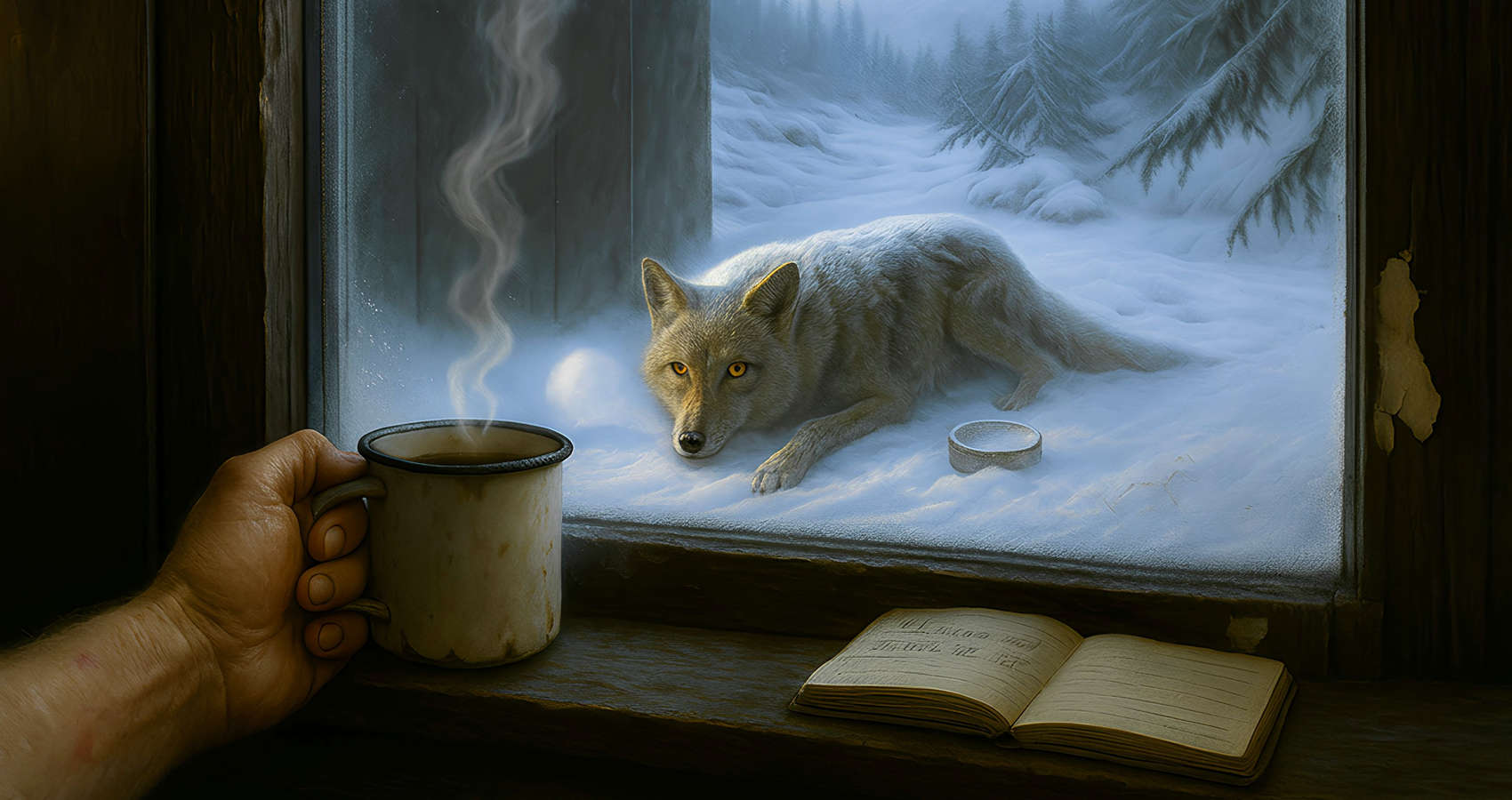
It was freezing outside, six inches of snow blanketing the ground. The mountain town of North Carolina had not expected such a storm this year. I stood at my kitchen window, coffee in hand, the photograph of my grandfather watching from the wall. Twenty years had passed since my own bite. Twenty years of living with the weight of inherited fear and lived trauma braided together.
Then I saw it: a rare, brownish figure against the endless white. Time itself seemed to pause.
I pulled on my jacket, gloves, and hood, and stepped out into the biting cold. My boots sank deep into fresh snow, each step a small collapse. The air stung my lungs.
It wasn’t a dog. It was a coyote. Its fur was matted with ice, its breath coming in shallow gasps, one hind leg dark with blood and held at an unnatural angle. It lay in a small depression it had dug, as if trying to burrow into the earth for warmth.
For a long moment, I stood still, the steam of my breath mingling with the winter air. The coyote’s eyes found mine—amber and ancient, neither threatening nor trusting, just aware. Watching. Waiting.
Every instinct screamed at me to go back inside. This was how it happened. This was how the curse returned—not through malice, but through mercy, through the fatal mistake of reaching out to a wounded thing.
I thought of my grandfather, fevered and dying, his mind lost to the wilderness. I thought of my own body pinned beneath snapping jaws, the way fear had rewritten my nervous system. I thought of a lifetime of caution, of doors closed to joy because they might also open to pain.
Calling animal control wasn’t an option; no truck could make it through the white silence that buried the roads. I could leave food, perhaps. Water. But would that be enough? Would that be anything more than prolonging its suffering?
I took a step closer. The coyote’s ears flicked, but it didn’t move. Couldn’t move, perhaps. Its ribs showed through matted fur, each breath visible in the expanding and contracting of its side.
Another step. The snow crunched beneath my boots, loud in the quiet. My hand found a sturdy stick—not as a weapon, I told myself, but as a tool. To move it. To help it. To keep a distance between teeth and flesh.
The coyote’s eyes never left mine.
I knelt in the snow three feet away, close enough now to see the frost gathering on its whiskers, the way its injured leg trembled. Close enough to see it was young, perhaps barely more than a yearling. Close enough to understand that it was dying.
“I’m sorry,” I whispered. The words came unbidden, meant for the coyote, for my grandfather, for myself. “I’m so sorry.”
The coyote blinked once, slowly, and something in its eyes reminded me of the photograph on my wall—that same quality of being caught between worlds, neither fully here nor fully gone.
I could save it. Call a wildlife rescue, though they might not come. Wrap it in blankets, bring it inside, risk everything my family had feared for generations. Or I could show mercy of a different kind—quick and certain.
But I did neither.
I stood, my knees wet from the snow, my heart hammering against my ribs. I walked back to the house, measured and deliberate, and retrieved a bowl of water and some raw meat from my refrigerator. I set them in the snow, close enough for the coyote to reach if it could muster the strength.
Then I went inside and called every wildlife rescue, every veterinarian, every animal control office within fifty miles. Most didn’t answer. Two said they couldn’t help. One—a woman with a kind, tired voice—said she’d try to get there by evening if the roads cleared.
“If it’s still alive,” she added. Not unkindly. Just honest.
I returned to the window. The coyote hadn’t moved toward the food. It lay still, watching the house, watching me through the glass. Snow continued to fall, beginning to dust its fur with white.
Hours passed. I couldn’t leave the window. The light changed from grey morning to greyer afternoon. The coyote’s breathing slowed, visible even from this distance.
The day was steeped in a brittle stillness. Anxiety throbbed beneath my skin like a second heartbeat. I pulled the blanket, but the bed was cold, indifferent. To distract myself, I scrolled through videos on coyote behavior—how they hunt, how they stare before striking. The phone slipped from my hand, and sleep folded over me like fog. In that dream, a coyote lunged, its teeth sinking into my neck, the warm spray of blood staining the white snow. I woke up gasping, my throat dry, heart pounding—unsure which was more real, the fear or the silence that followed.
At four o’clock, as the winter sun began its early descent, the coyote lifted its head. It looked directly at the window where I stood, and for a moment—I swear this is true—it seemed to nod. A slight dip of the muzzle, there and gone.
Then it lay its head down in the snow and went still.
I stood at the window as darkness fell, watching the snow slowly cover the coyote’s body, erasing its shape, returning it to the white silence from which it had emerged. The bowl of water froze. The meat disappeared under fresh powder.
The wildlife rescue never came. The roads never cleared.
That night, I took down my grandfather’s photograph and studied it by lamplight. His eyes, I realized, were amber—a detail I’d never noticed before. The same shade as the coyote’s.
Was it him, returned? Was it a test, a curse came full circle, or merely the random cruelty of a hard winter?
I don’t know. I will never know.
What I do know is this: I did not turn away. I did not hide behind locked doors and inherited fear. I stood in the snow and looked suffering in the eye, and I tried—however imperfectly, however inadequately—to help.
I scribbled in a notebook quickly, “The curse, if there ever was one, was not in the bite. It was in the fear that kept us from reaching out, from risking ourselves for another living thing. It was in the walls we built, the love we refused, the connections we severed in the name of safety.” Alas, confused thoughts. It’s not helping either!
My scars still ache when the weather turns cold. I still tense when dogs approach. The fear doesn’t leave you, not completely.
But neither does the memory of amber eyes in the snow, watching without judgment, accepting what mercy I could offer.
Outside, the storm finally broke. Morning light touched the mountains, turning snow to diamond. I made my coffee and stood at the window. The photograph of my grandfather hung back in its place on the wall, his eyes forever amber, forever watching.
I have learned to live with the scars. Both kinds. I stepped into the frozen air. The coyote lay motionless, eyes sealed like frost over a stream. For a moment, the mountain felt utterly silent, holding its breath.

- The Bite - November 8, 2025
- 100 Foot Valley - August 6, 2025
- Jasmin’s Tale - March 12, 2025