

The Changing Tree
written by: Stuart Mark
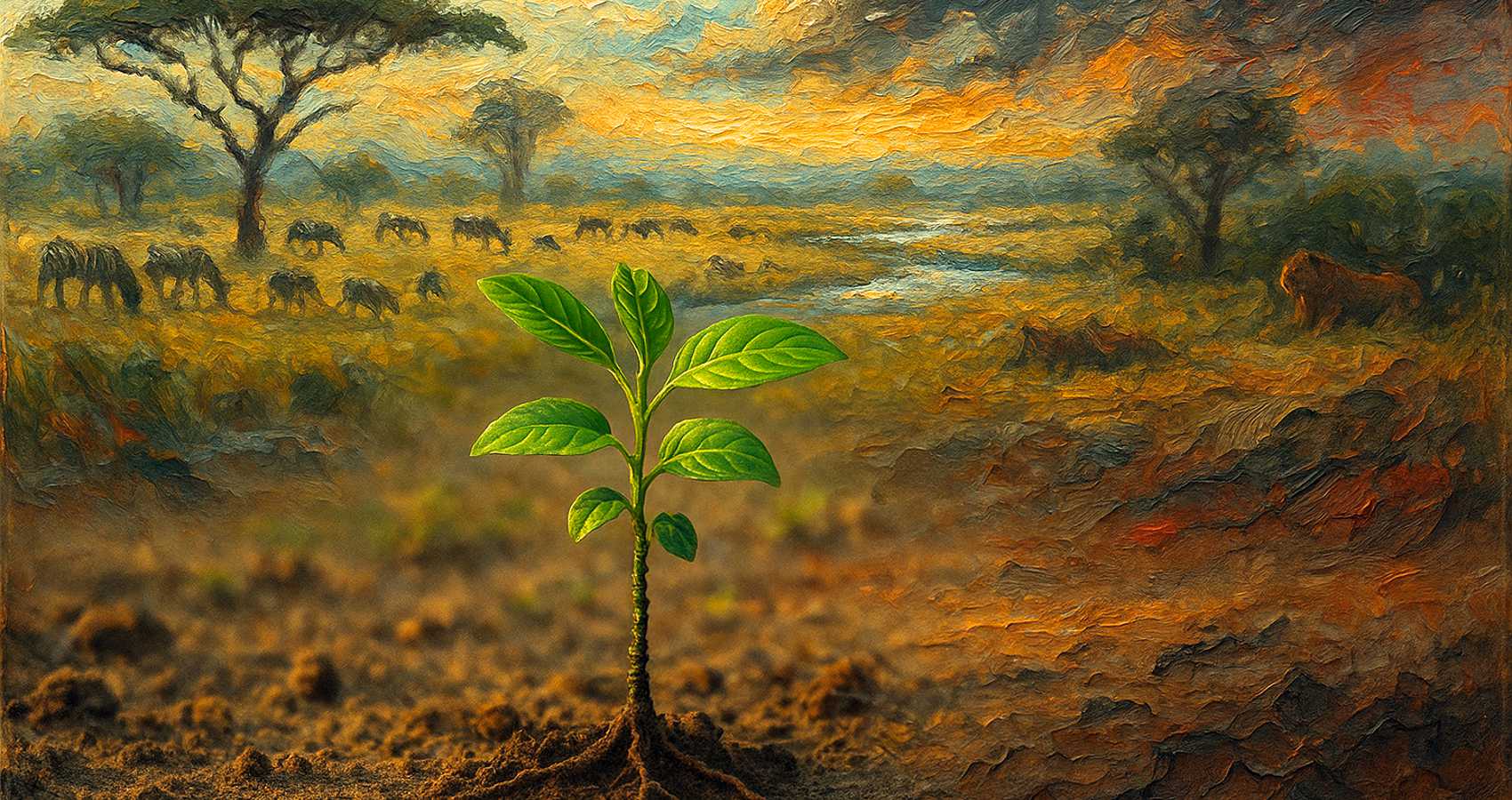
‘Hello and welcome to the world, my little one. Humans would say you have shot up out of nowhere and be surprised, but not me. I expected you, and I am delighted to see you.
‘Let me show you the wonders around your environment. This is where you will live, rooted for many years into the future. Over there, you will enjoy the view of the plain lowveld savanna studded with some of your species as well as many others, especially the thorn trees, acacias is their correct name. A symbol of the African veld, a welcome place of rest for the many species and, sadly, one of the trees the humans have removed in their quest for farming land. The veld here stretches for as far as you can see. Green and lush in the spring and early summer, brown in autumn, and almost white and battered in winter, when it is the dry season. A seasonal changing vista of natural beauty if it is left to do it by itself.
‘It has rivers and streams running throughout, and if it is the wet season, they will be filled with sweet, clear water to nourish all. You cannot see the rivers from here, so you will have to trust me that they are there. You will find the water you need beneath you. The grass arises fresh and lush each spring, bursting vibrant green, rich with nutrients and food to feed the grazing giants, Buffaloes, Rhinoceros, and other wonderful animals. The Wildebeest and Zebra are my favourites, but I really shouldn’t have favourites. You will find there are a lot of Impalas too, but they are, so I have heard the humans call them, the McDonald’s meal of the African bush. Always there for a quick snack. They all serve a unique purpose, elements in the food chain, they are, and every one essential.
‘You will see the thrill and the gore of the hunt by the predators in their quest for sustenance. The Lions will hunt with the females doing the damage, patient but thorough. They will encircle the prey, picking a weak one carefully and isolating them from the herd. It is a method of ensuring that there is enough food for their males as well as their offspring. The males get to eat first, yes it is a patriarchal society, then the females, and finally the offspring. Although the females will often let the young eat with them. The Cheetah will dazzle you with the speed that they hunt with, fast and ruthless, far faster than the lions. They will take an animal down in the blink of an eye. Then there are the Leopards. The quiet, solitary hunters cunning in their resolve and clever in bringing their prey high into the trees to protect it from the scavengers. Difficult to spot in the trees where they will spend most of their day. They always ensure that their offspring are well-fed. They will enjoy your generous boughs once you are fully grown.
‘The scavengers are important, though. The hyenas will come in and take what the Lion has not consumed. They will fight each other to get to the corpse, often pushing aside the lions, now tired and needing a rest to digest their food. Their teeth, sharp and vicious, will clean the corpse to be void of almost all the meat. The vultures will drop in too, literally from their lofty perches and strip it completely to the bone before leaving it to bleach whiter than white in the African sun.
‘But it doesn’t stop there. The tiny animals play their role. The ants, beetles all come along and clean up the tiny bits the rest have left behind. Consuming even the blood spilt in the kill.
‘As I said, it is a food chain with a purpose. The grass feeds the grazers, which in turn become the food for the carnivore predators who leave some for the almost invisible animals to consume and break down. Eventually, the predators die, and then the scavengers tidy up. All the animals produce fertiliser on a continual basis to nourish the ground for the next season of vegetable growth. They also spread the seeds far and wide, which is useful for all. It is a system that has worked and grown over thousands of years.
‘You will also see the elegant giraffes nibbling the top leaves of the thorn trees, which helps to encourage them to grow more. Elegant animals they are, and you will enjoy watching them stretching their long, elegant necks down to the edge of the water hole. Their front legs splayed to allow the head to reach. Their eyes are alert for the ever-present danger that can look like a floating log but isn’t. Those crocodiles basking on the bank of the river, digesting their last meal and keeping a wary eye out for their next unfortunate victim, are masters of disguise and deception. You will be amazed at how slowly they can move and then strike with cruel, fast accuracy.
‘There are some odd characters around as well. The rhinoceros with its single horn, a quiet grazer. The other animals can be wary of them. They are ferociously protective of their young, and that horn can damage an animal that strays between mother and offspring. You may think that they are the largest animals, but they are not.
‘The elephant is the heaviest by far. They also graze on the vegetation from the trees and migrate around the area in search of the best food and the sweetest water which they will suck up through their long trunks. The young also enjoy spraying each other as they play in the pools.
‘You may now be thinking that you have arrived here into what may appear to be a Garden of Eden, a place of immense bounty, and currently it is, and that is what I wanted to create. But I must warn you, you have work to do, things to change. You need to adapt and change faster than your species has before. If you cannot evolve, you will not survive. This paradise is going to change, and you must move with it. Let me explain.
‘The food chain was planned by me, including the humans. In them, I am disappointed, dismayed with their evolution. They take from the environment and contribute nothing in return. Their greed and thirst for energy has devastated this environment, your environment, my vision of utopia for centuries, but in the past two hundred years, this has increased exponentially. In a handful of years, the planet will not be able to recover.
‘Their actions were initially not too harmful, but this has changed. Their wanton greed has decimated the environment. The warning signs were there, but most ignored the shouting that some of the humans did. They held conferences, always agreeing the need to change and prevent global warming, but then went on their way and did not follow through
‘Remember, I said all the organisms are going to have to change, and that includes you. This is what you must do. Listen closely.
***
‘This view is very different to a few years ago and unrecognisable from what was here fifty years ago when you sprang to life. The most pessimistic would not have imagined it would be like this. They would be shocked if they could remember the changes like you and I can. I see that my conversation with you back then hit home with the gravity that I intended. I know that the words I used were difficult, horrible to understand, and incredulous to believe. Not everyone listens to me with the fervour and determination that you have demonstrated. How I wish they had. It would have avoided a lot of what I have seen.
‘You have done well, outstanding in fact. To say that I am impressed with what you have done would be an injustice to your efforts. The changes that you have been able to make in such a short time are outstanding. When we first talked, you didn’t believe me when I said that changes are coming and serious changes that will need you to make radical adjustments. You see now how right I was.
‘Your view, it has changed. The river used to flow strong in the rainy season and dry out for the rest of the year. Its waters clear and reviving to a parched animal. Necessary for your growth and support. In the dry season, you saw that there was still enough water hidden beneath the sandy bottom, water that the elephants were able to bring to the surface through stomping of their massive feet. Their young would then drink, and after they moved off, the water would sink securely below the surface again.
‘When last did you see that? When last did you even see one of those magnificent beasts, let alone the herds of hundreds that used to come through the river every year? You must have enjoyed their stampeding through after crossing the river. They have gone. Gone far away to find better grazing and more reliable water. Their numbers have dwindled, and the areas they went to are now overgrazed with trees like you having hardly a leaf below the reach of an outstretched trunk.
‘And worse than that, when last did an elephant rub against your bark? Pluck some luscious, plump, tasty leaves from your proud canopy. I see that there are no recent scrape marks, which means that the elephants are gone, and you are not going to see them anytime soon. They need the water, and it is not there as it used to be. Are you sad that they are gone? I suspect that you are.
‘The hippos you used to hear at night calling from the pool a hundred metres away are long vanished. They needed the deep pools for food as well as breeding. They trudged through the riverbed to find a better pool somewhere with a consistent supply of water. A lot of them have died on the journey, and many failed to find anything much better. I hope you remember the sonorous sounds of their calling for you are not going to hear it again.
‘I also see that there are no signs of the leopards that used to sleep in your lofty boughs. Sleeping for days with their latest kill, maturing in taste and texture, safe beside them. They liked your spacious accommodation with its generous canopy.
‘Remember how you used to house the vultures as they waited for the hyenas to finish before they swooped in to pick the bones clean for the sun to bleach?
‘You must have been surprised how quickly it started. Massive flooding following a few days of rainfall. Rainfall that was gentle here but upstream, it was months of rainfall in a matter of hours.
‘Yes, you saw water come through. Rough tumbling waves of angry brown water crested with white spray. They carried trees and animals that were too slow to get out of the way. Carried them to a watery grave. Those flash floods followed days of rain that far exceeded the monthly norm. They washed down the parched riverbed with such savagery that it could not absorb it fast enough. It flowed like a stampeding herd of zebra keen to get out of the way of the hunting lioness, rapid, uncaring. It burst the banks in many places and flooded the plains, washing delicate seeds to where they will never germinate and grow. They swept past you, leaving you standing in metres of water, far more metres than you had experienced before. That damaged some of the delicate life forms that inhabit in your mosaic-like bark.
‘The water disappeared as fast as it came, taking with it the insect life that thrived at your roots. It flooded their nests deep in the earth. This led to other small creatures moving away, looking for an environment that would support them. The steady supply of insects you provided is gone and gone forever.
‘The rains were not the steady flow that the wet season used to bring. The same floods occurred for seasons afterwards, and each year it seemed to get worse, and it was. It moved at a slow, almost not discernible, pace, a millimetre or two each year, but the millimetres add up and soon compound into metres of change. And then you had seasons of drought with almost no rain to nourish you, to wash your leaves and leave them sparkling green and dust-free. It was a struggle for all, you included. You had to put your roots deeper to get the water you needed.
‘The wind changed, too. The gentle breezes occasionally punctuated with a Lowveld thunderstorm changed; they became more violent. The storms grew longer, the wind blowing harder than you had ever seen before. They pulled at your deep roots, bullying you to go with them, leave the earth you have been rooted in for so long.
‘They tore the nests from your branches, smashing the bird’s eggs on the ground in a makeshift mess of an omelette. The birds are now gone, off to find safer environments. But they won’t find them easily. They will have to adapt, change, and they are but some of them will not survive. They will go as the Dodo went so long ago, although they were forced into extinction directly because of human activity. Not the same for you, although the action of humans is what has caused the changes you are going through. They have to, as their sources of food have changed.
‘You will have noticed the dry seasons are drier and the wet seasons wetter. The damage has increased. Look at the river now. It has deep banks that the animals hate, the few that come down here. They have all moved away, looking for safer ground, higher ground, a more predictable environment, an environment that will give them the elements they need for life. I am not sure all will find it. I know they won’t, not all of them at any rate.
‘But you cannot move. Your feet are planted deep into the soil, so here you will stay, but if you are to survive, you will also need to change. And you are. I can see some of the changes already, and you are doing well. Only time, though, will deliver if you are doing enough.
‘I see that the cracks between the bark have decreased. This will help you and your progeny retain the much-needed water that you currently sip, rather than slurp from the ground as you used to. Your leaves are changing, too. The stomas are changing, reducing in area to restrict the amount of water that you will lose. All good changes.
‘You have done well in such a short time to adapt, and I am sure that new genetic code you created is now in the fruits that you have borne and cast out into the world. The floods and winds will carry them far and wide. Probably much further than you would have done in the past. There is some benefit in the heavy rains after all. Your offspring will take up the fight now with a better chance of survival that your changes have given them.
‘You do not have much time left. The last floods have washed away a lot of the bank between you and the river. The topsoil is washed away, and the rocks below are not going to provide the grass with what it needs to grow. The next flood will wash more, and then your roots will be exposed. In all likelihood, the flood after that will cause you to collapse into the river. I’m sorry, but your life is nearly over, and there is nothing that can be done to prevent it from ending.
‘Take heart, you have done all that you could to ensure that your species survives. But it is time, time for you to contribute your last to the world. Your extensive boughs and magnificent trunk will take years to disappear, and as they do, you will add to the world that springs up just as you did. You will be a shelter and a feast for so many animals. You will give the nutrients made over the years back into the earth. So the cycle continues.’

- The Back Alley Life - October 6, 2025
- The Changing Tree - June 23, 2025
- 18:52 - January 17, 2025