

The French Warbride
written by: Rosella Sims
The weather was cool for Paris, a moderate temperature of only 60 degrees in early September 1944. That was not normal, but nothing was as the war raged, destroying the happy life she had grown up in. The world wasn’t safe anymore for Germaine Dubois, old enough now to help; she looked for ways she could. Germaine was the only child born to older parents tired of begging God for just one child. When her parents found they were expecting they credited God for the “un cadeau du ciel”, “a gift from heaven.”
Now, both parents gone, Germaine knew they were watching over her. This is what she was taught to believe, now easing her heart, knowing if they were still alive, just the thought of war would have taken them harshly. Germaine’s parents cherished “the old ways,” especially sharing them with their daughter, who had inherited the gift, a keen ability to take simple ingredients like flour, water, and yeast and turn them into something nutritious and comforting. The art of bread making came from Isabella, her mother, who was eager to share the skills of creating a good loaf of crusty bread. “Baguette,” known as French bread, was what her mother and her family, before her, were known for in Paris. Isabella would bake several loaves in the early morning hours, then walk to the Tower, her basket filled with her crusty loaves, where people would wait for her to buy them. Every day, she sold every loaf, more for pleasure than the money they would bring, but always making more than enough to cover the ingredients, with a little left to add to the household budget.
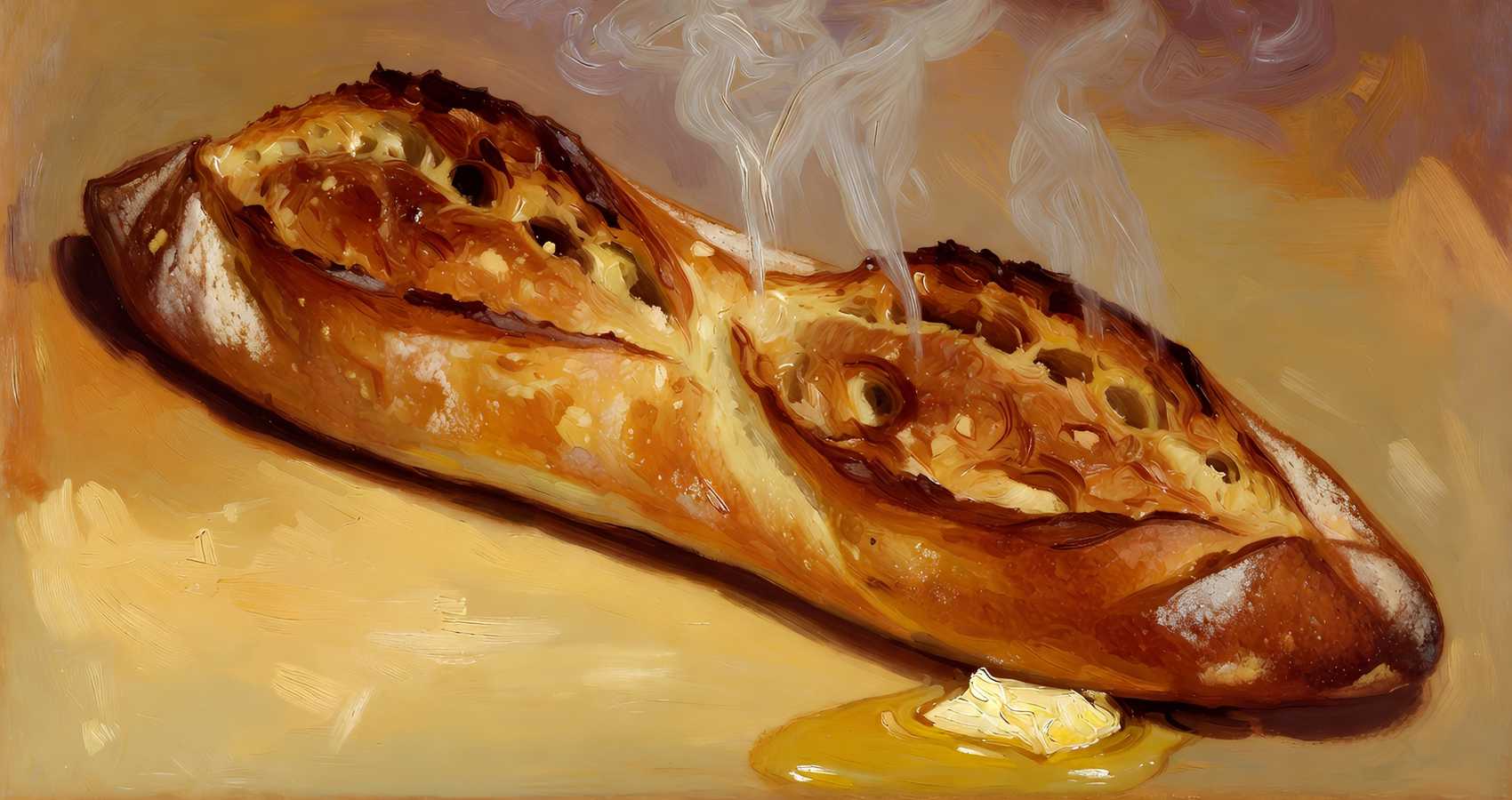
It seemed her hands were charmed. Holding the ingredients, she would add a pinch here or take away a pinch, until it reached “just enough,” feeling her creations into form. Once the ingredients were blended and mixed, the dough would become soft and pliable as alchemy took place, creating an artful, tasty loaf. In her kitchen, she was the potter, her bread dough her clay, producing beautiful brown long loaves of tasty perfection!
Simple yet flavorful, with a hint of yeasty notes, a slight sweetness, and a warm, crispy crust, with, every so often, a flake of fine salt.
Tradition was everything to Monsieur and Madame Dubois. They took the responsibility of parenting very seriously, knowing she was their gift from God. They wanted to make sure she was prepared for a good life in every way. From a very young age, Germaine would sit next to her mother, Isabella. Their cottage kitchen was small but always well stocked with every appliance and ingredient she needed. Her husband’s Henri’s love made sure of that. Germaine watched her every move, and at just 2 years old, Isabella put her daughter’s little hands into the bowl, guiding her ever so slowly, teaching her the ways of the flour, yeast, water, salt, and a pinch of sugar, the secret ingredient that invited the others to rise up to life. “Sentir la pate,” feel the dough, she would say as she watched Germaine’s heart grow hungry for more. Isabella beamed with joy, knowing the secrets of their family traditions would live on through her daughter. Her tiny hands, though tiny, held the family magic that had come through generation after generation and generations before them.
For Parisians, military occupation, was a series of frustrations. Food was being rationed among other things like tobacco, coal, and clothing. Times were different now, as flour, yeast, salt, and sugar weren’t easily accessible. But not for Germaine, who knew her parents watching over her had something to do with it. The ingredients she needed were always at hand, allowing her, in her small way, do what she could. She would share, as her mother did and generations before her, bread, the staple of life, knowing it would help in some way unbeknownst to her.
The Eiffel Tower, a short walk, only blocks from her family cottage, was one of the places soldiers from America would visit. Many would come riding bicycles, their transportation while there, due to fuel shortages. Paul Patrick, an American, had enlisted, eager and proud to serve his country. He was from a small town high up in the states, a region they called the Pacific Northwest. He, like Germaine, was also an only child and cherished by his parents.
When he told them he was enlisting, his parents worried the war might take him from them, a worry so many families shared, but something deep within him knew he must do his part.
Paul came from meager means. His people worked hard with their hands, not school-educated but educated by life, the fields, the rivers, and the streets. They had good common sense, and a good work ethic, Paul was blessed with both. Although he had been in Paris for a while, this was his first time seeing the Eiffel Tower, breathtaking, he thought as he not only saw the tower but Germaine as she rode up on her bicycle. Little did they know, their lives were about to change forever.
With the early light, Germaine began baking that day. She was 19 years old now, and bread baking had become a part of her more than a habit, more of a ritual. As soon the ingredients began to fill her hands, she would hear and feel her mother’s guidance as her bread took form. Within a few hours, she would load her bicycle basket with her elegant, warm loaves and off she would ride to just beneath the Tower as her mother, Isabella, had.
It was here she met him, the man who would steal her heart. It was here that she fell in love so hard she would leave her country and travel far across the waters to America. Was it by accident Paul Patrick was at the Tower that day? Germaine was taught to never believe in accidents but divine providence. She believed it was the work of her parents, working from heaven, that made this meeting possible. Paul was at the bottom of the Tower when she rode up, her bicycle basket spilling over, filled with her crusty loaves. She didn’t have to say a word to him, their eyes said it all. He boldly walked up to her, not a common action for his normal shy disposition, “Combien” (how much), he said, “2 euros Monsieur,” “for the whole basket?” he laughed, saying it in English, which caused her eyes to sparkle and her heart to grin. She knew just a little of the English language to get by. His sense of humor called her to laugh too, something foreign these days in France. He bought every loaf she had and every loaf she would bake again.
It didn’t take long for them to fall in love and for his proposal. Paul promised her a good life, where they would make a home and family of their own and where she could bake her bread as much and as often as she liked. The day she said yes to him was the day she became a French War Bride.
World War II officially ended, September 2nd, 1945. The War Bride Act was enacted in December that same year. The Act made it easier for a foreign spouse and minor children of U.S. servicemen who had served, to migrate to the United States.
Before they left France, she would become Mrs. Paul Patrick. Her love so strong it bonded her to Paul, which made leaving bearable. She was excited to begin a new life with him, but knew it meant she would leave her old life behind. But she was willing, knowing her heart would always carry the memories and traditions of her family, no matter where she lived.
Paul had grown up in a small town in the States, Sumner, Washington, which sat at the base of Mount Rainier. The mountain, originally named Tahoma, was majestic, covered in snow, it gave its valley plenty of water to farm and grow rich crops. The Sumner Valley was fertile, known for growing hops, then soon daffodils and tulips. In the spring, its fields were covered in colorful flowers, soon celebrations broke out, and it became known as Sumner, the Daffodil Capital of the World.
Germaine loved her life, and it was just as Paul had promised. As soon as they were stateside, he found a stable job at The Fiberboard in town, where they made wood products like hop boxes and fruit crates. He had always been good with money; all the monies he made in the military he sent home to his mother to bank for him. When the war was over, he had enough for a down payment on a little house. Paul and Germaine were welcomed home by Paul’s parents and invited to stay with them until they found their own home, which only took a few days. Their first little house on Elizabeth Street was perfect, being just blocks from Paul’s new job. Paul loved being able to walk home at lunch time to be with his Germaine, who was still adjusting to this new way of living in a foreign country. America, even though it came with a new family, was a big adjustment for Germaine, who was learning a new language without her own family or the family home she grew up in. Especially the kitchen, Germaine had all the skills she needed, but not the equipment. Improvising became her specialty. She made up her mind to see it as an adventure rather than a problem because life was new, and she wanted to give it a chance to be good. Within a couple years, Paul and Germaine welcomed 2 children, making their family complete. The first, a boy they named Paul after her husband, then a daughter, Candy, which made their lives even sweeter.
In her new country, she would work her magic creating her French bread, now with “her” daughter by “her” side.
Friday was her day for baking the family’s weekly bread. The small neighborhood they lived in was filled with children playing in their yards. The smells from Mrs. Patrick’s kitchen wafted through the neighborhood, drawing the kids to run and grab a seat on her front lawn, where there was always an open invitation. They sat patiently knowing, she would be out at any minute, with fresh, warm, crusty bread oozing with melted butter, a piece for each of them. This was one thing the kids of this neighborhood could always count on: Mrs. Patrick’s French Bread. Every Friday, her yard was always filled with children eating her bread, their faces covered in Isabella and Germaine’s love.
As the windchime makes its graceful music from the gentle breeze, I am called back from one of my favorite childhood memories. Mrs. Patrick’s French Bread. I only knew her as Paul and Candy’s mom, but my imagination creates her story, certain she was a special lady with a special heart and beginnings. Her generosity and talent for bread baking were among the greatest gifts that made a lasting imprint on my heart and memories of joy she brought to the children of our little neighborhood.
She taught me that the magic in my hands and generosity of heart can change people’s lives.
Because of her, I was encouraged to learn the art of baking.
Because of her, I was encouraged to share my baked treasures with others; to leave special packages on people’s doorsteps in the early morning hours. Packages that created smiles and joy. A sweet little help for a special day.
Because of her, I shared my baked goods with the neighbor kids, knowing it was touching them in ways I may never know, just like she had never known how much she impacted me.
In my life, I have found it’s the things we count as “little” with the right ingredients that become the magic, that make lasting tracks across our hearts. And just like the secret to a good loaf of bread, “the sweetness of sharing” makes it rise within us, lasting for a lifetime.

- The French Warbride - January 30, 2026