
’76
written by: David Heaton
The first time it happened, I was no more than a toddler. I have no memory of the event, or any evidence that the ‘unusual’ aspect of it happened at all, except for my continued existence on this earth and the testimony of a neighbour who claimed to have witnessed it. Everybody took her subsequent bizarre statement with a gigantic pinch of salt – she was very old – but what was beyond doubt was the fact that from that day onwards, the elderly lady would cross herself whenever she saw me on the street, before disappearing behind her front door, waiting for me to pass by.
That didn’t do much for my self-esteem for many years.
According to dad (who afterwards regarded the episode as nothing more than one of life’s amusing anecdotes to narrate in the pub), we were having new windows installed in our terraced house. I was upstairs in the large front bedroom, squirming and generally being awkward in the arms of my mother, while she and dad were engaged in conversation with the workmen. Finally, in frustration at my annoying antics, she put me down on the floor, whereupon I quickly toddled off into the adjoining bedroom, leaving the adults to their discussion.
By the time my distracted parents realised that the window in that room had been removed pending the installation of the new one, leaving a temporary gaping hole to the outside world, I was outstretched on the concrete paving slabs of the pavement fifteen feet below it, having fallen straight through the opening.
“You were just lying there, screaming fit to waken the dead by the time we got down to you,” my father would tell me in the following years, whenever the event was brought to mind. Then his voice would grow quieter, as if pondering one of the great mysteries of the universe, and he would shake his head slowly. “But there wasn’t a single mark on you. Not one.”
An immediate visit to the hospital had confirmed this, to the relief of my sobbing mother. And with that, reference to any ‘strangeness’ regarding the unfortunate event would probably have ended, chalked up in the great ledger of youthful accidents as another extremely lucky escape, possibly due to the ‘flexibility of children’s immature bones’ or some other such medical platitude to explain my miraculous survival.
But old Mrs Grayson, out cleaning her doorstep a few doors down, had seen the whole thing. According to dad, she had called round later that same evening, ostensibly to see if I was all right, but in truth probably just to let my parents know what a freak of nature they had spawned.
“I’m telling you, I saw it all,” she insisted to my mother and father, standing at our front door, arms folded over the faded apron which seemed to be a permanent fixture on her. “I looked up just as he fell.” She looked around her, as if daring someone to appear on the street to contradict her. “He tumbled forward through the opening and dropped like a stone. Then he…” She paused, frowning, almost confirming the absurdity of the fact to herself before she declared it out loud. “He slowed down. I swear. He slowed down a few feet from the ground and landed like…well, like a feather.”
Then, oblivious to the awkward silence emanating from my parents, she had added with slightly more uncertainty, “And something else. In the opening. Just for a second after he’d fallen. Something…dark.”
At this point, years later, dad (doing his best impersonation of Mrs Grayson standing at our doorstep – minus her teeth – declaring this unnatural event to my parents) would break down into uncontrollable laughter as he narrated the tale to us. My older brother and I would follow suit – dad did mimicry very well – and the topic of conversation would soon move on to something else. I know I laughed as hard as my dad and brother at the strange story. I’m sure I did. It was totally ridiculous after all. People don’t float like feathers. Magic acts were very much confined to entertainers on TV.
But there was always a part of me that wondered.
And I seem to remember that mum would always quietly leave the room whenever the event was being recalled.
The second time…well, that one I do recollect quite clearly and I’ll come back to it. But 1976 is the year that sticks in my mind above all else. The year of the third – and last – weird happening, which seemed somehow to sum up that strange, freakish summer when I was eleven and the relentless sun baked the ground across the country to the consistency of concrete for week after week.
Those long, dry months are etched indelibly in my mind, but not for the reason most people recall them. For me, that summer will always be about Dad’s garage and the canal. About Shank Briscoe and what I came to call ‘the shiver;’ and the brief moment when I held the balance of a life in the wavering palm of my hand.
And, of course, the ladybirds. Christ, the ladybirds. Even now, just the sight of one makes me want to heave.
That summer, I was in the limbo period between primary and secondary school. Dad spent most of those holiday weeks under his car, the front half of the Cortina jacked up, wheels off, parked on the road outside our house. It looked almost as if it was turning up its nose at the rest of the street. God knows what dad was doing under there, but if he could save money doing it himself, he was a happy man. He was between jobs at that time, a victim of ‘the current economic circumstances’ as he was fond of pronouncing from behind his daily paper as he scoured the jobs page. I hadn’t a clue what he was talking about. I only knew mum’s equally frequent complaint of “he’s getting under my feet” was something I understood a bit more.
I was his fetcher and carrier, earning extra pocket money walking (even trotting when my asthma allowed it) to the tumbledown garage he rented for storage on a patch of wasteland a few minutes’ walk away. I would bring him the necessary tools and other things he needed when his disembodied voice requested them from beneath the elevated vehicle. My role meant I couldn’t stray far from the house while I awaited his instructions, but I didn’t mind. I was saving up for a better bike – a Raleigh Chopper – and some sacrifices were worth making. And on the plus side, it was giving me a decent grounding in how to be a mechanic.
“Michael. You there? I need that can of engine oil. Near the back.”
His muffled instruction, the first of that day, floated up from underneath the car. A few yards away, I was sitting in the shade inside the open doorway of our house, lathered with protective suncream, reading a comic, already beginning to feel the increasing heat despite the relatively early hour. It was going to be another scorcher.
I put the comic aside, grunted in acknowledgement, and set off, initially along the narrow cobbled back streets, bleached paler by the sun, turning the garage padlock key over and over in my pocket to reassure myself it was still there.
Dad’s garage stood in the middle of a little enclave of similar dilapidated buildings on a rough bit of land behind an abandoned mill. It wasn’t the most salubrious of areas. In fact, mum had quickly objected when dad had suggested I trot back and forth there for him, alone.
“No. I don’t like it. He’s too young and it isn’t safe.”
I had stared at her in surprise. I was eleven, not five. In a few more weeks, I would be going to secondary school – ‘big school’ – on the bus by myself, finding my way in a large town I barely knew. I was trying not to think about that too much, to be honest, for lots of different reasons, but in the light of that irrefutable fact, Mum’s objection did seem a bit unreasonable. She’d always been over-protective of me, but if she knew some of the places my friends and I frequented, as well as the things we got up to, she might well have changed her tune.
Luckily for me, Dad wasn’t having any of it.
“He’s fine,” he said, getting up from his armchair to change channels on the television. “It’s perfectly safe. He’s not stupid. Besides, the exercise will do him good.”
And that was the end of that.
The metal padlock on the garage felt hot as I unlocked it and dragged one of the rickety double doors open to gain access. It scraped heavily along the rough, uneven ground as I tugged at it, its hinges getting more useless with every visit. It was a workout just to get inside.
Finally, I managed to open it enough to allow me to squeeze through. The gap allowed a narrow beam of light into the cluttered, windowless interior, just sufficient for me to see by. The place was absolutely rammed with junk. Not just dad’s car stuff, which consisted mainly of rusting tools, engine parts, and other paraphernalia, but also broken or discarded household items which he had decided might be useful at some point in the future. To date, they never had.
I squeezed past woodworm-ridden tables, chairs, and cabinets piled high on each other towards the rear of the garage, where I knew the item he wanted resided. The light from the open door barely reached here, and the objects at the back were bathed in shadow, but I could just make out the outline of the angular can of engine oil I was looking for. Breathing in, I pressed myself into the small space between a mouldy armchair and the side of the garage and bent to retrieve it, swearing out loud as I scraped my bare arm against the rough brick wall.
On the floor, a few feet away in the darkness at the back, something moved.
I jumped in alarm, forgetting the confined space I was in, and almost toppled backwards. I put out my hand to steady myself and felt the mildewed leather of the old armchair, cold and slimy beneath my fingers. The next breath I took was an asthma breath, a struggle, like trying to breathe through a sponge in the trapped heat, which was just hanging there, unmoving, suffocating.
Rats? We’d had them before. Dad had done his best to seal anywhere they were likely to make an entrance, but every now and again one still managed to find its way in. My heart rate began to lessen, and I felt the tightness in my chest relax a little as I contemplated this possibility. I didn’t much like the shiny-eyed rodents, but I wasn’t scared of them either. My older brother had an air rifle and told me the disused mill nearby was full of them. He would disappear there on Sunday afternoons with one or two of his mates and come back regaling us with the gory tales of how they’d shot twenty, thirty of them, revelling in the details of their lingering deaths. Mum would tut in disgust, while I just listened open-mouthed with fascinated revulsion, and dad shook his head, trying to pretend he wasn’t interested.
With a slight sense of excitement, I wondered if there was more than one here. A nest! If so, maybe dad would tell my brother to bring his air rifle and dispatch them. Perhaps I could help him. He might even let me have a go with the rifle…
Whatever it was shifted again, a slow, unhurried sound. I leaned forward cautiously, peering over the junk down into the gloom.
I could see something on the floor in the darkness, lying up against the back wall of the garage, the size of a cat or small dog, yet neither. At first, I thought it was some tangle of old rags bundled together in a messy heap, practically blending into the oil stains and disorder; but the more I stared, the more my eyes adjusted, and its shape became clearer.
It did not move again. Not in any way I could see or hear. But I could feel it; pressing against the air, thickening it, making it harder to breathe. A slow, steady pull, like the drag of an unseen current beneath still water.
It was formless, its edges gently shifting. Black, but not like a shadow — darker, deeper, sucking at the space around it as if it were a hole in the world.
And then came the hum. Faint at first, just at the edge of my hearing. A low, almost musical vibration; the sound of a distant tuning fork struck against glass. It wasn’t coming from the thing itself, not exactly. It was inside my head, pressing at the base of my skull, threading through my spine, creating a slow, creeping shiver.
And I knew I had felt this before.
I could feel my own breath, shallow and quick, as I watched the thing pulsing, expanding, and contracting in the semi-darkness, as though it were breathing in time with me.
As this feeling of synchronisation grew, I realised it felt familiar. I did not know how, or why, but I knew it.
And it knew me.
A clear image suddenly flashed across my mind, and I saw myself momentarily from its own point of view, my face pale and ghostly in the murk of the surroundings, gazing down from above, as though I were looking into a mirror.
I jolted myself out of the hypnotic state which had gripped me. I moved backwards, knocking against a stack of old furniture, sending a tower of wooden chairs teetering dangerously. Turning, I shoved my way past the obstacles, and burst out through the gap into the heat of the day.
The waste ground outside was empty. The weight of that dark presence was gone, left behind in the shadows. I stood there for a long moment, the can of engine oil still clutched in my hand, its sharp chemical smell suddenly grounding me. The sun still beat down relentlessly, but as I pushed the door and padlock back into position and made my way back home, I could not stop shivering.
It took the rest of the day before I found the words, and even then, they felt foolish as I said them.
“There’s something in the garage,” I told them at dinner, pushing my food around my plate. “At the back.”
Mum looked up from her plate sharply but said nothing. My father barely glanced up from the newspaper on the table next to him.
“Rats?”
“No. Bigger.”
That caught my brother’s attention. “What, a dog?” More excitedly, “A fox?”
“No. Just… something.”
That was the best I could do. I could not explain how it felt. The hum, the shiver, the way the shape of it seemed to be there and not there at the same time. So I just repeated, weakly, “Something.”
They humoured me, of course. My father rolled his eyes, my brother snorted, but they went to check, my mother standing at the doorstep silently as the three of us set off. I followed behind them in the early evening light, my brother carrying his air rifle expectantly in its black, faux-leather case, while my heart hammered away in my ribcage, praying that they would see it too and dad would put an end to it in that no-nonsense, grown-up way that made sense of the world.
But of course, as I’d half-expected, there was nothing. Not even the humming noise which had accompanied it. Just the clutter, the shadows, the stale smell of old oil and damp wood.
The only things that little outing managed to produce were constant comments of derision from my brother, and an evening’s irritation from my father, annoyed at being dragged away from the telly on what I later heard him refer to as ‘a fool’s errand.’
And that was that. I was alone with my strange secret. But I hadn’t imagined it, despite their remarks. I knew without a doubt that it was still there. Waiting.
I really didn’t need this. I was already nervous, on edge with the prospect of ‘big school’ looming in a few weeks. To be honest, just the thought of that was giving me sleepless nights. The impending change hung over me like a thundercloud. I’d been plagued by asthma and eczema since birth, and had grown up a nervous, self-conscious kid, continually bracing myself for the next stare or comment about the appearance of my blotchy skin or the sound of my wheezy, laboured breathing. The first few years at primary school had been a struggle, trying to prove to my classmates that I wasn’t different, at an age when appearance and conformity meant everything. By the end – with just a few exceptions – I think I had generally succeeded. Yes, I’d heard every asthma imitation, every leper joke in existence (even invented a few myself), but I had made some good friends and had, on the whole, been happy.
Now I would have to start all over again. It just didn’t seem fair. Deep down, I was aware of a desperate urge to cling to the safe, familiar world which seemed somehow to be slipping away. But I was eleven. I couldn’t vocalise those feelings any more than my best friend’s dog could. Honestly, it would probably have done a better job.
Over the next few days, I tried to put the incessant worries out of my head, but every time Dad needed something from the garage, I felt my pulse speed up. As I walked over there in the scorching midday sun, my feet would start dragging, my body reacting before I’d even made it to the door. I’d slide the padlock out of its place, drag open the door just a crack, and hesitate. My heart would pound, waiting for that feeling to return.
And, every time, it did. Without even seeing it, I could tell it was still there at the back, lurking, instigating that ‘hum’ and the resultant shiver throughout my body. There was no noise, no sound of movement now, just that thick, smothering stillness that pooled at the back of the garage.
My fear started to dissipate. I began to feel drawn to it. There was something familiar in its quiet presence; as though it shared my own dread and uncertainty about things I couldn’t name. The thought was comforting, almost…safe. I didn’t know how to explain that, even to myself, but each time I entered to pick up an item at dad’s request, a strange calm began, more and more, to settle over me. Beneath it, though, a vague sense of unease remained, like I was standing on a frozen lake, enjoying the ice steady beneath my feet, until I suddenly realised I had no way of knowing how thick it really was and that the very next step could be my last.
During these visits, I began to recall that second unusual event, four years previously, the one in which I clearly remembered the only other time I had experienced that bizarre, shuddering feeling.
It had started with a ball, in the twilight of an early autumn evening, grasping at the dregs of sunlight for one final game on the street before darkness closed the day.
There are three of us, standing on the pavement. The other two are brothers from the next street, one younger, one older than me. Occasional playmates rather than friends, we seek each other out when options are limited. The older one has brought a tennis ball, a ragged, tattered thing which has seen better days. We are throwing it to each other in turn, trying to see who can pitch it the highest for the next one to catch. The sun, low in the sky, casts our moving shadows long and eerily thin across the paving slabs.
It is my turn to catch the ball. The older one throws it skywards and up it soars, higher than the rooftops, higher than the sinking sun, our eyes willing it onwards and upwards until finally it reaches the peak of its journey, hovering for the briefest moment, caught in a delicate pause. Then, gravity takes over, pulling it back towards the ground and me, directly underneath, keenly watching its downward trajectory, arms outstretched and hands cupped in anticipation.
At the last second, it drops in front of the orange sun and, momentarily blinded, I lose track, an irritating hum beginning to sound in my ears. The ball skims the end of my outstretched fingers, hits the edge of the kerb, and veers off at an angle between parked vehicles into the road.
Unthinking, like a dog chasing a rabbit, I run after it.
The shiver strikes before I even hear the car. A sudden jolt, like ice water trickling down my spine. I turn my head and freeze.
The car should hit me. There is no earthly reason for it not to.
It doesn’t. It stops dead, mere inches away, its back end lifting into the air as though it has slammed into an invisible brick wall. There is no sound of screeching brakes.
For a second, there is absolute silence, then the driver stumbles out, dazed, blood trickling from his forehead, staring at me in confusion as I stand there in front of the car, unharmed but rooted to the spot. Finally, he begins to shout at me.
Mum runs from the house, drawn by the noise. She doesn’t look at the driver, doesn’t speak. She scoops me up, crushing me against her chest, ignoring his groggy shouts of protest.
As she carries me away, I look back over her shoulder, crying. The stunned driver is now leaning against his car for support, talking loudly to himself and shaking his head. The car’s interior is empty.
But for the briefest moment, through the windscreen, I see something inside – almost like black smoke, twisting and curling against the glass. And then it is gone.
“Gently, Michael,” mum whispers quietly into my ear as we enter the safety of the house.
They are the only words she utters. She puts me down in dad’s armchair – generally a strict no-go area – and stares at my shaking form for a long time. The hum in my ears begins to subside. I expect her to erupt, launch into a full tirade, forbid me to play out again, send me to bed, invoke all the punishments available at her disposal.
But finally, she just puts her hand to the side of my face for a few seconds before disappearing into the kitchen.
I know I have got away lightly on all counts.
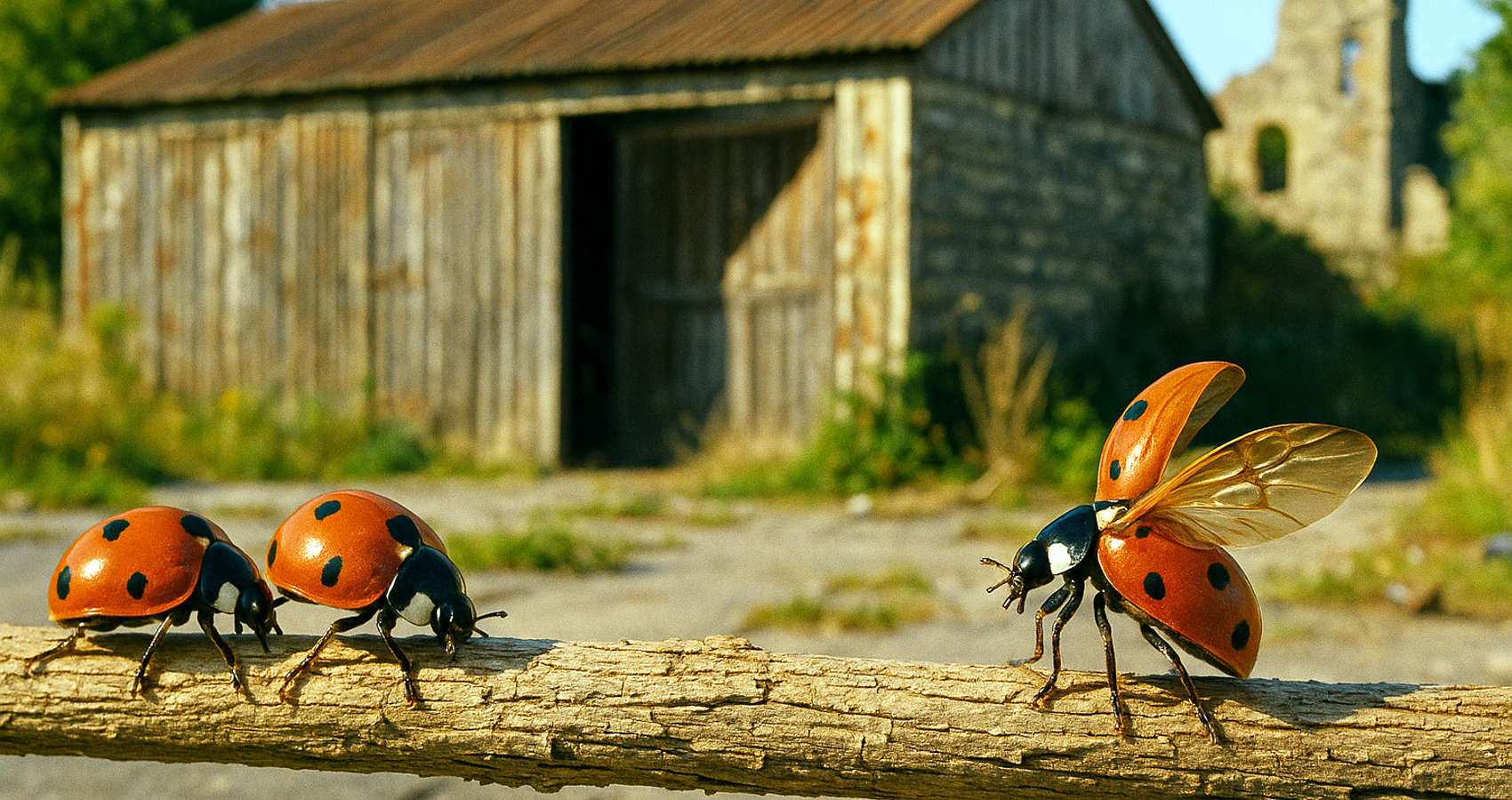
The school holidays continued. The summer pressed down, unrelenting. The news warned of more heat, more days without rain. Then, in a diversion from the daily reports of drought and hosepipe bans, the climactic conditions served up their most surprising course yet. The country suffered an ‘invasion’ of ladybirds on an almost Biblical scale. Suddenly, the seven-spotted flying creatures were everywhere, their bright red bodies covering the most unlikely surfaces. We watched the news on our TV in fascination, stunned by the footage of ladybird swarms at seaside towns we knew well; chuckling at the images of scantily-clad visitors on the beaches, batting the insects away in alarm, flailing arms desperately trying to hold on to ice-creams.
But the infestation wasn’t just confined to the coast.
“Michael! Down here, quick!”
I’d only just finished my breakfast one morning and was upstairs getting dressed. I hesitated, my pulse jumping. Had I left the garage door unlocked again? Trailed mud through the hallway? I pulled on my jeans and shot downstairs. But when I reached the doorstep, I saw why he’d really summoned me.
The Cortina’s bonnet was alive.
A shifting, glinting mass of red and black. Ladybirds. Thousands of them, packed so tightly together that their shells blurred into a rippling, living thing. The sun caught the curve of their backs, making the whole swarm shine like something molten.
Dad swore under his breath. “Have you ever seen anything like it? It’s a bloody plague, that’s what this weather’s brought.” He picked up a rag, gripping it like a weapon. “Stand back.”
He swept it across the bonnet, and suddenly the whole mass lifted.
A wave of tiny wings filled the air, a rustling so thick it was almost a roar. The light dimmed as they swirled around us, frantic, disoriented. I flinched as a few brushed my face, their tiny feet clinging for an instant before they were gone.
Dad grunted, brushing the last few stragglers from his sleeves. “Keep the doors and windows shut or they’ll be in the house next.” He wiped sweat and grease from his forehead. “Go on, get out of the sun.”
I nodded but didn’t move.
For a long time, I just stood there, staring at the empty space where they had been.
The heat pressed on, day after endless day. It felt like the town itself was suffocating, airless, under a sky too low.
Dad gave me a day off. Thankful for it, I used the opportunity to walk across town to meet Pete, my closest friend from school. We would be going to different secondary schools soon. We both knew things would inevitably change between us, but for that afternoon, those thoughts were forgotten, unmentioned. We continued to be soldiers, explorers, secret agents, bionic men, until, finally, laughter and the heavy, oppressive heat joined forces to exhaust us.
On the way back, tired, I took a shortcut, the canal towpath, though I knew I wasn’t supposed to.
The canal water was thick, sluggish, reflecting the sun in shattered pieces, thick green algae resembling floating manicured lawns covering it in parts. The path was empty except for a few crisp packets stuck in the weeds. I was halfway along, throwing the occasional stone into the stagnant water to watch the ripples dance, when I heard it. A whisper – a thin thread of thought that didn’t feel entirely mine.
Go back.
I stopped mid-step. The world around me held its breath, the buzz of insects fading to an unnatural quiet. A strange prickle ran up my spine, cold despite the heat. I shook my head, rubbed my arms, and walked on.
Then I saw him.
Shank Briscoe emerged from the bend ahead, his closely cropped red hair unmistakable. In his hand, he held a long stick with which he was beating and chopping at the parched vegetation petulantly as he walked.
Shank was bigger than me – bigger than most kids our age – and his presence was like a punch to the stomach. In the same class as me, he had made many of my days at Primary school a misery, zoning in on my illnesses like a moth to a flame, instinctively picking on my insecurities the way an animal can detect weakness in another. I had survived the only way I could – by learning to stay as much as possible under his radar. But this was always a fragile state of affairs. The relief I felt if he wasn’t picking on me was always tempered by the fact that, somewhere, I knew he would be enjoying the discomfort he was inflicting on someone else. It was the way he lived, the way he thrived. He had been the one person whom I had told myself I would be glad never to see again, as my classmates had said goodbye to each other on the final day of term.
I made to turn away, but it was too late. He had spotted me, his mouth curling into that familiar grin that made my gut lurch.
“Scabby Mike!” he called, his voice laced with mock friendliness.
My feet seemed rooted to the spot. In my mind, a distant humming noise was beginning.
Shank was on me in seconds, his fingers twisting the front of my T-shirt, pulling me closer. “You’re a long way from home, aren’t you? What are you doing out here? Shouldn’t you be home with your mummy?”
I stared at the ground, my throat too tight to answer.
“You look hot. Or maybe it’s just your scabby skin. Hard to tell.” He stared into my face, while with his other arm, he hit the stick he was holding repeatedly against the side of his leg. I was used to this kind of talk from him, and it didn’t bother me. At school, it had become almost like water off a duck’s back.
But this was worse. Here, now, we both knew one thing.
I couldn’t swim.
He dragged me toward the canal’s edge, my feet stumbling over the cracked concrete. “Let’s try cooling you down.”
He shoved me closer to the water. I could see the dark, slow-moving surface, the weeds tangled beneath like skeletal fingers. The hum deepened.
“No, Shank,” I croaked. “You know I can’t …”
The first ladybird landed on Shank’s cheek, small and red against his pale skin.
He slapped it away in irritation, but another took its place. Then another.
In seconds, they were everywhere – on his face, his arms, crawling into his hair, his ears. Shank dropped the stick he was holding and started swatting at the swarm with both hands, but it was futile. They poured over him like a living tide, their tiny bodies gleaming in the sunlight, covering his head, filling his mouth, his nose, his eyes. He cried out, but the sound was lost in the frantic rustle of tiny wings.
He stumbled, the mass of ladybirds shifting and shimmering on him like liquid. His foot slipped on the slimy edge, and he toppled into the canal.
The water swallowed him with a splash, and for a moment, there was silence.
Let him sink.
The voice, previously a whisper, surged inside me now, insistent and cold. I watched Shank’s arms flail in the water as he resurfaced. He was struggling. I could hear the thing from the garage, feel the darkness of its presence wrapping around me like a shadow.
He’s nothing. Let him go.
But then I thought of Mum, her voice soft and certain, the day she’d told me to use the shiver gently. I thought of her leaving the room whenever Dad laughed about my lucky escapes, of the way she looked at me sometimes like she knew something I didn’t.
The shiver ran through me now, colder and sharper than ever before, but this time I fought it.
I dropped to my knees at the edge of the canal and picked up the long stick Shank had discarded, stretching it out over the water as much as I dared towards his grasping hands. His fingers missed it a couple of times before finally closing round the end.
I braced and pulled with all the strength I had.
It felt like hours, but eventually, I dragged him to the bank. He lay there coughing, his face pale and streaked with dirt. On the canal, a small number of immobile ladybirds floated on the surface, but for the most part, they were gone, as if they’d never been there at all.
I sat back, trembling, the weight of the shiver receding.
Shank sat up. For a moment, he just stared at me. Then he scrambled away, shuddering, never looking back.
A minute slipped by. Then another. I sat motionless on the towpath, exhausted, staring blankly at the canal’s now-calm surface. Something sharp stung my face. Startled, I raised a hand to brush it away – then hesitated, frowning, as my fingers came away wet.
I looked up as the rain began to fall.
When I went to the garage the next day, it felt different. The air inside was still and empty, the shadows no longer heavy with presence. The thing at the back was gone, leaving only silence in its place.
A few days later, dad finally finished whatever he’d been doing to the car and, shortly after, the school holidays of that bizarre, intense summer drew to a distinctly soggy close.
I never did get that Raleigh Chopper.
The distance of years sometimes offers a platform from which to view the past with a sense of detachment. Now, years later, as I sit in my quiet house, fingers curled around a cooling cup of tea, the memory drifts through me, as it sometimes does, blurred at the edges but sharp at its core.
I’ve learned that many fears, often almost tangible in their intensity at the time, turn out to be baseless. A use of the keenest, focused mental energy for the end purpose of…nothing.
Secondary school proved not to be the nightmare I had anticipated. Oh, it had its moments right enough, and plenty of them – but somehow there had been a shift in my ability to face them.
Dad had taught me well. I did become an engineer – and a successful one at that. But some things have eluded me in life. No passionate love affairs. No long-term relationships. No children.
I think I would have liked to have children.
That summer was the last time. The last time the shiver had come in its full, terrible force.
And yet, even now, in the deep of the night, in the moments before sleep, I wonder – is it truly gone?
Or just waiting?
There’ve been other moments over the years. Just faint flickers of it. Once, when my car skidded on black ice and I struggled to regain control. Another time, when a man stepped too close behind me in a darkened street. Each time, a twinge of the hum, the shiver. A whisper of the thing that had once urged me to let Shank Briscoe drown. Small hints at the certainty that something, benign or otherwise, has been with me all my life, protecting me.
Or perhaps controlling me.
I have wondered, a great deal, where it came from.
Mum? Maybe.
She never spoke of it. Never said a word, but there were times when I caught her watching me, her eyes distant, seeing something I couldn’t. As if she knew more than she let on, but chose to keep it to herself.
I think about my parents often, both long gone, their voices reduced to echoes in my mind now. But it is to my mother that my memory constantly returns.
Did she possess it too?
Were her fears and anxieties ever made manifest in something inexplicable?
Did she find a way to silence it. Or did it simply…leave her?
And one day, when my own time ultimately comes and my body falters, when the darkness calls and I wish to answer, will it finally let me go?
Or, perhaps the most frightening prospect of all.
Will it stand between me and the end, as it always has?