

Calib and the Alchemy of Truth
written by: M.D. Smith
Calib Farrow, a quiet and intelligent university junior, lived a life of quiet ambition. He studied biochemistry at Malton University, spending most of his days buried in textbooks or assisting in the dim, cluttered lab of Dr. Thaddeus Watkins—a once-renowned chemist whose reclusive nature and bizarre experiments earned him the nickname “The Mad Molecule.”
Dr. Watkins was an eccentric with a bald head, tufts of wild white hair like startled cotton, and eyes magnified tenfold by thick-rimmed glasses. He shuffled like a specter among beakers and burners, muttering arcane formulas and talking to himself more than to any human.
One evening, Calib stumbled upon a hidden folder on Dr. Watkins’ computer titled “Genesis Protocol.” It contained formulas and logs that weren’t merely about chemistry—they detailed a way to biologically “edit” human nature itself. Greed, aggression, fear—all targeted like genetic code. Watkins claimed he had discovered “The Philosopher’s Toxin”—a serum to distill humanity to its “purest potential.”
Calib’s stomach turned. He confronted the doctor, but Watkins merely smiled, unnerved and too wide.
“Young man,” he said, “You stand on the edge of perfection. Join me to change mankind. The world has always failed because men let their nature run amok. But what if we could reshape man’s nature?”
Calib refused. “That’s not science. That’s tyranny in a test tube. I can’t be a part of that—sorry.”
The professor’s shiny dome turned red in anger. “Your loss.”
In his distress, Calib turned to Professor Anara Dey, a retired ethics professor and friend of his late mother. She listened intently, then told him of a time when Watkins was lauded for breakthroughs in cognitive medicine—but lost everything after a trial on lab animals went catastrophically wrong, like a stillborn puppy with no legs, but a paw growing out of its mouth.
“Knowledge without wisdom is poison,” she warned. “If he’s resumed those experiments, he must be stopped. You’re one of the few who’re close to him. You may have a chance.”
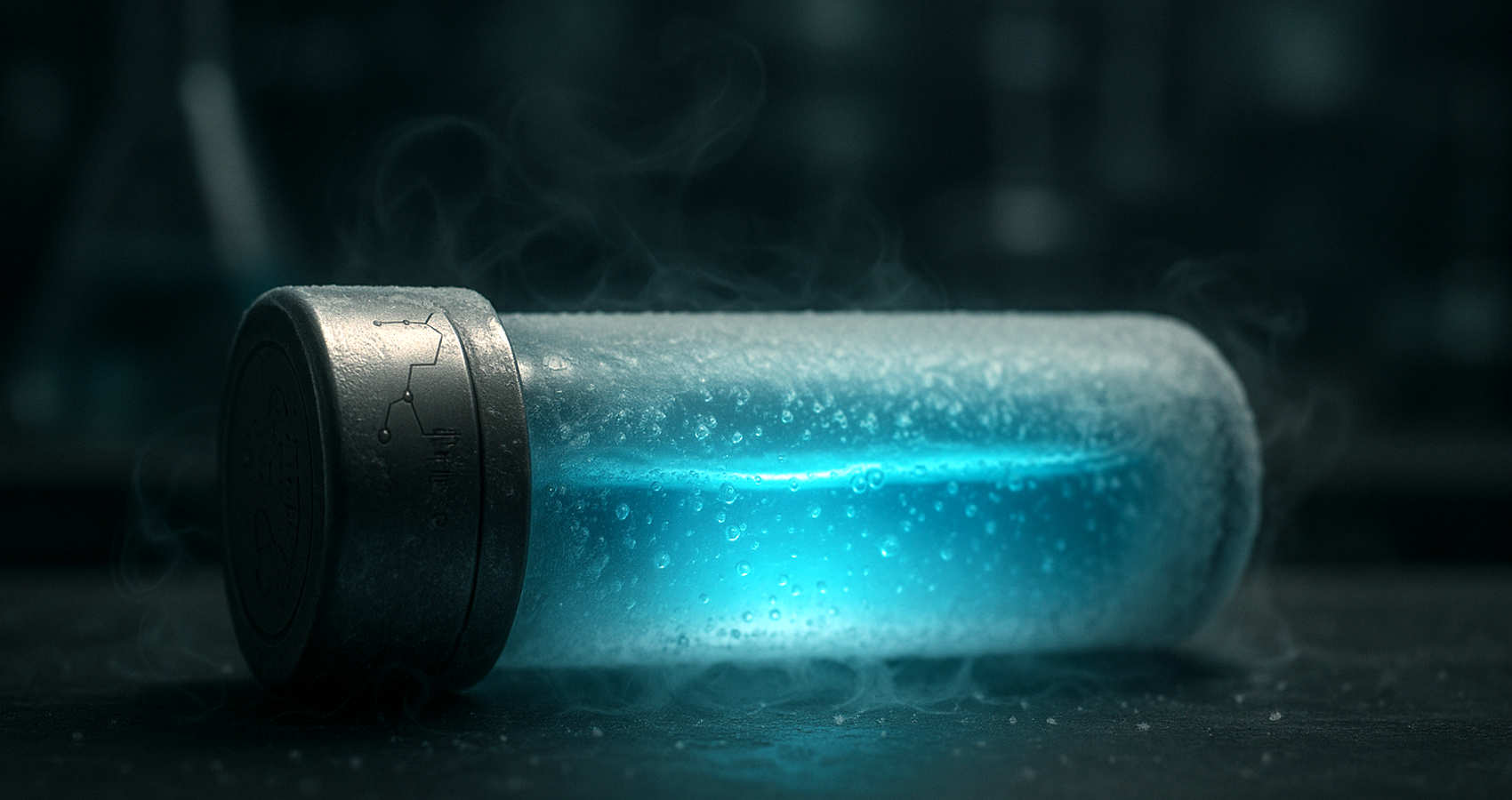
That night, Calib broke into the lab and stole the vial of the toxin—glowing faintly blue, sealed in cryogenic containment. He had to destroy it before Watkins could test it on human subjects, which the notes suggested would happen soon—very soon. He emptied the contents into the campus lake.
Watkins was furious when he found his creation gone.
Calib’s attempts to warn university authorities failed. The dean was in Watkins’ pocket, invested in the professor’s patents. He instructed others to watch Calib closely.
Calib found one friend in Marley—another lab tech who believed him and joined his mission.
They infiltrated Watkins’ private lab beneath the university’s science building, a lair of humming machines, glowing tanks, and security drones. There, they found documents and video footage: Watkins had begun human trials. Clearly, he had other vials of the formula.
They didn’t know there was a Ring camera alerting the professor on his phone. Watkins caught them.
“You naïve boy,” he hissed, revealing his final test subject: himself. He had injected the serum—“Purity Serum No. 7.”
But instead of the divine transformation he’d claimed, Watkins was deteriorating—mentally unraveling.
“I removed fear,” he laughed, “and now I see everything. I see the lines behind the atoms, the strings of cause and consequence. I have no remorse.”
A struggle ensued. Watkins unleashed his lab’s automated defenses. Marley was injured—acid on his arm and a slash on his leg. He screamed in pain, seeking water to wash off the aqua-regia.
Calib fought through burning equipment, nearly drowning in chemicals, some toxic, and finally—by using Watkins’ own magnetic containment fields—trapped the professor in a suspended field.
The feds sealed the lab. Calib handed the serum to federal bioethics authorities. Marley recovered, and Calib became a whistleblower and minor campus hero. Authorities dubbed Watkins mentally unfit and unbalanced, and confined him in a secure psychiatric facility. “The Mad Molecule” wouldn’t infect anyone.
But the journey weighed heavily on Calib. He struggled with his studies, wary of how easily knowledge could be misused. Marley stayed by him, becoming his best friend, encouraging him not to give up. Calib thought it was all over.
Months later, Calib began having strange dreams—memories that weren’t his. He began understanding formulas he had never studied. Words Watkins had said echoed in his mind.
He took a blood test.
His DNA had been altered.
In the chaos of the lab’s final fight—amid the chemicals, shards, and vapors—he’d been exposed to the serum after all. But unlike Watkins, Calib got a smaller dose and had been stable, moral, grounded. The serum had worked. It had enhanced—not corrupted—him.
Calib never told anyone. He resisted the desire to take more. Others would abuse it like any drug, always wanting to increase the effects.
He kept his change hidden, buried under a mask of normalcy. But he used his knowledge and growing capabilities to quietly guide scientific progress—not from a pedestal, but from the shadows.
People also noted, they no longer could catch fish in the campus lake—they were too smart to bite a hook. And someone swore they saw several bullfrogs strutting on their hind legs, hand in hand, before plunging into the water.
For the elixir Calib returned with was not power—but perspective. It was good being the head of the Department of Chemistry at the university. He could teach students what wasn’t in books.

- Calib and the Alchemy of Truth - October 3, 2025