

Denial
written by: Etya Krichmar
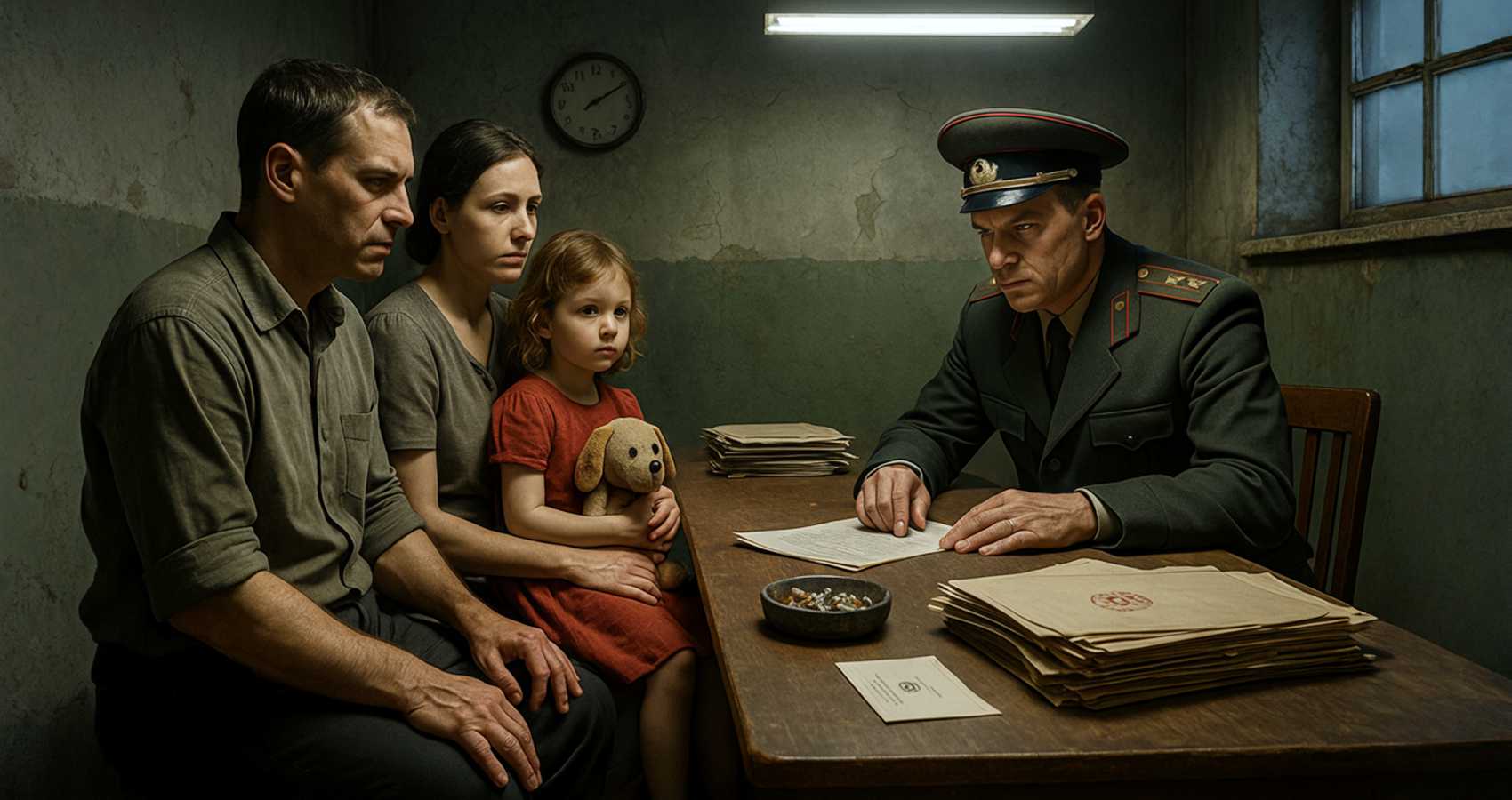
The room smelled like stale paper and tobacco, and the heavy scent curling around my nose refused to leave. The clock on the wall ticked loudly, slicing through the suffocating silence. My husband, Alexander, sat beside me, his shoulders tense, his hands gripping the edge of the wooden bench.
Our two-year-old daughter, Annushka, rested against my lap. Piff, her stuffed dog, dangled limply in her tiny hands. Her wide, curious eyes searched my face as if waiting for me to undo the invisible tension weighing down the room. The innocence on her face was a cruel contrast to the oppressive walls surrounding us.
The officer’s desk sat like a fortress in the room. Behind it, a young man in his early thirties, trained by the KGB and dressed in a sharply pressed uniform, leafed through our documents with agonizing sluggishness. His fingers, adorned with a thin gold ring, moved methodically, but I noticed a flicker of something in his expression, boredom, perhaps, or even a hint of discomfort. He hesitated briefly before resuming his slow inspection as if searching for something to say. It was a small crack in his otherwise impenetrable demeanor, but it vanished as quickly as it appeared.
“Do you know what this application means?” he finally asked, not looking up. His voice was cold and precise, like the snap of a whip.
“Yes,” I replied, my throat dry. My voice sounded foreign in the sterile space.
He looked at me then, his eyes sharp, his mouth a thin, unsmiling line. “You’re asking to abandon your homeland. To betray it.”
My heart raced, but I kept my face neutral. I had practiced this expression for weeks in the mirror, teaching myself to mask fear. To show fear was to lose.
“We’re asking for the opportunity to live elsewhere,” I said carefully. My words felt like eggshells cracking beneath my tongue.
“Elsewhere,” he repeated as if the word amused him. He closed the folder and leaned back in his chair, studying me with a predator’s gaze. “And what has this country denied you? Why do you feel entitled to leave?”
The words stabbed at my composure, but I kept calm.
Alexander cleared his throat, his voice steadier than mine. “We want a better future for our daughter. A place where she could grow up without discrimination. A place where her opportunities won’t be limited because of her ancestry, where she could be free.”
The officer’s gaze shifted to my husband, his eyes narrowing. “You’ve enjoyed an education, a job, a roof over your head, have you not? And now you want to spit in the face of the state that has given you all this?”
His words hung in the air, sharp and accusatory. My husband didn’t flinch, but I could see the strain in his expression, how his jaw tightened, and how his hands gripped the arms of the chair. Beside me, Annushka shifted, clutching Piff tighter against her chest. Her little fingers dug into the fabric of the stuffed dog, her wide eyes darting between me and the officer. I placed a hand on her back, trying to steady her and myself. The silence was unbearable. I felt a surge of anger hotter than my fear rising.
“Education?” I blurted out before I could stop myself. “The committee denied me admittance to the university not because I wasn’t qualified, but because I was Jewish.”
As if on cue, Alexander opened his mouth and said, “Roof over our heads? We have been married for three years, and still living with my parents? Is this what you are referring to?” He inhaled and said, “I bled for this country at the Afghan border. And this is the gratitude we receive?”
Alexander’s jaw tightened, and his frustration was visible in every tense line of his face. I touched his arm lightly, a silent plea for calm, and he exhaled slowly, steadying himself.
The officer leaned back, his smirk fading into an expression of disinterest as though we were no more than a minor irritation. The air in the room grew heavier, pressing against my chest as though daring me to fight.
“Do you understand what this application means for your family? Your parents and siblings will all be labeled traitors and enemies of the people, bearing that shame.”
For the briefest moment, his eyes flicked downward, and his voice faltered, just slightly, as though the weight of his words hung heavily in the air. But when he looked up again, his cold expression returned, sharper and more calculated than before.
His words hit like punches. Annushka stirred on my lap, clutching at my sleeve, her wide eyes searching mine for reassurance. I adjusted her in my arms, brushing a stray curl from her forehead as if the gesture might shield her from the weight of his words.
I thought of Mama’s weary face, etched with years of hardship. “They’ll make your life impossible,” she had said, clutching my hands as if trying to anchor me to this soil.
“We understand,” I said softly, though the weight of his words felt unbearable.
The officer sat back, seemingly bored now. He opened the folder again, flipping through it as if searching for something.
“We’ll process your application, eventually, but don’t hold your breath,” he said, his tone dismissive.
The room tilted slightly, and it took everything in me to stay upright. It wasn’t a yes. It wasn’t a no. It was limbo, a denial of certainty.
“We’re done here,” he added, waving us off like we were nothing more than an inconvenience.
Alexander stood first, his movements stiff. I followed, cradling Annushka, who had been quiet throughout the ordeal. As we exited the office and into the dimly lit hallway, the air felt no lighter. If anything, it pressed even harder.
We walked in silence. The gray sky hung heavy, mirroring the rejection already taking root in my body. The streets of Kishinev stretched before us, familiar yet foreign, as though they, too, were rejecting us.
When we reached home, the silence between my husband and me broke. He paced the room, his anger radiating with every step. “They’re playing with us,” he spat. “Keeping us in this purgatory to remind us who’s in control.”
I sat on the worn sofa, holding Annushka close. “They didn’t say no,” I offered weakly, though the words felt hollow. Deep in my heart, I already knew.
“They didn’t say yes either.” His voice was sharp, cutting through the fragile hope I was trying to cling to.
For days, the waiting consumed us. Every knock at the door, every phone call, sent my pulse racing. I tried to keep busy, cooking meals I had no appetite for and cleaning a home that felt smaller with each passing hour. Alexander buried himself in his work, though the frustration etched into his face betrayed the futility of his distraction.
One evening, as I put Annushka to bed, she looked up at me with wide, innocent eyes and asked, “Mama, when are we going to the new place?”
My throat tightened. “Soon, my love,” I whispered, kissing her forehead. “Very soon.”
But I didn’t know if that was true. The uncertainty gnawed at me, turning every moment into a battle between hope and despair.
Weeks later, the letter arrived. The envelope bore the KGB insignia, its mere presence on our kitchen table a threat. Alexander opened it with trembling hands, scanning the paper with his eyes.
“Denied,” he said, his voice flat. He dropped the letter as though it burned him and walked away.
I picked it up, reading the cold, bureaucratic language that sealed our fate. The authoritarian government rejected our application to leave the USSR. No reason was given, and there was no avenue for appeal. It’s just a definitive “no.”
Tears blurred my vision as I clutched the letter to my chest. I thought of Annushka, asleep in her crib, her tiny body safe, but her future still shackled to this place. The KGB officer’s sneer echoed in my mind, the weight of his words pressing like chains. But as despair curled its claws around me, a memory surfaced: Annushka’s first cry, the day I promised her a life without fear.
Holding the letter, something deeper stirred in me—a defiance. At that moment, I knew that no matter how many times they could deny us, nothing would stop me from refusing them to define our future. We would try again. And again, however long it took, whatever sacrifices it demanded, we would find a way out for me to fulfill my promise.
This vow burned brighter than my despair, igniting a resolve no denial could extinguish. It was not the end. It sparked a new beginning—a first step in our search for freedom. We would fight for Annushka and our future. And no denial could extinguish this resolve.

- The Last Supper - February 12, 2026
- Denial - September 24, 2025
- A Journey Through Monet’s Water Lilies - May 25, 2025