

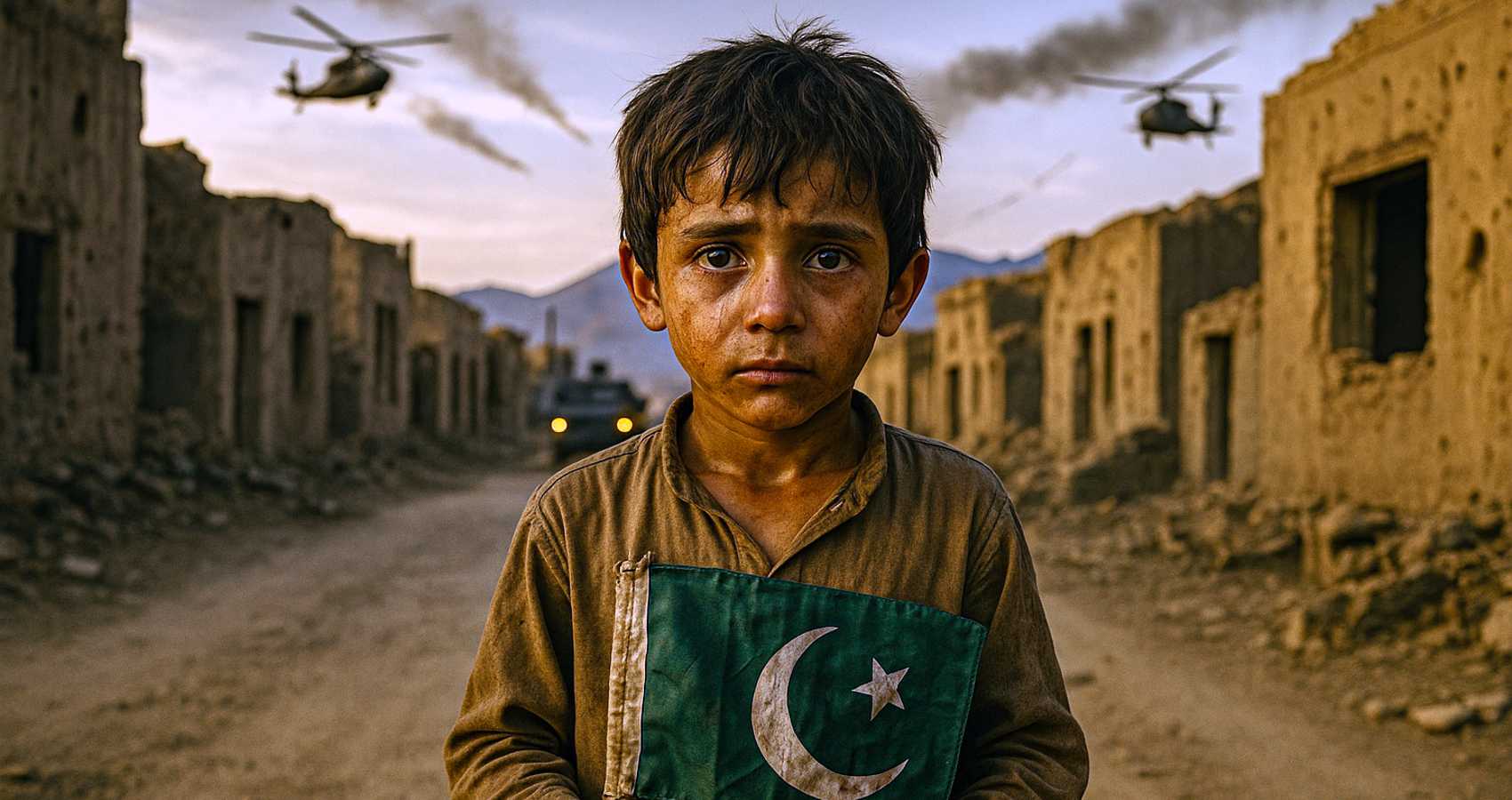
Dusk in the Valley of Shadows
written by: Imran Zarif
It was a sweltering Thursday afternoon in July when Wadaan, weary from a long school day, made his way home at sharp 2 PM. The relentless sun bore down upon him, its rays piercing his skin, forcing him to place his heavy school bag atop his head with both hands in a futile attempt to shield himself from the oppressive heat. The streets were deserted, as most sought refuge in their homes for their midday nap, a common habit during the intense summer months. As Wadaan turned from the main road to the first street towards his home, he heard two elderly men speaking in hushed tones. “The Taliban,” one said gravely, “have spread throughout the district. They’re planning to bomb schools and madrasas.”
The words sent a shiver down Wadaan’s spine. His heart pounded, and without a second thought, he bolted toward home. Fear gnawed at him as his small feet pounded against the dusty path. Upon arriving, he rushed to his mother, his voice trembling as he relayed what he had overheard. His mother herself remained resilient, reassured him, made him stay calm. “There’s no need to worry, beta,” she said softly. “These are just rumors. Be cautious, but do not let fear consume you. Stay home for now, and we will see what happens.” Wadaan sat at the table, beginning to eat his lunch. His mother remained nearby, sitting on the edge of the sofa, her mind troubled despite her reassuring words.
“Wadaan beta, you will not go to school for the next two days,” she said suddenly.
“But why, Ami?” Wadaan asked with a pain in his voice. “Is it true then, what they said about Taliban?”
“No, beta, God forbid. I just want to make sure these rumors are baseless before sending you school,” she replied, her voice steady but tinged with worry.
“Okay, Ami,” Wadaan furthered with a deep sigh. “But if I do not go, who will take my place at the assembly? Who will sing the national anthem?”
His mother pulled him close, enveloping him in a tight embrace. She remained silent and said nothing, but Wadaan felt her quiet tears—tears of fear, of love, and of a pain she could not voice. The uncertainty of the world outside crept into their home, yet in that silent hug, she held onto the hope that her child would remain safe.
***
On Monday, Wadaan’s elder brother dropped him off in front of the school so that he could restart his normal school routine. It was around noon when Wadaan and all the children were enjoying their break in school. A group of police officers entered the school and went directly to the principal’s office. Some students asked the guard what was happening. “The police received a report of a bomb in the school,” the guard said solemnly.
The news spread among students like fire. Fear spread to every corner of the school. Students started crying and running, but they had no idea where to go. Some of them went to their classes to lie down behind the chair, some went to the washrooms to be safe, and some rushed to the gate so they could escape from the school. Wadaan, frozen with fear, sat on the floor in a corner of the classroom, huddled together with his classmates. His small face was drenched completely with tears and sweat, his heart pounding wildly in his chest. Moments later, a tall police officer with a stern face and thick mustache entered the classroom. His voice boomed over the panicked cries of the children. “Go home! All of you, go home quickly!”
Wadaan did not need to be told twice. He rushed out of the school, running as fast as he could. His cheeks were wet with tears, and his breath came in panicked gasps. As he was running, he saw a heart-wrenching sight: mothers and sisters of the students, who had always remained behind the veil of tradition, barefoot and in a frantic rush, were running toward the school, wailing the names of their children. These were the women who never left their homes without wearing the full “burqa.” Here, without thinking of anything else, they rushed to reach their loved ones.
As Wadaan reached home, his heart was still racing. He found his mother, and without a word, he went into his mother’s arms. The fear that had built up inside them was now pouring out in the shape of tears. Suddenly, an ear-splitting sound ripped through the air, an explosion so powerful that it shook the ground beneath them and rattled the walls of their home. It was a bomb blast near Wadaan’s school. The blast shocked the family, screaming and crying in terror. The entire neighborhood was consumed by fear as people cried out, unsure of what would come next.
A thick blanket of fear descended over the region. Parents isolated their children indoors, afraid to send them back to school. The once-vibrant streets fell eerily silent, as uncertainty gripped the hearts of every family. The people of the district, innocent and unaware, did not understand who these “Taliban” were or why they had brought such violence to their land. All they could do was pray for safety, for peace, for their children’s futures.
By the next day, the Pakistan Army took control of the area, their presence offered a hope for the people. But for Wadaan and his family, the damage of that day ran deep. The echoes of fear and uncertainty remained, even as soldiers patrolled the streets, ensuring the protection of a people who only sought the return of peace to their once quiet corner of the world. An announcement was made through the mosque loudspeakers, cutting through the stillness of the early morning. “All schools will remain closed from today onward,” the voice declared. “At night, no one is to turn on their lights—not even for a second.” The message was suffocating.
With electricity now a danger, people resorted to lighting their homes with candles, their dim glow casting long shadows on the walls. It seemed from no angle the 21st century for them. Each family chose one or two members to stand guard at night, keeping their eyes open to avoid any attack on the home.
People were greeted every morning by the sight of 20 to 25 helicopters hovering above their village. The ground seemed to vibrate with the hum of their engines, sending ripples of panic through the already strained hearts of the villagers. From morning until evening, these helicopters circled endlessly, casting long, foreboding shadows over the town. The sky itself was looking like an enemy, spreading terror with each pass. The once familiar sounds of daily life—children laughing, women chatting—were now replaced by the incessant drone of military machinery, a constant reminder of the unseen threat looming just beyond their reach.
***
In August, the people began fleeing, desperate to escape the violence that had made its roots stronger in their once peaceful land. Wadaan’s family, too, made the difficult decision to leave their motherland. They owned a buffalo and two goats, but they had grown weak from the lack of food, as it was far too dangerous for people to venture out into the fields. Wadaan’s family, like so many others, had to sell their livestock at a fraction of their value. The fields that once sustained them now seemed as perilous as the battlefields. Wadaan’s family decided to escape at noon from there. But on the same morning, some news came of a family who had been targeted by a drone strike while fleeing. Small children, the elderly, men, and women were all reduced to ashes. The terrifying news sent waves of fear through Wadaan’s family, causing them to delay their departure.
A few people, including Wadaan’s relatives, were killed in bomb blasts. Their families never saw their faces, not even their dead bodies. They were left with nothing to bury—only fragments, a ring, a shoe, or a piece of clothing remained.
In the second week of August, with hearts full of sorrow, Wadaan’s family finally left their home. Everything they held dear was packed into a small pickup truck, mattresses laid on top for seating. As they drove away, Wadaan’s wide, tear-filled eyes saw the tanks that lined the roads, military vehicles staffed by hundreds of soldiers in the very streets where he once walked to school without a trace of fear. The peaceful roads of his childhood had become the domain of war.
As they crossed the borders of their district, they were greeted by kind-hearted Pakhtun people who offered food to every migrating family. Eventually, they reached Haripur, the last district of Khyber Pakhtunkhwa, near Punjab. Here, they found temporary shelter in the home of a local family, but after six days, they were asked to leave. The entire area was saturated with refugees, and finding a place to stay seemed impossible. With nowhere else to turn, they took up residence in a local government girls’ school, temporarily vacant for the summer break.
On the night of the 13th of August, the family lay on the floor of the empty school, the exhaustion of their long journey finally allowing them to sleep peacefully. Wadaan’s mother, however, lay awake beside her children, her thoughts consumed with worry. She missed her parents, her siblings, and the life that seemed to have slipped away without warning.
As the clock struck midnight, the sky above them burst into life, filled with the dazzling colors of fireworks. It was the 14th of August—Independence Day, a celebration of freedom and nationhood. The contrast between the joy of the celebration and the despair in Wadaan’s mother’s heart was painful. She stepped quietly out of the classroom, leaving her children peacefully asleep on the floor behind her. The night sky was aglow with bursts of fireworks, their brilliance reflecting in her tearful eyes. She was looking at the colorful sky when her thoughts drifted back to the days when she and her family used to celebrate this night, just like the people now doing so outside. It felt like a lifetime ago, a world removed from the one she was now living in.
Suddenly, a piercing cry from inside the room shattered her thoughts. Wadaan was calling for her, his voice was filled with fear. She ran back, finding him wide-eyed and trembling, his small body shaking as he clung to her. “Ami,” he sobbed, “someone attacked our home and fired on us.” She wrapped her arms around him, her voice soft and soothing.
“No, beta,” she whispered, “it’s not firing. It is 14th August. People are celebrating Independence Day. The sounds you hear are fireworks, not gunfire.”
Wadaan’s fear melted away as quickly as it had come, replaced with excitement. Wiping his tears, he looked up at his mother with wide eyes. “Ami, did you bring my Independence Day dress?”
His mother smiled gently, stroking his hair. “No, I forgot it in the hurry to leave, but I have good news for you.”
Wadaan’s eyes lit up, his fear now fully transformed into anticipation. “What is it, Ami?” he asked eagerly.
“There’s a big festival tomorrow at the boys’ school nearby,” she said with a warm smile. “They’ll be celebrating Independence Day with a lot of excitement.”
Wadaan’s face brightened instantly. “Ami, I’m going to participate in the festival! I will celebrate Independence Day!” He declared with newfound determination, his earlier fear now fully gone.
His mother kissed his forehead, her heart aching with love and hope. “Okay, beta. Now off to sleep. Sweet dreams.”
As Wadaan lay back down, his excitement for the next day made the dark, unsettling events of the past few days seem distant. His mother watched over him, knowing the weight of the world would return soon enough, but for tonight, she let him dream in peace.
***
Wadaan, usually slow to rise in the morning, wakes with uncharacteristic eagerness. Despite everything, the spirit of the day pulled him from his bed. He quickly dressed, ready for the day’s event. After breakfast, Wadaan and his mother left their temporary home and headed toward the boys’ school, where a grand Independence Day festival was to be held. In the streets, everyone was incredibly happy, children waving flags with enthusiasm in their hands, their faces shining with the happiness of celebration. The festival began with the national anthem and recitation of Tilawat-e-Quran. As the festivities continued, Wadaan’s mother approached the event host and requested him to give some minutes to Wadaan to sing a ‘Mili-Naghma.’ In the final half hour of the event, Wadaan walked onto the stage. His small frame seemed dwarfed by the weight of the moment, but his innocent and patriotic words filled the air.
“My name is Wadaan,” he began, his voice steady, “and I am a proud citizen of my beloved country, Pakistan. I belong to one of the most beautiful districts of Pakistan, known as the Switzerland of Pakistan. I am here in front of you and celebrating Independence Day in a different district because of ‘Taliban.’ They have attacked our beautiful Swat and have transformed it into a battleground. We, the people of Swat, do not know who these Taliban are and what they want. We do not know why they have always targeted us, the Pakhtun tribes
System: and not others. We do not even know if they are really ‘Taliban’ or if there are other people behind it.” His voice grew louder and more impassioned. “Even after all this, I still do not love my country the way it deserves to be loved. Because, despite everything, it has given me so much.” Tears welled up in his eyes, but he wiped them away with his arm.
“A country is never brutal for its people, but it’s the mindset which runs it,” Wadaan concluded with a deep pain in his voice.
With that, he began singing the ‘Mili-Naghma.’ His tears were continuously dropping down on his small face, but he continued. As he reached these lines…
یہ زمین مقدس ہے، ماں کے پیار کی صورت
میں تم سب ہو، برگ و بار کی صورت
He stopped and ran off the stage into his mother’s arms, who was sitting in the second row among the other women of the town. The audience, deeply moved, stood in applause, their own eyes brimming with tears.
Every family had left a member of the family behind them in Swat to care for their home, fields, and livestock. Among them was Lmar, Wadaan’s elder brother.
Lmar was a 22-year-old, tall, handsome boy with green eyes and long reddish hair. It was a dark night with no light on in the whole village. Lmar lit up the last cigarette of the packet and sat on the stairs of their home in Swat. He was worried about his family, whether they were fine or not. Lmar had not heard from his family in weeks due to the signal outages. As he crushed the cigarette under his slipper, his Nokia phone suddenly beeped—the signal had returned for a few moments. He rushed towards the phone, with trembling hands, dialed his mother’s number.
“Asalam o alaikum, ami!” he said with relief in his voice.
“Walaikom asalam, beta! How are you?” His mother answered, looking up at the sky with tears in her eyes.
Despite everything, Lmar put on a brave face. “I am colorful, Ami. How are Wadaan and Rishma?”
“They are fine, mera bacha. Do not think about us, we are fine. Take care of your health and try not to go outside without necessity. Offer Salah regularly and pray for peace,” his mother said, her voice heavy with unspoken fears.
“I will, Ami. I am fine, do not worry. I wanted to—” His words were cut off as the signal dropped again. Lmar tried repeatedly, but it did not deliver. Lmar wished that he had had some words with Wadaan as well. He sighed, telling himself he would speak to Wadaan next time. But he was unaware that it would be his last conversation with his family, and he would never hear their voice again.
***
Months passed, and slowly, news came that the Army had cleared the region of Taliban, and everything was normal now. Families began returning to Swat. Lmar was also one of those hundreds of young men awaiting the arrival of their loved ones. They had no contact with their parents as the network was still down. The road was completely packed with people. Families were greeting and looking at each other with wide eyes and heartfelt smiles, like a meeting after the death.
Lmar saw Wadaan standing in a pickup and looking out for him. Lmar was still at a long distance from them, climbed onto the roof of a car, and waved. Wadaan saw him and immediately called his mother’s attention to Lmar. As Wadaan’s mother turned to look at Lmar, a sudden panic gripped the crowd. People began screaming, “Bomb! Bomb! Bomb!” Lmar lost his footing and fell from the car.
His mother did not understand what had just happened and was looking for Lmar. After a few seconds, an ear-splitting explosion tore through the air. The blast sent people flying, bodies tumbling like rag dolls, the streets soaked in blood. Wadaan’s mother rushed toward thick black smoke, screaming her son’s name with a loud cry, “Lmar! Lmar, where are you? Lmar mera bacha, please! Lmaaaar, say you are here, please. I will die. I will die without you, Lmar, Lmaaaar…” Her voice broke with each cry, her heart shattered beyond repair. She fell to the ground, her face streaked with tears and grief. In the chaos, her heart finally gave out, and her eyes remained wide open toward the sky.
Wadaan and Rishma watched in horror as their mother and brother were both taken from them in an instant. They both were in a coma for a month. When Wadaan finally woke, he was no longer the same boy. He withdrew from the world. Wadaan never went to school after that day. He sought refuge in the mountains, far from people, where he lived in isolation. That sweetheart of his family turned to someone unafraid of death, sleeping in the open sky in the lap of the mountain, living without people. Life was now meaningless for Wadaan as he was counting days and nights and waiting for his death.
Years later, Wadaan’s skeletal remains were found in a cave. Most of his body was consumed by birds and insects. It remains a popular claim to date that Wadaan had written a book with a title “The Secret behind Taliban,” believed to expose the identity of those behind the terrorism. It is said that the book revealed critical details about the real forces orchestrating the violence. But to this day, that manuscript is missing and has never been found. No one knows who took it and where it is…

- Dusk in the Valley of Shadows - September 25, 2025