

Junior
written by: Andrew Buckner
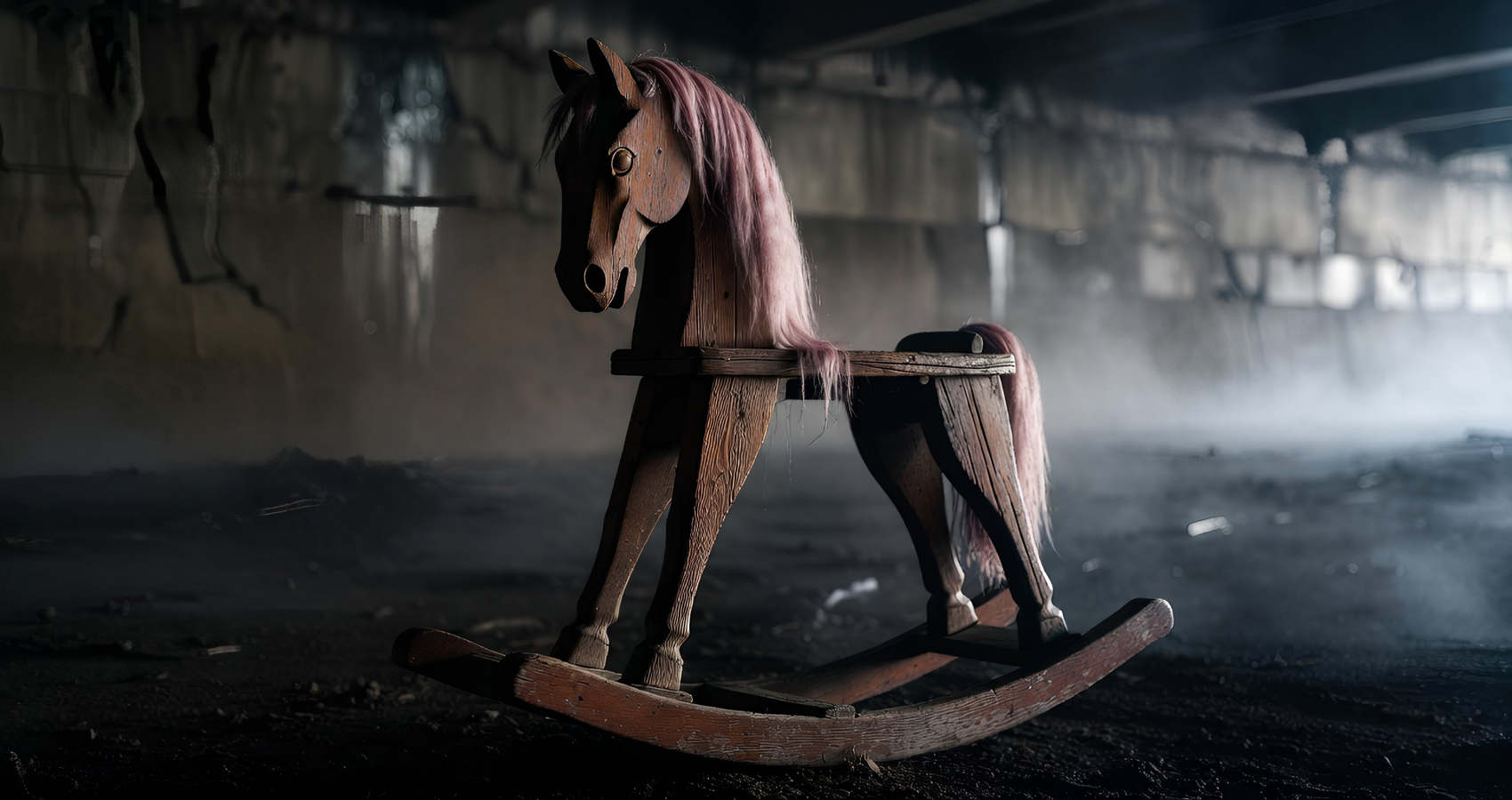
As soon as the clock turned to 1:13 a.m. on the fog-drenched, unusually summery night of October 15th, 2025, the digital compass on the dashboard of forty-two-year-old Byron Blake’s red 2019 Chevy Sonic cracked in synchronicity with the unexpected popping of the right passenger tire of the vehicle. Forced to quickly park off to the left side of the road, near a bridge-like underpass that Byron didn’t remember being in this labyrinthine section of I-80, the sleep-deprived blue of Byron’s crimson-cracked eyes was immediately drawn to the rhythmic sway of a rocking horse in the darkest recesses of the underpass. With his mouth suddenly dry, his tongue desperately roaming around the parched area to give it a temporary bout of moisture, and his heart galloping in his chest, Byron forgot his car problems. Mesmerized by the sight of the familiar children’s toy, he slowly trudged towards the still-moving object.
“Junior,” Byron wanted to cry out as he cautiously inched towards the creaking rocking horse.
Visions of Byron Blake, Jr. receiving the rocking horse with the pink mane and the soon missing right eye, which Blake, Jr. inexplicably named “Bernie”, from his grandparents, then sixty-six-year-old Jamie and Jenny Blake, on his first birthday, painfully erupted in Byron’s brain.
Byron clutched his heart and fought back tears in response. Then, the anguish stemming from Byron’s core exploded as he thought back to Thursday, September 4th, 2014 at 7:34 a.m. when he nervously cut the umbilical cord, the source of sustenance which connected Blake, Jr. to his mother, Julie Oglesby, whom Byron never had the courage to make his wife despite their decades-long courtship, and for the first time ever held the seven-pound, moppy-haired wonder, a red-faced ball of flailing hands and delicate flesh, in his arms.
As the memories played before Byron, he realized two things. The first was that somewhere along his slow walk to Junior’s rocking horse, he had stopped moving. He had even started to back away from the familiar object. The second recognition was that these remembrances of Junior weren’t just moving through his mind. They were being showcased, as if they were a reel of celluloid in a film projector, onto Bernie, who, for the moment, had stopped swaying.
When Byron caught his breath, completely ignoring the fact that his exhalations were being released from his mouth in visible plumes, and started to slowly tread towards the toy again, he noticed that most of the recollected images he was seeing were being reflected in the hollow space that was once Bernie’s missing right eye.
He also noticed that he was getting more frigid the deeper he went into the underpass.
Byron even, inexplicably, thought he felt and saw bits of snow dropping onto his right hand and the sleeve of the red Ecko hoodie he was wearing.
It is in this moment of awkward awareness that Byron gasped and stopped moving again.
Something, perhaps a hand, reached from the cavernous blackness of the underpass. It swiftly, unexpectedly pulled out a glistening bottle from the mid-section of the rocking horse. Before Byron could understand what he was seeing and what it represented, the fast-moving extremity, which was filled with maggots and blood-drenched flesh, rolled the container towards Byron. It landed under the tip of Byron’s black Nike sneakers with an almost inaudible thud. Byron didn’t need to look at the label of the golden object to know that it said Charlie’s Own Hard Tea on the front.
“You know nothing,” Byron cried out at whoever had tossed the bottle his way. “That is a baseless accusation. I never touched a drop in my life.”
In response, the ever-quick, hard to discern hand reached again into the middle of the rocking horse. It then, rapidly, threw a knife with spots of blood on it towards Byron. This also landed quietly near his sneakers.
“You did this,” Byron screamed so loudly that he could feel the veins branching out in his neck. “Whoever you are, you were the one who made my son disappear!”
“No,” a guttural, raspy voice echoed from somewhere near the arm. “I am a manifestation of your guilt for being cowardly your whole life and for never pursuing what happened to your son further. You know, he would’ve been eleven last month. That is a whole decade of grief eating at you.”
From somewhere above the impenetrable darkness near the rocking horse, a set of teeth, wolf-like and caked in dried gore, bit at the air three times. Then, as soon as they were seen, the clacking incisors disappeared.
As an effect of the trio of chomps, three bites hit Byron so quickly that he barely realized, at first, that they had occurred. One bite landed on the right side of his neck. The other two hit him in his chest. It was right by his heart. Doubling over from the sudden and unexpected pain, Byron put a hand to his neck, felt the cold fluid of his own blood, brought it to his eyes, and growled at the seemingly supernatural creature that claimed to be his own grief.
Then, inexplicably, Byron’s eyes caught a flash of something. It was the rocking horse, teeth exposed in an exaggerated and almost animated grimace, as if it were growling back at him.
Byron then realized that the voice wasn’t coming from the creature of grief. It was coming from the rocking horse.
“I am everywhere,” the voice of the creature of grief sounded from deep into the depths of the underpass. “I am here,” it sounded from the sky. “I am there,” it said from somewhere below his feet. Then, most chillingly, it screeched out, “I am everywhere,” from right behind Byron’s ear.
This sudden sound made Byron gasp and turn around.
No one was there.
From Byron’s vehicle, the headlights unexpectedly turned on, and the vehicle roared to life. In the next few moments, Byron saw two things that were surprising to him. The first was that he had an electronic compass that was seemingly stitched into the fleshy folds of his right hand. The second was that there appeared to be someone in the driver’s side of Byron’s rundown automobile.
Initially, as Byron cautiously stepped nearer the shadowy individual inside his car to get a better look at who or what it may be, Byron believed he was somehow seeing a doppelganger of himself.
“This would make sense if the creature that is my grief, if that actually is who or what it is, wants me to really find out what happened to my son,” Byron pondered. “Julie was in my car at the time when I called her and told her that Junior had gone missing.”
“No,” the creature of grief hissed. This time, it sounded like it was speaking from within Byron. “I will not show you. You must find the truth of yourself and of the event. You must find out the ‘why’ of it all. You put this off for over a decade. Your time to hide is no more. You must come out into the light, dear Byron. Hiding solves nothing. You and I, we all need to know who you really are and what you are really made of before the compass cracks and stops pointing in one direction and your time permanently runs out.”
As if motivated by the words from the creature, the compass in Byron’s hand exploded in light. That is when he saw the eleven-year-old version of Junior, looking just like he would if he had never disappeared, sitting in the front seat of Byron’s vehicle.
Running towards Junior with fresh tears sprinkling down his cheeks, the vehicle then bounded towards the darkness of the underpass. As soon as the car sped past the rocking horse, it disappeared.
Automatically, Byron peered down towards his palm, saw that the compass that was now a permanent fixture of his hand was pointing towards the darkness, and, without thinking, ran into the blinding black fog of the underpass.
Eerily familiar eyes followed Byron as he ran into the darkness, which continued to be so heavy that he couldn’t make out anything either in front of or surrounding him. He didn’t need to know anything more about these strangely chummy eyes that were pursuing him to understand that they were the glowing, crimson irises of the ever-watching creature of Byron’s grief.
“You must walk through the total darkness that now surrounds you in blind faith for both yourself and for those around you, like you did throughout your life,” the creature of grief cackled as if it were standing shoulder-to-shoulder with Byron. Then it stated, as if going to another topic entirely, “Junior’s disappearance isn’t just a mystery from your life. It is a question of both our existence and of our fundamental nature.”
“How is a disappearance philosophical,” Byron screamed at the creature. He immediately regretted it.
“We all disappear. Why do some disappear sooner than later? Is the meaning of life to simply disappear?”
“This is my child you are talking about,” Byron shouted.
His voice echoed madly off the cavernous walls of the wintry underpass as Byron and the creature trudged deeper into it together.
“Mowing on Mondays. Taking the trash out on Tuesdays. Sweeping and dusting the house on Wednesdays. The habitual cleaning of the cat litter twice a day. Making sure that the shelves of your house are stocked full of food, that is, since your should’ve-been-wife, Julie, left you several weeks after the incident with your son, and that is all that is left now of your tiny, crumbling, insignificant world, so that you have everything you need in case of any type of unexpected emergency. The panic attacks. The anxiety that you attribute to a midlife crisis. The anxiety you and your neurologist foolishly think is caused by a B-12 deficiency. It’s all caused by Junior’s disappearance. We all disappear eventually. Such is life.”
“If you know where he went, tell me,” Byron shrieked.
No response.
They continued walking. The more they did this, the colder it got.
“Hell isn’t fire and brimstone,” Byron found himself thinking as he went deeper into the underpass. “It’s an endless winter.”
“None of life’s answers come that easily. That is, if they come at all. Maybe you disappeared, and you didn’t know it. Maybe he has been looking for you this whole time. Would any of us know if we just disappeared?”
“Is our purpose simply to disappear?”
“Then why live?”
“Are we alive? If we are, what do you call those who are breathing, those of us who check all the boxes of being ‘physically there’, but leave no visible trace that they were here when they actually disappear into tiny coffins? What about the people who live their physical life like ghosts and do not leave any art, children, or anything to signify a physical existence behind after their death? What about those who are simply content to just work, pay bills, and die, like the majority of the populace? Are they ever truly alive?”
“That isn’t life.”
“Maybe not by your definition. All eyes cast different perceptions. ‘Tis why one word cannot have a single definition.”
There was something noticeably different about these last words that the creature of grief uttered. It made Byron think of Julie and the odd, increasingly accusatory behavior she cast towards him in the short time before Junior’s disappearance.
Suddenly, Byron’s mind went to another place, one outside of the mysteries of life and the disappearance of his son. It was a place as dark as the underpass through which he was ever so carefully trudging in that moment. It was a place that contained some of Byron’s angriest recollections. It was a place where the well of love, the one which sprang to eventual hatred from the fifteen years he spent with Julie, resided.
“Are you sure you’re not an alcoholic,” he still remembers hearing Julie unexpectedly spit out on that otherwise indiscernible Wednesday night all those years ago in 2014, when Junior was only a few months old, and Byron’s anxiety from working full-time and taking care of a newborn was starting to come out of him in unexpected bouts of short-tempered rage.
She had asked this otherwise simple question several times beforehand. Nonetheless, there was something about that night that still crawled up his skin, gave him goosebumps, and made him bite down on his tongue to quell the merciless, Arctic blizzard of disgust that was released from Byron every time he thought about the incident.
He remembered this question, which came from Byron taking a bottle of Charlie’s Own Hard Tea out of the refrigerator and walking into the living room with the recently opened can, resulting in Julie saying some inane comment about their golden retrievers, ten-year-old Carly, and five-year-old Mindy, smiling as an attempt at bringing levity to the situation.
Byron still vividly recalls the blankness with which Byron responded to this half-hearted joke. It was one of the rare instances where he couldn’t even force a laugh at Julie’s obvious gags. This caused a ripple of silence in that moment that echoed throughout the rest of their relationship.
Seconds later, Byron wordlessly took the full bottle of tea and poured it down the sink.
It was then, shortly before Junior’s disappearance, that Byron knew that the timer on their relationship was about to ding and signal its abrupt end.
Byron’s brain then flashed to a few nights later. It was an incident where Julie’s sister, Melissa, and her husband, Carlos, came over, and Byron went out of his way to prove that he wasn’t an alcoholic.
Julie, fulfilling the role of the punctual housekeeper, offered Byron a glass of pink Moscato. He accepted and, on his way to the living room where Julie, Melissa, and Carlos were about to gather and chit-chat, acted like he forgot the glass of wine and left it in the kitchen. Byron did this so that Julie could see that he wasn’t sneaking a sip of the alcoholic beverage on his way to the living room couch.
He then remembers Julie genuinely, sweetly telling Byron that he had forgotten his glass of wine and handing it to him. From herein, Byron took the glass again and immediately put it back down in the living room to showcase that he wasn’t drinking any of it. After a few minutes, when Julie asked if he was going to have a drink, he said he was too tired from work and went immediately to bed.
Though this was never brought up again, Byron believed that on some level, Julie, who usually couldn’t seem to grasp his messages even when they were spelled out for her, understood what he was telling her. That was that if he was, indeed, an alcoholic that with everyone else in his presence drinking and drinks being offered to him that it would be almost impossible for him to turn down a swig of alcohol.
Then, his mind flashed to a disagreement that happened a short time after what he called “the wine glass incident.” Julie had gotten caught up in her emotions one Tuesday morning and accused Byron of being a liar, a cheater, abusive, and every other negative thing that her mind could come up with in that moment of billowing rage. She screamed these accusations at Byron face-to-face to him in the upstairs bathroom and then, unapologetically, went in and snuggled Junior, as if it were her sole motherly duty to protect him from someone as brutish, violent, and unhinged as Byron. She then wordlessly waited for Byron to leave for another endless, 12-hour shift at the local Lion’s Paw Frozen Foods warehouse. It was a miserable, physically demanding endurance test of a “job” that made Byron work for seventy-plus hours and six, sometimes seven, days a week on average.
When Byron got to work at noon that day, he saw as close to an apologetic text from Julie as he would ever receive. Byron didn’t recall the exact wording, but it said something about her heart breaking, which was punctuated by an emoji of a partially-ripped heart. The text also asked Byron to call on his first break, which was at 2:30 p.m., to make sure that everything was okay between the two.
At 2:36 p.m., after seriously considering not calling at all, he telephoned Julie. He immediately said they were still okay but, even in that instant, he knew that he should’ve said more. He should’ve held his ground and told her how he didn’t deserve any of the accusations she was suddenly hurling his way. He should’ve asked her why she was acting this way and what caused this behavior. Instead, he did what he always did and chose to do and say whatever smoothed out his problems the quickest.
Byron didn’t know how many times, when he was upset at work, that he reflected on this moment and wished he would’ve just broken through the chains of pleasantry that had bound him so in those days and for, perhaps, the first time ever, actually said how he felt to someone.
This was especially true, in retrospect, since Byron now knew that they weren’t going to make it as a couple anyways.
“But would they have made it as a couple if Byron was able to save Junior from disappearing,” Byron’s mind echoed.
“You only get one go,” a cacophony of voices began inside the darkness of the underpass, one of which included the usually upbeat tone of Julie and the unmistakably soft and innocent inflection of his son. “You only get one try. Then, that’s life! That’s life!”
Byron’s psyche flashed to Junior’s disappearance on September 20th, 2015, at 8:14 p.m. Shakily, he recalled calling Julie and, through a trail of stutters, half-sentences, and tears, was able to tell her that he just looked in on Junior’s crib and that he wasn’t there. Then, he told her the worst part. It was that Byron couldn’t find Junior anywhere.
Then, Byron mentally visualized the fights that ensued, Julie’s accusations getting worse, and her inevitable departure from him, which came with her disappearance in early October 2015. This was after Byron came home sweaty, hurting, and already physically and mentally drained from completing another seemingly endless warehouse shift.
Then, the blinding headlights of an automobile, one Byron didn’t need to see to know that it was the older version of Junior was driving, rushed towards Byron so quickly that he had no time to react to the situation.
Instinctively, he went to cover his face as the headlights came so close to Byron that he could feel the heat coming off them. He then waited for the pain of being run over to spring forth throughout his body. It was a potentially fatal anguish Byron believed he deserved for how cowardly he had been his entire life.
Instead, something shifted his sights. Byron then understood that the light was coming from his body. Remembering the compass in his hand, he peered down at it and watched the needle frantically fly in a continuous circle.
“That’s life! That’s life,” the voices of the group went on chanting.
“Is the meaning of life to forgive ourselves,” Byron said to himself as he cast his gaze towards where the headlights were pointing, which appeared to be towards the exit of the underpass. “Is the meaning of life to correct our own mistakes? If religion is merely a controlling device, like money, which I have believed my whole life, is the meaning of life to comfort ourselves with lies in order to numb the inevitable tragedy that awaits us when we all disappear, as we all will eventually?”
As the darkness and the impenetrable, almost supernatural chill of the underpass, left him and Byron went towards a light that reminded him of the headlights on his vehicle, a small, familiar, child-like shape, which was unmistakably Junior, grabbed his right hand, compass still attached, and they walked towards whatever awaited the duo.
Before both the relentless blackness and the ever-encapsulating chill that came with it stopped forever, Byron peered towards the right corner of the underpass.
The familiar shape of Junior was gone. In its place was his right hand, which was now devoid of a compass.
“The journey is over,” Byron whispered to himself as he saw another well-acquainted sight in the right corner of what remained of the underpass.
It was the still-swaying rocking horse, the one with the wild pink mane and the missing right eye, waiting and watching in the shadows.

- Junior - January 17, 2026
- Jake Depree and the Castle of Worms - November 1, 2024