

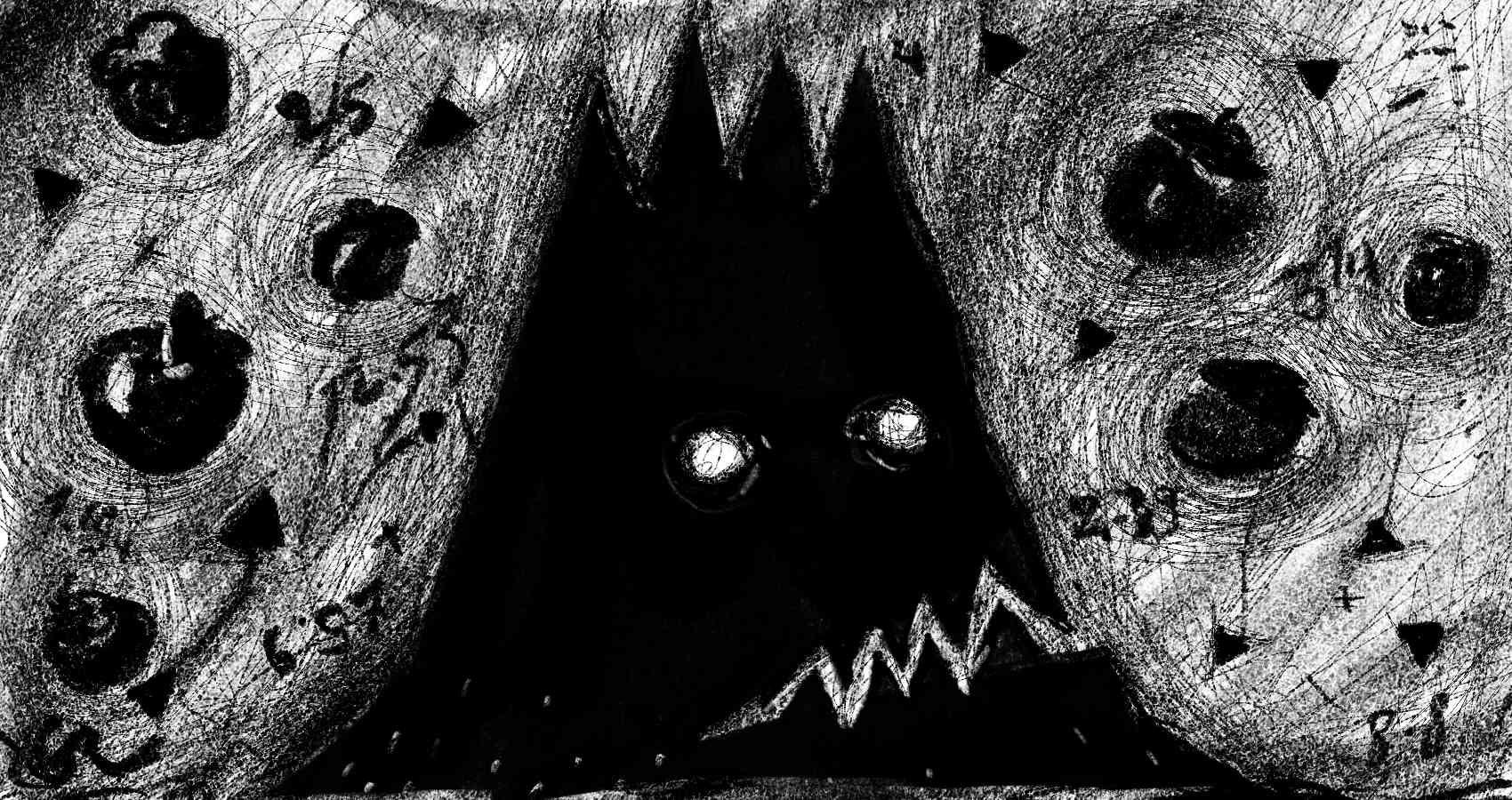
Mother Night & Wolf
written by: George Ro
When I was a child, I lived with my family in an orchard of persimmons. We were growers and weighed baskets of fruit on a large scale made of steel. There, Ma showed me how to value life in pounds, and Pa taught me to measure burdens by the number of free radicals in my blood.
The orchard was our lifeline. The glue keeping us together, so to speak—a place reminding us we were human.
But it was also our deathbed.
A fence around our orchard marked our boundaries. And when our trees bloomed, their leafy branches blocked our view of the outside world.
Very often, Ma and I would forget where we lived.
People in the nearby towns and villages didn’t know us by name. To them, we were the strangers who provided fresh and dried fruit, juices, and jams with persimmon and cinnamon to everyone. Most of them loved our persimmons, apart from those who didn’t. They called Ma the man’s Persimmon Lady. I was the man’s homeschooled son, a somewhat misleading label, of course, since my parents taught me only how to use a scale, how to count, and how to tilt my body to keep my balance when walking with a basket full of fruit in hand.
Out of the three of us, Pa, the Man himself, was the only one with full access to the outside world. He was the one telling us how bad things were beyond the orchard and how lucky we were to live in exile. He often expressed how much he disliked those who didn’t pay up front, and how much he despised those who didn’t enjoy our products.
Pa was always willing to teach those haters a lesson.
“I can’t teach a lesson to a tornado or a wildfire,” he used to say. “But that lowlife scum should learn a lesson or two if they keep acting like that.”
He never said what type of lesson that was. But every time he taught them something, he returned with a new scar on his face. He also brought back a bag of unripe persimmons, which he would eventually feed to wild animals.
To this day, I believe Pa was wrong. He sucked at managing things. He was good with the scale, weighing fruit, and such. I give him that. But in his personal life? The scale was broken. He was someone who would say too much or too little, always at the wrong time and to the wrong people.
That’s what I believe, and he can’t argue with that anymore. May he rest in peace.
***
One day, Pa left home and never returned. Ma had been searching for him for days. She left no stone unturned. She even set foot outside the orchard for a full ten minutes. I couldn’t believe my eyes. And she couldn’t find him. I searched in the orchard because I wasn’t allowed to step outside. With my small hands, I heaved up logs and pitchforked heaps of dry leaves. And I couldn’t find him either.
After a week of searching, we decided that Pa was officially goner. Ten years of marriage and never-ending struggles were lost in a single moment.
“He will never come back,” she said. “But he will always be with us.”
I never understood these abstract ideas. They weren’t my thing. While Ma liked them, I found them confusing and useless.
How can Pa be with us? I thought. He is out of the picture. End of story.
Everything changed after that moment. The house was cold year-round. The lights flickered after midnight. The plumbing in the bathroom and the in kitchen leaked.
Everything was awful.
It was only Ma and I, the sound of leaves, and the hoo-hoos from distant trees.
Ma spent more time on the scale weighing herself than weighing fruit or tending to the orchard. She dwelled on her past mistakes, forgetting about everything else for a long, long time.
Soon, the trees turned pale. Most of them never bloomed again, and each season, we had just a handful of persimmons.
The streak of bad luck just wouldn’t end, though. Things got worse when our scale broke down. Our baskets collected several inches of dust, and we weighed the fruit by hand. Many of the fruit were bad, and instead of feeding them to wild animals, Ma gave them to me.
This was what the menu had almost every day: a bad persimmon for lunch and crackers for dinner. Occasionally, when a pigeon wandered into our orchard, Ma would catch it and cook it for me. I couldn’t complain, though. Ma was barely eating. I remember her sitting at the table, having a glass of water for lunch, and sometimes having plain tea for dinner. With all that, she quickly became ill, both mentally and physically.
“I’m ten pounds shy of reaching perfection,” she said, standing in front of the mirror.
At first, I was pleased that she was concerned about her well-being and appearance.
If she meets her goal, I thought, she’ll have one less worry. Then, maybe she’ll come to her senses and look after me and the orchard again.
But when the sticky notes on the fridge had numbers well below 120 pounds, things spiraled. The line between losing weight for fitness and losing weight for dying is thin, and Ma was poised to cross it.
Her goal wasn’t to lose weight. She was fine, alright. She looked good for her age. And that’s the truth. But in my small, ignorant brain, I excused whatever she did. I couldn’t identify the underlying cause, and so mistakes were inescapable.
Back then, I didn’t know better.
Ma had a faint new feature growing on her chin, too. The dimples she used to have only when she cried were now there 24/7. The deeper the dimples, the more erratic her behavior.
My biggest mistake was sitting by her side when she made dinner. It was suicide. In fact, I shouldn’t have gone near her. Whenever she called my name, whenever she held that long and rusty kitchen knife in her bony, shaky hands, I should’ve stayed in my bedroom.
More than once, that knife flew right past me. I saw it falling between my legs. I saw it cutting through my shoes, splitting my socks.
On a very cold mid-November morning, the knife slipped out of Ma’s hand when I was by her side. I avoided the knife at the last moment. A second longer and the knife would’ve found its way through my skull. Had that happened, we never would’ve been able to pull it out, because we were both in terrible shape for different reasons. Ma was weak from not eating, and I was growing weaker each day, because my body was growing and my stomach, paradoxically, was shrinking.
Pa had warned me that kids who don’t eat like wolves stay kids forever. In fact, he said that they grow smaller until they disappear and become hardly visible to the naked eye. He said that’s how he had lost one of his best friends when he was younger. His friend hated eating. One day, he got tiny, and his mother just brushed him away. She tossed him into the fireplace, where he burned alongside the love letters from a guy she dated in secret. She was never aware of the harm she caused.
“That’s what happens to little people,” Pa had said.
I raised my shoulders in response, because how small can someone be not to be heard? Even snails squeal in boiling water.
***
Pa’s friend’s fate kept me company for many years. When I first heard the story, I didn’t understand the meaning. I accepted his friend’s death at face value, when the moral of the story was negligence. The act of oversight. That’s one way to put it.
Just like Pa’s friend, I fell into a similar category: I was a boy without a past, present, or future.
Although Ma wouldn’t directly harm me, she passively did what she could.
The worst thing of all, and her dearest tool, was that rusty kitchen knife.
The last time the knife slipped from her hands, I picked it up before she did. Its tip had snapped. I pocketed the pointy tip and handed the knife back to Ma. I kept the tip as my secret trinket and never told her about it. If she had the tip in her hands, she would have tried to glue it back on the knife, and then I would have had to watch my step once again.
Ma took the knife out of my hands, and put it under the water, and started scrubbing.
“The knife is rusty,” she said. “I have to take the rust off.”
I watched her frantic movements. While scrubbing, she definitely cut herself many times. At one point, I couldn’t tell if there was any rust left or if the red hue on the knife was simply her blood.
“Ma,” I said. “This isn’t rust, it’s the last color of the season. The colors of fall. Autumn. In a few days, winter will come, the knife will be clean, and we will have a wolf in our house like we did last year.”
The knife was rusty and dangerous, alright. But I didn’t mean to scare her. I had to calm her down, for my own safety, too.
Last December, when Pa left, a wolf moved into our basement. He stayed until spring, when the grass in our orchard grew tall enough for him to jump out.
Through the holes in our wooden floor, I could see his large, unblinking eyes, bulging through the darkness. He was hairy, tall, and when he got hungry, he stood on two legs, scratching the ceiling for food.
Ma threw an unripe persimmon through the hatch we had under the carpet in the living room. She fed him the unripe fruit because nobody else would take it.
“The persimmons will turn the wolf’s mouth numb, and he won’t be able to eat us alive,” she said. “He won’t be able to howl at night. His pack will never reach him.”
***
The days passed, bringing snow back to our porch. It was December. Ma’s kitchenware was clean.
On the last night of November, I saw the last chip of rust fall to the wooden floor, and Ma piled the rust into the corner.
“You go out and spread the rust in the orchard,” she said. “It will deepen the color of the fruit.”
And she paused.
“And stay away from the basement,” she said. “The wolf is back. I saw him in the orchard the other night.”
“I think he’s the same wolf from last year,” I said. “He is a big, black wolf with a scar on his face, but he’s missing a tooth. ”
“Better for us,” she said. “Weak wolves don’t bite.”
I took the bucket and a small shovel with me and stepped outside. The snow was still soft and fresh, crunching under my boots. I lifted the bucket twenty times, spreading rust at the roots of our twenty persimmon trees.
When the bucket was empty, I went back inside.
Ma was waiting at the table. She had her tea, and I had some crackers waiting for me.
“How are the trees doing?” she asked.
I left the bucket in a corner, sat at the table, and grabbed a few crackers, munching on them before saying anything. I was hungry.
“The rust did the job,” I said. “The fruit is now ripe and looks healthy. The colors are warm, and the scent is sweet.”
Ma stood up and opened the curtain to check on the orchard.
“There’s no better place than the orchard,” she said. “Do you want to stay forever with Ma in the orchard?”
I sat still, not knowing what exactly she meant by that.
“Pa left us,” she said. “If he had stayed in the orchard with us, he would still be around. But he always did things his way.”
“I want to grow big and bring back Pa,” I said. “I know he’s somewhere thinking about us. I want to visit the towns and the villages and sell our fruit, too.”
She didn’t like what I said.
I know she was trying her best to sell the fruit all by herself. In fact, since Pa left, she began taking regular walks just outside the orchard, and our remaining clients came to us instead.
This wasn’t enough, though.
“If they want our fruit, they should come and get it from here,” she said. “You have no business outside.”
At that moment, somewhere in my small bedroom, I heard the wolf scratching the underside of the floor—the ceiling of the basement.
“You made the wolf angry,” she said, and grabbed a persimmon from the basket. “Angry wolves eat nasty kids. Don’t you forget that.”
She tossed me the persimmon. The dimples on her chin were now larger than ever.
“Make sure to feed the animal inside before sleeping,” she said, and then went into her bedroom. “But don’t let him in. He will swallow you alive.”
Around eight, Ma was already fast asleep, and I moved into my room. I had the persimmon in hand and the tip of the knife in my pocket. I wasn’t sure if the wolf was still in the basement. I couldn’t hear him breathing, walking, growling, or whimpering.
I had a plan.
On the wooden floor underneath my bed were two holes. The only way to know if he was still in the basement was to peek. Since the holes were too small, the worst he could do was sniff me. No tooth or nail would go through. I was safe.
I tiptoed to my bed and then crawled until I reached the two holes. Then I saw him. His yellow eyes sparkled. His tongue, red and pointy, stuck out of his mouth, licking his bright, wedge-shaped teeth.
“Come on,” I said. “I brought you fruit. Do you want to eat?”
He raised his foot and pointed at his mouth, which had a missing tooth.
I wasn’t wrong.
He shook his head.
“You don’t need food?” I said. “Do you need this?” I asked and pulled the tip from my pocket.
The wolf whimpered like a puppy.
“Take it,” I said, and got rid of the tip.
He picked the tip of the knife and placed it where he missed a tooth. Then he gave me a wide grin, showing off all his teeth, and stood up and walked away.
I ran to the kitchen and peered through the window. I thought he would leave the orchard. But he didn’t leave. Instead, I heard the stairs creaking.
He was coming upstairs to meet us.
I ran back to my bedroom, shut the door, and turned the key. I dragged my cedar chest and shoved it against the door.
“I’m not for eating,” I said.
I could hear the wolf walking in the house, sniffing at things. He pressed his nose to the corners of my door and sniffed rapidly, sucking all the air from inside my room.
Breathing was impossible.
“Go away,” I said. “I healed your mouth so you can eat. I deserve something in return.”
He growled and left. He was still in the house, though, just not in front of my door.
A while later, I heard Ma screaming.
A thin wall divided my room from Ma’s. I pressed my ear against the wall, and I heard her talking to the wolf.
“Come here,” she said. “Your food is ready. I’ve got your milk.”
Then I could hear the wolf slurping.
I was upset. I felt betrayed—deceived.
For all this time, all I had were crackers and bad persimmons, I thought. And the moment a wolf walks into the house, he gets milk.
I wanted to know where Ma had the milk hidden all that time. And I took my sharpest pencil and dug a hole in the wall.
Ma was in bed with the wolf. She had her bare chest out, nursing the wild creature.
With every suck, the wolf shed fur. With every suck, he became more human. With every suck, he grew into Pa.

- Mother Night & Wolf - February 19, 2026
- Fading Sun - July 13, 2025