

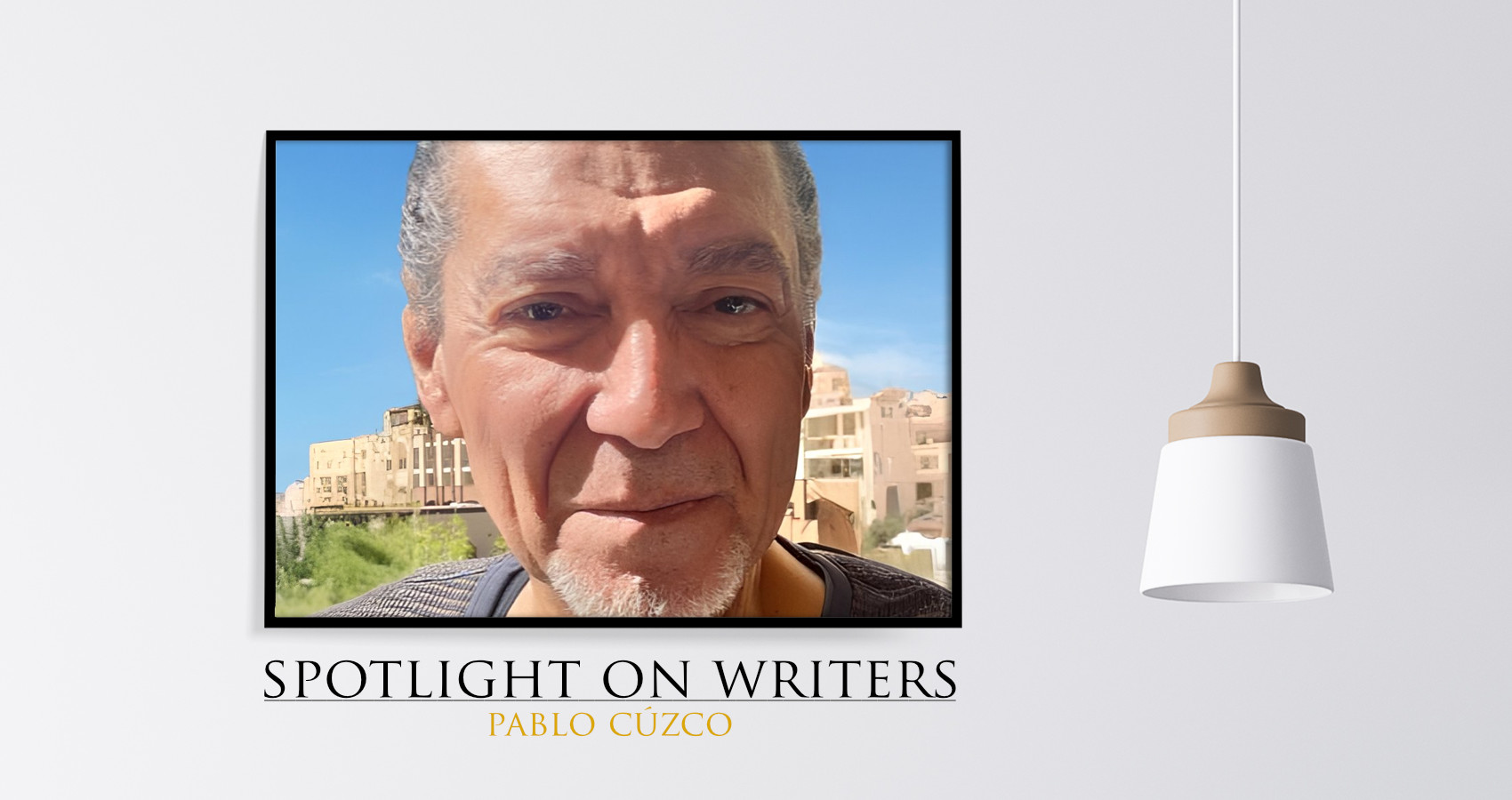
Spotlight On Writers
Pablo Cúzco
- Where do you originate from?
If you’ve read any of my writer’s bios, you know I spent my early years in Europe, mostly around the Bordeaux region of France and Westphalia, Germany. What you don’t know is what a wonderful childhood it was. Some of my earliest memories were living in a rural village (we called it the “Economy”) surrounded by wild fields and orchards and farmlands crisscrossing the landscapes like checkerboards. Near Aschaffenburg, Germany, we lived over a farmer’s stables. I recall him shoeing his horse. Every time he’d slam his fingers with the hammer, he’d curse, “Sacrament!” I only found out it was a word not to be repeated when I used it the first time in front of my mother.
From the hills that surrounded the village of Gailbach, my brother, sister and I would spy on the people below, watching them go about their daily routines. One time we watched a woman trying to separate a dachshund and a terrier that were coupling, smacking between them with a large broom. For some reason the dogs were attached in a desperate clinch, even the older frau’s blows couldn’t break. I mention this because later, as we came back to the streets of the town, we saw the same wiener dog happily running past us with a large gauze bandage taped to his neck, covering what seemed like a serious wound. Odd.
One of my earliest memories was when my father took my broken tricycle to a man in Cavignac, France. I saw how he straightened out the spokes by tightening each one separately, like a piano tuner adjusting the strings on a baby grand, until they all became aligned. Later, I watched him filling empty perfume bottles he used to water his canaries. He was running them under a spigot that seemed to just pass water over the tiny glass openings. At that early age, perhaps three or four, I asked him how he got the water into the bottles, because the holes were so small. He showed me how he could tip the bottles sideways, so the water would leach into the tiny openings. Funny, the things we remember in life. Perhaps they’re better than the things we forget.
- What do you cherish most about the place you call home?
I think the one thing I cherish the most about home is my wife. She suffers from Alzheimer’s disease. Knowing the degenerative course the illness takes, I try to make every moment we still have together count. We were also two of the earliest known cases of Chronic Fatigue Syndrome diagnosed in the US (before it became trendy, and when doctors still knew little about its pathology), so our activities are limited. Between doctor visits and streaming videos, even playing video games, I make sure we can take something of value from whatever occupies our time. We spend the better part of each day engrossed in long conversations. Many of these are about the past, a thing for which she has retained a remarkable memory. We sing to each other the words to a song from long ago, called “The Dutchman”. In it, the protagonist has lost his memory and Margret, his wife, remembers it for him. In our story, we’ve had to reverse roles.
- What ignites your creativity?
I like to consider myself the Pablo Picasso of the prose poem. There are many years of notes in my portfolio, especially lyrics to songs I’ve written in the past. I try to see them from the point of view of a storyteller instead of a singer. When I convert them into longer pieces, they suddenly take on the form of abstract art. Even though I haven’t perfected them yet, and few of these pieces have been published, I hope they will eventually become the legacy I leave when I’m long gone.
- Do you have a favorite word and could you incorporate it into a poetic phrase?
The first time my wife read a poem I wrote using the word ubiquitous, she said, “What? Does anybody even know what that means?” I took it out of my work, because her gut feelings are usually right when it comes to craft. Now, years later, I hear it all the time in the media. It’s become, well, ubiquitous.
“Though my writing is very little recognized now, I hope it will one day become as ubiquitous as the descriptor is to the noun.”
- What is your pet peeve?
Politics. Taking sides in today’s political firestorm is like shooting oneself in the foot. No matter what you say, it can be misconstrued and used against you. I prefer the old days when civil rights were about being civil and not about masked terrorists rounding people up in unmarked cars. Being liberal was once about helping people, not just ridiculing those who disagree with you. But being Latino puts me in a precarious position, so that I have an acute awareness of the existential danger my people face just living our everyday lives.
- How would you describe the essence of Pablo Cúzco?
Pablo Cúzco is the Americas before Christopher Columbus, a man of indigenous origins to whom a Hispanic heritage was grafted alongside the marks left by a cross-Atlantic slave trade. The subsequent generations that led to who he is today make sure his feet point West, and while his mind stays anchored in Europe, his heart is fixed on the philosophies of the Far East.
- God and Whisky - February 26, 2026
- Pack My Bags - October 17, 2025
- Spotlight On Writers – Pablo Cúzco - September 13, 2025