

The Curious Case of the Chichester Tablet
written by: Simeon Whiting
Sue Ruddy knew better than to be surprised when her husband dropped a muddy slab of chalk onto her kitchen table. This was not the first time Bill had marched into the house direct from the fields, leaving a trail of dirt in his wake, dropped some kind of unpromising lump onto a previously clean surface, and expected Sue to share his excitement. However, this latest find seemed unusual, even by Bill’s standards.
A farmer by trade, Bill had been digging up topsoil, trying to sort out a drainage problem in the field nearest the house. He had found nothing more interesting than loam and silt until his spade suddenly met something hard, which was clearly not helping with the drainage. Bill kept digging and uncovered a slab of Sussex chalk, rough-edged and about a metre square: a squarish slab which, after the worst of the soil had been brushed off, revealed itself to be covered in weird markings. What do you think it is, Bill asked. Sue, having no more idea than her husband, suggested calling Graham Walker: local historian and authority on all manner of arcane subjects.
Graham arrived at the front door, breathless and windswept, exactly fourteen minutes later. After the most cursory of small talk on the doorstep, Graham barged past Bill and headed straight for the kitchen table. His eyes shone as he ran his hands reverentially over the uneven grey surface. After a few minutes of examination, Graham looked up and announced with undisguised delight that this was without doubt a discovery of national – if not international – importance. Bill repeated his earlier question: what on Earth was it? Graham’s answer was simple: no idea.
Whatever Graham said to the Evening Argus, it was enough to draw a visit from their leading reporter. After that, things escalated far faster than even Graham could have expected. Two national newspapers (The Guardian and The Telegraph) ran small articles based on the coverage in the Argus. Next, BBC News wondered if something might be up, and their 6pm bulletin included an interview with Bill (scratching his head, nonplussed) and Graham (pink-cheeked, verbose). The next day, two timid members of the Sussex Archaeological Society appeared at Bill and Sue’s door, asking if they might be permitted to examine the find. Examine, they did. In short order, several of their colleagues had also arrived, dug two trenches in the Ruddys’ field, and were scouring the ground for other artefacts. After a good deal of chin-stroking, they decided they needed advice back-up; the eminent Wessex Archaeology was summoned.
None of them had ever seen anything like it. The slab was rough and pitted, but its edges had been rounded off enough to suggest it had been in the ground for a very long time. How long? Impossible to tell on the basis of current evidence. The shapes carved into the surface weren’t any kind of Saxon code or Norse runes. Bill’s field wasn’t more than a mile from the Roman villa at Fishbourne, so some of the researchers theorised that the slab might have something to do with the settlement around the villa. Of course, it was also quite common for people to exchange messages in code during the seventeenth century – especially Catholics trying to avoid persecution from the Protestant authorities. Perhaps this was a coded message from that era, or even a key to a code. But then, why carve it into stone, when paper was freely available and easier to destroy if it was at risk of falling into the wrong hands?
It was only a matter of time before the lunatics hijacked it. A local YouTuber by the name of CanUDiggit posted a video pointing out the similarities between the carvings in the Chichester Tablet (as it was now known) and selected pieces of Aztec art. CanUDiggit’s film was fanciful but created with the best of intentions. Unfortunately, the same cannot be said of those who picked up his ideas and ran with them. It was obviously an alien artefact, they said. How could it have been possible for two ancient peoples to have transcended such great distances without the influence of an alien civilisation? Do your research, sheeple.
Just as the whole episode threatened to descend into farce, Dr. Eileen Carey brought much-needed gravitas to proceedings. A Senior Lecturer in the Ancient History department at the University of Oxford, Dr. Carey, presented a far more thoroughly researched theory as to the tablet’s function. She hypothesised that the carvings were a form of proto-Sumerian and demonstrated that, if the characters were read as pairs opposite each other, and in a clockwise manner from the top right corner, they could be interpreted as: ‘god/lord, peace, journey, bottle’. It was clearly, Dr Carey explained, a message from Mesopotamian merchants, assuring the ancient Britons of their peaceful intentions towards them and desire for mutually-beneficial trade. When it was pointed out to Dr. C that there was no previous evidence of Mesopotamian trade further west than Lebanon, the good doctor became somewhat defensive. Her venerable features took on a pinkish hue, and she blustered rather a lot about merely following where the evidence was leading her. Incidentally, funding for Dr. Carey’s department has increased substantially since she published her paper on the Chichester Tablet.
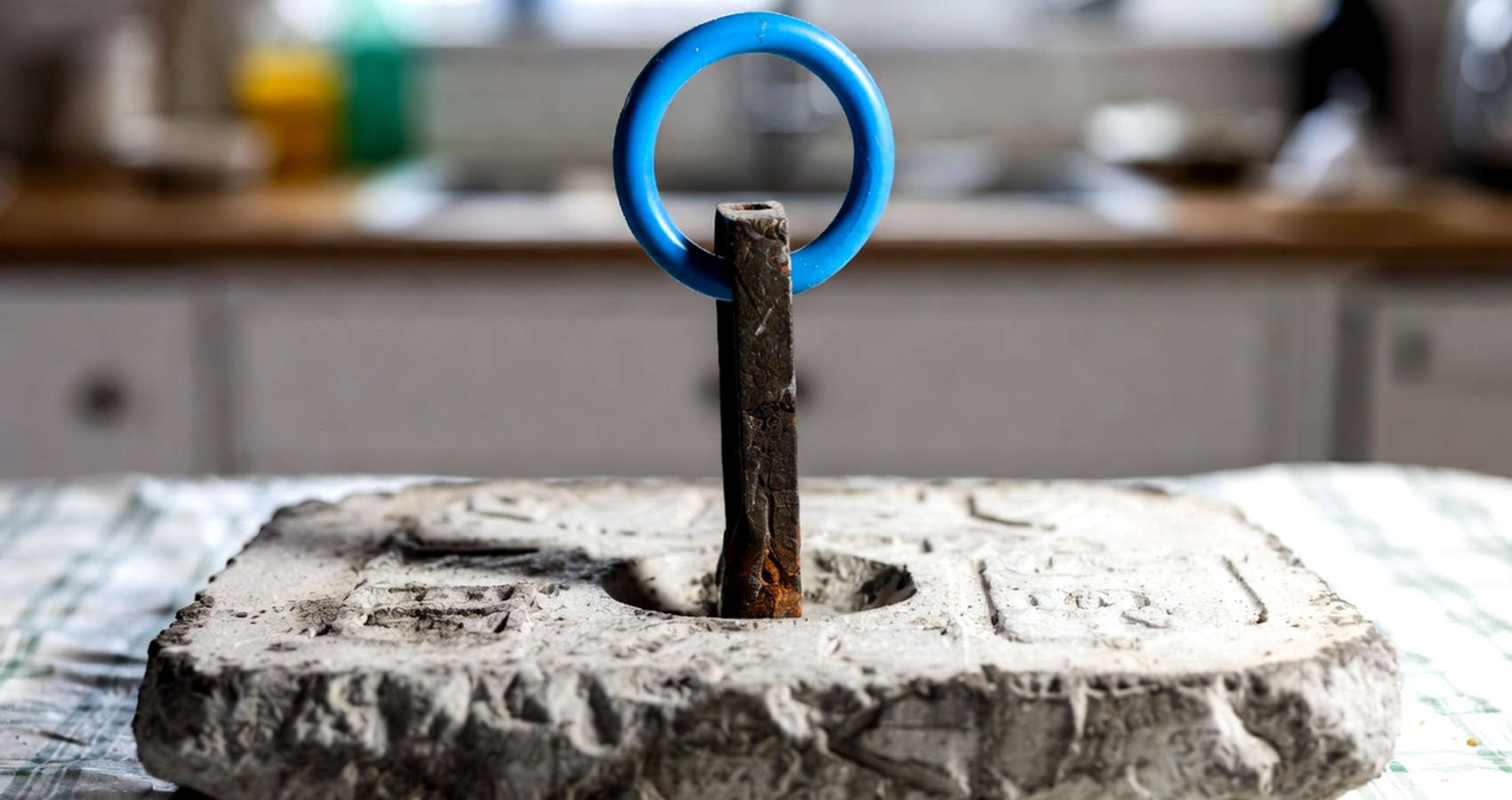
The debate continued for nearly two months with no resolution in sight, and public interest in the tablet was waning until the archaeologists in Bill and Sue’s field made a second find. This time, it was a rusty iron pole, buried just a few feet away. One of the team – a postgraduate student – thought to pick up the pole and stand it on the tablet. There were audible gasps as the pole’s pinched and battered end fit perfectly into several of the markings and partly into most of the others. The interest in the find was now raised to fever pitch. Not just a Chichester Tablet but now a Chichester Staff too. What could these two artefacts mean? And how were they related to each other? All previous theories had been blown out of the water.
Step forward, Howard Jenkinson, senior archaeologist on the dig, with your back bent and your knees gnarled from forty years of crawling around in trenches. In a morning conference with his colleagues, Howard recalled an episode from the 1970s at an excavation at Skara Brae on Orkney. Howard never raised his voice. He didn’t need to. At this point in his career, he commanded instant respect just by opening his mouth. His colleagues stood around Howard in perfect silence as he described the remarkable skill with which Skara Brae had been built. Even 5,000 years after it was abandoned, some important features of the settlement remained quite distinct, including a curious stone channel built into one of the larger houses. The channel was around twenty feet long, ramrod straight, and constructed at such an angle that the light of the setting sun would have been cast perfectly on the interior wall opposite the channel’s end. This hinted at a deep spirituality among the residents, not to mention extraordinary architectural skill for a Neolithic people. It was just possible that something similar was at play in this unassuming field in Sussex. The tablet and staff might form some kind of arrangement to catch the light of the sun and focus it on a particular point of ritual significance to the ancient community. The hair stood on the archaeologists’ necks as Howard urged them to continue the dig and discover what secrets the land still hid.
Howard suspected that the staff might have been missing a ring piece that would slot into the hole at its end and focus the light of the sun when properly arranged. The very next day, there was jubilation as a likely-looking piece was discovered. Dr. Carey, CanUDiggit, and the swivel-eyed alien obsessives joined with enthusiasts the world over in watching the site’s live feed with bated breath. Graham Walker could barely contain himself as he saw the archaeologists huddle around their latest find.
They were all in for a disappointment.
It was Howard Jenkinson who emerged first from the huddle. They had indeed found a ring piece which fit perfectly into the top of the staff, he said. Surprisingly, though, the ring piece was made not of iron but of plastic. Clearly, this challenged their previous assumptions about the great age of the staff and the tablet. It also seemed unlikely now that these artefacts had any particular ritual or spiritual significance. The most likely explanation was (and here, Howard’s voice dropped even lower in volume than usual) the Chichester Staff and the Chichester Tablet comprised some kind of modern domestic laundry apparatus. In layman’s terms: a washing line.
Bill and Sue Ruddy surveyed the scene from their back door. Four trenches, twenty feet long and three feet deep, now ran across Bill’s field. He hoped those archaeologists were going to fill them in again before they went away. Actually, it would be nice if they could help him sort out that drainage problem, too.

- The Curious Case of the Chichester Tablet - March 26, 2026