

The Keeper of Rains
written by: Monika Ajay Kaul
Somewhere in Cherrapunji*
It had been raining for six days straight. But that wasn’t unusual for Cherrapunji.
Rain here wasn’t weather… it was ancestry. It came down like stories passed from sky to earth. Ancient and unresolved.
Nayani didn’t notice the sixth day any more than she had the fifth. Time had blurred. Only the sound of rain against the thatched roof marked its passage. That, and the solitude in her home.
Her grandson Nirad had died five days ago.
She hadn’t said his name since.
The others had left after the cremation. A few neighbours had stayed back, offering her tea and the kind of words that try to console but never quite reach the place where sorrow lives. She didn’t remember what they said. All she remembered was the way the rain had changed that day; how it fell! Not like mourning… but like pining. As though even the clouds couldn’t bear to let him go.
Nirad had always been a child made of pauses and sky. Not troubled, just… tuned to something quieter than the world. As if his soul belonged more to clouds than to crowds. He had the kind of eyes that never stayed still. Always searching the skies, tracing patterns in the clouds, reading meanings in the mist.
At age ten, he had once asked her, “Aaji, do you think people can be born from rain?”
She’d smiled. “Hmmm! What makes you say that, Neer?”
He had looked away, solemn.
“Sometimes I feel like I wasn’t born from you or Ma. I feel like I just… fell. From somewhere. Like a drop. And one day, I’ll go back.”
She had brushed his damp hair aside and said nothing. Just let her fingers rest a little longer on his forehead, as if they could gather the rain before it reached his eyes.
She didn’t respond. She never interrupted the way his thoughts drifted into words. But she remembered that line… ‘a drop that simply forgot it could fall.’
It had stayed with her for years. Not because it was unusual, but because it was him. Fragile. Unassuming. Full of things the world rarely paused to understand.
She had loved him without needing to be understood in return.
And she remembered the dholak (a traditional Indian hand drum with two heads, played with fingers).
He had found it abandoned in a storeroom one monsoon, the skin worn, the wood cracked. Most children would’ve walked past it, but not Nirad. He had carried it to the verandah, patched it with rice glue and cotton, and began playing it. Not like a child imitating noise… but like someone who knew the rhythm.
“I’m playing the rain, Aaji,” he said, his fingers tapping out a pattern soft as drizzle, sharp as hail. “It has a song, you know. And some days, I think it remembers me too.”
At night, when the rains grew louder, he’d sit cross-legged and play along, matching beat for beat. Sometimes, he didn’t even open his eyes.
“It’s not drumming,” he’d grin and say. “It’s listening. I’m just playing what it already knows.”
She’d watched him then with a strange ache in her chest, as if he hadn’t come from the bloodline, but had drifted down from the clouds… borrowed from the sky for a little while.
***
Now, without him, the house felt like silence dressed as walls.
That evening, she unlatched the rusted tin trunk he used to keep his sketches in. His sketchbook was there. Half-drenched, ink trailing like veins across paper. Drawings of rain in every shape: spirals, arrows, falling fish, lines like strings of a sitar.
“Aaji, I think the rain is trying to say something. Not just fall, but speak. Each sound… each tap on the roof… is an utterance. It’s like Ma humming to me at night.” She remembered the way he had murmured it, barely awake, as the two of them lay side by side listening to the rain fall endlessly outside.
It had struck her then as the kind of thought only a child would say. But now, sitting in the hush he left behind, it felt like truth.
***
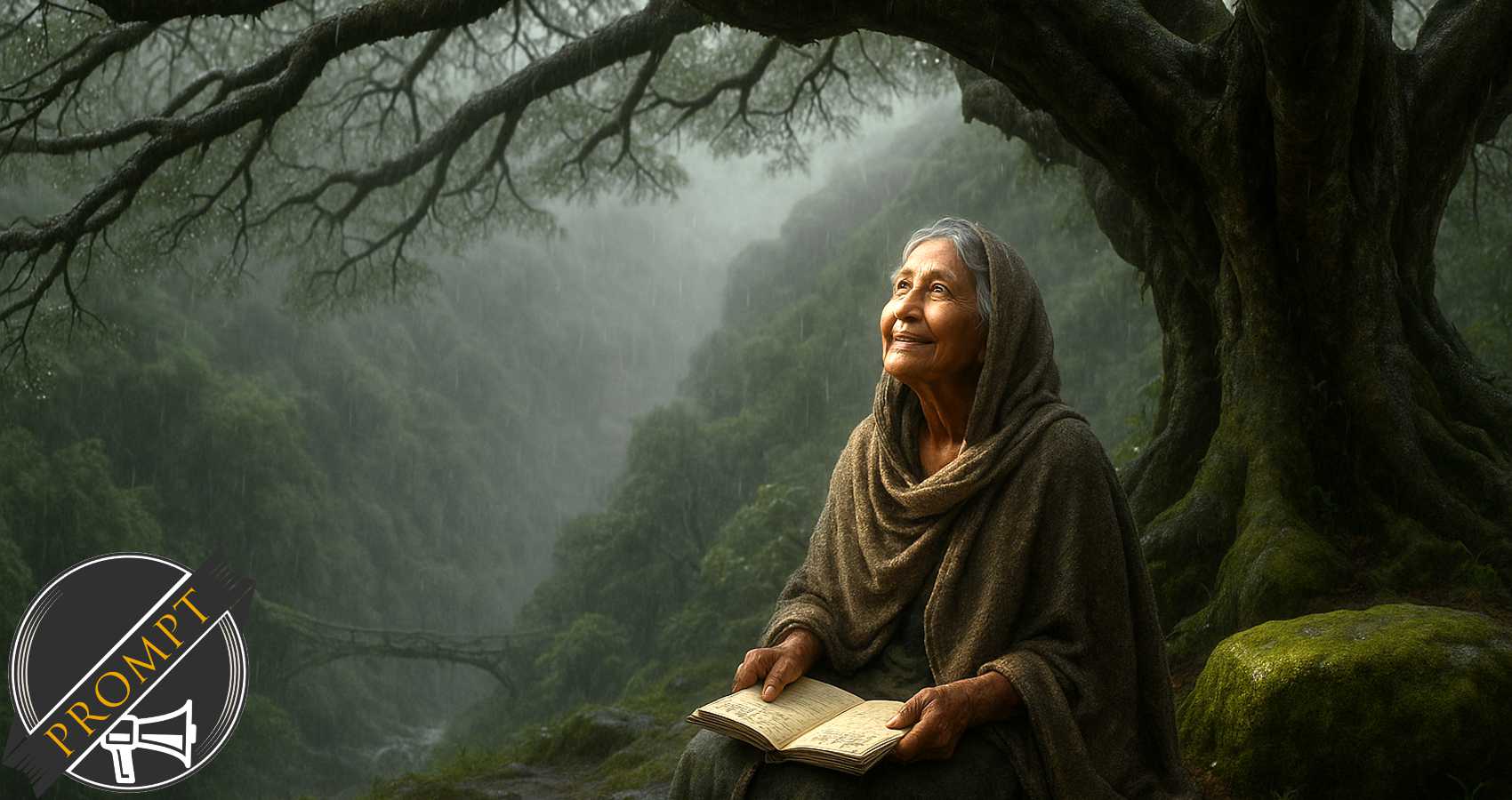
On the seventh day, Nayani wrapped herself in her old shawl and walked up to the sacred hill… the one Nirad used to call “the place where the sky learns how to weep.”
Along the way, she crossed a living root bridge, grown patiently over decades. Banyan roots woven by hand and time, curved into an embrace above the rushing waters. Nirad had once called them “songs made of trees.” She paused there for a moment, steadying herself on the damp curve, as if the bridge, too, ached with the thought of him.
It was slippery. She fell once. But she didn’t stop.
When she reached the top, the forest lay beneath her like a folded storybook. Mist floated lazily, unhurried, like it knew it belonged. She sat beneath the oldest rain tree. Gnarled, majestic, and always wet.
And then, without knowing why, she began to talk.
“You know, Neer… you were right,” she said. “Rain isn’t water. It’s a memory. We’re soaked in it. All of us.”
She paused, her breath misting in the damp air.
“I used to think grief is about holding on. But maybe… maybe it’s also learning to let fall. To let things become rain. Maybe that’s what you were trying to tell me.”
The clouds shifted. A single shaft of sunlight broke through. A rare thing in these parts; and touched the stone beside her, turning the moss into emerald. For just a moment, she felt a warmth on her cheek. A brush of mist. A kiss, maybe.
And in that moment, she laughed.
Softly. Through tears.
“Maybe you were rain all along, Neer.
Maybe you were a drop that simply forgot it could fall.”
***
Back in the village, no one noticed when the rain changed. But it did.
It became slower in some parts, like it were listening. It avoided certain rooftops with reverence. In the evenings, it sounded like someone drumming gently on old bamboo. At times, the mist would wrap around a passerby with such softness, they would pause mid-step, unable to explain the ache behind their ribs.
Children said they could hear humming when they walked past the sacred hill. Farmers claimed their crops didn’t drown that year. And Nayani… who lived a few more monsoons… began to speak to the rain out loud.
Every evening, she would step outside and say,
“Alright, Neer. I’m listening.”
And she believed, some nights, the rain replied.
NOTE FROM THE AUTHOR:
Based on the Prompt – A Conversation with The Rain
* Cherrapunji, nestled in the hills of Meghalaya in northeast India, is one of the wettest places on Earth. Known for its lush forests, living root bridges, and near-constant rainfall, it is a land where clouds drift low, and water weaves itself into daily life.

- Star Gazers - March 4, 2026
- The Measure of Redolence - November 21, 2025
- Songs Beneath the Tangerine Tree - October 18, 2025