

The Last Supper
written by: Etya Krichmar
The night before our departure, Mama made blintzes. It was a quiet ritual I had seen many times before, but this time, the weight of finality made every movement feel sacred. The crack of the egg, the metallic scrape of the whisk, the soft hiss of butter hitting the pan, and the quick swoosh of the batter swirling across the hot surface—all those sounds were imprinted on my memory like a farewell lullaby. Even years later, I can still see and hear it in my mind.
That day, I watched Mama work with quiet precision. She didn’t need to think. Her small, capable hands moved with the grace of tradition. The years of repetition shaped each of her motions into perfection. However, I noticed the faint tremor in Mama’s fingers as she flipped the golden crepes.
The air around me was thick with the scent of vanilla and browned butter, warm and familiar, but it didn’t soothe. Instead, it stirred a dull ache in my chest. What once promised comfort now carried the weight of goodbye. The aroma no longer called me home. It clung to the air like a fading memory.
I sat at the table, my fingers tracing the familiar grain of the wood, worn from years of elbows, teacups, and laughter, as I remembered the countless times we gathered here as a family. I could almost hear the echoes of past meals whispering in my ear how much we valued being together. The radiator hummed softly, and through the thin walls, the murmurs of neighbors drifted in as if the building itself sensed we were leaving.
“Do you need help, Mama?” I asked softly, not because I needed to, but because the silence had gone on too long.
She didn’t turn. “No. Sit. I want you to eat while it’s still warm.”
I looked around, recalling happier times when our apartment didn’t feel empty, and our packed suitcases weren’t lined up in the hallway. I thought of my beloved Papa, my steadfast knight, my shield against the world’s cruelties, the one whose presence at the table once made everything feel safe, whole, and unshakably right.
Today, he should’ve been with us, his back straight, shoulders broad, sitting at the head of the table like a captain steering his ship through any storm, eyes crinkled with that quiet pride I knew so well as Mama placed the steaming blintzes before us, her offering of love wrapped in warmth and tradition. He should be reaching for his chipped porcelain mug, filled with that overly sweet tea he always insisted tasted better that way, taking slow, deliberate sips as though time itself bowed to his custom.
Under the table, his calloused, strong, reassuring hand would find mine and squeeze it gently in a silent message that needed no translation. Especially now, he should be here with us, cracking a joke, something dry and clever, to draw out a laugh from me. And when my laughter faded into a silence edged with sorrow, he should be leaning closer, his voice low and steady, telling me that everything would be all right, even if the tremble in his voice betrayed the truth he couldn’t change.
But he wasn’t there. His chair, which he claimed like a throne, stood hollow and still, its vacancy louder than any word spoken. It hadn’t been filled in a long while, but today, the emptiness took on a new weight that bent my spine, pulled at my chest, and made the edges of the room blur.
I didn’t need to look to know his presence haunted every corner: the way his fingers used to drum on the table while he waited, the faint scent of tobacco and mint that still clung to the worn cushion, and the echo of his laughter hidden in the grain of the wood. He should have been here. And yet, all I had was the silence where his baritone should be and the aching space between us that no memory could bridge.
Charna, my sister, stirred her tea again. Itsik, my brother, leaned on his elbow, his brow furrowed as he looked past the window. Yefim gently bounced Irina in his lap, murmuring something that made her giggle. Her tiny hand reached for Charna’s spoon. She was too young to understand the weight of grief pressing down on us and squeezing our hearts with pain. I envied her innocence and her unawareness of the sorrow that had been here long before we decided to leave our homeland.
In the kitchen, Mama layered the blintzes on a plate like pages of a story we would never tell again. She then placed it in the center of the table and looked at us.
“Eat,” she said, her voice sharper than expected, a command wrapped in love.
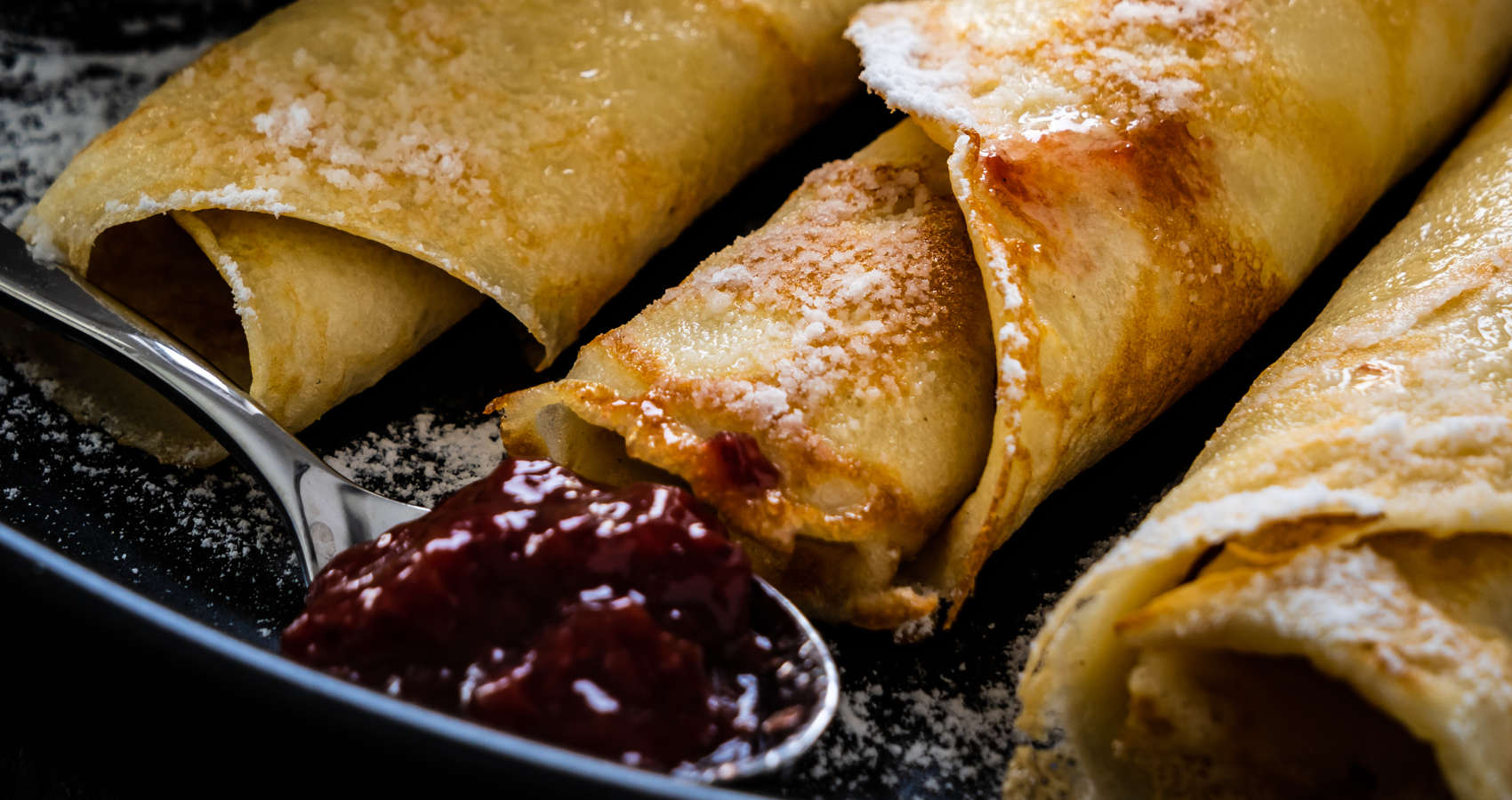
We didn’t speak; we reached out. Blintzes were passed with silent reverence, smothered in thick swirls of sour cream, with cherry preserves spooned on carefully. The rolls, shaped like neat cigars, felt almost ceremonial. I lifted one to my mouth and bit gently. The soft, warm dough dissolved against my tongue, and the sweet, tart, familiar preserves filled my mouth with the echo of many childhood mornings.
Each bite was slow and intentional, like flipping through the pages of a book I wasn’t ready to finish. The rising steam from the tea blurred my sight, blending with the quiet rustle of Mama wiping her hands on her apron as if washing away the grief from the moment.
That day, every bite carried the taste of memory. And of parting.
I closed my eyes, and suddenly I was five again, sitting on Papa’s lap as he took a piece from my plate, winking as Mama pretended to be outraged. The blintz had tasted sweeter then, as if wrapped in laughter and light. Now, it tasted like the pain of things that once were.
Mama didn’t sit down.
She stood by the sink, her eyes fixed on Irina. There was something in her gaze, a desperate desire, which seemed to suggest she hoped her beloved granddaughter would remember this moment, even though she was too young to understand.
“Save one for Papa,” Charna said suddenly.
Mama froze, just for a second.
“I can’t,” she replied softly. “He’s already had enough. He’s consumed every memory we’ve shared at this table.”
Silence settled like dust.
When we finished, there were only crumbs and stillness left. I turned to Mama.
“Do you want me to help clean up?”
She shook her head, avoiding my gaze. “Go,” she said, voice thick. “Be with your daughter.”
Mama gathered the plates and turned to the sink, her back to us. I watched her like a hawk, noticing her shoulders shake before she stilled herself, her breath coming in measured beats. My heart broke. I wanted to stand, help, and do something to ease the moment. But what could I say when I knew this wasn’t just a meal but a point of no return?
Yefim cleared his throat and stood up, lifting Irina. Charna set her untouched tea on the counter. Itsik, a man of few words, pushed his chair back with a sigh that spoke louder than words.
“I will not forget this,” he said quietly, almost to himself, his gaze fixed on the empty plate in front of him.
We rose, one by one, as though leaving the table meant stepping into the unknown.
Before leaving, I took one last look at the kitchen. The single light bulb cast a faint glow, softening the edges of the small space. I observed everything: the dent in the stove where Mama had dropped a heavy pot, the curtain fluttering slightly from the draft, and the smudges on the wall where our hands had rested over the years. These were the remnants of a life we would soon leave behind. All of it was painfully ordinary and incredibly sacred.
Tomorrow, we will leave, and Mama’s warm, fleeting blintzes will stay only in my memory. That night, as I quietly said goodbye to my loved ones, I carried the taste of home on my tongue and the ache of it in my heart, knowing that no matter where life took me, that flavor would never be the same.

- The Last Supper - February 12, 2026
- Denial - September 24, 2025
- A Journey Through Monet’s Water Lilies - May 25, 2025