

The Love That Moves the Sun
written by: Nelly Shulman
Florence, 1525
The inn’s sign was propped against the attic wall. Signor Giuseppe, the owner, had inherited the building from his father, who had run a tavern there.
“I will renovate the rooms for respectable people. Enough of hosting all sorts of riffraff,” the owner promised.
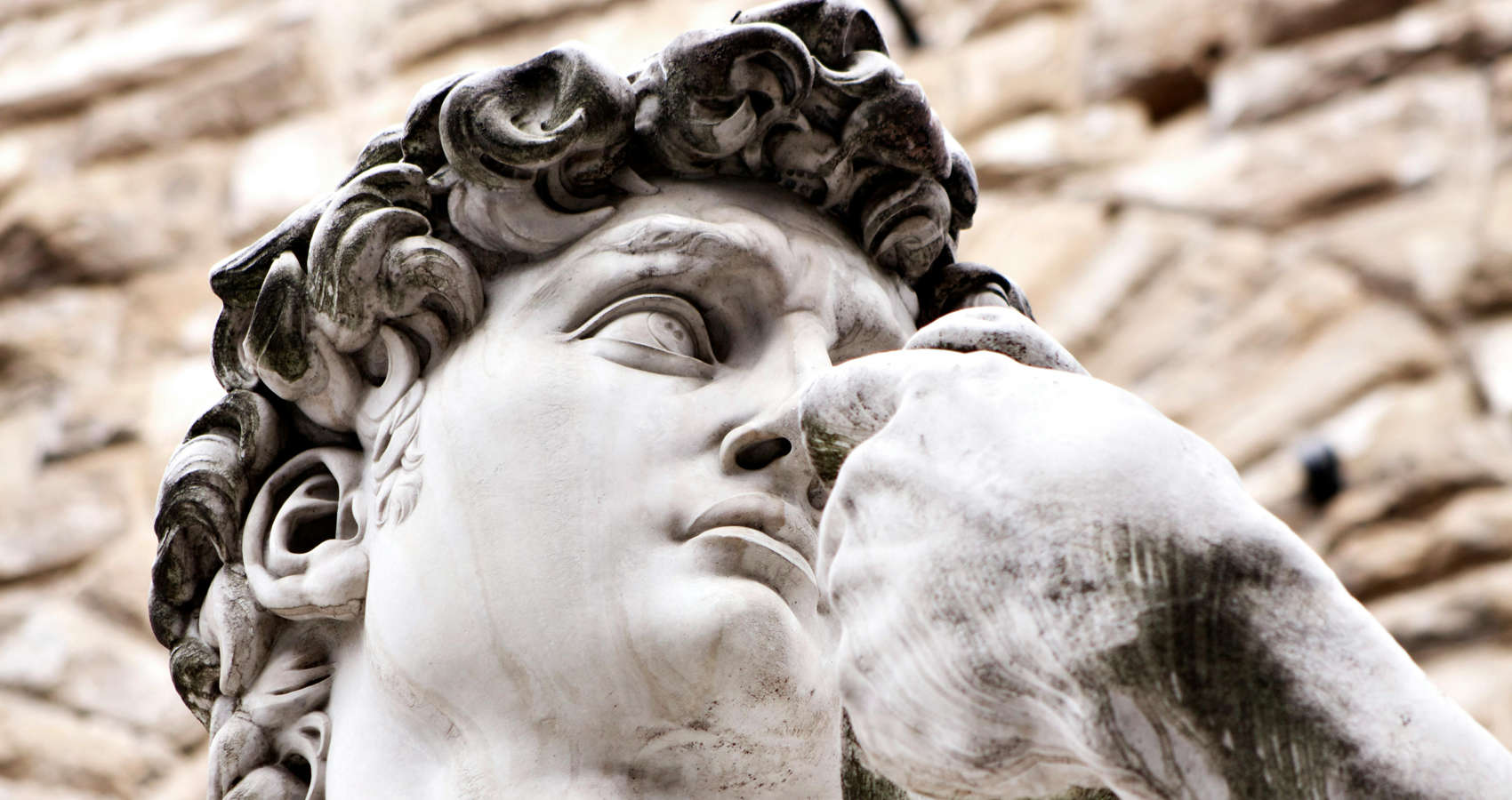
All over Florence, builders cut stone. The statue of David towered in the Piazza della Signoria, and scaffolding obscured the façade of the Basilica of San Lorenzo, where Michelangelo had been commissioned to create sculptures for the Medici Chapel. The Master had left for Carrara, where he always personally selected the marble.
The midday sun flooded the attic with gold. The light here was sharper than in Venice, where Rosso Fiorentino had come from.
Signor Giuseppe Ferelli, the future proprietor of rooms for noble guests, on the other hand, was a true Florentine who never missed a chance to turn a profit.
The contract for the inn’s sign had turned into a commission for a dozen paintings. Rosso, who was waiting for Michelangelo, needed to earn money.
“Why suffer the bad roads and return to Venice?” Signor Giuseppe shrugged. “I won’t charge you for room and board.”
The rooms were furnished with lace-canopied beds and cedar chests, which Rosso also had to paint.
Bidding Rosso farewell in Venice, his father, Giovanni Tedeschi, had smiled.
“It’s time for you to fly away. Your sister is married, and now it’s your turn to see the world,” he patted Rosso on the shoulder. “Bring back a wife.”
Marta, Rosso’s sister, had married late—at almost twenty-four.
“But she handled Father’s business,” Rosso mused, “and, to be honest, she was picky.”
After the wedding, Marta had moved to Novgorod, and now her letters took three months to reach Venice. Rosso did not want to distract the Master by sending a message to Carrara.
“He told me to come in the summer, and so I did,” he jumped down from the windowsill. “He doesn’t have to keep track of his apprentices’—or future apprentices’—travels.”
Rosso, who was known in Venice, still had to make a name for himself in Italy. Clattering down the paint-scented stairs, he decided to take another look at Neri di Bicci’s altar in the neighborhood church.
Upon entering the side chapel, Rosso bowed his head before the tomb of Donna Beatrice Portinari. The scent of summer flowers wafted through the air, prompting Rosso to turn.
A tall girl in a crimson dress carried an armful of wild roses. A floral wreath adorned her head, and the white chemise peeked out from the gold-embroidered slits in her sleeves.
Rosso hadn’t changed his shirt in three days, but if the stranger noticed the smell of sweat, she gave no sign. She laid the roses on Donna Beatrice’s tomb.
Golden sparks danced in her eyes as she smiled. Even the Florentine accent couldn’t mar her tender voice.
“My name is Lucia Portinari,” she paused. “You are Signor Rosso, the artist.”
The young man blushed.
“How do you know?”
Her hair brushed against the sleeve of his rumpled shirt. Donna Lucia was almost as tall as he was.
“Everyone knows,” she chuckled. “Have a nice day, Signor Rosso.”
Her footsteps faded away, and Rosso opened his album.
“I must draw her, for she is like the sun.”
The lead pencil glided across the paper as he muttered, “When with mine eyes her eyes encountered… Yes, exactly so.”
***
Rosso had hoped the Piazza della Signoria would be empty, but the merchants still shouted at the top of their lungs.
“Fresh strawberries!”
Rosso sat next to a large cobblestone marking the place of Fra Girolamo Savonarola’s execution. Opening his album, he read the line from Dante he’d scribbled next to the sketch of the woman’s head.
“The Love that moves the sun and other stars.”
Signorina Lucia Portinari recited the “Divine Comedy” during the séances. The request from Signor Michelangelo flattered Signor Portinari, but the banker didn’t consider it proper to leave his daughter alone with the young artist.
Giulia, Lucia’s younger sister, could not serve as a chaperone, so the elderly nanny sat in the corner of the frescoed grand hall of the Portinari mansion. Giulia was busy with calculations, and the nanny dozed off.
“Giulia is only interested in numbers,” Signorina Lucia giggled. “They’re in our blood.”
Lucia and Giulia’s grandfather, Signor Tommaso, was a patron of the arts, and their father also appreciated paintings.
“No wonder he allowed Lucia to pose,” Rosso smirked.
After meeting the girl at Signora Beatrice’s sarcophagus, Rosso sent word to Signor Michelangelo in Carrara. A week later, a messenger with papal keys on his doublet dismounted in the courtyard of the future inn of Signor Ferelli, where Rosso lay on the scaffolding. The contract for a dozen pictures to decorate the rooms had turned into the painting of the entire mansion.
“As if you are building a new Pompeii,” Rosso said. “Why do you need frescoes?”
Signor Ferelli crossed himself.
“May the Madonna save us from such a fate, but it would be wonderful to excavate Pompeii, Signor Rosso.”
Signor Ferelli never missed an opportunity to make money and was surely green with envy after calculating the profits of innkeepers in Rome.
Signor Michelangelo had sent word to the Portinari family.
“You’ve done well, already asking for the recommendation,” Rosso read the Master’s sloppy handwriting. “The future church will benefit from an impressive panel. The Ginori family bought the Madonna and Saint Joseph chapel, and a betrothal scene will be very appropriate.”
The Portinari family would never refuse such an honor.
Rosso headed toward the merchants who, in the evening, gave away berries for next to nothing. The guy in the cart tossed Rosso a woven basket.
“Two denari,” he rattled off. “You won’t find them cheaper.”
Someone elbowed Rosso in the side.
“Be careful,” he said to the tall man. “You’re not alone here.”
The stranger disappeared into the crowd, and, feeling the side of his doublet, Rosso touched a cut string.
“That bastard,” he muttered as he looked around. “I didn’t even feel him stealing my wallet.”
Rosso spotted the hair gleaming golden in the sunset light.
“He won’t get away from me, that cursed thief!”
Rosso dashed off in pursuit.
***
Chopped ham sizzled in olive oil on a hot skillet. The soot-covered tripod was set on a rough stone hearth. Flatbreads browned on their sides, and a pile of fresh spinach filled a wooden bowl. The Wolf twirled an egg.
“I promise you’ll lick your fingers. Let’s call this a Florentine flatbread.”
Rosso stirred the puffing wheat porridge in the pot.
“You’re such a liar,” the painter smiled. “Your patron couldn’t have told you about this recipe because it doesn’t exist.”
The Wolf shrugged.
“Now it does.”
Watching his deft hands, Rosso said, “Signor Leonardo painted the noble lady Cecilia with an ermine. Her hands are the best in the world, and your fingers are similar. When Signor Leonardo died, the light departed from us.”
The painter added, “I want you to pose for one of my works.”
For the sake of decency, men and women posed separately. Rosso did some mental calculations.
“He’s blond, and Lucia is dark-haired,” Rosso blushed. “They’ll look good as a couple.”
The Wolf took the wooden spoon from him.
“In Rus’, we love buckwheat with mushrooms and onions,” he said, and the painter assured him.
“Don’t worry. We have plenty of mushrooms around Florence.”
Catching up with the thief in the narrow alley, Rosso pinned him against the wall.
“Take your wallet,” the youth muttered. “I pinched it more out of habit.”
Rosso detected a familiar accent in his Italian. Accepting the wallet, he remarked, “You came with Tsar Vasily’s embassy.”
The young man looked at him in surprise.
“How do you know? The embassy has already left, but I really am Russian.”
The Wolf had decided to travel and see the world.
“It wasn’t safe for me to stay in Moscow,” he explained. “We say that God protects the cautious. They cut off my father’s head, and mine could have been next.”
The stranger’s name in Russian was Maksim.
“Massimo in Italian,” he said, “and our family name is Wolf. My grandfather served at the court of Tsarina Sophia but was executed when the heir to the throne, Prince Ivan, died. At that time, my father was only twenty-five.”
Piling polenta onto clay plates, the Wolf slapped a piece of ham on top.
“My father decided it wasn’t worth hanging around in Moscow and fled to Lithuania. He eventually returned home, and I will return, but first, I’ll make a name for myself.”
Rosso poured wine from a straw-wrapped bottle.
“Did you pick up Italian from your Genoese?”
An enterprising merchant, Signor Paolo Centurione, secured a privilege to trade in the Baltic.
Removing the flatbreads from the griddle, the Wolf chuckled.
“God only knows how he plans to trade during our perpetual war.”
In addition to trade, Signor Paolo also dealt with state affairs.
“He brought the tsar a letter from the pope,” Massimo snorted. “The Christian kings should unite in the fight against the Turks instead of quarreling with each other. Meanwhile, Smolensk is Russian, then Polish again, and there’s no end to it.”
Tsar Vasily sent a reply to the pope with the Genoese.
“We’ll see what happens next,” the Wolf concluded. “Maybe the tsar wants to find a bride in your lands.”
Rosso was surprised.
“But he’s married.”
The Wolf drank more wine.
“Yes, but childless. He will send the tsarina to a convent if she doesn’t give birth soon. However, I’m no longer Signor Centurione’s guard but a freelancer.”
The Wolf still planned to go to Genoa.
“I want to see the New World,” he admitted. “Signor Paolo said some Spanish captain has set off west.”
Rosso nodded.
“To India. Signor Columbus believes it can be reached by sea. However, the Russians don’t sail the seas.”
The Wolf snorted.
“Who says we don’t? People from our North trade with the Norwegians, and my grandfather served as an admiral in the Turkish fleet.”
Rosso burst out laughing.
“You’re lying again.”
The Wolf spread his hands.
“My father told me this. He learned Italian from my grandfather and taught me.”
Rosso scratched his tousled curls.
“Anyway, while you’re still here, you need to earn some ducats in an honest way.”
The Wolf raised his glass.
“It’s good that we met, even if you wanted to break my nose.”
Rosso pulled out an album.
“I agree. Let me show you what the painting is about.”
He spread the sketches on the table, and the Wolf gasped.
“You’re really good. Draw me,” he demanded, “just as I’m sitting now.”
Rosso warned him,
“In the painting, you’ll have to stand because it’s the betrothal of Mary and Joseph.”
Massimo responded, “I have never been betrothed before, but maybe I’ll meet a girl to my liking.”
Rosso took out a piece of charcoal from a wooden case.
“Don’t move,” he ordered.
***
Rosso settled into a window niche near the tomb of Signorina Beatrice Portinari. The golden sunlight lay on the stones. He curled his paint-stained fingers.
“The doctors say everything is going well,” he murmured, crossing himself.
He had received news from Palazzo d’Este through Lucia’s younger sister. Young women didn’t walk alone, but no one had yet managed to argue Giulia down.
“I have to get to Father’s office,” the girl shrugged. “Nonna can’t keep up with me. It’s stupid to send a messenger to fetch my calculations ten times a day. Father arranged for me to work in the back rooms of the shop.”
The wealth of the Portinari exchange office relied on Giulia’s mathematical abilities.
The Wolf, sitting nearby, seemed serene. Florentine girls always lingered at the painting of the betrothal of Mary and Joseph in the Basilica of San Lorenzo, for which Wolf had posed.
Giulia was supposed to return from the country villa of the d’Este family, where Lucia had been sent in anticipation of childbirth.
Wolf yawned.
“Sorry. I’ve been wielding a trowel, and when I sit down, I feel sleepy. You should have run away with Lucia last summer. In Russia, icon painters are held in high regard, and our boyars decorate their chambers with frescoes.”
Rosso looked downcast.
“I should have, but now…”
Behind the chapel door, fabric rustled.
“Giulia is here,” Wolf smiled. “Take Lucia away with your child. The d’Este will chase us but won’t catch us, as long as I’m the Wolf.”
Lucia’s younger sister was out of breath.
“A carriage is waiting,” she said. “I pretended I wanted to pray at the family tombs. Lucia’s labor started this morning.”
Rosso clenched his hands.
“Let everything end well.”
***
The boat struggled against the powerful current. The captain had dropped them in shallow water within sight of a desolate shore.
A rope ladder unfurled down the ship’s side, and the sailor muttered, “A woman on board always brings bad luck.”
Giulia merely pressed her lips together, and the German added, “I don’t want to linger here with winter approaching.”
The Wolf, nevertheless, thought them lucky.
“Not everyone would agree to go so far east,” he told Giulia.
After the offended d’Este clan murdered Giulia’s family, she had faced a choice: a forced marriage or life in a convent. The Wolf couldn’t blame his friend Rosso, who had nearly lost his mind after Lucia died in childbirth.
Nobody knew what had happened on the night after Lucia’s funeral when Rosso went to Palazzo d’Este alone and disappeared without a trace. The next funeral was that of Lucia’s widowed husband, Count d’Este. The boy Lucia had given birth to had also vanished.
The Wolf woke to furious knocking at the door of his poor room. Rain dripped from Giulia’s cloak, and mud smeared her bare feet. Her blond hair stuck out from under her hood in all directions.
“I love you, Massimo,” Giulia said, “and I’ll go with you to Moscow. We must leave Florence immediately.” She rummaged in her cloak pockets. “I took a few things from the room where those cursed villains locked me.”
A pair of gold candlesticks and a pearl-adorned goblet got them to Hamburg. The Wolf remembered the name of the Novgorodian Nikita Sudakov, who had married Rosso’s sister, Marta. The ships heading to the Baltic turned them away, and they risked the northern route.
Giulia climbed out onto the white sand, and the Wolf pulled the boat ashore.
“I’ll reinforce our hull,” he said, kissing Giulia on her cold nose. “Don’t be afraid, my love. We’ll make it to Russia.”
The wind tossed her hair, the color of Baltic amber.
“This is also Russia,” Giulia said. “It’s good we’ve returned home, Wolf.”
Gently taking her face in his hands, he agreed.
“Yes, Uliana.”

- The Love That Moves the Sun - January 3, 2026
- The Farewell - May 9, 2025
- Welcome, Comrade - January 20, 2025