

The Mariposa Witches
written by: Roger Turner
It was generally agreed in Mariposa that there hadn’t been a proper witch sighting since about the time the lake froze before Thanksgiving and stayed that way till April—which, you understand, is going back some years. The old-timers recalled that the first witches of Mariposa weren’t bad sorts, as witches go. They were just three sisters from the edge of town who made soap that could peel paint and candles that burned with the persistence of a tax collector.
The trouble started, as troubles often do in Mariposa, with the Reverend Mr. Drone. He noticed one Sunday that the ladies’ hands were always greasy and smelled faintly of lye. By Monday, it was common knowledge that they were up to dark arts of the domestic kind—boiling fat, muttering recipes, and producing candles that flickered even when the wind wasn’t blowing.
Within a week, the town’s Committee on Public Decency and Other Necessary Matters declared them guilty of “witch-like activity of an unspecified yet concerning nature.” They were to be given a fair trial, and if they confessed, all would be forgiven. If not—well, that would be a matter for the Lord and the constable.
As it turned out, the sisters refused to confess to anything beyond poor soap quality. So naturally, they were declared witches and symbolically burned at the stake. “Symbolically,” meaning they were banned from the Ladies’ Aid Society and made to sit at the back of the church.
Their cottage was left empty, save for a few cauldrons and a remarkable smell that clung to the place until 1889.
By that time, Mariposa had entered a new age of progress—railway schedules, telephones, and the peculiar invention of regulation. Bootleggers, naturally, were the first to take notice.
When the temperance laws came into force, the cleverest men in town realized that the surest way to keep a secret was to wrap it in superstition. And so the “New Witches of Mariposa” were born—not from broomsticks and curses, but from barrels and cunning.
The ringleader was none other than Clifford Pottle, who ran the feed store by day and a clandestine distillery by night. Clifford reasoned that if folks feared the swamp after dark, it would make an ideal distribution point for whiskey.
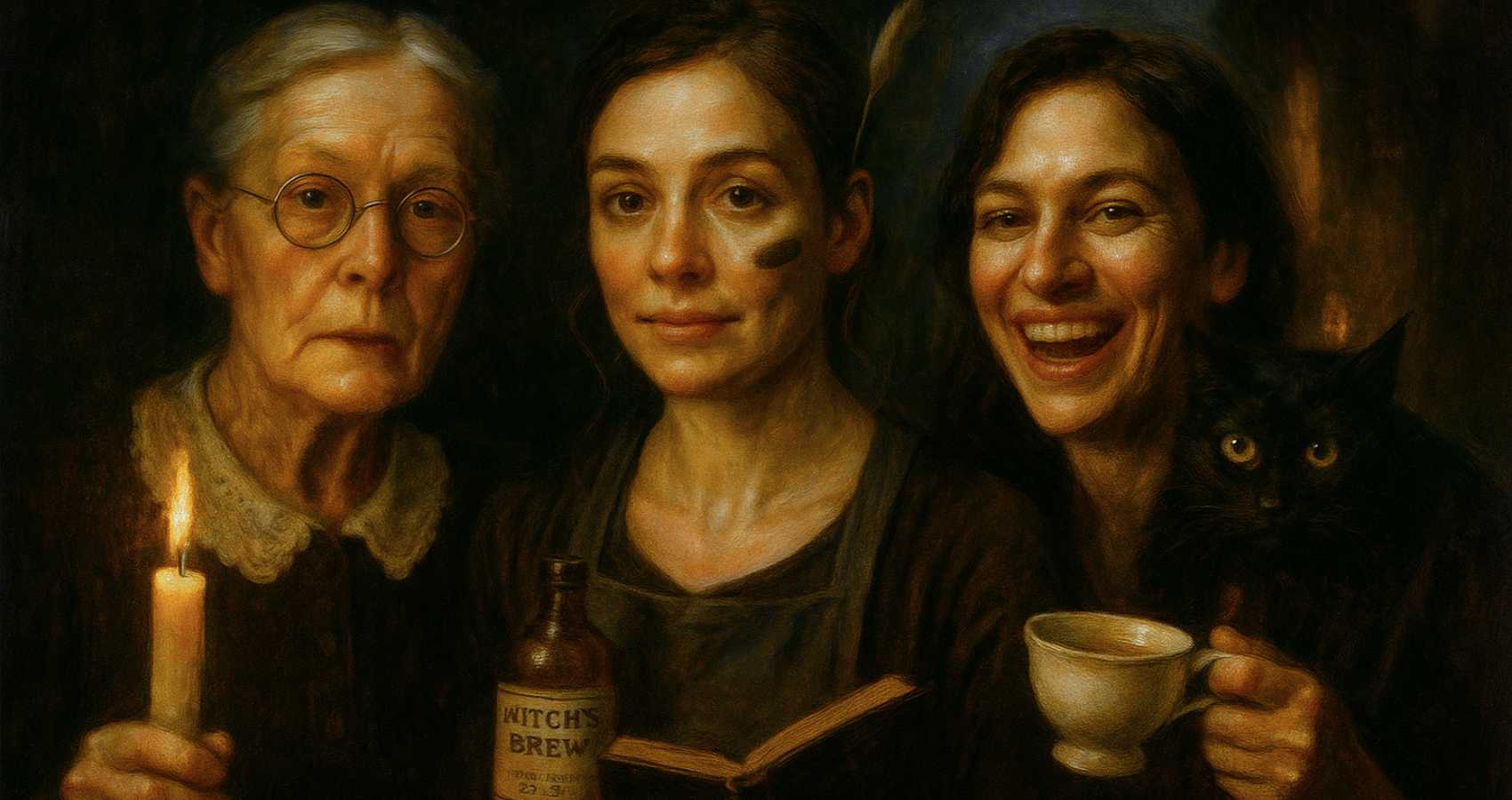
He recruited three local women of considerable theatrical ability—Miss Eliza Curry from the Dramatic Society, her sister May, and a certain Widow Trelawney, who already owned a black cat and a disposition to match.
Every Friday night they’d put on their old cloaks, paint their faces with lamp soot, and wander out toward the cattail marsh. The sight of three figures chanting and waving bottles under the moon was enough to send any sober man running home to his Bible.
Of course, sober men were rare in Mariposa. Still, it was enough to discourage the constable, who preferred his duties to end at sunset.
The operation went splendidly for a while. Clifford’s whiskey found its way into nearly every cupboard in town, labeled as “Witch’s Brew—For External Use Only.”
It was Eliza’s idea to sell the bottles through the church bazaar under the pretense of medicinal tonics. Even Reverend Drone took home a bottle “for his rheumatism,” though it was later noted that his sermons became both livelier and longer.
Meanwhile, behind the church—quite literally behind it, in a small clearing shielded by cedar hedges—a very different sort of witchcraft was indeed taking place.
The real Mariposa Coven met there every Thursday evening, utterly unknown to the bootleggers, the constable, or even the Reverend himself.
Their rituals were mild by occult standards: a bit of chanting, some candle lighting, and a good deal of gossip. They discussed the moral decay of the younger generation, the quality of flour at Smith’s General Store, and occasionally whether the moon looked particularly judgmental that night.
Their leader, Mrs. Henrietta Wicks, was a woman of iron convictions and lace collars. She maintained that a true witch could still bake a pie for a church social without compromising her principles.
The coven’s main objective wasn’t world domination but the preservation of old recipes and the strategic acquisition of plum jam from rival households.
They met quietly behind the church, never suspecting that a few hundred yards away, another kind of spell was being cast—one involving corn mash, copper coils, and a lot less hymn singing.
The bootleggers, meanwhile, began to take their act too seriously. Clifford started introducing new “rituals,” claiming they added to the mystique. He had the “witches” throw handfuls of grain into the fire while chanting advertising slogans.
At one point, he even had them ride around the swamp on broom handles to confuse anyone who might be following. This, unfortunately, resulted in the Widow Trelawney spraining her ankle and having to be carried home in a wheelbarrow.
Rumors spread fast. Old man Mullins swore he saw witches flying across the moon. Miss Lawson claimed her butter wouldn’t churn for three days because of them. And by week’s end, Mariposa was back in the grip of full-blown witch hysteria.
The church council called an emergency meeting to discuss “recent nocturnal disturbances.” It was agreed that if witches were indeed abroad again, something decisive must be done—preferably something that didn’t involve physical danger to the committee.
Constable O’Hearn was dispatched to investigate. He returned two hours later, pale as a ghost, insisting he’d heard voices by the swamp and seen firelight “of an unholy hue.”
In truth, he’d stumbled upon Clifford’s still, mistaken the copper kettle for a cauldron, and run home shouting, “They’re back!”
By Saturday morning, the town was in uproar. Women locked their pantries, men gathered their pitchforks, and the Reverend composed a sermon titled The Devil’s Detour Through Mariposa.
Only Mrs. Wicks and her coven seemed unbothered. “Probably a misunderstanding,” she said serenely, stirring her tea. “People are always mistaking one thing for another. Why, I once saw a weasel and thought it was a Presbyterian.”
But the misunderstanding grew. Clifford, fearing discovery, told the “witches” to lie low. Unfortunately, Eliza took that to mean “hold a moonlit ritual of misdirection,” which she did—right behind the church.
When the real coven arrived that night, both groups froze like cats at a tea party.
There stood the bootlegger “witches” in their ragged costumes, bottles clinking in their aprons. And there stood Mrs. Wicks and her ladies, clutching hymnbooks and candles.
For a full minute, nobody spoke. Then Mrs. Wicks said crisply, “Well. I see the young people have taken an interest in tradition.”
Eliza, thinking fast, curtsied and said, “Yes, ma’am. We’re rehearsing for a—uh—biblical pageant.”
Mrs. Wicks looked doubtful but approving. “Good. Keep your incantations brief. The rector dislikes noise during his after-dinner nap.”
And with that, the two covens—one ancient and the other accidental—merged in perfect ignorance of each other’s true purpose.
From then on, the Thursday gatherings became curiously lively. The bootleggers brought refreshments, the real witches brought hymnbooks, and everyone went home feeling rather improved.
Reverend Drone even remarked one Sunday that “there is a remarkable peace over Mariposa lately—like the calm after a righteous storm.”
He was quite right, though he never knew the reason.
When the constable finally discovered Clifford’s still months later, it was declared a miracle that the “witch plague” had passed. Clifford, ever the diplomat, blamed it on divine intervention.
The Widow Trelawney gave up broom-riding and took to knitting. Eliza married a travelling salesman who specialized in lamps.
As for Mrs. Wicks and her coven, they continued their Thursday meetings behind the church, serenely unaware that they had once shared communion with bootleggers and frauds.
To this day, if you wander down by the cedar hedge in Mariposa on a calm evening, you might still hear laughter and the faint clink of bottles—or maybe teacups.
And in Mariposa, as everyone knows, it’s best not to ask which.

- Christmas Baking - December 17, 2025
- The Krampus Carol - December 2, 2025
- The Mariposa Witches - November 13, 2025