

The Morning Star
written by: Jon Negroni
The snow had come in the night and done it clean. It lay across the yard without tracks, not even from the stray cat that knew the warm engine and the milk saucer. Miles stood at the door in his socks and breathed the cold through the crack. The air bit the soft of his nose. It was good air. He closed the door and dressed by the little lamp that made the room yellow and left the corners to themselves. The clock said four. He did not need the clock to know it.
He boiled water on the stove and poured it through the paper into the mug with the blue ring. The coffee rose and steamed and smelled like when Claire was little and ran in her socks and slid on this floor on Christmas mornings and laughed because sliding felt like flying when you are that age. He put the lid on the travel cup and set the mug down and looked at it, and then drank from the mug first because that was how to wake a man up, true.
He put on the wool cap and the coat with the broken zipper that held anyway if he convinced it. He took the shovel. He opened the door, and the cold came in like a guest that does not talk at first. The sky was a wounded mix of color, with orange fairy lights stretched round the graying blue. The porch steps wore the snow without shame. He stepped down, and the first print showed black wood between white. He shoveled, and the scrape rang down the street where no one else had opened their day. The breath came and hung and went, and he watched it like a man who has quit smoking watches another man’s smoke and remembers all the good and none of the bad.
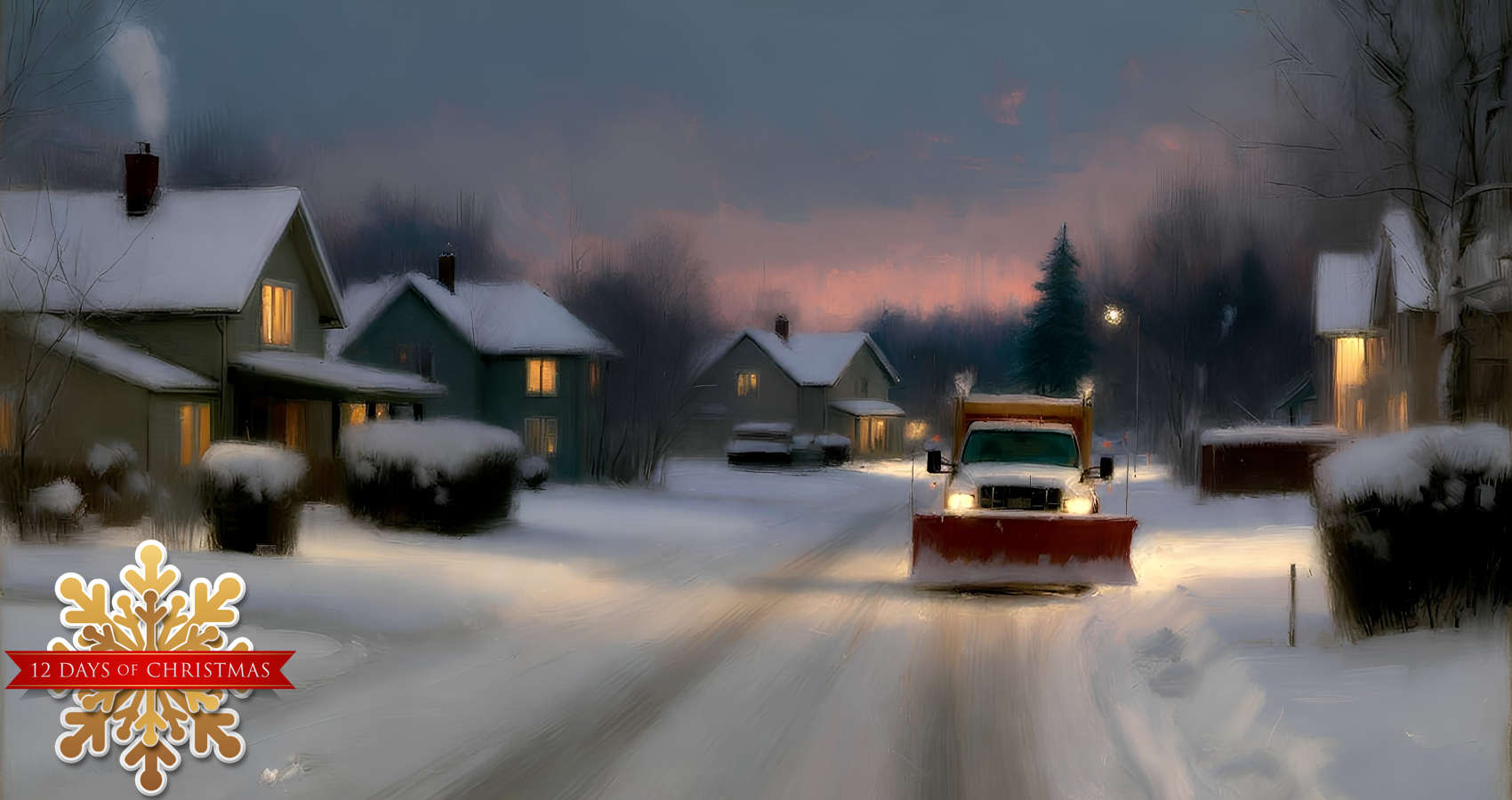
When the steps were clear, he did the walk, the small square of it first, and then the part that reached the street. The plow truck sat at the curb, nose into the drift like an old dog asleep against a barn. He brushed its windshield with his sleeve, and the snow came off in one sheet, and he liked the look of it. He climbed in and turned the key, and the old thing woke as if it had been listening for him. The fan pushed air that was not warm, and then a little warm, and then enough. He let it run. He went back inside and turned off the lamp, and took the little string of colored lights from the drawer where the rubber bands and the old tape measure lived. He draped them along the window and plugged them in. They flickered and chose themselves and steadied. He stood a moment with his hand on the sill and the sill cold under his palm and the colored dots on the glass doubled by the dark outside.
He took the travel cup. He closed the door behind him with the care he would show an old friend. He brushed snow from the seat with his sleeve again and climbed in and set the blade. He drove out, and the blade sent its first long curl into the ditch, and the road showed itself under. It felt like shaving a man who had let his beard roam and was ready to see his face again.
He took the two-lane east to the flats where the wind comes when it wants to say it was here. The cornfields on both sides were white bodies under white sheets. He could see where the stalks had been by the small ridges, the ribs still hidden. He drove slowly and savory. The radio gave him a carol through the static. He sang the line he knew and left off the one he didn’t and felt no worse.
The blade hit a stone, and the truck jumped, and he laughed by himself and kept the wheel. It was good to feel the weight of a thing that wanted to throw him and to keep it from doing so.
At the gas station, the lights were the harsh kind that make a new morning in the dark. The clerk waved, and Miles lifted his fingers from the wheel, and the clerk held up a thermos like a cheers. Miles did not stop. He would stop on the way back when the tongue had learned again what it was for. He took the curve near the creek where the road would slant if he thought too long of other things. The creek was black and thin and moved just beneath its own skin. He dropped another run of snow and watched the ditch fill with clean.
The blade chattered where the blacktop had cracked and remembered summer. The sky lightened as he drank, and the coffee was too hot, and he took the burn and appreciated it. At the bakery, the window glowed. Martha was already in there with her hair under the net and the hands that knew flour. She waved the way bakers wave, with the wrist, like kneading, even when not. He thought of Claire and the cinnamon roll she took apart in spirals when she was nine and said the middle was the prize, and he had said life is like that, and his wife had looked over the rim of her glasses and smiled under the look.
At the next mile, the drifts had blown across the road with a troubling falseness. He set the blade lower and made a lane. The dawn found color. The color was frail, like wine cut with water, and then it sharpened and did not ask permission. He felt the hour come into its shape.
There, at the bend before the pines, a car sat nose-down in the soft, the tail just in the lane. The tracks told a hasty story: brake, drift, the little turn that is not enough, the surrender. He eased the truck to the shoulder and set it. He put on the gloves that held the messy curves of his hands as the leather had learned him. He stepped down. The cold took what the inside had made and set it brittle in his chest, then let him have it back.
A woman stood by the guardrail with a boy wrapped in a blanket that had once been white and now was the color of snow after a day. The woman had that look of having held too many things with the same two hands and kept them from breaking. The boy waved at the plow like it was a parade float.
“You all right?” Miles said.
“We slid,” she said. Her mouth made the word and sent it into the cold small. “It just went.”
“I see that,” he said.
The car’s front wheels had dug. The snow there was sugar over-packed ice, and the ice had ideas. He took the shovel from the bed and set it, and it bit and threw and bit again. The ring of the blade in the ice came up his arms and into his teeth. He liked that too, though it made them ache. The woman came beside him and pushed with a little shovel from her trunk that would have been good for a flower bed in June. He did not tell her it was foolish. He liked that she wanted to move the world with it.
“We’re going to my sister’s,” she said. “He wants to see the big tree.”
The boy made the sound of an engine and stamped his boots. He had a hat with a pom that had gone flat on one side. He looked at Miles as if men in old coats are saints some mornings.
“You got it in park?” Miles said.
“Yes,” she said, and took the shovel and set it again, and the small shovel knocked against the big one and made a different music.
When the trench was clean enough, he jerked his chin at the boy, and the boy’s eyes went wide. “You can help,” he said. “Stand there and tell your mom when the tires smoke.”
“They’ll smoke?” the boy said, pleased.
“They’ll think about it,” Miles said.
He went to the back of the truck and took the little bag of grit. He threw it under the tires the way he fed chickens, a toss, let it scatter. He showed her how to rock the car in reverse and drive, and the soft hum of the engine strained, and then the tires took, and then they did not, and then they did. He pushed on the hood, and she gave it gas, and the wheel jerked, and the car came back to the road with a kick like a fish returning to water. They all stood there with their mouths open, then laughed because when a thing that was wrong becomes right again without anyone dying, Miles would laugh.
“Thank you,” she said, breath showing in little puffs. “I have cocoa.”
“You keep it for the boy,” he said.
“I made too much,” she said.
She had a thermos. She poured into the little black cup, and the smell was sweet, and there was a nutmeg to it and a memory. He took it and pushed the glove back and felt the heat in the web of his hand and drank. It was too sweet. It was perfect. He coughed once because it asked him to. The boy watched to see if he would make a face, and when he did not, the boy approved him for the day.
“You plow the whole road?” the boy said.
“I make a path,” Miles said.
“My name’s Harry,” the boy said. “We’re going to see the big tree. It goes to the ceiling.”
“Good trees do that,” Miles said. “They don’t stop if you let them.”
The woman smiled in the way tired mothers smile when a stranger talks to their child and does not make the child smaller. She took the cup and capped the thermos.
“We’ll get out of your way,” she said.
“You’re not in it,” he said.
“You work on Christmas?” Harry said.
“Eve,” Miles said. “Tomorrow I eat eggs and drink eggnog and watch the light move.”
He had not meant to say watch the light, and it came out and stood between them like a small dog that had followed him, and he pretended it had always been there. He lifted his hand, and they lifted theirs, and he went back to the truck, and the truck welcomed him in its old way. He pulled into the lane and watched them in the mirror until the curve took them and the pines held their secrets again.
He sat with the engine low and the heat good now and watched the morning open. The sky took a color like the inside of a peach and then threw that away and went to pearl and then to the pale hot blue that winter makes when it feels like boasting. The snowbank he had made caught the early light, and each thrown arc showed its edge. It was a pretty piece of road now. He thought of calling Claire. He would call tomorrow. Tomorrow was for voices. Today was for work and the quiet the work brings.
He set the blade and went on, and the road ran out under him like a ribbon a girl lets go in wind. He waved to Martha again and she held up a paper bag and he stopped and she came out in her coat with the bag and handed it up to him and said it’s on the house, fool, and he said you’re the fool and then thank you and the bag was warm with rolls that had sugar melted in before it cooled and he looked down at her and she had snow in her net and she laughed and went back in and he loved her in the way he loved anyone who feeds another person for no reason but that it’s right to feed people, especially on the holiday.
He circled at the county line and came back. A deer had stepped when the plow first went, and the track crossed where the black showed. He followed it with his eyes until it reached the fence that had never stopped any deer in its life. The bells from the town church carried short and honest. He hummed a bit under his breath, and the humming sounded like he knew the tune but not all the words, and he loved it anyway.
By the time he cut the last pass by his own street, the day had become a day that anyone would claim. He parked the truck in front and left it running while he went to the porch. He stood there and watched the exhaust make its own cloud and then undo it. He looked down the block where the small houses had the same roof of snow and the small differences in how people had cleared their steps. In one window, a blinking plastic candle bothered the eye and then soothed it. In another, a woman held up a dress against her and turned and set it down. The neighbor’s dog barked once to say he had not gone south. The world had settled into its next hour.
He went inside, and the lights in the window were still on and kind. He set the paper bag on the counter and opened it and the sugar on the rolls had turned to a thin glaze and he took one and tore the middle out with thumb and finger and put it in his mouth and chewed and the sweetness was simple and the salt was there and the butter said its piece and he closed his eyes once and then opened them, as he knew to do when he was alone.
He rinsed the travel cup and filled the kettle, and set it, and the blue flame licked into place. He took the phone from the shelf and looked at it. He set it down. He took it again and scrolled to Claire’s name and held a thumb over it, and the thumb did not press then. He would press tomorrow. He had the words ready. Happy Christmas, honey. I cleared the main. You get any snow out there? He smiled at nothing. People in that place called it rain when it was not proper rain, and he would tell her she was wrong and love her wrongness for being hers.
He made coffee in the mug with the blue ring and the blue had chipped on one side, but the ring was a ring anyway. He carried it to the chair by the window where the light could find him. He sat. He felt his back tell him what it thought about shovels and bent iron. He told his back he had heard it. He took a small breath and let it go slowly. The little lights wore their color without arguing. Outside, the snow wore the light and gave it back in a softer way that made the houses look like they had been forgiven for something minor.
He could see the road he had cut from here, a thin, clean lane down the block and around the turn. A pickup went by, and the driver saluted three fingers, and Miles did the same, and the old language worked. A boy dragged a sled that had lost paint on the runners, and his father pulled the rope twice, and the boy laughed as if he had been pulled all the way to the North Pole and back again. A woman in a red hat carried bread with a towel over it to keep it warm, and the steam rose and vanished, and no one cried out at the vanishing.
He thought of his wife’s last Christmas and the way she had put the ribbon between her teeth and cut it because scissors were under the paper, and she could not be troubled to go find them. He recalled the last present she had given him, a pocketknife with a bone handle that had lived in his pocket ever since. He touched it there through the cloth to make sure the luck was still where luck should be.
He did not say grace out loud. He had no words for it. He drank coffee and watched the day, and when he swallowed, he swallowed for the men on the road and the women at the ovens and the kids who dragged sleds and the dogs that put their noses deep into snow and came up wearing small white beards. He swallowed for the woman and the boy, for the small shovel that was wrong for the job and yet made its music, for the thermos that held the too-sweet cocoa that he would drink any day you gave it to him. He swallowed for the clerk and the baker and the church bell and the deer and the creek persisting in the cold. He swallowed for the plow that was older than it should be and still worked and for the stone that made it jump, and for his laughter in that moment at nothing.
The bells started again. He listened. He knew the song even if he did not know the verse. The line about a star went through him easily. He stood, and the chair creaked in its old way, and he went to the window and put his palm against the cold where the glass met the frame, and he left the print there, and the print looked like a wreath with the lights seen through it.
He walked back to the stove and turned off the kettle that had forgotten it was done, and started to sing to itself. He broke another roll and saved the prize in the middle and ate it last. He cleaned the cup and set it upside down on the towel. He unplugged the little lights, and the colors died one by one and then together, and the window went back to being a window. He left the string in place as evening would want it.
He went out again to knock the snow from the evergreen at the corner before it bent and broke, and he used the broom the way his father had used a broom on a tobacco shed, with respect for how things remain the same if you tend them. The snow fell away in small avalanches, and the tree stood a little taller. He looked up and the sky was now full blue and let the thin pale sun through without any fuss. He looked down the road he had made, and it was clear. The day would bring its noise. For now, it was good enough.
He went back inside and shut the door with the same care and stood in the quiet of his kitchen and smiled the grin not meant for anyone and was real because of that. He sat and took the phone and scrolled to Claire again and hovered and almost pressed and then set it down and said out loud, “Tomorrow,” and heard how the word made a promise and took nothing it could not give back.
The truck outside ticked as its engine cooled, mixing with the mutters of the house. On the counter, the paper bag sat open like a mouth in a good mood. He breathed, and the air in here had a bit of cinnamon and a bit of beans and a bit of wool and the faint iron of old pipes. It made him think of the creek under the ice and how it went about its business without asking for much. And the star in the old song did not care where it had been or whether it had been, but liked that men had sung about following light in the dark for this long without the singing wearing thin.
He picked up the knife with the bone handle and opened it and closed it, and it made the sound it always made, and it was the right sound. He put it back. He leaned his head back and closed his eyes, and let the house hold him in its arms, and the morning held the house. He did not sleep. He did not need to. The day had started, and he had started it, and that was all a man could ask from a day like this. When he opened his eyes, the light on the sill had moved the length of a finger, and he liked the measure of it.
He rose and put a log on the small fire in the stove, and the flame took its time and then took its duty. He went to the window and plugged the lights back in, knowing that sometimes a man can give himself a thing without being ashamed for wanting it. The colors came and settled and looked back at him in the glass with the morning beyond them and his face in the middle, and he lifted a hand to himself, and it was a toast to all of it. Outside, the road shone. Somewhere out there, the boy in the hat had seen the big tree that went to the ceiling and put his head back, and the mouth had opened and made the sound boys make when the world is full, and they have to let it out or drown. Miles knew that sounded better than most others. He had made it once when he was small and then later when he was not.
He stood there and held the sill and let the warmth of the little bulbs be cheap and good against his knuckles. He could already taste the eggs for tomorrow, and he could hear how the fork would sound on the plate, and he knew he would call Claire tomorrow and say, Happy Christmas, honey, and then hear her voice say, Happy Christmas, Dad, and that would be that and everything. He looked at the morning star, that was not a star but the bright spot the sun makes in the window if the glass is just dirty enough to catch it. He smiled at that, too, because even the dirty can hold light right when it needs to.
He took a breath. He let it go. The day. The road. The light. He stood in all of it, unshakeable as an old plow in a good lane.

- The Morning Star - December 21, 2025