

The Mouse on the Hearth
A Christmas Tale
written by: Cathy Anderson
In the English county of Essex, but far from the coast and the cold North Sea, a village lay in the green hills of Stepshire. An hour’s carriage ride from the village was a small country house, clothed in wood shingles weathered to gray. A woman lived in the house, and from its back door she could see the pine woods and the bank of the river, which ran swiftly over its rocky bed to the mill. From the front door, she could see the road to town. Next to the door was a hat rack, which held a beribboned bonnet but no sturdy, wide-brimmed hat suitable for a man. There were no man-sized boots near the door, no shaving razor at the basin. The man whose belongings would have cluttered the rooms, whose presence would have warmed the house—the man who was to have been the woman’s husband—had left her and married another. In the years since, the bitterness of the loss and shame had grown in the woman until her heart was as cold as a stone in the riverbed.
The woman kept a cow and a horse and some chickens, but she lived alone, but for a green-eyed cat who plagued her for food all day and took up the center of her bed at night. The cat was her only companion. The people of nearby farms had given up trying to befriend her with their fresh-baked crusty pies or bags of musky-smelling walnuts, and the merchants in the village had stopped trying to chat with her about the weather or the doings of the town. As the years ticked by, there were fewer and fewer people the woman wanted to talk with at all. She shunned the attentions of others, wrapping her aloneness around herself like a threadbare shawl.
One winter, a few days before Christmas, the woman was sitting by the hearth, eating a supper of thick stew and bread, when the cat suddenly jumped up and bolted to the other side of the room. He howled triumphantly, as if he had performed a great feat. The woman got up to see what the cat had captured and saw a squealing mouse with its tail trapped under the cat’s paw. “Good kitty,” the woman said and turned to go back to her supper. As she stepped away, she was surprised to hear what sounded like someone calling her name. There it was again—someone had spoken her name. “Lydia!” Lydia!” “Please help me!”
She was puzzled, then astonished, because the sound seemed to be coming from the mouse. “Mercy!” she said. “I must be losing my mind.” The mouse was struggling to free itself, and the cat was slowly releasing the pressure on its tail, anticipating in his shrewd cat mind that the mouse would break free. Then the cat would make a quick leap and grab the fleeing mouse by the neck, and it would no longer struggle or run away.
“Save me! Save me! Please!” the mouse pleaded in an increasingly human voice. Suddenly, the mouse broke free and scurried across the floor. The cat crouched and rapidly shifted its bulk from one back foot to the other, preparing to make the final leap. But before the cat could get off the floor, Lydia made a leap of her own and snatched the cat into her arms. She put the cat in the other room and closed the door, ignoring his howling and the mad pawing at the door.
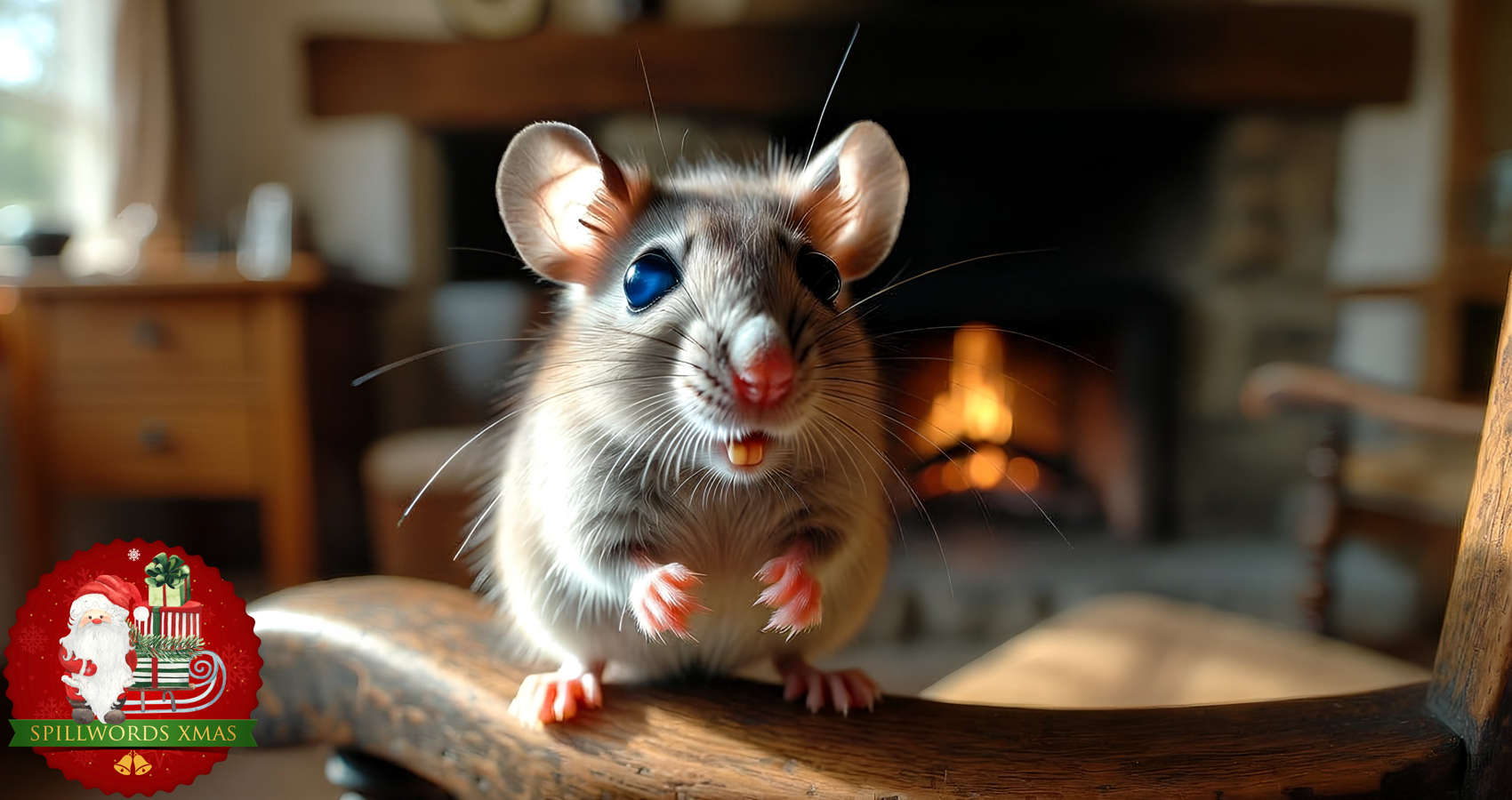
Lydia was a bit confused and didn’t quite know what to do next. Had she just been spoken to by a mouse, or had she gone mad in her near isolation and imagined someone talking to her? She looked around, but there was no sign of a mouse, talking or otherwise. Still befuddled, she went back to her place by the hearth and began to eat the lukewarm stew. After a while, as she sat gazing into the fire, she heard a voice close by. “Thank you.” Lydia turned her head toward the sound, but saw no one. “I said, Thank you.” Puzzled, Lydia looked down and saw the mouse perched on the arm of her chair, its body upright and front paws raised. It looked odd for a mouse—fur the color of sawdust and eyes of bright blue. Then the mouse spoke again, its large, white teeth sparkling in the firelight. “I would very much like to repay your kindness. If you will allow me to remain here until Christmas, I will give you, each day, one of the world’s greatest gifts. All I ask in return is that you protect me from that evil cat while I am here.”
Lydia considered the mouse’s strange offer. She imagined herself living in a lavish house with servants and going to town in a fine carriage pulled by a large, beautifully groomed horse. She imagined sumptuous meals, prepared to her liking by a great chef. She thought of herself dressed in corseted gowns and satin slippers, with silken gloves gracing her long, slender arms. But then she remembered that her arms were not the long, slender reeds of a lady’s arms, but were strong and freckled from years of working her small farm. And the thought of squeezing her buxom figure into a corset and her oddly shaped feet into dainty slippers almost made her groan. But the worst part of such a life was that she would be just as sad and alone in a mansion as she was in her little weather-worn house. She was accustomed to her life, solitary as it was, and thought it best to go on as she had. Tired from her imaginings and the very odd experience of the evening, Lydia dismissed thoughts of the mouse, got into her nightgown, and crawled into bed beside the surly cat.
The next morning, as Lydia was finishing her breakfast, the mouse climbed onto the arm of her chair. “I am prepared to give you the first gift,” he said. “Watch as I call it up from the ashes.” The mouse scurried onto the hearth and jumped into the ashes in front of the grate. He began to jump and spin, creating a great cloud of ashes that drifted up over the fire. As Lydia watched, the cloud formed a ring, which assumed the very appearance of a holly wreath. Lydia looked into the center of the wreath and saw splashes of color—red, orange, blue—floating, melting, intertwining. The colors formed images of faces—proud, sad, smiling, noble, but sharing a common humanity. The faces dissolved into lines—curving, twisting, connecting, then splintering in a free-fall of multicolored dots that spread like spray in a fountain. Next, everything went green and gold, and she was whisked over meadows and floated over hills speckled with marigolds and daffodils. Then the world turned blue, and she was swept next to pond, lake, and ocean under a sapphire sky, which turned to pink and lavender and gold as a crimson sun slipped into the water. Then the ocean became iridescent, an undulating sea of liquid glass, which roiled and crashed onto a crystal beach. She watched the sparkling foam seep into wet, gray sand, which turned to the soft gray powder of ashes settling into the fire. The mouse emerged from the ashes, then looked up at Lydia from the hearth. “I trust you will pass a very pleasant day today. The second gift will be yours tomorrow.”
Lydia did have a very pleasant day. She was somehow more appreciative of the beauty around her—the grey-green woods, the sparkling river, the hills under a cloudless blue sky.
The next day, Lydia didn’t even think about breakfast but went straight to the fireplace to start the day’s fire and await the mouse’s visit. In a short while, he climbed up the side of the chair and took his place on the arm. “Good morning,” he said. “Your second gift awaits.”
A copper ladle hung from a hook on the front of the fireplace, and with great alacrity, the mouse jumped to the small table next to the chair and leaped into the bowl of the ladle, then bounced out onto the hearth. The ladle clanged against the stone fireplace, bouncing and swinging like a pendulum, making ringing noises. The noise became more resonant, then melodious, like the ringing of church bells. The sounds blended into harmony, and Lydia heard voices in a choir, some soft and high, others sweet and full, still others deep and powerful. As she listened, captivated by the rush of the music, the soft, soulful drone of violins came in, followed by the deep groan of the cello. Then she heard horns, so sweet and clear, complementing the voice of the strings. The music swelled into rich and melodious sounds, the likes of which she had never heard, from instruments she could not even imagine. Then, when she thought her heart would erupt from her chest, the symphony burst into its crescendo, which moved her to tears. As the melody faded, the soft tapping of a drum took its place. She found it difficult to sit still as the rhythm of the drum was joined by other sounds—thumping, banging, sometimes clanging, which then became the soft clanging of the ladle settling back against the stone fireplace. Lydia’s face was wet with tears, and she could not name the feelings that rushed into her consciousness.
The mouse spoke to her from the hearth. “It appears to me that you still have much love and compassion to give. Perhaps you will find someone to share them with. Good day, mistress. I bring your third gift tomorrow.” Lydia sat still for some time, then went back into her bedroom and picked up the cat. She stroked its soft gray fur, then patted his ample belly. She considered the cat’s face, as she had not done for a long time. It was heart-shaped and had luminous green eyes and a velvety gray nose. As she stroked him, he began to purr and rubbed his face against Lydia’s chin. She finally reminded herself that she had chores to do and reluctantly let the cat resume his place on the bed.
She slept restlessly that night, as if she had left something undone or had an important task to complete. When she awoke, much later than usual, she hurried into the other room, quickly tended to the fire, and took her place by the hearth. “Oh dear,” she thought, “I hope I haven’t missed it.”
But soon the mouse appeared and smiled a big mousey smile at her. “Good morning, lovely mistress. Watch the fire—your third gift will soon appear.” The mouse dashed onto the wood bin on the hearth, took a twig, and flipped it into the fire. Sparks flew from the fire, hanging like stars in front of the sooty black wall of the fireplace. The lights began to assume patterns, until Lydia could envision the shapes of people and animals traced against a night sky. The seven sisters appeared, then pirouetted into the shape of a bull. The bull leaped aside, and the hunter, Orion, took its place. The hunter shot an arrow that arched toward a great bear. Then the lights multiplied until they filled the sky with whorls and dots and shooting stars, so many that Lydia could not take them all in. The tiny points of light merged into a huge, searing ball of flame that was racing in a great circle, as if running to put out its own fire. Then the ball shimmered into a softly lit sphere with the enigmatic face of a man. She could not comprehend the vastness of the scene; she was simply awed by the majesty of what she was seeing. Finally, the shining sphere melted into one perfect, softly glowing star that hung over the fire, then burst into a shower of sparks that settled gently downward.
The mouse said, “I have given you art, music, and science—great gifts indeed. But tomorrow I bring you the greatest gift of all.” Lydia was overwhelmed. For the first time she could remember, she felt a connection to the world around her and to the other people who shared her world under the vast sky.
After some time, Lydia got up and made plans for the day. She would go into town. She bathed with extra care and put on a high-collared dress that she had been saving for a special occasion that had never come. She took some money from a crock on the mantle, coaxed her horse into the harness, and rode her rickety cart into town. She knew many of the people she encountered there, most of whom were taken aback when she smiled at them and said, “Merry Christmas.” Others stuttered out confused replies to her “Good morning.” The simple greeting gave her pleasure, like a sweet taste she hadn’t experienced in a long time. The gaslights that lined the streets were graced with red bows, and the shop windows, displaying each store’s best wares, were decorated with greenery and ribbon. Lydia went happily from store to store, picking up a jar of candied apples, some mince for a pie, and a tin of pears.
As she wandered, looking for nothing in particular, she saw porcelain-faced dolls dressed in taffeta and lace, great sleigh-shaped baskets of breads, and silver platters of sugar candies—so many pleasures for people to enjoy and share. As Lydia thought of the nearby houses with families great and small, the bitterness of her unrequited love pained her once again. Then she thought back on the wonders of the last three days and thought, “If there is so much beauty in the world, maybe there is love enough for everyone.” At the very least, she might find friendship among the townspeople. Surely there were gentle souls among so many people.
Lydia walked on until she came to a woman sitting in front of a shop. She had a tub of holly branches and was weaving them into wreaths, thick with clusters of red berries. The woman smiled at Lydia and said, “Good morning! Would you buy a pretty holly wreath? It’ll brighten your home and your day.” Although Lydia was careful about spending her hard-to-come-by pennies, she couldn’t resist the woman’s pink-cheeked face. She dropped the coins into the woman’s hand, took the wreath, and went on into the shop. Once inside, she was quickly drawn to a table of miniature glassworks. Among the sculptures were a tiny horse with its head raised in the air, a butterfly with patterned wings, and a small bell engraved with tiny doves. She was taken with the bright tinkling of the bell, so she carried it to the counter where the shopkeeper stood. He smiled in surprise to see Lydia looking so pleasant and said, “Good morning, Miss Brown. How are you on this blessed day before Christmas?”
Lydia thought for a moment, then replied, “Very well, thank you. And you?”
“I am well, if a little short-handed in these busy days,” he said. “Your wife is away?” Lydia said, glancing around the shop. “I almost always see her here.”
“I am sorry to say my wife took a fall and is housebound until her leg heals. It may be some weeks before she is back.”
“Maybe I could pay her a visit,” Lydia said, more astonished at the words that came out of her mouth than the delighted shopkeeper was.
“That would be splendid,” he said. “May I tell her when to expect you?”
“Tell her I’ll come day after tomorrow.” Lydia took the carefully wrapped package and placed it in her basket. “Goodbye,” she said, “and have a merry Christmas.”
As she walked on, wondering about her uncharacteristic congeniality, she came to the general store. In the window among the utensils and pots, there was a star made of polished tin ribbon. She admired the workmanship and the simplicity, and it seemed like a fitting thing to take home on a Christmas Eve. She went in and asked the clerk for the star, but he was busy putting up stock and told her she would have to wait. Lydia had done business in the store many times and had treated the clerk with polite indifference at best, so she wasn’t surprised at his rudeness. She touched the sleeve of his shirt lightly and said, “I really need to be getting home, if it’s not too much trouble.” Then she smiled at him, as if to say she was sorry.
The clerk glanced at her, raised an eyebrow, and said, “All right.” He handed her the star in silence, but when she smiled again and said, “Merry Christmas,” he smiled too and wished her the same.
Lydia rode home feeling warm and happy. She would enjoy her baubles and a bit of her sweets and sit in front of the fire with her cat in her lap. Tomorrow was Christmas, and it would be a special day after all.
On Christmas morning, Lydia awoke early with a sense of pleasant anticipation. She tended the fire, fixed her breakfast, and took her place by the hearth. She was pleased to see the festive holly wreath hung over the fireplace and the little glass bell on the mantle. The shiny tin star hung in the fireplace opening, turning slowly in the warm, rising air. These things reminded her of the miraculous events of the previous days, and she was almost afraid to acknowledge the change they had wrought, for fear that she would lapse again into the bitter, solitary person she had been.
The visions she had seen and the feelings they brought had been increasingly in her thoughts. She recalled how pleasant it was to be among the townspeople, to see the children so full of life, laughing or fretting, and their parents, somehow drawn to each other, whatever their fortunes or troubles. Maybe there was hope for her.
Lydia sat musing by the fire for some time, but the mouse didn’t return. She was disappointed, not so much that she wouldn’t receive the gift she had been promised, but that she wouldn’t have the company of the mouse. She had come to enjoy his bright and energetic face, his brisk little movements, and the kindness in his eyes. She would miss him. As she went about her housework, it occurred to her that the gift she had been promised might be at hand after all. If the greatest gift is love, as it surely must be, maybe she had found it among the townspeople and in herself. If the love of a good and faithful man never came, at least she had the hope of love and the companionship of other people who struggled through life’s troubles and savored its joys, year upon year.
She did a bit of mending and passed a very pleasant morning with her cat, then she took a walk toward the mill, where she could watch the river play among the stones. When she got to the mill, she stopped and sat on the stone wall in a patch of sunlight. After a while, a man of imposing size appeared on the road, and as he came near, he tipped his hat and said, “Good afternoon, lovely mistress. May I rest a while on the wall? The sunlight is very inviting on this brisk Christmas Day.”
“I suppose you might,” replied Lydia. The man removed his hat, and a mass of wavy hair the color of sawdust tumbled from under it. He looked her way and flashed her a smile that was welcoming and somehow familiar. When she returned his glance, she was touched by the sweetness in his bright blue eyes.
“If I may introduce myself, my name is Edward Bosley. I’m on my way to the Christmas fair in Carrolton. It’s quite a spectacle—jugglers, fiddlers, dancers—–and I hear there’s a fortune teller. Wouldn’t it be wonderful to have a glimpse of the future?”
Lydia smiled, thinking of the visions she had seen of late, and said, “I think the future will take care of itself. But the fair sounds lovely. I’ve never been to one.”
Edward said, “My word! You must come with me, then. We’ll have a grand time.”
Lydia was surprised by such a proposal from a stranger and said, “I couldn’t possibly go off with a man I’ve only just met.”
The man worked his fingers around the brim of his hat and cast his eyes downward as he spoke. “I beg your pardon, but we have met before.”
“I think I would remember meeting someone like you,” she replied. “You must be mistaken.”
“There is no mistake,” he said. “I came to you in the form of a mouse.”
“You must be daft!”
“I was enchanted, but I’m not daft. The colors, the music, the heavens—those were my gifts to you to repay you for saving my life. They were real, and so am I.”
Lydia could not believe what she was hearing. She was frightened but could not tear herself from the stone wall that held her and seemed to be the only thing solid and real in her life. She searched the man’s face for insincerity or malice, but she found only the kind and wise expression of a man who had been humbled and redeemed.
“I know what I’m about to say will seem impossible, but I swear it is true. Please, just hear me out.”
Lydia could only nod.
“I spent the better part of my adult life in retreat. I was afraid of the consequences of every step I took. My father and mother were quick with the strap, and I never outgrew my childhood fears—although I certainly outgrew my clothes. I cowered in front of anyone who might hurt me with a word or a harsh look. I walked not with the confident stride of a man but with the shuffling gait of a rebuffed boy. As the years went by, I found myself alone, afraid to risk even friendship. I contented myself with the company of animals and found employment in stables and on farms, though I was educated to be a teacher. I was the most miserable of men, but in the end, I could not think of myself as a man at all, and I threw myself into the river to drown.”
“Oh, my!” said Lydia.
“I lost consciousness in the water, and the next thing I knew, I was crawling up the riverbank on the other side, as a mouse.”
Lydia threw her hands over her face as if she couldn’t bear to hear any more.
“Please, let me go on. You will understand presently.” He raked his fingers through his hair and began again. “I didn’t have long to consider my situation, because I had no sooner shaken off the water when a large dog began barking and chasing me. I ran under a log and stayed there for what seemed like hours, terrified and nearly deafened by the dog’s barking. But that was only the beginning. Over the next several years, I learned what real fear was. Peril was every place I turned. There was never a day that something or someone wasn’t trying to eat me, smash my head in, or poison me. I have been chased by so many cats that I must be a legend in the annals of catdom. I have been cut, beaten, clawed, trapped, and scared witless. I have looked in the face of death.”
By this time, tears were sliding down Lydia’s face, but she could not stop looking into the man’s eyes.
“A few days ago, I was thinking about throwing myself into the river again. I wasn’t hoping to die—I was hoping that I might emerge as a man again. I had learned something about courage and compassion in those years as a mouse, and I wanted a chance to put them to use as a man. I was on my way to the river when I saw the smoke from your chimney. I ventured in to feel the warmth of a fire before I plunged into the river again.”
“But the gifts you gave me, the sounds and lights and colors—how was that possible? Weren’t they real?”
“Yes, they were as real as any thought I’ve ever had. I think I was able to stay alive through those years as a mouse because I had emerged from the river with the ability to project my thoughts. Sometimes I could bring up a vision that would distract or confuse whatever was trying to kill me. While they were entranced, I would escape. Unfortunately, I couldn’t bring up a vision when your cat had me by the tail. So it was your compassion that saved me. I gave you my visions because that is the only way I had to repay your kindness. They are visions of the depth of beauty, love, knowledge, and compassion in the world. I had been too fearful to acknowledge them in my life as a man.”
“I, too, had failed to see the gift that life is,” said Lydia. “I could see only my sad and lonely existence. You gave me hope again. Thank you.”
“You are most welcome, lovely mistress.”
Then Lydia thought of the sweet little mouse throwing himself into the cold river. “Oh, my! Did you… ?”
“Throw myself into the river? No,” he said, “I curled up on your porch last night to sleep. When I awoke with the sun, I was a man again. Christmas truly is a time for miracles.”
“It certainly is,” she said. “It certainly is.”
“So, will you come with me to the fair?”
“I believe I will,” she replied. She was not frightened anymore, and what better way to spend the first Christmas Day of her new life than in the company of a kind and wise man?
“Delightful!” he replied.
They soon began walking, the sun soft on their faces. Edward began to talk about the life he saw before them, and he flashed her his big, toothy smile. Lydia smiled back, musing about the magical days that lay before them.
The End

- The Mouse on the Hearth - December 26, 2025