

A Different Country
written by: Christopher Johnson
I remember childhood as a different country from adulthood. In the country of childhood, emotions are more intense than in adulthood, the perceptions are sharper, the slights cut more deeply, the experiences imprint themselves more firmly in memory. The feelings are nails being driven into your body. It is a time of intensity: joy, boredom, pain, loneliness, enthusiasm.
The boredom can be piercing—a rainy Saturday afternoon when the television is broken and your friends are all busy, and you’ve read all your comic books twice already, and your sister’s at a friend’s house so that you can’t tease her so much that she ends up hitting you, and your dad is fixing the toilet, and your mother is sewing. Boredom. It’s like being in the ninth ring of hell.
In childhood, humiliations are serrated knives that cut deeply. But somehow, as children, we learn to bounce back from those humiliations. When we are children, a huge gap separates us from the adult world. The adult world gives all the orders, and the children’s world obeys, at least until the plague of adolescence sets in and we engage in our little rebellions.
Those are the feelings that flood me as I remember the piercing excitement I felt on the day when my father was going to take me fishing. I was nine years old, and I was unable to sleep the night before. I can’t remember exactly where we were going to go fishing. We lived in northern Ohio, around Cleveland, in a semi-rural area, so there were many rivers and streams abounding with fish.
But I do remember one thing very vividly: I was certain that I would catch many trout. Before we began to fish, there was the all-important preparation. That meant catching worms. Of course! No artificial flies for us. I walked with my father into the nearby woods, which sprawled like a jungle across several acres of land at the end of our block.
We marched into the woods, I carrying a pail, Dad carrying a garden fork with which we would impale the soil in which the succulent worms were just waiting to become dinner for some hungry trout. Worms that we would find by digging into the good, brown, precious earth of the woods. Healthy worms. Scrumptious worms.
It was a stunning July day—one of those days that seem to last forever—a day on which the resplendent sun shot its arrows through the canopy of trees and cast a golden glow that seemed to set the woods on fire. It was a day that gleamed with slowly gathering heat, a day on which no breath of wind trespassed through the trees, a day that held magic in the air—a day so beautiful that it promised to transport the soul to a more elevated state.
As we marched farther into the woods, Dad suddenly stopped tramping and looked down at me and said, “Ulee, this looks like a great spot to dig for our worms. So, worms, watch out! We’re comin’ for you!” What intuition had led my father to decide that this was the best spot in these woods to find our yummy worms? I had no idea. It was one of the mysteries that surrounded my father—how he decided that this was the perfect place to dig for our scrumptious, finger-licking worms.
I set down the pail I was carrying, and Dad took the garden fork in hand and, using his right foot for leverage, plunged the fork deep into the earth. I watched him as he dug. He was as thin as a board but strong, and the veins protruded like streams from his wrists and hands. He dug with a single-mindedness that was almost frightening to me. He was like that. When he painted or fixed something around the house, he concentrated on the task completely, tuning out the rest of the world. On his left cheek, he had a two-inch-long scar, caused when, as a teenager, he had been tussling with his beloved dog, Peppy, and the tussling had gotten out of hand. His blue-silver eyes crackled with concentration. Even though I was only nine years old, I intuited that my father’s face was a mask that hid thoughts and feelings behind a stony exterior.
He continued to dig with ferocious intensity. He dug up clods of earth, and we bent down and sifted through the earth, searching for those luscious worms. And we found them—wriggling, squiggling creatures. Dad said, “Ulee, dump some soil into the pail, and we’ll put the worms in there. That way, they’ll stay fresh and alive till we’re ready to use them as bait.” Wisdom from my father. He knew just what to do. How did he have this seemingly infinite knowledge?
We filled the pail halfway with soil and took hold of six or seven worms, and placed them into the pail, and they wiggled and squiggled as if they were still at home in the woods. Dad looked down into the pail and said, “We could use some more.” He looked down at me. “Why don’t you dig for some, Ulee?”
“Really?” I said. Digging for worms felt like a very heavy responsibility–handling this adult tool, delving for the succulent worms myself. Dad showed me how to grasp the garden fork in both hands, how to place my left foot on the ground, and my right foot on the horizontal bar from which the tines of the fork protruded. Those tines still had clumps of soil clinging to them, and Dad kicked the soil from the tines. Now the tines gleamed like weapons in the sun, and the points of the tines looked as sharp as razors.
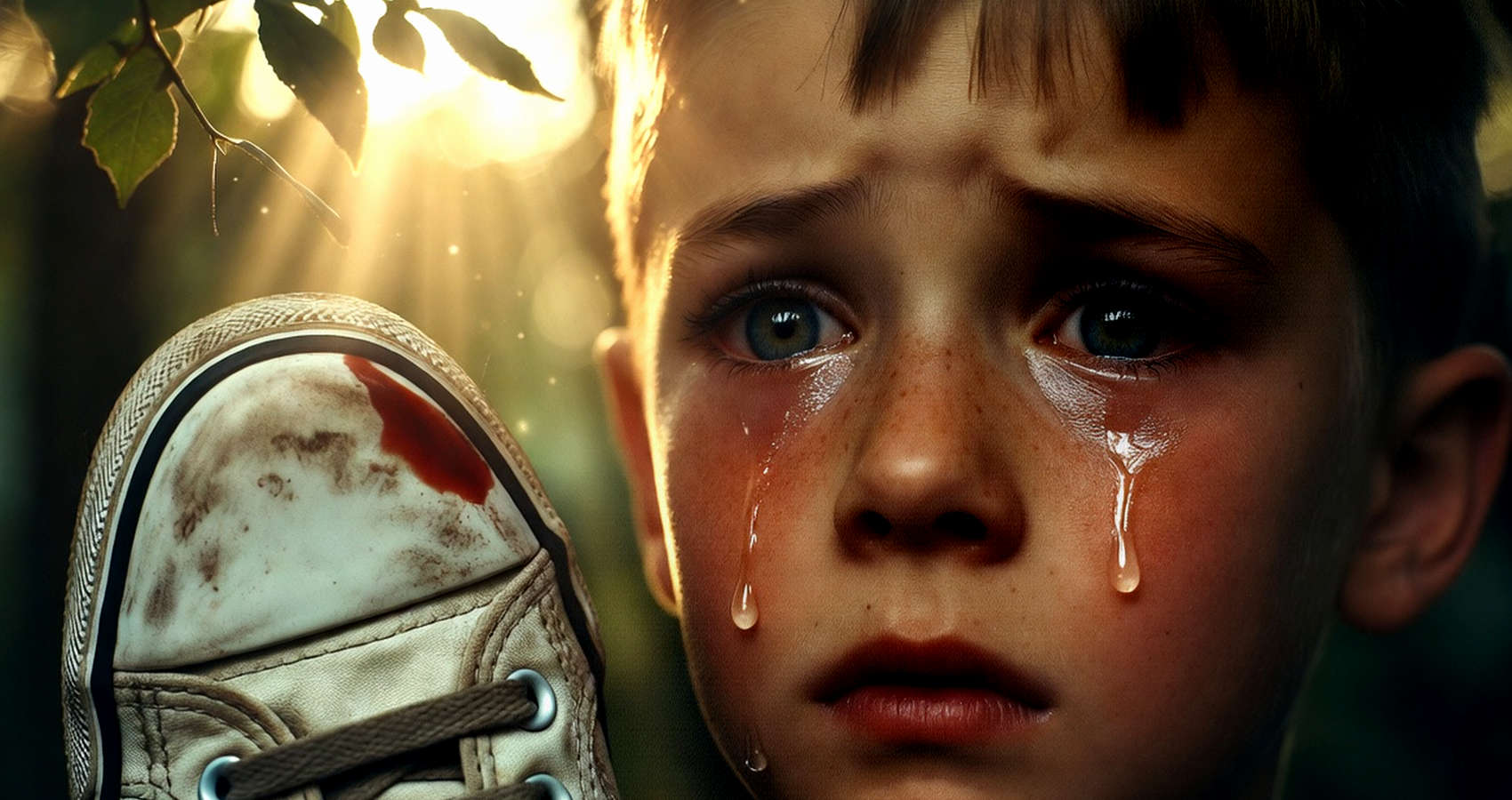
I was wearing my trusty Keds sneakers, which had been through every element that the earth had had to offer that summer. The sneakers had originally been pristine white, but now they were brown and spotted with soil and water, and the tread was nearly worn away. Those Keds had carried me into ponds and across streams and up hills that my buddies and I had imagined into sanguinary battlefields. The sneakers were tattered and torn, and the shoelaces were frayed, but still, they had carried me through every adventure imaginable that summer.
I did—or tried to do—exactly what my father had taught me. I grasped the fork with both hands, and placed my left foot on the ground, and raised my right foot, and placed it on the horizontal bar of the fork. I was able to balance myself. My left foot was a few inches from the spot where I was aiming with the fork. I raised the fork with my hands and pushed down with my hands and my right foot. I pushed down with all the strength that my nine-year-old body could gather.
But as I pushed the fork down, I lost balance. The fork veered to the left as if it had a mind of its own. Before I could stop the fork, one of the tines plunged into the Keds on my left foot and broke through the canvas of the sneakers and stabbed my left big toe.
I howled. I howled with pain. In retrospect, I have to admit that it was an impressive howl, even a heroic howl. A howl that echoed through those verdant woods. I collapsed to the ground, writhing in pain. I screamed frantically. What I remember, most, though, is my father staring down at me and shaking his head and muttering, “Damn it, Ulee, how the hell did you do that!?”
Tears sprouted like hot jets of water and trickled down my cheeks. The pain shot from my toe and traveled to the rest of my left foot, and shot like lightning up my left leg. I felt sure in that instant that my entire left leg would have to be amputated. I rolled on the ground, trying to quell the pain. Dad stood over me and stared. He shook his head ever so slightly.
Somehow, in the midst of my pain, I felt ashamed of my clumsiness, my stupidity. I could read my father’s disappointment in his eyes. I looked at my Keds, and the canvas covering the toe of the left shoe was beginning to turn red. Dad sighed and leaned down and carefully removed my shoe, which by now had formed a sizable red spot to blend with the dirty brown incurred from running free that summer. With the shoe off, we could see that the sock had a sizable splotch of red. He removed the sock. Yes, my big toe was bleeding, not profusely but in a small, steady stream. The fork had impaled my toe just above the toenail, just deeply enough to draw blood. Dad sighed. He shook his head. He said, “Nice job, Ulee.” His voice was flat.
He yanked his handkerchief out of his rear pocket—his trusty handkerchief, the one he carried like a talisman. He started to wrap it around my toe to stem the bleeding. I wondered, incongruously, whether he had blown his nose into the handkerchief that day, and I started worrying about germs. It seems strange, I know, but that’s what I thought. He wrapped the kerchief around my still-bleeding toe.
Muttering to himself, he emptied the pail of the soil and the writhing, juicy worms. Still, I lay on the ground. The tears of pain had dried up, but now, as I looked up at my father, I felt myself once again on the verge of tears. Now they were tears of shame that I had ruined our day of fishing through my stupidity and incompetence. I felt raw, weak, worthless. In a neutral tone, Dad said, “Well, the bleeding seems to have stopped. I’m going to lift you up, and we’ll see if you can walk. Otherwise, I’m going to have to carry you.”
He hoisted me up and put his right arm around my waist. I put my weight on my right foot and left heel, keeping my injured toe pointed up so as not to put weight on it. Slowly, we began to make our way forward, Dad supporting me and carrying the pail and garden fork. I looked down at my left foot, at Dad’s handkerchief wrapped around it. The bleeding appeared to have stopped. But as made our way forward, the pain chased away my wayward thoughts about the hanky and the germs that might be festering in the cloth.
We reached home, and of course, my mother was shocked and appalled and worried and all the other feelings that mothers have. She removed me from Dad’s arm, which must have been worn out by now, and helped me onto the sofa, and looked at the handkerchief, and stared in disbelief at my toe. She looked sharply at him. “Harry, did you have to wrap his toe in your dirty old handkerchief, for Pete’s sake.”
“It was all I had, Edie!” he responded sharply. “And it isn’t dirty!”
“Well, go in the medicine cabinet and get some iodine and gauze and elastic tape for me and a pan that I can wash the wound with.” I looked at my mother, at her brown hair with traces of gray, at her careworn face, at the brows drawn with concern over her earth-brown eyes. She looked at me, her lips trembling, her eyes ticking with alarm. Dad brought the pan of warm water and soap and a washcloth and the gauze, and medical tape. Mom looked at him. “Do you think we should take him to the emergency room?”
“God, no!” Dad said. “It’s just a flesh wound. Put some iodine on the toe and bandage it up. He’ll be fine.” He said it coldly, and he looked at me, and I could feel that his annoyance with me had not diminished since the accident had happened.
“Are you sure?” my mother said.
“Absolutely, I’m sure. If he hadn’t been so damn clumsy, we wouldn’t even be having this conversation.”
“Harry! It was an accident. It could happen to anyone, for God’s sake.”
My father shifted his eyes from me to my mother, and he bit his lip. “Well, anyway,” he said, “I really don’t think we need to go to the ER. Put the iodine and bandage on, and let’s see how it looks in the morning.” He left the living room.
By now, my mother had removed the handkerchief from the big toe, and she looked at the hanky as if it were teeming with millions of germs. Blood began once again to seep from the wound. She dabbed away the blood with the gauze and examined the wound where the tine of the garden fork had impaled the skin. My toe had ballooned up to twice its normal size. My mother stared at the toe and shook her head. She applied the iodine, which stung like an electric charge. She wrapped the toe in clean gauze and the elastic bandage. “It’s going to hurt,” she said, “but you’re brave. I know you are.” She looked at me. “Ulee, it was just an accident. It could happen to anyone. These things happen. You’ll get through it. Be brave.” She patted me on the shoulder, and smiled, and sent me off to watch television in the family room.
That night, the toe throbbed as if someone were hitting it with a hammer. I complained, and my mother put ice on it and reminded me to be brave. My father came upstairs as I was getting ready for bed. His blue-silver eyes were opaque, his face an impassive mask. He said good night from the doorway. That was it, nothing more. I felt his annoyance, his disappointment, which cut like a knife. He left. My mother lingered and said, “Try to get some sleep. You’ll be fine.”
I tried to sleep, but the day’s events ripped through me. I could not stop seeing the disdainful looks my father had given me after I had stupidly stabbed my toe with the garden fork. I lay in bed, feeling alone and replete with a deep sense of shame that encircled me. I felt dirty and infected and little and clumsy. I fought, I fought, but tears sprouted like demons in the corners of my eyes and swam down my cheeks and burned the skin as they crawled downward. I was afflicted with the sharp, intense feelings of childhood and especially with the pain of knowing that I had disappointed my father. I felt the stab of relentless shame, even of worthlessness, all over a simple accident. My sleep that night was like sailing through heavy seas. I woke up in the middle of the night and felt my injured toe throbbing once again with pain. I crept downstairs and took ice from the freezer and wrapped the ice in a towel and limped into the family room and held the ice against my toe and turned on the television and watched some old movie until the pain finally started to subside.
The next day, my mother was able to schedule an appointment with the pediatrician. He unwrapped the wound and looked at me and said, “Well, well, sonny, how in the world did you do this?” He remarked to my mother how well she had wrapped the wound, and he proceeded to apply more iodine, which once again stung like a horde of hornets, and he rewrapped the wound and gave me crutches to use at school, though to be honest, I didn’t really need them.
I missed a day or two of school, but when you’re young, physical wounds heal quickly. By Wednesday of that week, I was able to limp to school. By Friday, I hardly limped at all. My mother dressed the wound, applying ample amounts of iodine. At one point, I said, “Mom, can’t we cut down on the iodine, maybe a little?”
She glared at me. “No! We need to make sure that your beautiful big toe doesn’t become infected!” And that was that—more ample applications of iodine.
The psychic wounds were slower to heal. I continued to feel that I had let my father down, that I had fallen in his esteem with my stupid, clumsy accident. Those feelings surfaced even more strongly when, a week later, Miss Harmon, our fourth-grade teacher, gave us a writing assignment—to describe ourselves to a stranger—to someone who had never seen us or known us before.
Normally, I would have welcomed such an assignment. It was right up my alley. I loved to write, and I especially loved to write about myself. But not this time. There was too much hangover from the accident, in which I had revealed my true self—clumsy, inadequate, incompetent. I struggled. If you can have writer’s block at the age of nine, I had it. Miss Harmon gave us a week to write the theme. I agonized, putting off the writing until I had finished my math and social studies homework. I finally got it written, after much travail and soul-searching. Here is the theme, which I have kept all these years. It’s perhaps embarrassing to read, but it’s a reflection of how I was feeling at the tender age of nine:
Introducing Ulee Newman
Hello, stranger! My name is Ulee Newman, and I would like to introduce myself. I am nine years old. I was born in 1950, which was halfway through the twentieth century. I am four feet eight inches tall, which makes me pretty tall for my age. I weigh 62 pounds, which I guess is about normal for my age. I’m right-handed. My eyes are blue. My hair is light brown. I wear a crewcut. I’d rather have longer hair, but my father says short hair is easier to wash, so I don’t get these little creatures called lice. When I look in the mirror, I see that my lips are thin. I wish my nose was smaller. It kind of hooks in the middle like I got punched or something. And my ears stick out from my head way too much.
So, my outside isn’t perfect, but it’s acceptable. If I’m going to be honest, though, there are some problems with my insides. You see, I’m . . . well, I’m just not a very good person. I’m very clumsy, and I don’t always think about what I’m doing. I mess things up way too much. I know I shouldn’t, but I can’t help myself. I’m just not very good at anything.
Like a couple weeks ago, my Dad was going to take me fishing. He did this because he’s really a great Dad. But when we went to dig worms, I really messed up. Somehow, I stabbed my toe with this fork thing that we were going to dig for worms with. I went to dig worms with the fork, and instead, I stuck the fork right into my toe, and it started bleeding. My toe, that is. It hurt like crazy.
I fell on the ground, it hurt so much. But the worst thing was that I wrecked the fishing. We weren’t going to be able to go because I had messed up big time. My Dad was mad at me for messing up our fishing. I don’t blame him. He was right to get mad at me. I doubt that we’ll ever go fishing again.
So, that’s who I am. I’m someone with a few good qualities. But to be honest, I have to admit that I have way more bad qualities than good qualities. I really have to work on those bad qualities. Now, I’d like to hear about you. Thanks for listening.
I handed the theme in to Miss Harmon and didn’t think much about it afterwards. It was a school assignment, that’s all it was. My injured toe gradually healed, and pretty soon I was able to walk without a limp. Things returned to normal. Sort of. My toe healed, but I felt more tired than usual. I’d look at my father, sitting in the living room and reading his newspaper in the evenings. It seemed as if he talked to me less than before the accident. I don’t know why I got that feeling, but I did. I looked at him reading the newspaper. His face reminded me of a mask made of steel. His expression never changed. No matter what he was reading about, his face didn’t curl into anger or laughter or worry. He just kept staring at the newspaper. It was as if he were ignoring me, and it made me feel invisible, like I almost didn’t exist.
My mother talked to me just like she always did, talking about her day and going shopping, and being a volunteer at our school. She even got to know some of the teachers, including Miss Harmon.
But I constantly felt like I wanted to say to my father that I was sorry that I messed up the fishing, that I didn’t mean to stab myself so stupidly in the toe and ruin the whole day, that I was sorry for being such a bad, clumsy son. I’d lie in bed at night and go over and over that day, the day that we had planned to go fishing, and I’d think about what I could have done differently to change things, to avoid stabbing myself in the foot, somehow to make things in the past go differently. I lay in bed at night, going over and over things and feeling somehow empty and guilty and alone in the darkness, wishing that I could somehow, in some way, change things and make things in the past go differently.
Time passed, school went on, I passed through the black nights. One night, I was up in my bedroom, doing my homework like I always did, doing it so I could go downstairs and watch television. I heard my mother’s voice, calling me: “Ulee, will you please come downstairs?” Her voice snaked up the stairs and into my bedroom—a kind of plaintive call.
I pushed myself out of the chair at my desk and climbed down the stairs. My mother and father were sitting together on the sofa in the living room. An easy chair was next to the sofa, facing the sofa that my parents were sitting on. I saw them, and I immediately knew that I had done something wrong. I quickly, frantically, tried to think of what sin I had committed. I couldn’t think of anything. Still, I trembled, wondering what punishment would be doled out to me.
My mother said, “Ulee, would you please sit down here, next to your father and me? We’d like to talk to you.” Her voice didn’t sound at all like she was about to punish me. I noticed that she was holding a piece of paper in her hand. I looked at my father, and he sat there and stared down at the floor. I couldn’t see what was going on in his eyes. It was as if he was studying the pattern in the carpet–a huge box with a smaller box inside it and then a group of boxes that grew smaller and smaller until the one in the middle of the carpet was almost invisible. My father kept staring down, staring at the boxes.
My mother motioned for me to sit in the easy chair. I sat down, and as I sat down, I suddenly noticed that the piece of paper she was holding was my theme—the theme I had written for Miss Harmon to introduce myself. Why was she holding that theme? I tried to remember what I had written. What was so bad about the theme that Miss Harmon would give it to my mother?
When I was settled in the easy chair, my mother looked at me with her brown eyes, which reminded me of the soil in the woods. “Ulee,” she said, in a voice that reminded me of cotton, it was so soft. “Miss Harmon gave me this theme that you wrote recently. She told me the assignment was to introduce yourself to someone—I guess a classmate—and tell that person about yourself.”
She held up the theme so that I could see it. I noticed right away that there was no grade on it—no red marks at all. I was mystified. My mother continued, in a voice with a hint of sorrow, “Miss Harmon gave me the theme because she was concerned about it.” She paused. “She told me she was concerned about you.” I looked at my father. He hadn’t said a word or betrayed any emotion at all. He continued to study the patterns in the carpet.
I looked at my mother and said, “Did I do something wrong when I wrote the theme?”
She looked at me. “Well, I think Miss Harmon was worried about some of the things you wrote in your theme.”
I was completely in the dark, but I had this vague feeling that I had done something very wrong—very wrong. I continued to look at my mother. I didn’t know what to say. Finally, I said, “Did I write something bad?”
“No, no. Not exactly.” I looked at my father. He had not moved, and he continued staring at the carpet as if he were suddenly going to jump into it. My mother said, “Ulee, it was nothing you did wrong. Not at all.” She seemed unsure what to say next. I sat, waiting, expecting something, but not sure what it would be. I looked at her. I saw a slight glistening in the corner of her eye. She said, “Ulee, I… we… your father and I…” She stopped. I had never felt so alone and so isolated from my parents before. My mother continued, “It’s that… well, you wrote in this theme that you have… that you have so many bad qualities.” She paused. “You were so very hard on yourself.” The glistening in her eyes grew like quicksilver. “It… well, Ulee… it just broke my heart… that you think that about yourself.”
She stopped. I looked at my mother, and her face was gray. She was out of words. The words had missed her. They had escaped from her. She looked me square in my eyes, as if she were searching for something—some answer. “Ulee,” she finally said, “you have so many wonderful qualities.” I had never heard my mother talk like this before. An unspoken feeling floated between my mother and me.
A silence followed. I felt… how did I feel? Even now, looking back, I find it hard to put the feeling into words. It was as if I were floating somewhere new, where I had never been before. I felt wrapped in silence. I felt her words echo in me. I didn’t know whether I was supposed to say anything. My mother finally said, almost in a whisper, “Ulee, you have many wonderful qualities, and we love you very much.”
I felt the same glistening in my eyes that I had seen in my mother’s eyes. I felt enwrapped in something that I could not describe. My mother then turned to my father, who had continued to stare at the carpet as if he wanted to disappear into it. “Harry?” she said, barely above a whisper.
My father finally looked up from studying all the boxes in the carpet. He looked at me, and he was different. He looked at me, and I looked at him, and my mother was silent. I looked at my father, and the mask had fallen from my father’s face. He was naked. He looked at me, and his eyes were sad, as they had been at his mother’s funeral the year before. He looked at me with eyes that were naked with sadness, and it was a look that haunted me then and has haunted me ever since. His face was more somber and softer than I had ever seen it. He blinked. “Ulee,” he said. He stopped. I could see that he was struggling. There was something in him that wanted to come out, that was fighting to come out. I waited.

- A Different Country - March 29, 2026
- November Forest Walk - November 23, 2025
- Recluse - July 6, 2025