

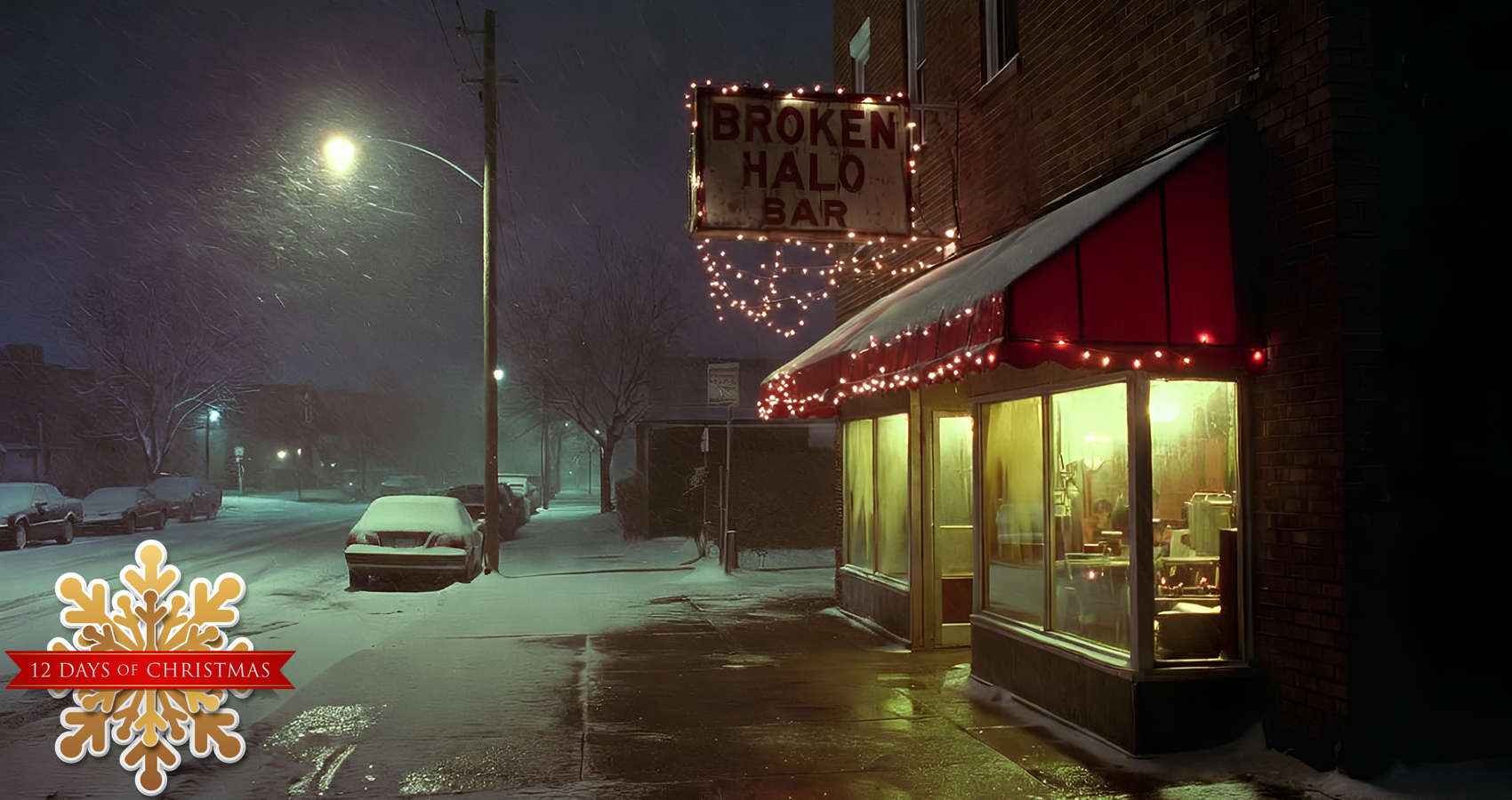
Broken Halo Blues
written by: Richard Wall
The snow came down like spilled ash, a grey powder that stuck to nothing but the cracks in the sidewalks and the soles of my boots. Streetlights glowed dimly like old neon ghosts, flickering in a rhythm only the city understood.
I could hear the distant clatter of the elevated train, like metal bones rattling in the cold, and the occasional bark of a dog that didn’t know the difference between friend and enemy. It was Christmas Eve, and everything about it felt tired, worn, like an old coat you can’t bring yourself to throw away.
I slipped into the Broken Halo Bar because it was open, and that was enough. The bell over the door sounded like an empty beer can kicked down the street, announcing my arrival to the room’s regulars: a couple of old men bent over a gin rummy table, their cards so slick with decades of nicotine that they slid across the felt like skaters on ice; a cabbie nursing a coffee and the remnants of a hangover the size of Lake Michigan; and a dark-haired woman in a red coat near the window, her gaze caught somewhere between the street and memory.
The air was thick with whiskey, wet coats, broken dreams, and something faintly metallic—maybe regret, maybe just the way cold water from the snow dripped off our shoes and into the floorboards.
The jukebox sat in the corner, half-dead, its cracked Bakelite buttons sticky from spilt beer. Only three worked: E7, B2, and C9, each playing the same off-key, scratchy version of Silent Night. The record skipped on the word “sleep”, like the song couldn’t finish its own sentence.
Lou, the bartender, wiped a glass with a rag that was best ignored. His Santa hat was more cigarette ash than felt. “You look like you lost somethin’, kid,” he said, voice rough like sandpaper and whiskey.
“Yeah,” I muttered, sliding onto a stool. “My holiday spirit.”
He poured a double from the plastic jug behind the bar. Everywhere you go, the house whiskey, smells like turpentine and memories. “If I see it, I’ll let you know,” he said. “But don’t hold your breath waitin’.”
The whiskey burned the roof of my mouth and lit a fire in my chest—the kind you welcome if you’ve got nowhere else to put it.
The woman in the red coat caught my attention again. She still had snow in her hair, glistening like fragments of a broken windshield scattered across black asphalt. She was tapping her fingers against the window frame, as if she could drum the answers to questions nobody had asked yet. Lou nodded toward her.
“Comes in every Christmas Eve,” he said. “Orders a gin and tonic, stares at the street till closing. Says she’s waitin’ for her husband. Been sayin’ that since he died in ’14.”
I watched her reflection in the glass. “Maybe she just likes the story better that way.”
Lou snorted. “Don’t we all, kid. Don’t we all.”
Someone walked out, the door swung open, letting in a gust that made the lights sway and scattered the ash of cigarette butts across the floor. The woman in the red coat walked over, sat beside me without asking, and ordered another gin.
“You remind me of Eddie,” she said.
“Who’s Eddie?”
Her laugh was like the sound of a heart breaking. “He was a musician. Played here on Fridays. Had a song… something about a snowstorm and a lost train ticket.”
“Romantic guy.”
“Mostly drunk,” she said, eyes distant. “Left one Christmas Eve. Said he was gonna make it big in Chicago. Never made it past Gary, Indiana. Car hit a patch of ice.”
I felt a cold trickle down my spine. “I’m sorry.”
She shrugged. “It’s been ten years. I still buy him a drink every December. Old habits die slower than people.”
Lou flipped the TV to the news; the mayor shaking hands, carolers singing, lights strung on buildings that didn’t care if anyone noticed. The snow outside was getting thicker, sticking now, piling on the streets like frosting on a cake nobody would eat.
“You got anywhere to be tonight?” she asked.
“Nope,” I said. “You?”
“Same answer every year.”
She drew a slow line on the bar with her finger, joining drops of spilled beer. “I hate Christmas,” she said. “All that talk about peace and goodwill, like it’s a coupon you can cash once a year if you’re polite enough to smile.”
I chuckled, the kind of laugh that comes out of your chest when it hasn’t been used in a while. “Some folks need the lie.”
“Yeah,” she said softly, looking at me for a second that lasted too long. “Some folks do.”
Midnight crept in on broken legs. Lou locked the door, muttering something about keeping the riffraff out. The jukebox sputtered on its own—this time C9. Silent Night again, but slower, more ragged. Maybe it was the machine trying to apologize for all the other nights.
I hummed along, low, off-key, like a man trying to remember the sound of hope. The cabbie tapped his spoon against his coffee cup. Even the old men paused their game, listening with the kind of attention that comes from feeling time slip through your fingers.
The cabbie cleared his throat and began singing:
“There’s a bar on the edge of the city,
where the snow don’t stick to the ground,
and the jukebox prays for mercy,
when the lonely come around.
Raise your glass to the ones still standing,
and the ones that slipped away,
Merry Christmas from the Broken Halo,
where the lost all come to stay.”
The woman wiped her eye. Lou muttered something I didn’t catch, and the world outside went quiet for a moment, the kind of quiet that makes you think that all the angels had stopped to listen.
I remembered the old days, the nights when my hands knew the fretboard like breathing, when my music could tell a story without using words, when someone’s smile meant more than their wallet.
Those nights were gone, of course. They left me with a cigarette butt and the faint smell of maple syrup from diner pancakes in the morning. And now, only ghosts filled the Broken Halo’s corners.
I drained the rest of my drink and took a deep breath, tasting the burn of whiskey, the tang of loneliness.
The woman stood. “I should go,” she said.
“Where to?”
“Nowhere that matters,” she said, eyes on the floor. She dropped a twenty under her empty glass. “For Eddie,” she said. “He always left the tip too big.”
I wanted to say something, anything, but the words lodged in my throat, hard and dry. She turned toward the door and disappeared into the night, swallowed by snowflakes like memories you try too hard to hold onto.
Lou started closing up. I lingered, staring at the broken piano in the corner. Only a handful of keys worked. I pressed one. It groaned. I pressed another. It groaned louder. And then I started playing – slow, ragged, with nothing but the feel of the keys and the whiskey still warming my hands.
The song wasn’t much, just a couple of bars, but it fit the night.
“It’s Christmas Eve at the Broken Halo,
where the lights are low, and the rent’s behind,
and the jukebox plays like an old confession,
from a heart that’s running outta time…”
Lou chuckled. “That’s terrible.”
“Yeah,” I shrugged, “but it’s honest.”
I left the Broken Halo behind me, the bell on the door jangled its beer-can jangle.
The night had been thick, full of ghosts and smoke and half-remembered songs. Now the air was sharp enough to cut, but clean. Cold. Honest.
Outside, the city was a white blur. Snow collected in the gutters and on the tops of abandoned cars, softening the edges of a place that never forgives.
I walked slow, boots crunching, smoke curling from a cigarette that was almost spent. Streetlights haloed the wet streets like they were apologizing for everything that had happened.
Somewhere down the block, a church bell rang once. Kids slept behind darkened windows, dreaming of reindeer. Couples held hands, pretending to believe in joy.
Me? I walked, following nothing but the sound of my own heartbeat and the whisper of ghosts who never left.
I caught my reflection in a storefront window, my coat heavy, my eyes tired. For a second, I thought I saw the woman there too, red coat glowing faintly like a warning, gin and tonic in hand.
Then the image faded. Just me and the snow. Just me and the city humming like a drunk trying to remember a song.
I lit another cigarette and walked, letting the smoke rise into the cold night.
Somewhere in my head, the jukebox in the Broken Halo flipped on again—C9. Silent Night, soft and steady this time. The needle caught the groove right. The sound wasn’t broken anymore.
And for the first time that night, the snow tasted a little like hope.
Somewhere beyond the rooftops and the alleys, life went on. Babies were being born, hearts were breaking, streets were shining under frost and neon.
And here I was, trudging through it all, humming to a song only the city and a few lost souls could hear.
It was Christmas Morning. Bitter, cold, unforgiving. But there was music. And that, for a while, was enough.
I kept walking, smoking, humming, and remembering: the ghosts always followed, but sometimes they taught you to breathe anyway.
Dawn crawled slowly into view, stretching itself across the streets like a drunk trying to stand.
I wandered down the avenue where the neon lights had burned out years ago, their broken colors smeared across the puddles.
Trash rolled lazily in the street, carried by the last breaths of the wind. I passed a corner diner, its windows steamed over. Inside, a lone cook was flipping pancakes, singing off-key to himself. The smell of bacon hit my nose, fat and smoky. I considered going in, but I kept walking. The city had too many ghosts for me to sit still.
A cabbie was scraping the frost off the windshield of an ancient yellow Checker cab. His breath came in clouds, each puff a little story of the night before.
He nodded at me. I nodded back. We didn’t need to speak. Not all connections have to last.
The river ran sluggish, grey and heavy, reflecting the pale sky. Ice clung to the edges like desperate fingers. I leaned over the railing, watching it move slowly and stubbornly, and thought about Lou, the old men, the cabbie, and her – the woman in the red coat who carried the last of the night with her.
The thought made my chest ache in a way that tasted like whiskey.
I kept walking. The city was waking. Windows opened, radios crackled, people cursed at the cold, and somewhere, a child screamed with joy.
I imagined her in the snow, red coat bright and stubborn, pressing her nose to look in the window of some apartment and smiling at a world she couldn’t quite see. I smiled too, for the first time since the night began.
A homeless man shuffled past, blanket draped around him like armor. He had a bottle in his hand, fogged with condensation. He mumbled a song, something ragged and familiar. I stopped to listen. It was the blues, the same blues I’d been humming all night. He nodded at me without looking, and I nodded back. That’s all the acknowledgment we needed.
Further down, a church bell tolled, its sound jagged against the clean morning air. A woman with a stroller passed me, arguing quietly with herself about the baby’s mittens.
I smelled coffee from a corner café and considered buying one, but I had no money and little appetite. Still, the smell reminded me the city wasn’t all ash and ghosts. Some things survived. Some things made it to morning.
I came to an empty playground. The swings swayed lightly in the wind, creaking like arthritic knees.
The snow had melted here, leaving the sand wet and clumpy. I sat on a swing, letting it rock back and forth slowly. I hummed a tune from the Broken Halo jukebox, the broken Silent Night that had kept me company.
As my boots scraped the wet ground, I could hear the city breathing again, alive and indifferent.
Somewhere above, pigeons cooed, hopping from rooftop to rooftop. Their cries reminded me of the old men at the bar, the ones who shuffled their cards like they were wrestling with time itself. I could still hear them in my mind, counting, complaining, laughing softly at each other. The Broken Halo was behind me, closed, but alive in memory.
I stood up and continued walking. The streets thinned. The sun tried to burn through the morning haze but was too weak, pale as cigarette ash. I passed a street musician, guitar slung low, playing in the key of cold.
He looked tired, beaten, but he played anyway. I stopped, listened, dropped a coin in his case. No words. No thanks. Just a nod.
We both understood.
A stray dog trotted by, mud caked to its paws, tail low but wagging anyway. It stopped, sniffed my boots, then ran off into an alley like it had somewhere better to be. I imagined the city from its eyes; rough, full of scraps and danger, yet still alive. I smiled again.
By the river again, I finally stopped. The city stretched endlessly before me, buildings grey and stubborn, the freezing water moving like it had secrets it would never tell. I leaned on the railing, inhaled the sharp, clean air, and replayed everything from the night – the smoke, the woman in red, Lou, the jukebox, the snow, the ghosts that never left.
For a moment, I thought about turning back, stepping into the Broken Halo, hearing the low hum of the broken piano, tasting the whiskey fire again. But morning had arrived. The night had passed. And somewhere in the city, life was still waiting to be lived.
I took a long drag of my cigarette, exhaled into the frost, and started walking again. My boots scraped against the frozen pavement. My hands were numb. My chest was heavy. But I walked anyway.
Somewhere, in the cracks of the city, in the snow that refused to stick, in the smoke that lingered on my coat, there was hope. Not bright, not warm, not permanent. But there, like a last song in a bar at closing time.
And somewhere, faint and distant in my head, the jukebox began again—C9. Silent Night, slow and ragged, carrying the ghosts of the night into morning. I hummed along, off-key and weary, but I hummed.
And behind me, the Broken Halo waited, like a barroom church where the lonely learned to stay alive for just one more song.
I kept walking.

- Broken Halo Blues - December 13, 2025
- Christmas Blues - December 24, 2024
- Drivin’ with Mr D - June 6, 2019