

Darwin Rules
written by: Clive La Pensée
When a racing car, or locomotive, moves away from us, the noise it makes drops from treble to bass. It’s an easy observation and was explained by a physicist called Doppler, and is now known as the Doppler effect. He said, as the locomotive approaches us, it squashes the air in front of it and pushes and compresses the sound waves. This causes a higher frequency in the vibrating air entering our ears, rattling our eardrum, and we hear a higher note than the locomotive should be emitting.
The racing car tears past us, and it is dragging air behind it, lengthening the sound vibrations, and we hear a lower note than the car is making.
Sound is a wave. Mechanically shortening or lengthening the wave causes the note we hear to alter.
Doppler’s idea remains a theory because we can’t look at air particles and what they are up to, but it explains the observation.
Light is also a wave and, in many convincing ways, behaves like sound. Stars emit light. If they are moving away from us, the light becomes stretched, and we observe the wrong wavelength. Scientists have calculated the wavelength of light a star should be emitting. This was a long and painstaking process involving modelling stars in the laboratory. Now done, they can compare the light which arrives on Earth, millions of years later, with a theoretical value.
Science often provides the unexpected. One always observes a shift in wavelength that shows the star is moving away from some central point – i.e., the universe is expanding.
By extrapolating backwards, one can calculate that all stars were once in the same spot. This was 13.7 billion years ago, and that moment in time is called the Big Bang.
Our universe at that point was a few mm in size, incredibly dense, and hot.
We used to be able to look at the Big Bang when we had tube TVs. The snow between stations is the cosmic radiation still swirling around.
As the Big Bang energy expanded and cooled, matter was made by atoms crunching into each other, breaking, forming, etc.
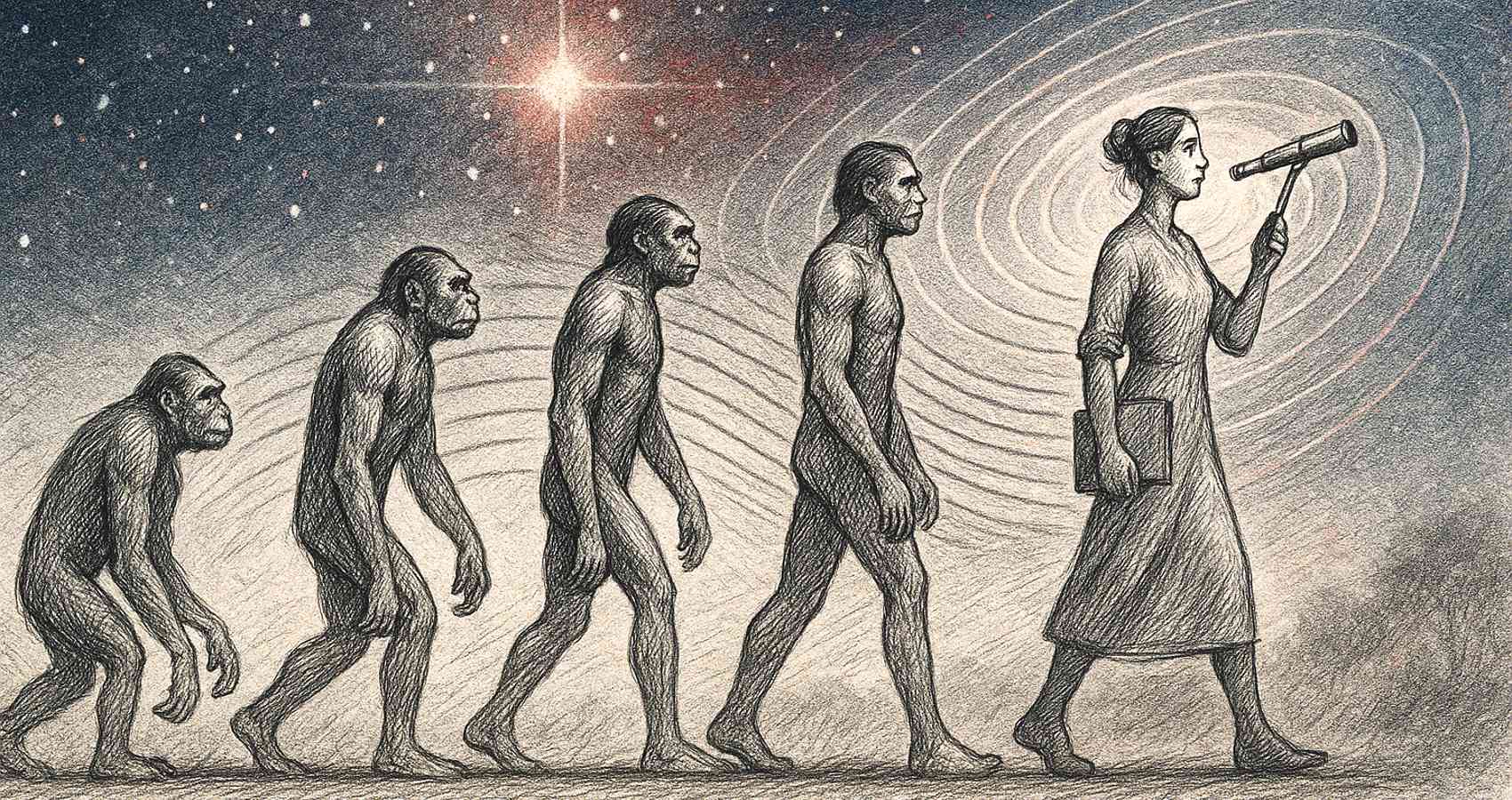
Darwin’s theory of evolution sits nicely with the Big Bang. Darwin proposes that changes take place over hundreds of generations and eventually sort out the best model for survival. Even ten thousand generations is nothing compared to the time it took us to get here.
The annoying thing about Darwin is that his theory rarely lets us down. One can test it over and again with real-world observations, and there it is, explaining the evidence.
That doesn’t make it right! Scientific theories are not set in concrete. They are just thoughts that explain what we observe. When our observations improve, we must update our stories to explain the new evidence.
Creationists argue that science must get it right immediately or be discounted.
Science isn’t like that. Science is a bucket of stories and theories, which men and women are working on. We prefer to call a story a hypothesis. It sounds better.
This week, I read a science question on evolution. The question was, what is the evolutionary advantage to humans and other higher ape females having periods? On the face of it, this cannot benefit mankind and certainly not womankind. The creationist talks about the original sin and is all about punishment and the power game.
Only a tiny number of mammals have periods – apes, gorillas, humans, and a few species of bats. So, if reproduction without a spongy womb lining works so well for over 6000 mammal species, why would the higher primates benefit from a womb lining that is dumped every lunar month and a giveaway to predators?
The fertilised egg descends into the womb and attaches itself to the spongy layer, which signals changes that result in the emerging placenta boring through the spongy layer, giving the growing embryo direct access to the mother’s blood stream, energy food, oxygen, minerals, etc. The growing child can help itself, and the mother must fight to control it, so that she can stay alive. This growing cell cluster also puts chemicals into the mother’s bloodstream, which alter her behaviour to the advantage of the embryo. The mother is invaded by hormones that change her body to make it the best breeding cupboard possible.
It’s a tug of war, which neither side may win. Before medical intervention, out of balance meant the destruction of mother and child.
The spongy lining is a challenging environment, where only the strongest embryos will survive.
It’s called selection!
And Darwin isn’t finished. The placenta and hormones hinder a mother’s ability to decide against pregnancy and resist bonding urges.
Darwin and natural selection win again, although women might think it is a lousy deal.
However, what emerges 38 weeks later is a super-baby. And because it received everything there was to get, it might one day be smart enough to calculate the wavelength a star should be emitting and show that it must be moving away from a point, because of the red shift caused by the Doppler effect. No other species can do this, nor build Rheims Cathedral or make trains run, aircraft fly, or write 1000 words and put some of them to music.
Sorry womankind. Beethoven’s Vth really was worth it.

- When I Die - January 28, 2026
- Make Britain Great Again - October 10, 2025
- Darwin Rules - July 11, 2025