
Giulietta
written by: Franco Forleo
I remembered my proud beginnings.
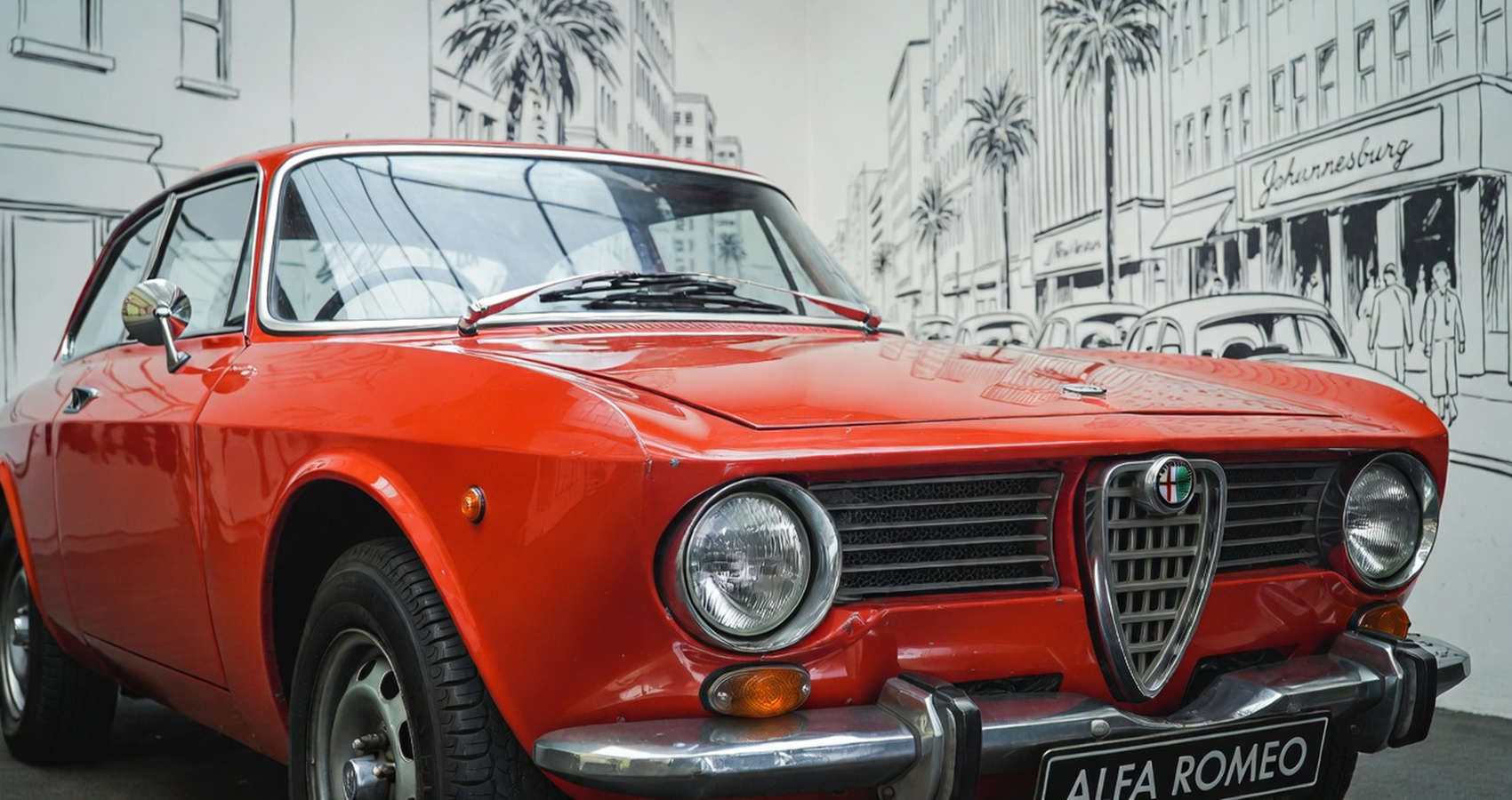
I had been in the showroom for three whole days. Brand spanking new. The spotlights bounced off my fire-engine red paint and chrome curves like newly blown glass from Murano. It felt like a summer dream: warm, glamorous, and entirely deserved. By day, people openly admired me. By night, they pressed their noses against the spotless glass, fogging it with desire. I thrived at it. I couldn’t help but smile as I watched the salesmen, each morning, scowl and polish away the greasy fingerprints and nose prints left behind by my admirers.
I was a sensation back then, and I knew it.
A limited series.
The Alfa Romeo 1600 Super Nuova.
More luxurious. More powerful. Temperamental, if you asked the mechanics, but that was simply passion in mechanical form. The dashboard and wooden console, arranged by Italian designers, exuded a confidence that was impractical but impossibly elegant. If you didn’t immediately understand where everything was, well… that was your problem. The Italians felt no need to explain themselves. They expected you to rise to the occasion.
It was 1978. I came at a premium, and I carried myself accordingly.
“She can be yours for R3,745.00!” the salesman boasted, tapping my roof as though I were a loyal dog. “Financing would set you back only R144.00 a month. We have a Westbank desk right there.” He pointed.
“She’s beautiful,” the young man replied, circling me slowly, “but sadly… out of my league.”
I pretended not to hear that last part. Even a finely tuned engine has feelings.
And I didn’t particularly like his shoes either.
And then I saw him.
He walked in on a Wednesday afternoon, trailing cigarette smoke and confidence. Bell-bottom blue jeans. A denim shirt unbuttoned just enough to be reckless. Shoulder-length hair and Ray-Bans that had clearly seen things and probably remembered them fondly. He didn’t rush. He moved like a man who understood engines… and the temperament of women.
He stopped in front of me.
Slowly, deliberately, he pulled his sunglasses down to the edge of his nose. I felt my mechanical heart kick, pistons fluttering in my chest. Please let him be the one, I thought.
He ran a finger along my fender, a knowing touch. I purred despite myself. Somewhere deep within my twin Weber carburettors, I blushed.
“Ah,” he whispered, almost to himself. “You’re a work of art.”
Yes, I wanted to reply. An Alfa. Perhaps not a sensible choice. Not forgiving. But certainly unforgettable.
The salesman cleared his throat, as if he were intruding on an intimate moment.
“Would you like to take her for a drive?”
The man smiled.
And in that moment, I knew: my quiet life under spotlights was over. My real journey was about to begin.
He was gentle, very gentle, and I liked that. As we rolled down the ramp of the Europa Car showroom in Eloff Street, we eased into the late-afternoon traffic. We crossed the Queen Elizabeth Bridge, and eventually, after a brief but awkward pause, he finally found my fourth gear.
I forgave him. Everyone needs time to learn an Alfa Romeo.
Later, he parked me beside my new garage companion: a yellow Fiat 128. She was cute in a cheerful, earnest sort of way. Sensible. Dependable. The sort who remembered birthdays and paid bills on time. My superior growl may have intimidated her slightly as he gave me one last rev before shutting me down, but I offered her a reassuring smile.
After all, we were both Italian.
And Italians stick together, especially when the electrics act up.
As the garage door closed and my engine ticked softly while cooling, I knew one thing for certain: life with this man would be dramatic, passionate, occasionally inconvenient… and worth it.
Just as an Alfa should be.
What followed was my introduction to the family.
First, Mama came out, apron on, floured hands, and even her nose dusted white like she’d lost a fight with a bag of Tipo 00. The ohs and ayahs were endless. “Bella, bella!” she exclaimed, circling me with delight.
Her hair was in a bun, and her face radiated warmth and approval. She looked wonderfully culinary, like someone who could solve most of life’s problems with olive oil and patience. I half-expected her to bring me a plate of spaghetti with meatballs. Possibly with extra sauce.
Then Papa emerged.
Hands in his pockets, he circled me slowly, thoughtfully, like a shadow that refused to let go. He nodded once. Just once.
“Auguri,” he said, glancing at his son. A man of few, carefully weighed words.
“Italian engineering,” he added.
High praise. Possibly the highest.
As the sun set, the garden lights filtered through the garage window. Crickets began their evening concert, and I noticed a mouse peeking out from one of the ceiling beams.
Very homely, I thought.
It was then that I heard a whisper. It came from my garage companion.
“You’re a beauty,” she murmured.
“Thanks,” I replied. “You’re not too bad yourself.”
“An enormous improvement on your predecessor.”
“Oh, yeah?”
“Uh-huh… a Fiat. One of those earlier models. An 850. Remember them?”
“No,” I said. “Before my time.”
There was a pause. Respectful. Slightly awkward.
Then I broke the silence.
“So,” I asked, “who drives you?”
“Mama,” she said proudly. “She takes Papa to work every morning. Fetches him again at 4 pm. Very much a routine. Papa doesn’t drive, but he knows more about the rules of the road than anyone else.”
I smiled into the darkness of the garage.
Ah, yes, I thought. This is family. This was going to be interesting.
Mama and Papa temporarily abandoned me the following morning. In the garage, alone with my thoughts and the faint smell of oil and yesterday’s adventures, whilst Mama whisked Papa off to work. Though not before Papa felt it necessary to run his rustic, tradesman’s fingers over my rear end. I stiffened. Honestly. One does not simply do that. Such familiarity! Still, I reminded myself, he was only “human,” and that humans have a regrettable tendency to touch things they admire.
Peace returned. There was silence. The sort of silence that settles only in garages, at night, or on those particularly long weekends. Broken occasionally by a drip, a creak, or the distant ticking of cooling metal. I waited. Patiently. Alfas are very good at waiting…. dramatically.
Eventually, my man appeared.
Denim bell-bottoms. Denim shirt. The top three buttons were deliberately left undone with intent. I accepted this as being his uniform, like a knight’s armour, only with more chest hair. He positioned himself behind me, a cigarette dangling from his fingers, smoke curling lazily upward as if even it was in no hurry. He stood there for a moment, just looking. Appreciating. I felt… noticed. If paint could blush, mine would have been rosso embarrassment, but thankfully, my flawless finish hid everything.
He slipped behind the wheel, settling into the seat as if he already belonged there (which he did). The key turned. I answered immediately, no hesitation, no theatrics…just a smooth, confident purr. One must maintain standards.
He didn’t rush me. Oh no. He let me idle, my rev counter needle dancing lightly, a ballerina en pointe, warming up for the performance ahead. The water temperature crept upward, slow and dignified, until it reached a comfortable 80 degrees Celsius. Perfect. Civilised. Italian.
He waited. He understood. Not everyone does.
Our first foray into the CBD was smooth and unhurried, the drive that makes a car feel smug. Mid-morning traffic was mercifully thin as we cruised up Jan Smuts Avenue, gliding past Wits University with all the quiet confidence of those who know exactly where they’re going… even if they’re pretending not to.
Past the Jeppe Street Post Office, we turned left into Small Street, crossed over Bree at that familiar kink, the one that always feels slightly improvised, and slipped into King George Street.
Reverse parking came easily. No fuss. A decisive move into a bay I would come to know intimately over the next eight years. A long relationship, that one. Faithful. Reliable. Slightly oil-stained.
He thanked me properly, with the warmth and courtesy of a true gentleman.
“Thank you, Giulietta, for the first of what will be many.”
I purred. Obviously.
He entered the shop next to where I was parked, and for a while, he disappeared.
The surroundings revealed themselves. Compact living. Apartment blocks stacked above me like spectators. Balconies leaning in conspiratorially. Shops below. Lubners, on the corner, serious furniture for serious living. Ritz, a bottle store with an ambitious name and a modest reality. A laundry. A record shop. And then… that smell.
Roast chicken.
Ahhh. Il Pollo. There you are.
Then, movement. My friend appeared at the shopfront and gave me a wink. A wink! What was that about?
I strained to see inside. Fire, a wood-burning oven. Dough balls were being rolled with purpose. Confidence. Flour. Intent.
Haaa. A Pizzaman.
My kind of man.
By midday, the place was humming. A steady stream of people flowed in and out while my man flipped perfect circles of dough into the air. He slid pizzas into the oven with such ease, calling out orders to the waiters who clearly respected his choreography.
All of this unfolded just metres from me. A plate-glass window between us; he inside, and I on the road. He worked. I watched. We understood each other.
A lady in a funny hat and a shoulder bag appeared. She knocked on the outer window, signalling to the pole which stood alongside me. My man stepped out of his workplace and inserted a coin into the bubble. He thanked her. She smiled and moved on to the next car, ready to write in her pink book.
By three o’clock, the frenzy had cooled. We were back on the road, heading home, the city behind us and the smell of wood smoke and ambition lingering faintly.
Time for a well-earned siesta.
For him and for me.
Routine can be boring, but life with the Pizzaman on King George Street was anything but.
We worked two shifts a day: lunch and then dinner. Once my job was done, I had all the time in the world to absorb the life swirling around me. Two entirely different settings shared the same strip of tar.
By day, the street belonged to business: commuters, lawmakers, advocates, and traffic, endless traffic.
By night, King George Street transformed into a residential hive. Diners lingering over meals, dog walkers tugged along by impatient leads, clubbers spilling laughter and noise, the loners, the umantshingilane (Zulu night watchmen), escort agencies, and street hookers. The street breathed differently after dark.
Things turned when she came back into his life. I disliked her from the first moment I laid eyes on her. But he was smitten—painfully so. I could see it in the way his hands lingered, the way his voice softened.
I told myself it was instinct, mechanical intuition, some finely tuned Italian warning system. But if I am honest, and Alfas are honest, if nothing else, it was fear. She did not look at him the way I did. She looked at him as something that could be claimed, and I knew then that I could be replaced. Not loved less, perhaps, but used less. For the first time since the showroom, I felt what humans call insecurity.
I soon gathered that they had known each other before. School sweethearts. And from what little I overheard, she had not been very honourable back then.
She looked me over as he introduced us. Slow. Measuring. I sensed the jealousy immediately.
How I wished he would fall for someone like that pretty girl who always leans out of her bedroom window in the building across the road. She is gorgeous. She watches him stretch the dough, sometimes blowing him a kiss. My Pizzaman only smiles and waves back. He was too decent for that. Plenty of men wouldn’t have hesitated, knowing her husband was away on border duty and that she was lonely.
I resented her sitting in the passenger seat, waiting while he finished work. Perched there as if she belonged. Using me as an excuse to be noticed. Who did she think she was? Didn’t she have somewhere else to be?
I remember cringing the day she asked to drive me. That was where he drew the line.
“No,” he bluntly replied.
And I was proud of him for it.
In the weeks that followed, the conversations conducted about me, around me, and far too often over me revealed more than any confession ever could. Between Pizzaman and my nemesis, truths slipped out like loose change from a torn pocket. It became increasingly clear that my unease was not a private affliction. No, it was communal.
Pizzaman was not welcome in her home. She was even less welcome in his. And Mama—ah, mama—made her position known with theatrical flair, employing words of such ancient fury that even Google Translate shrugged and said, “Nope.” Whatever dialect that was, it clearly meant absolutely not.
Still, every late afternoon, Pizzaman would dutifully drive her to Park Station so she could return to wherever it was she came from, somewhere distant, mysterious, and emotionally exhausting. These drives were not quiet. Ultimatums hurled across my cabin like emotional hand grenades.
“If you don’t marry me by the end of the year, I’ll find someone who will.”
Please do, I thought, my indicators twitching with hope.
Pizzaman, poor soul, tried reason. He explained calmly, gently, that he wasn’t ready. That families who loathed each other were a poor foundation for lifelong bliss. That marriage should be a happy family event, not a hostile merger.
But reason, as I was learning, had very poor traction.
Eventually, she got her way.
The two of them alone planned the wedding, which was fitting, really. A small church somewhere in the East Rand, chosen as her home turf. Pizzaman’s concern, however, was not the vows, the guests, or even the bride. He asked the priest one very important question:
Could my Giulietta be parked safely in a closed garage? Away from any hooligans armed with shaving cream and tin cans.
He had thought of everything. He always did. In that moment, I felt cherished and protected
Then came Durban.
My first long journey. A rite of passage. Pizzaman had rarely discovered my fifth gear before, treating it like a rumour rather than a feature, but out on the N3 I revealed my true self. I stretched, purred, I cruised. The road fell away beneath me like applause.
And then, the audacity.
She placed her grubby feet on my wood-panelled dashboard, settling in for the long journey.
“Take them off!” he snapped, righteous and immediate.
“I sometimes feel you love her more than me,” she said.
He does, I thought serenely, holding my line and speed.
Her jealousy filled the cabin, thick and sour. I behaved with dignity. Silent. Polished walnut veneer does not compete; it simply endures.
And so I carried them on, down the highway, into marriage, into inevitability… still loved, still loyal, and already knowing far more than either of them realised.
The months passed.
The baby came.
I was there.
Pizzaman spoke to me alone one evening, his voice low and reverent. He rested his hand on my steering wheel as if on a confidant.
“We’ll have company soon,” he said.
I knew then, knew he’d be a good father. He had the right hands for it: steady, warm, and loving. I, too, looked forward to the future. A baby chair at my rear. A small indignity, yes, but a noble one. I would carry precious cargo.
That night, I rushed them to Park Lane Clinic. I flew. Tyres singing, engine alive. It was unforgettable.
He came running back out later, joy bursting out of him like steam.
“It’s a boy!” he yelled.
I felt proud. A son. An heir. A tiny human who would one day kick my seats and smear biscuits into my upholstery. I was ready. And then… things changed.
She insisted.
“Baby chair is in that car of yours.”
The words were sharp. Contempt, barely disguised as practicality.
She had never once referred to me by my name. Giulietta.
It was beneath her.
Then, unforgivably, he allowed her to drive me.
I hated her immediately.
She crunched my gears as if punishing me, ash blowing back onto my seats like grey snow. She bumped me on the curb. Left my windows open in the rain. Once—once—she vomited. No apology. No towel. Just a door flung open, and shame splashed across my floor mat.
I felt humiliated.
One afternoon, “he” pulled up outside the driveway. She got out, walked to meet him. They spoke in low voices. He put his hand on her shoulder. I didn’t like what I was seeing. I sensed a deception. Where was Pizzaman?
Two days later, she handed him my keys.
Just like that.
For a moment, there was no road beneath me. No traction. No instruction. Just the terrible absence of weight, followed by a pressure I had never known.
I remember little after that. Memory fracture. Silence. Cold.
All I truly recall is the tow truck. Chains bit and yanked my undercarriage from the riverbed, where they had left me.
And so here I am now.
A remote part of a town I don’t know. No streets I recognise. No purpose, I understand. I’ve become a chicken pen for a dozen chickens and one arrogant cock who struts across my bonnet as if he owns it.
I don’t move anymore. I only have my memories.
Of the life I had.
Of the roads we travelled.
Of the man who once told me things first.
Of Pizzaman.