

Halloween Pay for Stay
written by: David Margolin
For George, Halloween was a double treat. Fall was his favorite season, and Halloween was his favorite holiday. He loved the energy of the wind blowing away the residual stagnation of summer, the pungent smell of piles of raked leaves being burned, the evolving display of fall colors.
George, more passionate about the holiday than other family members, was in charge of retrieving the perennial collection of decorations from the basement, selecting the best ones, and taping or thumb tacking them onto the knotty-pine siding in the den.
The display didn’t vary much from year to year. There were the classic witches, skeletons, bats, black cats, and pumpkins, with an occasional whimsical Frankenstein or cartoon character decked out for the holiday.
His costumes were usually store-bought, his mother wasn’t famous for her sewing prowess. Zorro, The Lone Ranger, Batman– George didn’t mind that the costumes weren’t imaginative. He was less interested in what he wore than in the process of trick-or-treating. Every year, he marveled that the holiday granted a license to impose. Only on this day of the year was it not a trespass to enter the property of others and give the “Trick-or-Treat” ultimatum.
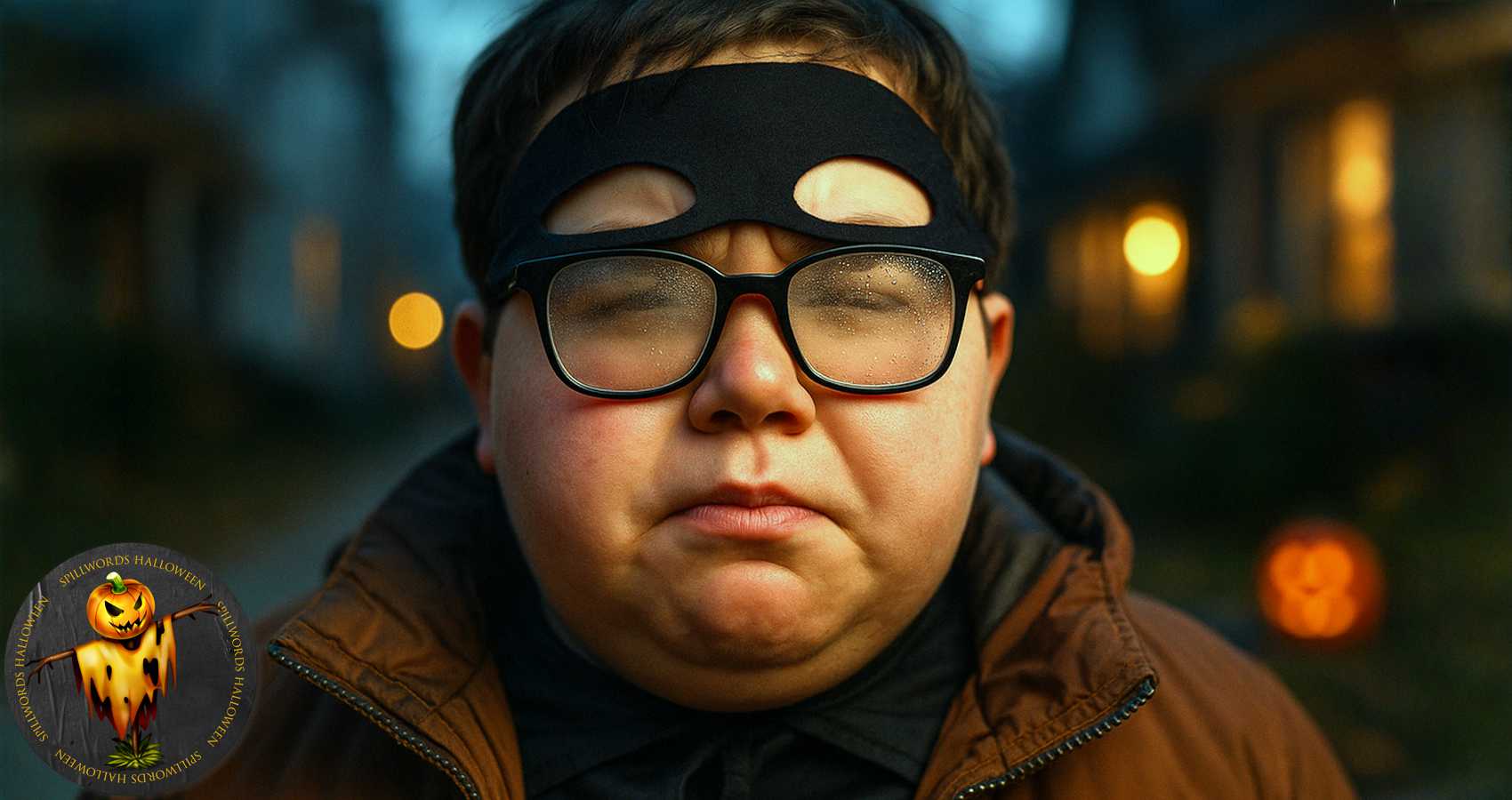
Halloween was a high point of his year, but it wasn’t perfect. There were his glasses. He was too nearsighted to safely cross the street without them. Usually, the glasses prevented the masks from sitting just right, and after walking a couple of blocks, his lenses would fog up. Worse than that, once the sun went down, the temperature dropped rapidly. George had to don his fall jacket, partially obscuring the costume. Every year, the similarities in his appearance (short, chubby, fogged, and heavily jacketed) outweighed the differences.
George’s middle-class neighborhood hosted a variety of residential buildings. Most common were small apartment buildings, including the two-story version, known fondly to Chicagoans as “two flats.” Small individual homes were less common, but George, not the most athletic kid on the block, preferred them over the other options because there was less stair climbing involved. He avoided the homes whose lights were off, a clear message that the residents had opted out of the process. Even the residents of homes with the lights on didn’t always answer the door, and if they did answer, the payoff was unpredictable. Unusually healthy-minded residents might unconscionably offer a coin, or a healthy snack, as the “treat.”
Because George avoided homes with the lights off, and the ones that had underperformed in prior years, his route varied from year to year, but there was one constant—Mrs. Rodale.
The Rodales lived in a single-family bungalow. Their backyard faced George’s backyard; they were separated by an alley. Mr. and Mrs. Rodale, a decade or so older than George’s parents, had one child, a daughter named Ivy. From time to time, George would see Mrs. Rodale working in her backyard, attending to her small garden. He couldn’t remember seeing her wearing anything other than a midweight house dress. She appeared old, but strong and determined. He had no recollection of ever seeing Mr. Rodale or Ivy, who was reportedly away at college.
Invariably, George visited Mrs. Rodale last, using the rear door. The front door looked more decorative than usable. Unlike all the other homes, there was no concrete pathway leading to it, no doorbell was visible, and the foliage around it was overgrown. It was clear that the back door was the intended point of entry.
George knew that Mrs. Rodale would be home; her Halloween attendance record was flawless. Sure enough, as he approached the back door, he saw her sitting in the kitchen, her back facing the door. Mrs. Rodale had a unique treat-dispensing technique. Everyone else gave out a set number of treats all at once, usually plopping them into the kids’ bags, plastic pumpkins, or other collection devices. Less commonly, the treater lets the kid pick one or two treats from a bowl or other main source. Only Mrs. Rodale employed the “pay-for-stay” technique.
Part of the technique involved strategic positioning. She sat close enough to the kitchen counter to reach the large bowl of candy with her left hand, but close enough to the refrigerator on her right to make it difficult to move around her. Although garbed in her signature housedress, she might as well have been wearing a suit of armor. Her heft and body language left no doubt that she was in command of the action.
When George entered the kitchen, Mrs. Rodale motioned for him to stand in front of her. She casually but firmly held on to George’s treat-collecting pumpkin with her right hand, and the ritual commenced. “So, how’s your mother?” While George was formulating his answer, his host’s left hand was slowly reaching towards the motherload of treats under her control on the kitchen counter.
“Oh, she’s fine,” George replied rotely, as his eyes tracked the slow-motion movement of candy towards his pumpkin. When the cellophane-wrapped yellow lollypop finally landed on top of his other treats, he wasn’t sure that the pain had been worth the gain, but he decided to stick around for at least one more round.
“Is she still PTA President?”
George managed a “Yeah,” but he was concentrating on seeing Mrs. R’s next selection from the motherload. It was a Mounds Bar, George’s favorite. His host was no novice; she was diabolically good at this. Her selection ensured that George would stay for at least two more rounds of “Pay for Stay.”
Twenty-five minutes and six questions later, George’s pumpkin was substantially fuller, but he was losing ground. His answer to the dreaded, “What’s your favorite subject in school?” question must not have been detailed enough to satisfy his host; it was rewarded with one orange-wrapped and one black wrapped piece of the dreaded sticky-taffy tooth-embedding concoctions that mercifully only surfaced for this holiday.
George could see the back of his house through the rear door glass. He longed for the companionship of the cardboard characters hanging on the wall of his den; they wouldn’t be pelting him with questions. He saw Mrs. Rodale look over to the supply of candy. He executed a deft counterclockwise turn, loosening her grip on his pumpkin, and leaving him barely enough room to pass her on her right. Like a man finding water in the desert, he gripped the door handle and made his escape, “Thank you, Mrs. Rodale, I promised my mom I’d be home by now.”
George was elated to be free as he quickly walked across the alley in the crisp, refreshing air, carrying the hefty collection of goodies. Before he reached home, however, he was feeling defeated–he figured that he had been the loser in this intergenerational battle of give and take. In fact, he felt that way every year after leaving the Rodales, but at George’s age, one year was a long time. By the following Halloween, the pull of the Mounds Bars would easily outweigh the push of the inevitable Rodale inquisition.

- Halloween Pay for Stay - October 21, 2025