

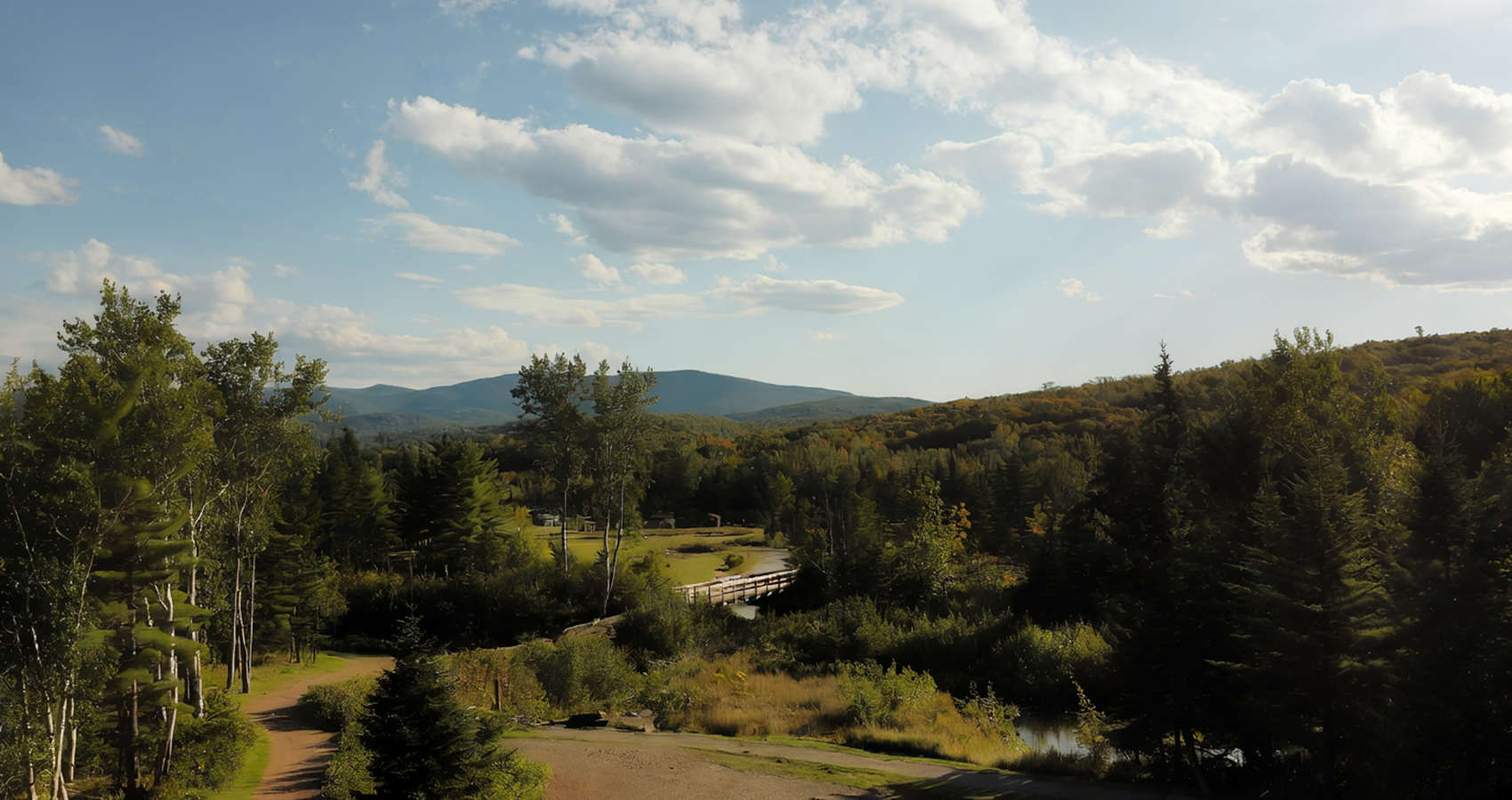
November Forest Walk
written by: Christopher Johnson
Framingham Centre, 20 miles west of Boston, is a symmetrical oval of grass just north of Route 9, the state route that cuts through the heart of the Boston suburbs of Framingham, Natick, Wellesley, and Brookline until it dumps you out onto Mass Ave in the Olde Towne itself. Churches built eons ago—churches with foundations of craggy, uneven gray boulders–surround this spot of greenery.
From the town center, Edgell Road winds its way north like a rudderless boat, following the contours of the terrain and curling past saltboxes, Cape Cods, and three-hundred-year-old colonials with rough-hewn beams and bump-your-head ceilings. The road then slips along the Nobscot Boy Scout Reservation before continuing on to Sudbury. It was into this reservation that I turned my blue Toyota Corolla in November 1987. It was here that I intended to spend my Saturday afternoon alone.
I pulled on my well-worn hiking boots and prepared to shlep myself up the steep hills of the reservation—some of the tallest in eastern Massachusetts. I just wanted to blank out for a while. The year I’d just completed had left me feeling on the verge of crazy. I worked for a textbook publisher in the Boston area and had been drowning in the development of a new elementary reading program.
Publishing a brand-new reading program is a complex undertaking, and this one had faced a brutal schedule. The staff worked from 7:00 in the morning until 10:00 at night, including weekends. Management brought in dinners—albeit, very good catered dinners–but somehow this was little consolation. And they brought in cots—cots for God’s sake! I didn’t use them, but I did go home a couple times at 1:00 in the morning and then wondered if I wouldn’t have been better off staying in the office for the night. I almost never saw my wife, Barbara, or my children, Matthew and Emily. I asked Matthew recently about that year, when he’d been in eighth grade, and he admitted that I’d been “pretty crabby.”
By the end of the project, I felt totally boxed in. I’d lost something—some spirit. I was sleepwalking. I needed renewal of some kind from somewhere. More or less by accident, I began to reread Walden, seeking wisdom from that contrarian Concordian, Henry David Thoreau. I’d read the book in college and had liked it a lot. Perhaps I was drawn to it because I still had my dog-eared copy from college, reminding me of younger days that wore the glaze of nostalgia.
I’d brought Walden with me as my sole companion, and I was going to spend the afternoon hiking at Nobscot, which butted up and down over only 450 acres but had an amazing number of curlicue hiking trails for such a small area. As I tramped, I was going to dip into Walden and try to reawaken something that I couldn’t even begin to identify.
At the entrance to the reservation, I saw a volunteer, who was winter-readying the rustic pine-log visitor’s center and from whom I bought a trail map for a buck. He told me a little about the reservation. It dated from 1928, when the Norumbega Council of the Boy Scouts began buying parcels of lands to protect green space in Boston’s suburbs for scouts to camp, hike, and learn about the outdoors. A forest of white pines, hickories, oaks, and hemlocks sheltered the hills, providing habitat for owls, fishers, porcupines, spotted salamanders, wood frogs, and other wildlife. Scouts used the reservation not only to camp and hike but also to view and identify wildlife, learn the basics of forestry, and follow Leave No Trace principles.
That volunteer was the last representative of humanity I would see for the next three hours. It was November, and the reservation, which in spring and summer crawled with Boy Scouts and their leaders, was deserted. I thought about the fact that during this dying time of the year, we meet nature directly, confront it without ornamentation, without apology, without the polite introduction of leaves and plants. I would be encountering nature without its red shoes on and stripped down to its bare essentials. And that was what I wanted.
As I embarked on the trail, I entered stony silence. I’d walked this trail in spring and summer, and the forest had always spoken a cacophony of sounds: birds’ exclamations, squirrels scuffling in the underbrush, scouts shouting and giggling. But November had robbed the small forest of its voices. The only sound that broke the silence was the padding of my feet on the layer of leaves that carpeted the trail.
Paucity of color equaled paucity of sound. The trees stood naked on either side of the trail, the ends of their branches thrusting up to puncture the sky. I planted myself under one tree and looked at the top, and the limbs and branches crisscrossed as if the gods had drawn a crazy quilt of lines across the sky. There and then, I felt the wildness of these depopulated woods. They were unkempt, fierce, untamed.
I desperately needed this dose of wildness. I felt way too tame. I worked hard, did as I was told. I dutifully put on my Sears sports jacket and my necktie and shod myself with my Dexter penny loafers and carted myself off to the closing-in walls of my office every day. I transported the children to their dance recitals and basketball practices and went to the PTA meetings and the movies and the dinner parties.
The deserted trail and the bare trees with their crazy, chaotic branches stirred something beyond those everyday responsibilities. I opened the pages of Walden and channeled Henry David. “Before we can adorn our houses with beautiful objects,” he admonished me, “the walls must be stripped, and our lives must be stripped, and beautiful housekeeping and beautiful living be laid for a foundation: now, a taste for the beautiful is most cultivated out of doors, where there is no house and no housekeeper.”
Mere words–but such words! Words to scrape away the moldy surface of things! I paused. I started to walk. Crushed, brittle brown leaves littered the trail I was tramping, and along the path, small pools of water were edged with ice because the temperature hovered around freezing, dropping a few degrees below 32 degrees at night and rising a few degrees above 32 during the day. Dozens of downed and rotting trees sprawled on the forest floor, decaying ever so slowly as they reunited with the soil. In the summer, these fallen trees hid from view behind a wall of green vegetation, but November unveiled the decay, revealing the inner workings of the forest. I took a few steps off the trail and sat on one of the downed trees. The trunk felt springy–far along in its cycle of returning to the earth. I easily tore off a chunk of the tree and hurled it through the air. It banged against a still living and breathing tree and broke into tiny bits.
I began to climb Nobscot Hill, elevation 602 feet, and saw to the left a tiny log cabin, about a hundred feet off the trail. The cabin was perhaps ten feet by ten feet in dimension, and a rusted metal chimney poked out from the roof. The cabin leaned to the side, on the verge of collapse. The forest was reclaiming the cabin, and I knew that in a matter of years, the structure would collapse completely, and its particles of wood would slowly blend back into the soil until finally no traces of the cabin would remain, except for the rusted chimney.
As I regarded the cabin, I remembered a childhood scene as if it were a film that I’d seen yesterday. I was eight years old and was playing in the back yard of the Troxells–our next-door neighbors in the Cleveland suburb in which we lived. Their back yard was thicketed with trees and sundered by a stream that had carved a small ravine through the yard. John Troxell, who was a little older than me, had a plan—to build a pirate ship! We gathered old planks and boards from the Troxells’ garage to build a raft to float on the stream. We nailed boards together to form the deck. Then, to keep our raft afloat, we attached the inner tube of a car tire to the bottom side of the deck. The raft was a little tippy, but John and I figured out how to balance on it and more or less stay afloat.
What joy that little raft gave us! We pretended we were pirates raiding ships in the Gulf of Mexico and plundering the booty, which always included copious amounts of gold. We would spend an entire Saturday afternoon as pirates, and then I would go home as the sun plummeted toward the horizon. My sopping jeans wore rivers of mud. My mother would tsk-tsk me but never admonish me.
I remembered the pirate scenes and the Troxells’ back yard so clearly—the trees that lined the stream and towered above us, the frogs that lunged aboard our ship, the willow trees with their long branches hanging like whips. I remembered the Keds sneakers that we wore–the peanut butter and jelly sandwiches that we carried because even pirates get hungry at mid-day–the skull-and-crossbones flag that we hung on our pirate ship. With these memories, I started to feel a dormant flame begin to reignite. I dipped back into Walden. “Children who play life,” he reflected, “discern its true law and relations more clearly than men.” Who knew that Thoreau was so kid-friendly?
As I climbed Nobscot Hill, I found that my memories of backyard piracy fueled me with renewed energy. The hill had grown steeper, though, and the leaves on the trail didn’t help me in my ascent. When I put pressure on my feet and legs to hoist myself upward, I slipped on the smooth, wet leaves. Sometimes when I slipped, I caught hold of tree trunks to keep from falling, and the bark felt gunmetal cold and rough to the touch, like skin that had been abraded by the November weather.
I took a short detour to see a formation of granite known to the Boy Scouts as Ol’ Man Nobscot. The formation did, indeed, bear an uncanny resemblance to a human figure. His chin jutted out with determination and grit. The granite was dark gray, and the Ol’ Man’s features were chiseled hard into the rock. He looked over his domain, and the look he gave was cold and stern.
It was appropriate that the Scouts had given a legendary name to this simple formation of rocks. It was all part of the storytelling that children build around the mysteries of nature. Our son, Matthew, had been in scouting, and I remembered storytelling at the camp at Nobscot as one of my most treasured memories. We sat around the campfire, and the fathers spun tales that we had heard in our own youths—the inevitable tale of the bloody hook hanging like a dead fish on the handle of the car in which a couple is romancing the night. Such urban legends of youth–passed from one generation to the next—blazing with the wildness of youth. These stories told at night brought Matthew and me closer together: lying awake in our tent, listening to the sounds of the night, spinning hokey old tales. The other side of magic.
I continued to struggle up Nobscot Hill. So lubricated were the leaves by rainwater and decay that my feet gave way and I sprawled to my knees, feeling a tiny bit humiliated by this seemingly unremarkable hill. Rising slowly to my feet, I picked my way upward more carefully, following the trail as it curled around several large trees that wind or lightning had attacked.
I recalled another childhood incident. I was eight years old and was in Indian Guides with the local YMCA. My father and I had gone on a camping trip with the rest of our group in a wooded area south of Cleveland. Some of us went to play, and we found a cliff. We crept closer, ever closer, to look over the edge. I stepped on wet shale, and my feet slipped. I felt myself sliding closer, closer to the edge of the cliff. I scrambled to return to dry ground, but the harder I scuffled, the more slippery the shale became. I flailed silently to get myself off that shale, not even thinking to scream for help.
Two other boys saw what was happening. I was about a foot from the edge of the cliff. They reached out, plucked me by the arm, and dragged me off the shale and onto solid ground. I remembered that moment with photographic clarity: the leaves lumped together on the ground, the trees black and stark against the sky. The two boys dragged me onto terra firm, and I didn’t say a word. But when I was safe, I stared at the edge of the cliff and then beyond, at the ground far below. It was only then that I became aware of my heart screeching like a trapped animal and of the exhilaration of danger, which exploded into every cell of my body. I felt acutely, deliriously, promiscuously alive.
Energized by the memory, I finished the ascent of Nobscot Hill. The summit afforded a fantastic vantage point from which I could see other hills, populated by hundreds of leafless gray trees. One hill merged into the next to form a ridge stretching from south to north. The landscape was uncompromising. Without shame or embarrassment, it said, “Take me as I am, warts and all.”
Nearby, I saw Tippling Rock, an outcropping of enormous granite boulders. The granite was cold and gray, its corners as sharp as those of a steel strongbox. I walked out onto the granite ledge and looked down the hill. Below me marched a battalion of trees. The naked limbs of the trees formed arches, and the branches crisscrossed to create delicate patterns against the overcast sky.
I stood on the very edge of Tippling Rock—the very edge. Suddenly, I felt the urge to scream, as if I were once again a wild boy. I took a deep breath and emitted a blood-curdling howl. My scream took on a life of its own and catapulted off the surrounding hills and echoed back to me. I jerked out another roaring bellow, as bloodcurdling as I could make it. Again, the echo returned to me, like a chorus of ghosts haunting the woods.
God, it felt good to scream! I felt each howl gather energy in my lungs and travel through my esophagus and fly through my throat like a bird of prey. I howled again and again. The screams came from somewhere that had been buried in me since childhood. They felt glorious! They felt like the most beautiful symphony I’d ever heard. With those screams, I became brutal and wild in the woods. “To be awake is to be alive,” Henry David told me in clear and emphatic language. I was awake. I was alive. I had awakened from the dead.
I retreated down Nobscot Hill. As I did so, a singular sight stopped me—an ancient oak tree with limbs and branches too many to count. The girth of the trunk was at least twenty feet, and the trunk rose and divided into limbs and branches that twisted their way toward the sky. Through the decades, the limbs and branches had grown upward and outward, and the topmost branches resembled fragile fingers. It was almost inconceivable that something so thick and wide at its base could grow into a crown so fine and delicate. In that oak, the architecture of nature was visible.
Autumn had torn away the camouflage of leaves, and in the crisp November air, the stripped-down beauty of the forest emerged. I looked down, and at the foot of this magnificent tree stood a pool of water, which in its stillness perfectly reflected the oak. The flawless reflection was pure accident—yet in such accidents resided the poetry of nature. Then, through the silence, I heard words. Give yourself over to the forest. Forget the bric-a-brac—the phony salutations–the hearty nothingnesses. Know the naked woods. Know the wildness in your heart.

- November Forest Walk - November 23, 2025
- Recluse - July 6, 2025
- When She Would Iron - May 2, 2024