

Shellshock
written by: Mark Woodward
They say the war is over.
Someone always says that.
I’m not sure who “they” are.
“They” are never in the room
when the body answers back.
“They” never carried a drip stand
like a dance partner.
“They” didn’t lie awake
counting hours until the next chair,
the next needle,
the next apology
from a nurse who didn’t cause any of this.
Chemo ends
and there’s an idea hanging in the air.
Relief.
Closure.
A bell rung.
A handshake.
A photo taken.
Six months done.
Poison stopped.
Job finished.
Like it was a building contract
and the scaffolding came down.
Like the house is now liveable
and the leaks have all gone.
I don’t know where that idea comes from.
It didn’t come from me.
It didn’t come from my body.
It didn’t come from the nights
that still don’t behave.
I come back from the trenches
and people expect relief.
A breath out.
A smile that obeys rules.
Gratitude lined up and ready.
They think the fighting ended
when the drip was unhooked
and the poison stopped running into my veins.
They think poison is only poison
when it’s visible.
They think the battle leaves with the bag.
As if the body reads memos.
As if anxiety respects office hours,
and agrees to stand down.
I am home.
Technically.
I walk back into my house.
My chair.
My mug.
My bed.
My shower.
My table.
My window.
My street.
Everything where I left it.
Everything mine.
And none of it feels like arrival.
I lie in bed
as hours pass
without sleep doing its job.
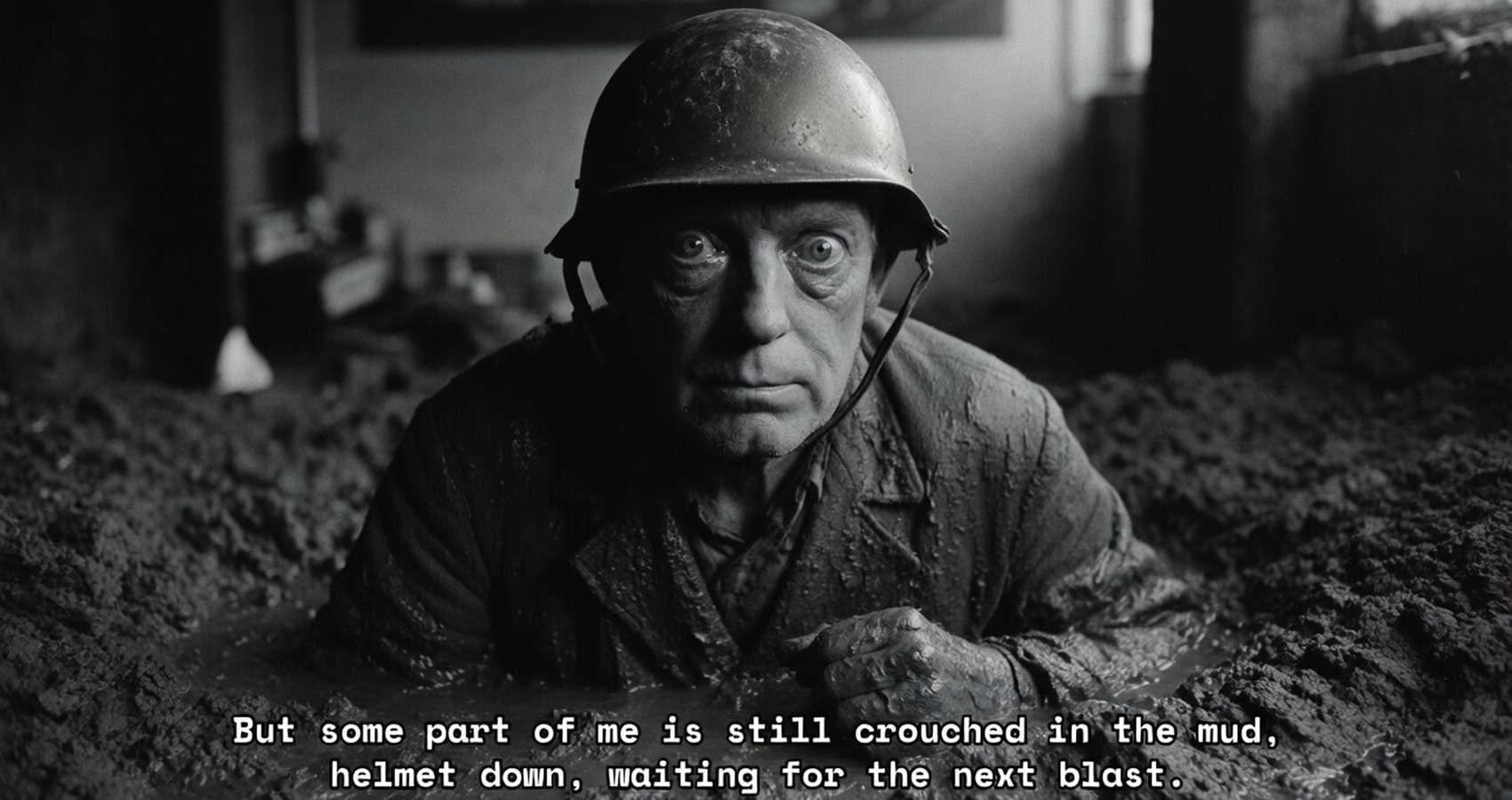
But some part of me
is still crouched in the mud,
helmet down,
waiting for the next blast.
Some part of me
didn’t make it back.
No one talks about that bit.
They don’t put it on discharge papers.
They don’t give it a pamphlet.
They don’t warn your family
that you may look present
but feel partly missing.
The battle didn’t end.
It changed address.
It moved inside
and stopped wearing a uniform.
It learned how to live in your thoughts
in a way that keeps you alert.
It’s still crouched.
Still locked-on.
Still watching for danger
in places that used to be safe.
Chemo teaches a new kind of time.
Not days and nights.
Cycles.
Counts.
Blood results.
White cells up.
White cells down.
Red cells failing reveille
Battle reports that decide
whether you are allowed more poison
or if you get a week’s delay
and a forced optimism.
You learn to live
appointment to appointment.
The future shrinks
until it fits
inside a clinic room.
Your whole life
boiled down
to a blood test.
Then it ends.
All that structure disappears.
What’s left
is a hollow
that rings in your head.
The fatigue comes first.
Or maybe it never leaves.
I can’t tell anymore.
People call it tiredness.
This isn’t tiredness.
Tiredness lifts.
This doesn’t.
Tiredness is a bad night
and a better morning.
This is sleeping
and waking exactly the same.
It plummets through you
and settles somewhere deep.
In places sleep can’t reach.
Lifting a mug
feels like lifting history.
Walking to the front door
feels like crossing no-man’s land.
Your body shuts down.
Alone.
Absolutely.
Some days the sofa wins.
You don’t look ill.
That’s another problem.
That might be the hardest part.
From the outside,
you appear returned.
Improved.
Hair grew back,
or never left.
Skin healed.
Scars tucked away.
No tubes.
No drips.
No masks.
People see recovery.
I feel aftermath.
They see “better.”
They see “recovered.”
I feel “changed.”
I try to think ahead.
My legs say no.
Not forcefully.
Just final.
Like a door that won’t open
no matter how deferentially you knock.
Your mind doesn’t trust peace anymore.
Every ache becomes a suspect.
Every bad day becomes evidence.
You scan yourself constantly,
like a soldier
listening for distant artillery.
Is that pain new?
Was it there yesterday?
Is this how it starts again?
With metastatic cancer,
you don’t get the luxury of forgetting.
Gleason 9 doesn’t fade.
Incurable doesn’t loosen its clutch.
Hope comes
with conditions attached.
Not years.
But CT scans.
Results.
Reviews.
Especially when it is aggressive.
Already spread.
Already known.
It reminds you
this isn’t over.
It’s slowed.
Then there are the injections.
Three-monthly jabs.
Daily tablets.
Hormone therapy
that fights the cancer
by dismantling you.
Strength drains away.
Heat floods your body
without warning.
Emotions slip their leash
and don’t come back.
You are still under fire.
Smouldering.
They call it treatment.
It feels like subtraction.
Less muscle.
Less certitude.
Less of the old you
in places you didn’t know were vital.
A slow accounting
where the bill is always yours.
This is the part
no one really prepares you for.
The after.
Where the fuss is gone
but the damage isn’t.
Where you’re meant to be grateful
while your body
is still dragging itself
out of a crater.
You grieve yourself in pieces.
The man who worked all day.
The man who didn’t ration energy.
The man who didn’t plan rest
like a military campaign.
You don’t say much about that grief.
It feels indulgent.
After all,
you’re still here.
Still here
is complicated.
Your mind goes back.
Not in scenes.
Just returns.
A smell.
A clinic corridor.
A trolley scuffing tile.
Your body remembers
first.
That’s shellshock.
Not from bombs.
From survival.
From being kept alive
by things that hurt you.
From discovering
that help comes with needles.
From absorbing that aid
can still make you sick.
Friends say,
“At least the chemo’s over.”
As if that was the ending.
Chemo leaves a deep mark.
It teaches your body fear.
It teaches your nerves
that danger can arrive
through kindness.
Even now,
months later,
my body tenses
at exhaustion
the way it once tensed
at nausea.
It remembers.
You learn how alone this place is.
Not because people don’t care.
Because they can’t follow you here.
Words waver.
Walls fall.
You can’t bullet-point
being emptied out
and left standing.
What remains
is a strange courage.
Getting up anyway.
Resting without regret.
Continuing to love
while knowing time
is no longer neutral.
Other chemo warriors
recognise this place.
They don’t need it explained.
They’ve lived in the long after.
Where the war doesn’t end.
It just changes tactics.
I am home.
I think.
But the battle is still going on.
Inside my body.
Inside my head.
Inside the parts of me
that haven’t understood
how to stand down yet.
Every day now
isn’t about winning.
It’s about outlasting the hours.
About getting up when I can.
About sitting when I can’t.
About living in the aftermath.
This is shellshock.
Not from destruction.
From continuing,
when parts of you
are still elsewhere.
Not finished.
Not fixed.
Not final.
Not free.
Not forgotten.
Not forlorn.
Here.
I am home.
- Shellshock - March 24, 2026
- Spotlight On Writers – Mark Woodward - January 3, 2026
- Breakfast on the Beach - November 30, 2025