

The Light We Keep
written by: Itunu Taiwo
The city was dark again.
From her kitchen window, Sade watched as the last light bulb in the neighbourhood flickered and died. Outside, Lagos held its breath. The December night stretched deep and quiet, thick with the scent of harmattan dust and roasted plantain.
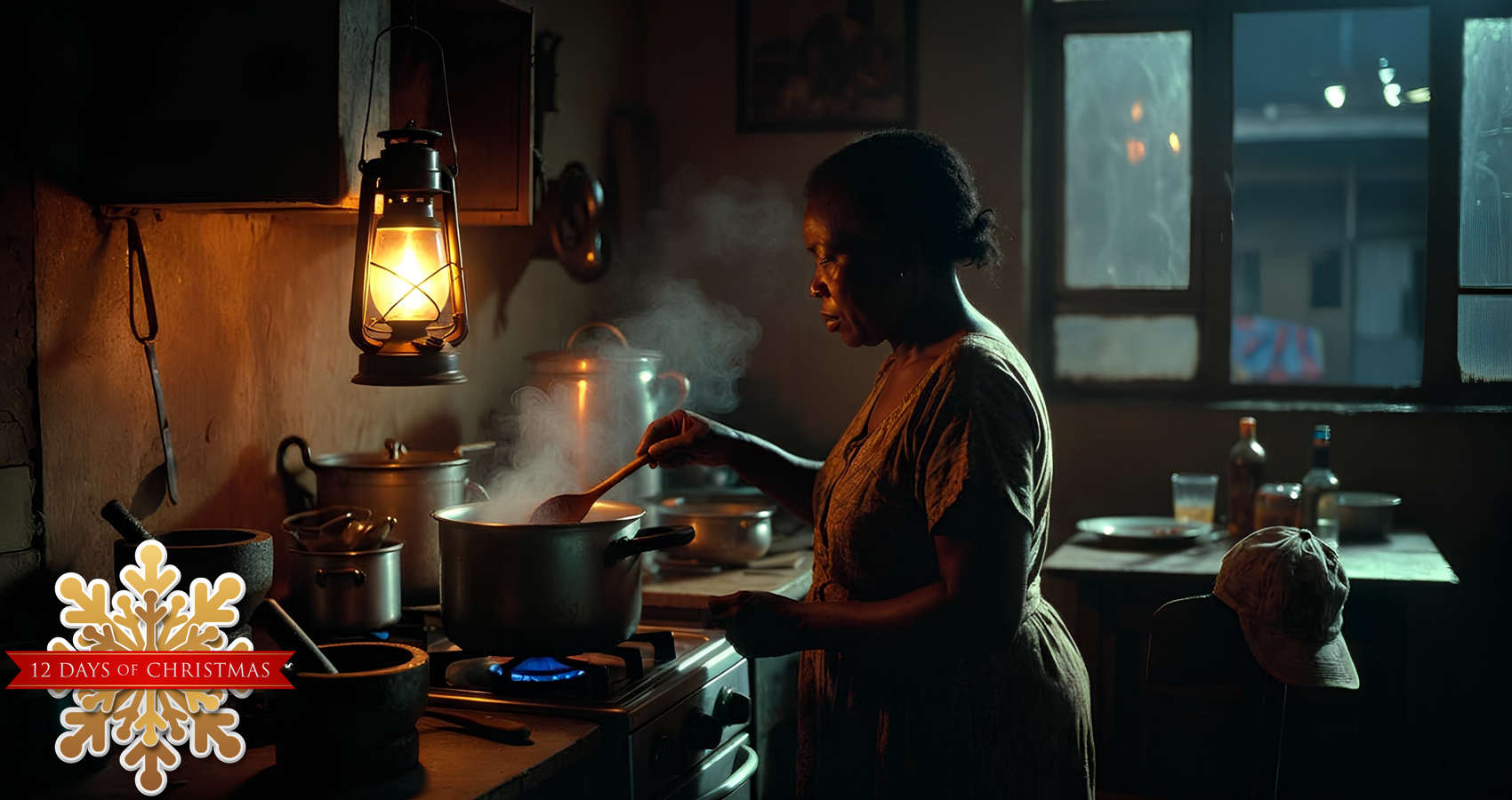
She stirred the pot slowly, the wooden spoon making soft circles in the pepper soup. It was the same recipe her husband had loved. Catfish, scent leaves, a touch of lime. She hadn’t cooked it since the year he passed, but tonight, something inside her wanted to remember.
Christmas Eve used to fill their home with noise: Sade’s children running through the yard with sparklers, her husband singing off-key to Ebenezer Obey, the radio humming Christmas songs that smelled like old joy. She would fry plantain till it crisped gold, while he teased her for burning the first batch on purpose. Now, the walls only echoed the hum of her thoughts.
Still, she set the table for two.
On the second chair, she placed his cap, the one he wore the day they danced in the rain outside St. Dominic’s church, back when Christmas meant something more than just another date on the calendar.
The power had been out since morning. NEPA’s promise of light soon had grown into an old joke. Sade had grown used to it. Yet, as the shadows lengthened and silence crept into her bones, loneliness pressed harder than usual. Maybe it was the music drifting faintly from a neighbour’s radio. A choir singing Joy to the World, each note tugging at her memory like a child asking to be let in.
She took a deep breath and whispered, You would have laughed at all this, wouldn’t you?
The kitchen light, or what was left of it — the dull glow of a kerosene lantern, wavered like it was listening.
Then came the knock, small and quick, like a bird against glass.
She opened the door to find three neighbourhood children. Ireti, Kunle, and little Bayo standing in the cold. They were barefoot, clothes patched and faded, holding a single candle in an empty Fanta bottle.
“Aunty Sade,” Ireti said, her braids glistening with beads. “We came to sing carols for you.”
Sade smiled, her heart stuttering. “Carols? In this darkness?”
Kunle grinned, missing one front tooth. “That’s why we brought light.”
And then they began — soft at first, shy and unsure, but then the melody caught the night and grew.
Silent night, holy night…
Their voices trembled and cracked, but they were bright and alive, the kind of voices that refused to bow to hunger or harmattan.
Something inside Sade loosened. She let them finish the verse, then waved them in. “Come inside before harmattan steals your voices.”
The children hesitated. Homes had grown cautious these days, but warmth called louder than fear. They entered shyly, eyes darting to the food on the table.
“Sit,” Sade said, pouring soup into small bowls. “Eat while it’s hot.”
They obeyed, giggling between spoonfuls. She watched them the way one watches fire… with both awe and ache. For a moment, her house came alive again: spoons clinking, laughter bouncing off faded walls, the soft glow of candlelight painting shadows that moved like old memories.
“Your soup is sweet, Aunty,” Bayo said, licking his fingers.
She chuckled. “Eat plenty. I cooked too much, as usual.”
“You cooked love,” said Ireti, tilting her head. “That’s why it tastes warm.”
Sade blinked. The child’s words landed softly but deeply. After they’d eaten, Bayo asked, “Aunty, do you still have your Christmas lanterns? The red ones that used to hang by your window?”
She blinked. “Ah, those ones. They’re sleeping somewhere in a box, I think.”
“Can we help you wake them up?”
Sade hesitated, then laughed quietly. “You children have big hearts.”
She found the box beneath her bed, covered in dust. Inside were the paper lanterns her husband had made years ago. Although they looked fragile and wrinkled, they were still as red as a sunset. Together, they patched the torn edges with tape and bits of old wrapping paper. The children lit small candles inside, one by one, and soon the house glowed like a living ember.
Outside, the darkness softened.
Sade sat back, watching the flicker of colour on the children’s faces. “You’ve brought Christmas back to my house,” she said softly.
“No,” Ireti replied. “We just found the light you already had.”
Something inside her gave way to gratitude. The kind that warms even the coldest heart.
***
That night, after the children left, Sade stepped outside with one lantern still burning. The city stretched before her as she took in the black rooftops, scattered fires, and a sky heavy with stars. She placed the lantern on her gatepost, its light trembling against the wind.
Down the street, other small lights began to bloom: one from Mr Okoro’s porch, another from Sisi Funke’s balcony. One by one, the neighbourhood flickered awake, like a constellation remembering itself.
The air smelled of fried rice and gunpowder from early fireworks. Somewhere, someone began to sing an old Yoruba hymn, and others joined, their voices blending into the night like a prayer stitched from a thousand small hopes.
Sade stood there, shawl tight around her shoulders, heart full of something she hadn’t felt in years.
When she closed her eyes, she could almost hear her husband’s voice again. It was warm, teasing, and full of life. Sade mi, you see? Even darkness cannot swallow light that is born of love.
She smiled into the wind. “I see it now.”
***
Later, inside, she sat by the window, watching the lantern burn low. The house smelled of pepper soup and candle wax, and for the first time in a long while, she didn’t feel alone.
She reached for her old Bible, its leather cover cracked, and turned to Luke, where the shepherds saw light and were afraid. She thought of those shepherds, standing in their fields, startled by brightness in a dark sky. The same kind of brightness now trembling in her chest.
Her fingers brushed a folded photograph tucked between the pages — she and her husband, younger and smiling. She held it to her chest.
“Thank you,” she whispered, unsure if she spoke to him or to God or to the small flame still holding steady.
Outside, children laughed. Someone set off a firework — a streak of green and red cutting through the dark, bursting into brief brilliance before fading. But for that moment, the night bloomed like joy.
***
By Christmas morning, the light had multiplied. The children returned, dragging a string of lanterns they’d made from discarded tins and bottles.
“Aunty Sade!” they called, “We brought your light back!”
She laughed, a sound she barely recognized as her own. The street came alive: women pounding yams, radios blaring carols, the air thick with frying oil and perfume. Neighbours shared jollof and laughter, old grudges forgotten for a day.
When she lifted her eyes, she saw the whole street lit — lanterns swinging from balconies, paper stars pinned to trees, candles flickering in windows.
A current of warmth ran through her, fierce and soft, and for a brief moment, she silently wished this moment would last forever.
That night, when quiet returned, she sat again at her window. The last lantern still burned on her gatepost, its glow steady despite the wind. Somewhere beyond the roofs, the first church bell of Christmas rang out — slow, golden, and full.
Sade closed her eyes. “Merry Christmas, my love,” she whispered.
The wind carried her words into the night.
And across the sleeping city, a thousand small lights flickered in answer.

- The Light We Keep - December 20, 2025