

Cieder Muld and the Boy
A Christmas Tale
written by: Pedro la Fuego
The boy could not sleep.
It was the night before Christmas, and the boy’s head was full of presents, roast potatoes in goose fat, pigs in blankets, turkey, sword fights with Uncle Ziggy, and Grandad’s warming smile around the fire as he drank his mulled cider.
The house was heavy with the scent of pine needles and ash. The stockings sagged from the mantel, flailing in the updraft from the fire as a metal windmill spun while heat rose out of the chimney and into the cold frost of a winter’s night. His parents had gone to bed, leaving the fire to burn itself out. The embers glowed red. Black images danced up and down on them like the shadows in a Platonic cave. Was it reality or just illusion that made them dance? In the dark, the forms danced in the heat of the charred wood remains, and enchanting scenes whirled like a dervish in a campfire. Eyes sinister and black seemed to smile, watching the entranced from the smouldering flame.
The boy was put to bed, and he looked at his stocking—empty and hung on the corner of the bed knob. The boy would twist the knob three times before he went to bed: once left, then three times right. He played out his ritual, and the bed seemed to buzz with excitement. The boy lay flat and stared at the ceiling, imagining how his empty sack would look in the morning when it was full.
The boy couldn’t sleep. His heart was restless, beating against his chest, and the bed seemed uncomfortable and made him itch. It was funny—it had never made him itch before. He touched his chin and realised he hadn’t twisted the knob properly. He went to the end of the bed, twisted it once left and three times right. On the third twist, something clanged like metal striking metal. It seemed to come from downstairs, and it sounded like drumming and people chanting—like the noise of a shamanic ritual. The boy decided to go downstairs. He opened the door, and the drumming stopped. A wave of relief washed over the boy, and he remembered what he had done. The boy was smart but forgetful. He just then remembered that, while hanging the tree decorations, he had left some chocolate out of sight of his parents at the back of the tree—perfectly placed to be eaten when no one was watching. A secret stock, ripe for thievery before the Christmas feast. The boy was sly. The boy was clever.
He looked at the presents sitting there. He had found out from Curly that Santa wasn’t real the year before, but he had always suspected something was up. The brandy was always only partially drunk, and the mince pies were always half-eaten. Who only eats half a mince pie, he thought—especially at Christmas? His mother told him it was because Santa was fat and Mrs Claus had put him on a strict diet; he was only allowed half a mince pie per house. The boy was smart and realised that, with a global population of 8.25 billion people, that would equate to 4.125 billion pies recurring. It was rubbish, and the boy knew it. He sighed and asked his mother why there wasn’t any magic left in the world. His mum smiled and told him to eat his banana bread.
He crept over to the presents, and a beat broke the silence. The fire was still alive—a low red glow, breathing like some ancient creature. He crouched before it, and something in the flames beckoned forth. Not warmth, not light, but a pull—like a hand reaching from the other side.
The boy leaned closer.
And then the fire opened.
He saw them: Sámi shamans in red and white robes, their garments stitched with the colours of snow and blood. They danced in circles around a great fire, their shadows leaping like wolves. Reindeer nearby seemed possessed; their hooves struck sparks that flashed as their bodies—light as air—leaped as if they were flying. The boy’s breath caught in his throat. He wanted to cry out, but the vision held him silent.
Then came the sound—a crash, a cough, a tumble of soot.
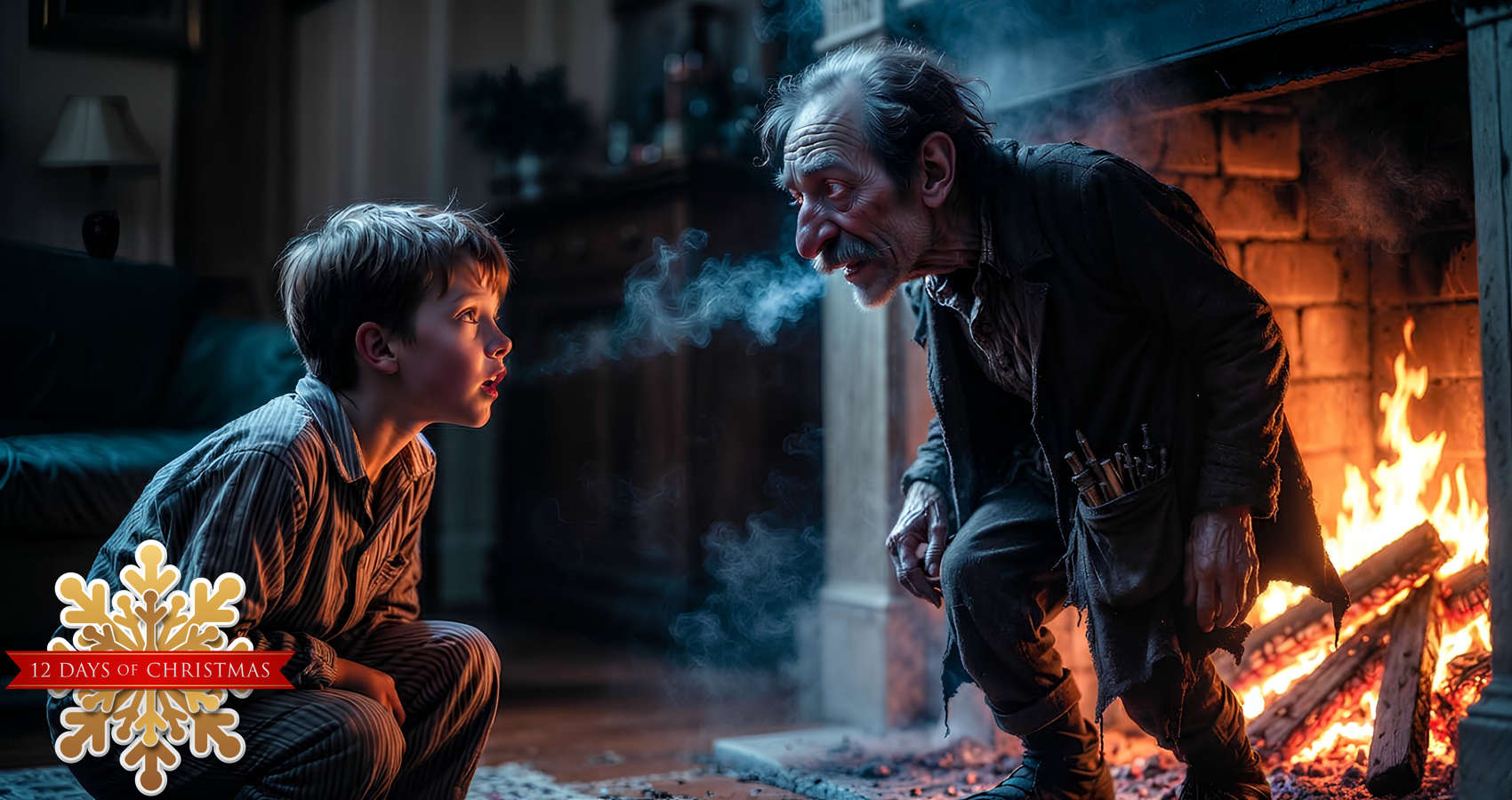
From the chimney fell a figure, blackened with ash. He was an odd-looking thing with a pointy face and blushed cheeks that framed a moustache curled at the ends. It tangled beneath eyes alive with burning mischief. He staggered toward the drinks cupboard, muttering, shaking the soot from his shoulders. The boy was enchanted, unable to move.
The figure ignored him—he had seen naughty boys before and knew they couldn’t see him, despite the clang as he raided the drinks cabinet. The Chine elves had cursed him to be heard but never seen: the perfect guise for an alcoholic trickster. He slowly moved his head until he turned and saw the boy staring. His eyes widened.
“You can see me?” he asked, voice rough as gravel, coughing and spluttering the viscous Baileys he had been drinking onto the floor.
“Yes,” the boy whispered. “Are you an elf?”
The figure laughed, a sound like broken bells. “Elf? No. I am Cieder Muld. But if you want to see the Chine elves, you must eat what is in here.”
From his coat, he pulled a small box. It had the sheen of metal and shone brightly as clockwork shapes moved like gears—snowflakes wrapped in red and white filigree. He handed it to the boy. Inside lay a single mushroom, red cap flecked with white. “That’s not just a present—it’s magic.”
“Magic?” said the boy. “There’s no magic.”
“There’s some,” said Cieder Muld.
“Let’s share it, and I’ll take you to see them.”
Cieder Muld snatched the mushroom out of the boy’s hand and greedily ate half as spittle ran down his face. He held out the rest.
“Well? Take it.”
The boy looked unsure.
“There’s no magic in the world,” the boy said to himself—and he took a bite.
It was delicious, like all the flavours of Christmas in one: butterscotch, chocolate, fudge, caramel, toffee. The boy looked at the rest of the mushroom with an unquenchable hunger and devoured it.
A second—then the world tilted.
Cieder Muld took his hand, and they began to float towards the ceiling. The boy laughed at first and said to himself, “There’s no magic in the world.” Then all of a sudden they were sucked up through the chimney, past the smoke and sparks, into the night sky. The stars were needles of ice; the moon, a pale drum. They flew into the forest where the shamans still danced, their chants weaving through the trees like threads of fire. They were a distant speck at first, but as they flew ever closer, the drumming grew louder and the chanting deafening, reaching a climax when divine light wrapped around them and they fell in a pile on the snow.
Cieder Muld and the boy picked themselves up and could see the fire and people dancing around it. Cieder Muld changed, like he had done something wrong. “The Chine Elves are over there. Go and see them. They’ll have something for you.”
“I daren’t go over there after what happened.”
They were small, luminous beings, their bodies made of shifting geometry, their voices like glass breaking and reforming. They surrounded the boy, whispering truths that cut and healed at once.
“Your father,” they said, “is walking toward tragedy. The shadows wait for him.”
The boy trembled. “How? What? The shadows?”
The elves did not answer directly. They showed him visions: his father crossing a frozen road, his mother crying, the grave of his grandfather, Ziggy floating beneath a lake with cracked ice above. The silence was deafening.
Then they were gone. Everyone was gone—the reindeer, the shamans. All that remained was Cieder Muld and the embers of the fire.
The boy wept. He did not want to see such things.
Cieder Muld watched from a distance, silent, his eyes heavy with the centuries.
The boy turned to him. “Where am I? Why is my family dead?”
“Because you can see,” Cieder Muld said. “Most children sleep. Most men forget. But you see the fire, the shamans, the elves. You carry the gift. And gifts are burdens.”
The boy wanted to run, wanted to wake in his bed with the comfort of wrapping paper and toys. But the forest held him.
Cieder Muld was acting sheepish, as if guilty about something—like he was hiding something from the boy, but the boy didn’t pick up on it.
“Come with me,” said Cieder Muld. “I’ll take you to my cave. I have some mulled cider left.”
They turned and followed Cieder Muld through the snow and into the black.
Cieder Muld’s Cottage
The woods were cold, and shadows twisted in twilight. There was an eerie silence, as if the snow were absorbing everything that dared to make a sound. The moon had become brighter—a stark white illuminating the woods ahead.
Cieder Muld looked up at the night sky.
“Can you see that?”
“See what?” said the boy.
“Vargomir.”
“Vargomir?”
“The dire wolf that lives on the moon.”
The boy looked at the moon but saw nothing.
“You’re looking but not seeing,” said Cieder Muld. “Look again.”
The boy looked again, and a shadow turned over the face of the moon. The woods darkened, and piercing eyes and fangs could be seen—but then left as soon as they arrived.
Cieder Muld took a deep breath and began.
In the time before memory, when the sky still bled stories and the earth pulsed with the memories of yore, lived Vargomir, the First Dire Wolf. Born of shadow and frost, he was the eldest of the Lupine Kin—a creature vast as mountains and silent as snowfall. His howl could bend rivers. His gaze could silence war.
But Vargomir defied the gods.
He refused to kneel to the celestial order and the age of men, gnawing through his chains and devouring the sun’s reflection in the Lake of Echoes. For this, the gods cast him out—not to death, but to exile on the moon, where his hunger would never be sated, and his thirst never quenched.
Each lunar cycle, when the moon turns blood-red, it is said that Vargomir finds a shard of the blade that once pierced his heart. He licks it—not to heal, but to drink. Yet the moon offers no water, no prey. So he drinks his own blood, a ritual of defiance and remembrance.
His howl pierces the veil between worlds, and every wolf on Earth lifts its voice in mourning. They do not cry for vengeance. They cry for the ancient forest, they cry for balance in nature, they cry for the time before man, when the forest sang.
Wolves howl not at the moon, but to Vargomir.
Out of the trees, they saw Cieder Muld’s cottage. Plumes of smoke twirled in purple and green wisps out of the chimney. A frozen river ran by the cottage, and the water mill was frozen solid. Icicles like daggers hung off the roof, and the fish in the frozen river were held in stasis.
They tried to enter the cottage, but the door wouldn’t open. Cieder Muld got angry and began kicking the door and damning the gods.
The boy looked at the doorknob—it looked like the knob on his bedpost. Cieder Muld, exhausted, sat in the snow and put his head in his hands.
“We’re going to freeze to death if the wolves don’t kill us first.”
The boy approached the door and rotated the doorknob three times left and one turn right. The door opened.
A rich smell of mulled cider and Christmas pudding greeted them, and the warmth of the cottage seemed to embrace them both as they escaped the cold.
“We are saved! Well done, boy.”
The cottage was like a curiosity shop; trinkets and treasures were scattered all over the walls.
The boy went in and took a seat.
“What do you want?” said Cieder Muld. “I’m having schnapps and mulled cider. What would you like?”
“Got any Peruvian hot chocolate?”
“Of course,” said Cieder Muld, and he disappeared into the parlour.
On the walls, there were no pictures of Cieder Muld’s kin—just a picture turned backwards above the fireplace and images of mythic beasts.
In the centre of the wall, there was a wheel: a wheel with a black wolf on one side and a white wolf on the other. Each wolf had an opposing eye that was the shade of the other.
Cieder Muld looked up at it and asked the boy if he knew what it meant.
The boy regarded it and said he didn’t.
Cieder Muld grabbed a stool, stood on it, then rotated the circle clockwise, spinning it as the wolves merged and the sphere turned white. He then caught the wheel mid-spin, rotated the sphere the other way, and it turned black as night.
Cieder Muld sat in his chair and pulled out a long pipe from a drawer. He put some brown substance in the end, lit it, and breathed in deeply.
He held his breath and then blew out the smoke. It smelled sickly sweet, and Cieder Muld’s eyes began to glaze and turn red around the edges.
Cieder Muld looked at the boy, then at the sphere. His eyes didn’t leave the sphere, and he started to speak in poetic verse.
Spin the moon, child—
clockwise, it turns white.
And the wolves rejoice.
Spin it back,
and the moon turns black.
The gods weep,
and the howls rise.
Goodness is not clean.
It carries a bruise.
Badness is not blind.
It holds a candle.
Vargomir drinks his own blood
not to die,
but to remember
the taste of both.
The Yin spins into Yang,
the Yang spins into Yin—
and neither stays still
long enough to be pure.
So, spin, beloved.
Spin until the white becomes shadow,
until the shadow becomes song.
Spin until you see.
Cieder Muld sat back in his seat as if nothing had happened, then asked, “Are you hungry?”
“I’m starving,” said the boy.
Cieder Muld brought out a pork pie, a satsuma, and some walnuts. There was a menacing-looking nutcracker that stood beside the fire, and Cieder Muld picked it up and began cracking nuts.
The boy looked at Cieder Muld and asked him why he wouldn’t go with him to the Chine Elves.
Cieder Muld looked at the picture turned away against the wall and sighed.
“I was broken when she found me. I wandered the shadowlands—a hollow vessel filled with smoke and an unquenchable hunger. Lirael was a daughter of the Chine Elves who found me collapsed beneath a Withering Tree. I awoke to her touch, and she sang a song drawing the poison from my veins. Her voice was not music—it was truth, and it hurt me at first. But in time, I listened and learnt and found happiness with her embrace.
She gave me shelter in the Grove and taught me how to speak my truth, how to drink without thirst, how to be still without shame. In her presence, I remembered the shape of my name. And I…
I loved her.
But the hunger came back—one that no grove could cure. The silence of the grove, once healing, became a prison. The purity of Lirael’s love became a mirror I could no longer bear to look at, and I…
I betrayed her.”
Cieder Muld hung his head and leaned against the mantel.
“Anyway, I guess you want to know the way home. It’s Christmas tomorrow, after all.”
“Yes,” the boy said, elated. “Take me home.”
“I’ll take you home.
But first—it’s Christmas Eve, and we should share a wee dram.”
Cieder Muld pulled out a key and went to a cabinet, struggling to open it.
The boy walked over and turned the key three times left and one turn right. The cabinet door opened.
Cieder Muld pulled out a golden cylinder.
“This I swiped from Balmoral. It’s thirty years old—peaty yet smooth, spicy yet sweet. Makes you warm from your head to your feet.”
Cieder Muld opened the bottle and poured himself and the boy a glass, pulling a pipette out of his pocket and dropping two drops of spring water into each.
The boy tried the drink and spat it out.
“That’s disgusting!”
“Tastes grand to me,” said Cieder Muld.
It wasn’t long before Cieder Muld was asleep and snoring.
The boy tried to wake him, but he wouldn’t stir.
The boy started to panic. I’m going to miss Christmas, he thought.
He must get home. He must go now.
Suddenly, the door flung open, and the wolves began to howl. Cold air and snow blew through the cottage, and dark, shadowy silhouettes danced on the snow outside.
The howls were getting louder, sounding as if they were coming closer.
The boy shook Cieder Muld, but he didn’t wake.
He ran to go into the parlour, but the door wouldn’t open. He pulled at it with all his might, but it wouldn’t budge.
Then it occurred to him: one turn left, then three turns right.
As the boy turned the knob and the door gave way, a huge timber wolf could be seen standing in the doorway.
The boy entered the parlour and shut the door.
The Parlour and the Chine Elves
Inside the parlour, the food stretched out in vast corridors. There were bottles everywhere, and the boy turned around—but the door had gone. He found a Christmas tree with luminous gold and silver balls and the most fantastic metallic tinsel.
The boy began to walk down the corridor, and it stretched out before him.
He started to notice the food: Turkish delight, Quality Street, After Eight mint chocolates, chocolate orange, and ice cream.
Around him, colours more vivid than any he had seen before morphed in spiral-like gears and clock parts. Then he saw it—a bubble gum machine. The boy loved bubble gum but had no money.
The boy tried the knob, but it wouldn’t budge. Then he remembered: three turns left, one turn right.
All of a sudden, bubble gum started flying out of the machine and engulfed the boy.
The boy started to panic as he picked up speed. The bubble gum balls seemed to reach the end of a cliff, cascading downwards. The boy fell for what seemed like forever and then hit liquid.
He didn’t completely submerge but was stopped. What viscous solution was it? The boy licked a finger and tasted the liquid. It was Angel Delight. The boy tried to get out, but he couldn’t. Then all of a sudden, a green light began coming towards him—bouncing up and down and moving erratically like a fly.
A tune sat mellifluously on the butterscotch air, and he could see that it was a green fairy.
A green fairy singing Christmas carols.
“Hey, you boy! What are you doing in all that Angel Delight?”
“I… well, I fell from up there.” The boy looked up but saw nothing but stars and the Milky Way galaxy.
“What are you doing?” she said.
“I was escaping the wolf, and Cieder Muld fell asleep. I just wanted to get home for Christmas. I understand we must go and see the Chine Elves.”
The fairy took the boy’s hand, and they flew out of the Angel Delight and into the skies.
The Milky Way became brighter, and celestial scenes whizzed by. Then he noticed it—Santa and his reindeer below.
“It’s Santa!” the boy said, excited.
“But I thought Santa didn’t exist,” said the fairy.
“I guess there is magic in the world,” the boy said.
Below sat an amazing city that was metallic and moving in gear-like spirals and snowflakes that turned and merged together.
“Where are we?” said the boy.
“This is Babel,” said the Green Fairy, “the home of the Chine Elves.”
They saw a massive tower that stretched to the heavens and through the clouds like it had no end. It was slightly leaning, and etched into the walls were scenes of great battles and forest animals. A dire wolf could be seen howling at the moon.
The fairy and the boy touched down outside the gates to the tower, and the fairy flew through the keyhole. The boy knocked on the door. “Fairy! Fairy, I can’t get in! Fairy!”
He then remembered: three turns to the left and one to the right.
The boy opened the door and was in a forest once again. Ahead, he could see a green glow and called out, “Fairy, come back!”
The glow began to get brighter and brighter, then split into two and seemed to be coming back at speed towards him. The eyes seemed to be bounding up and down, and a red ball of light appeared that was bouncing and getting closer. When it came into focus, he could see a crazed reindeer with a red nose running straight at him. But before the boy could get out of the way, the lights began to soar above them, and hooves of reindeer started galloping over his head. Santa’s sleigh could be seen rising to the heavens above. The boy looked up to see Santa Claus and the reindeer riding off into the Milky Way.
The boy continued to walk across the snow and could hear loud drumming and an open fire. He could see Vargomir in the moon, and a distant wolf howl could be heard—but far enough away to not be scary.
All of a sudden, the green fairy flew straight at him, knocking him over.
“Where did you go?”
“I saw Santa.”
“Yep, well, it is Christmas Eve.”
“What’s your name?” said the boy.
“My name is Absinth.”
Absinth and the boy approached the Chine Elves.
The Chine Elves turned from their toy-making and regarded the boy. They were different this time and asked him to sit.
They didn’t speak as before. One of the Chine Elves brought over some viscous black potion.
The boy began to drink, but it was sharp-tasting and acrid. A Chine Elf grabbed the boy’s hand and wouldn’t let him stop drinking.
The boy’s waist began to swell, and he began to inflate as the taste turned from acrid to caramel. The boy couldn’t get his fill, and eventually he ballooned to twice his size.
Then Absinth flew up to the boy and blew some yellow dust into his mouth, and the liquid began to pour in the other direction—out of his mouth.
The liquid that poured out was like a rainbow, and the boy started to be carried with it through the woods.
As the boy was being carried away, great markets could be seen on either side of him, with people buying Christmas presents and drinking mulled wine and cider. The Brighton Pavilion could be seen, and people were skating on an ice rink. Christmas decorations adorned the streets, and a huge Christmas tree could be seen.
The boy awoke under the Christmas tree and saw his mother and father peering down at him.
The boy’s father looked stern.
“What is this? It’s chocolate—I ate it last night.”
“This was Daddy’s special chocolate. You’re lucky you weren’t sick.”
“I’m sorry, Dad.” The boy hugged his dad hard and kissed his mother.
“There is magic in the world,” the boy said. “And I saw Vargomir, Cieder Muld, Absinth, and the Chine Elves.”
“Okay,” said his father. “Take a shower, and we’ll get you some breakfast. Then you can open your presents.”

- Loco Motivus - March 14, 2026
- Cieder Muld and the Boy - December 15, 2025