

Reaper
written by: Sharon Frame Gay
As an orphaned son of an orphan, I always see the glass as half empty. I picture the water murky and lukewarm, a waterline etched below the rim. Maybe with an ash or two floating at the bottom, because that’s what I do for a living. I deal with ashes. The remains of the deceased. No matter how those who pass away see their glass, meager or full, they eventually end up in a satchel carried on my shoulder.
My business card reads “Morton Stark Transport.” I’m called upon to disperse the ashes of the dearly departed and honor their final wishes. People hire me to escort the remains throughout the world, from the Alps to the warm sands of a coral reef. I’ve delivered them into the arms of their beloved, or flung them to the four winds.
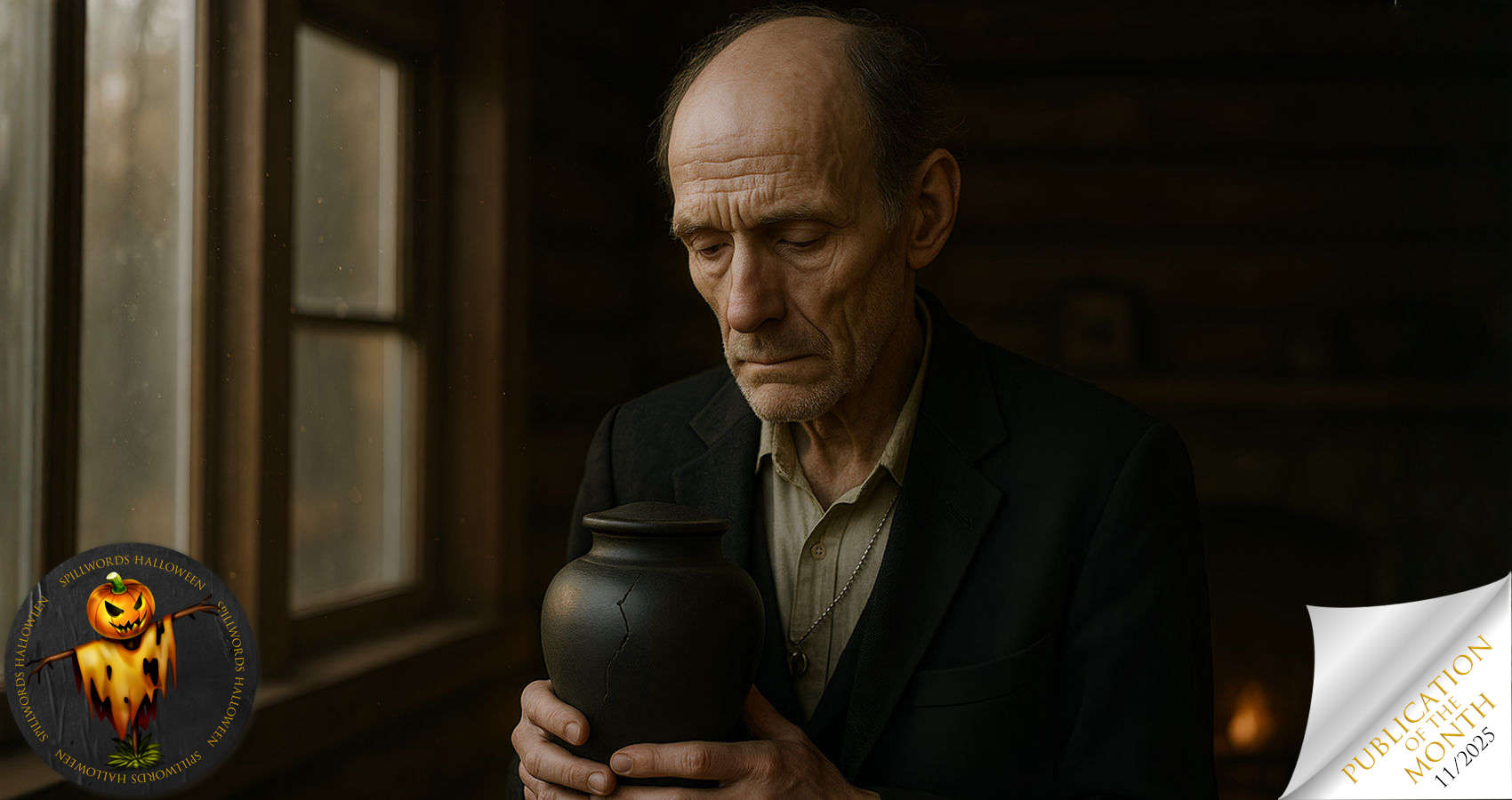
My few friends call me Reaper. Tall, dark, and exceedingly thin, I arrive on doorsteps in a black suit, appropriately solemn. My thinning hair forms a wispy crescent around my head, and I am slightly hunched from leaning down to talk to people. I’m not a great conversationalist. I prefer to hang back in the shadows, hands clasped in front of me, a dreary portent of gloom. Some might say I look dour. However, this is a serious business. Nobody wants to speak to a jovial man when they hand over Grandpa with directions to scatter his bones from a mountain gondola. I have the right personality, I suppose. Years in an orphanage taught me how to keep silent and observe. It was fitting I found a job bathed in solitude, my traveling companions as quiet I am.
At first, I simply saw it as a job, and a well-paying one. It wasn’t until I carried the ashes of a child that things changed.
***
Her name was Abby James. She was only four years old when death claimed her. Abby’s final wish was to visit Disneyland and go on the teacup ride, but she passed before the wish was fulfilled. Her parents were too devastated to see it through, so they called upon me to take Abby to California, then return her remains to them for burial. Her mother placed the small urn in my hands.
“Mrs. James, might I have a photograph of Abby? I’d like to take it with me to Disneyland,” I asked, surprising myself with the question.
She nodded at my odd request, and gave me a picture of a little girl standing in a field of tulips. Abby would forever be four years old in a blue linen dress, a pink balloon tied around her wrist.
Touched, I put the photo in my wallet and set about my mission. I rode in the whirling teacup with her urn and held her likeness in my hands. Seeing her face in the picture helped me understand the impact of such a wish. I realized this wasn’t just a job, but a true mission.
After Abby, I requested photos of all my clients. Most people seemed eager to oblige. They not only gave me a picture, but regaled me with stories of their loved one. By the time I reached my destination to disperse their ashes, I felt a connection with the deceased. I invented stories in my mind, put personalities to the rattling remains inside the jars. Afterwards, I couldn’t bear to part with the last reminder of their lives. It seemed cruel to shred the photographs, throw them in the trash, or return them to their families. I collected them instead.
On one of my trips, I spotted a vintage apothecary cabinet in an antique shop in Vermont. The finish had peeled off long ago, the brass hinges tarnished. Several small drawers glided in and out. It wobbled slightly beneath my hand as though it were breathing. There was something noble, almost magical, about the cabinet. It was the perfect resting place for the photographs.
I brought it home and spent hours sanding, varnishing, and polishing the piece until it glowed, then placed it in the living room. Each drawer held pictures of the deceased, along with special memories from their loved ones written on index cards in my finest hand. Before long, I formed a kinship with the essence of the souls that inhabited the drawers. I often took the photographs out and gazed at their faces, spoke to them, thought of the lives they’d led, and the stories they’d tell if they could.
I felt particularly sorry for those who had no family. A law office or funeral home would call me to retrieve the remains. There were no photographs or stories. Just papers to sign and orders to give. Then off I went, their last journey in the hands of a stranger who tucked them in for eternity. One drawer remained empty in the cabinet as a welcoming space in their honor, inviting their spirits to find a home with me.
***
It was a day in late September when I flew to Los Angeles to pick up the remains of a young woman, Cassie Strauss. The deceased’s mother answered the door. Her face was gray and haggard. I half expected she might swoon in my arms from grief. She led me to a sofa, a balled up tissue in her hand. In a small voice, Mrs. Strauss told me Cassie died two months before, and Cassie’s father passed away a year ago.
“It’s best John died before our daughter. It would’ve been too hard on him.” She raised tearful eyes to me. “Some days I wonder how I cope with all of this.”
Her hands were clasped in her lap, shoulders hunched. I noticed a small bruise on her leg, as though she’d run into a chair in the dark. I thought of the blood coursing through her veins, a heart that continued to beat despite the blows to her spirit. I pictured her mournful steps as she paced the apartment alone at night.
Mrs. Strauss seemed surprised when I asked for a photograph, but rose and left the room. She returned with several and placed them on the coffee table.
“This is Cassie,” she whispered.
I took the pictures, fanned them out in my hand like playing cards, and gazed into her daughter’s deep violet eyes. Cassie was stunning. In one photo, she held a small poodle in her arms. She was smiling into the camera, the corners of her mouth lifted. In another, she stood between her parents at her college graduation, chestnut hair sweeping her shoulders. I shook my head and glanced away.
“Cassie always said she wanted her ashes strewn on Black Bear Mountain in North Carolina. We took her there every summer.” Mrs. Strauss sniffed, dabbed at her eyes, then handed me a piece of paper. “I drew this map. Please take her to her favorite spot, the top of the mountain.”
“I can’t go,” she continued, “I can’t say goodbye to her like that. I want to keep her here in my heart the way she was before…” Her voice drifted off. She straightened her shoulders, took a breath. “…before she was murdered.”
I dropped the pictures, and they scattered on the floor. Apologizing, I leaned down and picked them up. The room seemed to darken. I felt a chill on the back of my neck.
“I’m sorry for your loss, Mrs. Strauss,” I said. “I’ll bring Cassie to the top of the mountain and prepare a ceremony for her. May I keep a photo to bring with me to North Carolina?”
“Keep them all if you want. I have plenty.” Then she stood abruptly and walked towards the front door. “Goodbye now, Mr. Stark. I can’t be in the room when you leave with her.”
I nodded in understanding as she walked away. Then I picked up Cassie’s urn and let myself out.
***
The flight to North Carolina was bumpy. I kept thinking of Cassie and pulled the snapshots out of my notebook, wondering what happened. I thought of researching her murder, but decided I didn’t want to know. It was too painful to think of someone harming such a lovely young woman. There was an extra drawer in the apothecary cabinet for a special photograph, and I knew it would be Cassie’s.
We had a layover in Dallas. The passengers were eager to get off the plane and stretch their legs. The next flight was leaving in three hours for Charlotte. Relieved to be freed from the cramped space, I strode into a shop on the concourse and set the satchel down, rubbing my tired shoulder. I reached into a pocket, brought out some change, and purchased chewing gum and a bottle of water.
“Where ya headed?” the clerk asked. He was short, an older man who appeared to be hard of hearing. I had to stoop and lean over the counter to speak to him.
“Charlotte, then by car up into the mountains.”
“Nice there this time of year. The mountains are ‘specially pretty. If you get a chance, drive over to Asheville. It’s got a big artist colony, and plenty to see.” He handed me a receipt. “Have a good flight.” He turned to help another traveler, and I reached down for Cassie.
The satchel was gone! I drew in my breath, shocked. I felt for the leather strap on my empty shoulder, the way a baby reaches for his mother’s breast.
“Did you see my bag?” I shouted at the cashier’s back.
He turned around. “Huh?”
“My bag! My bag, damn it!”
I looked around the shop, then raced into the concourse, spun in one direction, then another. Countless people moved along the walkway like schools of fish. A woman up ahead carried a familiar-looking satchel. I elbowed past the crowd and grabbed her arm. She stepped back, frightened. The bag wasn’t mine.
“So sorry,” I said. “I’ve made a mistake.”
The woman scowled, rushed away, and melted back into the crowd. I continued weaving up and down the corridor. A security guard leaned against the wall next to the men’s room. I ran to him and explained what happened in a shrill voice, sweat running down my face.
He walked me back to the concourse store. We searched the shop and spoke to the clerk. Then the guard pointed towards an escalator.
“Down there near Baggage is our Lost and Found Department,” he said.
“But it was stolen!”
“I know, Sir, but it’s your best shot.”
“There are human remains in it! Wouldn’t this be a matter for the police?”
In the end, I persuaded him to call the police, and we filled out a report. Then I filed a claim with the Lost and Found. They promised they’d contact me if anything turned up.
How could I tell Cassie’s mother her precious child was lost a second time? Cassie was murdered. Now she was gone forever, probably in a dumpster in a bad part of town. I pictured rats clawing at the urn, prying it open, running their whiskers through her ashes.
There was time to catch the flight to North Carolina. They could still find Cassie, I thought. It seemed hopeless, but why upset Mrs. Strauss when I didn’t know for sure? I continued the journey. I found the assigned seat, pressed my forehead against the window, and closed my eyes.
When the plane touched down in Charlotte, I drove to Black Bear Mountain, and found an inn for the night. Removing my dark suit, I collapsed on the bed and tried to think.
The next morning, I ordered a box lunch from the inn, changed into hiking clothes, and set off for the top of the mountain. The climb was arduous. Well-maintained hiking paths gave way to deer trails, underbrush that snagged at pant legs, branches scratching at my face. At the top of the mountain was a broad rock on the edge of a cliff. I sat down and gazed out across the great expanse. Then I brought Cassie’s photos out of my pocket and placed them on the mossy surface of the ledge.
“I see why you loved it here, Cassie,” I said, taking in the view. The rounded hillsides rolled to the horizon, the sky clear and unfettered. Below the cliff was a river that meandered through dense woods.
As if in answer, a murder of crows flew up from the valley and over my head, singing their truth. A gust of wind blew one of Cassie’s photographs off the ledge. It spun like a ballerina, then floated to the hollow below.
I shuddered. What have I done? How could I have been so stupid? All my memories of childhood, the orphanage, and every mistake I’d ever made bubbled up from my soul and wove through my brain.
I couldn’t possibly tell Cassie’s mother I lost her. How would she ever learn the truth? This orphaned son of an orphan would lie, and tell her I accomplished the job. I’d describe the lush mountainside, the blue skies, the sense of peace and joy when I released Cassie to the gentle breeze. It would be cruel to tell her what really happened.
I called Mrs. Strauss the next day and fed her my pack of lies. Then hung my head and listened to her gratitude, her relief, thankful that Cassie was at long last safe and at rest. Hanging up, I knew I’d done the best thing for Mrs. Strauss, but shame gnawed at my gut and tore at my deceitful heart.
I couldn’t go home right away. It would be too much to walk through my front door, safe and secure. I lost Cassie, her ashes tossed somewhere like a used newspaper. It was my fault. I didn’t deserve to put this episode behind me.
The inn had space available, so I settled into Black Bear Mountain, heavy with guilt. I didn’t shave or shower for days, and picked at my food with no appetite. Avoiding the other guests, I ventured from my room only to leave the inn. Every morning, I climbed the mountain, seeking solace on the ledge.
I had long conversations with Cassie, and told her what the crows were doing, how the leaves were changing into deep red and gold, a plaid quilt covering the valley and hills. I confessed that I’d lied to her mother to spare Mrs. Strauss more anguish and prayed for forgiveness.
There on the rock, I told Cassie about my life, the constant gloom. I couldn’t connect with the living, I said. It bruised my soul somehow. I never grew out of a childhood trauma. I always felt alone, a vast isolation forged in sorrow. I hoped Cassie was listening.
My nights were haunted by dreams, seeping into the waking hours, leaving me confused. Like vertigo, I could no longer tell up from down, imagination from reality. The days ran into each other like blood and tears, swirling and blending. I fell into a deep depression and descended into darkness. Calls came in for transport jobs, but I turned them down. I had no intention of leaving the mountain yet. Or Cassie.
Weeks passed. I continued to stay at the inn. Eventually, I felt like a part of Black Bear Mountain, and looked forward to my treks up the trail each day. Strength came back into my legs and heart. The sun warmed my face as I sat on the rocky ledge and spoke to Cassie, then listened to the wind for her answers.
One afternoon, I hiked down the mountain a different way. A small trail veered off to the north. I slid down rocks and grasped at bushes and tree trunks until it opened to a well-worn path that led to a cluster of cabins on a paved road.
I spotted a for sale sign posted on one of the cabin doors. Curious, I walked over and peeked through the windows. It was rustic and handsome, with a pine log mantel over a rock fireplace, wide plank floors, and a picture window that looked straight up to the top of Black Bear Mountain and the familiar cliff.
On impulse, I pulled the cell phone out of my pocket and called the realtor, who said she’d be there in an hour. When she stepped out of the car, my breath left me. She looked enough like Cassie to be her sister. I shook her hand and followed her into the cabin.
How can she trust me? I thought. How can this woman come here alone and show a strange man this cabin and not be fearful? I thought of Cassie at the hands of her killer, and turned away, shaken by the image.
We walked through the rooms. There were views of the hills from every window. French doors led to a wide porch with two rocking chairs and a brass telescope. I peered through the lens, saw a crow on top of the rocky ledge. I wondered what Cassie might think of the cabin, if she would like it.
In a faraway voice, I heard myself speak. “I’ll buy it.”
I moved in a few weeks later, my apothecary cabinet placed under the picture window.
***
Over time, I accepted jobs again. I never removed the satchel from my shoulder on my travels. Wherever I went, I thought of Cassie, and often checked with the Dallas police.
The cabinet continued to grow with photographs and index cards. Evenings were spent talking to the pictures, sharing my day with them. I took comfort in thinking their souls heard me, and perhaps they found comfort, too. Those pictures became the family I never had. Sometimes when I touched the cabinet, I thought I heard a low hum, like voices an eternity away.
Months had passed since Cassie’s remains were stolen. It was hard to imagine she was lost now. She was as real to me as the crows who circled the hills, the breeze on my face, the chatter of squirrels in the trees. I had no doubt that Cassie had somehow found her way to Black Bear Mountain, and into my heart.
***
It was a humid spring day. The hills were brimming with new life. I climbed the mountain and sprawled on the rock, gazing at the lush valley below. Reaching into my pocket, I pulled out an old necklace and held it between my fingers. It was of poor quality, tarnished, the clasp broken. A battered silver heart hung from it and swung lightly in the breeze that rose from the hollow.
It was time to tell Cassie everything.
“I don’t know where to begin. It’s hard to talk about this.” I paused, ran my thumb over the heart, the way I did for years. “You see, my mother was murdered too. She was an orphan like me. Her name was Beth. As a young girl, she fell in with wild kids. Got into drugs. She became pregnant at only sixteen years old. Beth gave birth to me in a halfway house for women. Afterwards, she ran away and left me behind. But she left a note and my birth certificate with our names on it. The note said she couldn’t take care of me then, but would return one day. They placed me in an orphanage. It was tough growing up without a mother. I always dreamed she’d come back. It’s all that kept me going sometimes.” I groaned, tossed a pebble over the ledge, and watched it plummet to the trees below.
“When I was twelve, I was told my mother was killed, her body found in a thicket by a railroad track.” I stopped here for a moment and rubbed my eyes. “They found this necklace in her hand. It’s all I have of hers. Beth was a drifter. It took months to identify her, and for the police to locate me. Nobody knows what happened, or who killed her. I’ve been haunted ever since. I don’t even know where her remains are. I’ve searched for information for years, but find no answers. I’m lost, Cassie. Just like you.”
A strong wind blew along the cliff’s edge. Low thunder grumbled across the hills. I watched as angry clouds crowded the sun. Leaves shimmered and danced on the trees as the storm made its way towards Black Bear Mountain. Drops of rain pelted my face.
A large crow landed on the ledge in front of me, a berry the color of blood in its beak. The bird dropped it by my feet, then flapped away, graceful wings fluttering against the dark sky. I reached for the berry and put it in my pocket with the necklace, then stood to leave.
My cell phone rang. I pulled it from my vest. “Hello!” I shouted, turning my back against the fierce wind.
“Mr. Stark, we have some news for you,” a Dallas police officer said. “We found what we believe is the urn with the remains of a Ms. Cassandra Strauss. The urn is cracked on one side, but the vessel is intact.”
I pressed the phone to my ear. “What? Cassie! Where did you find her?”
“The urn was found in a vacant house,” the officer said. “Whoever stole your bag brought it there, but they didn’t dispose of the vessel. The landlord read Ms. Strauss’ name engraved on the urn and called the authorities to see what he should do with it. The police had your report and made the connection.”
“I’m on my way,” I said, my heart as light as a wedding day. I was finally bringing Cassie’s ashes to Black Bear Mountain!
***
It’s been several years since I brought Cassie home. For the first time in my life, I feel a sense of belonging in the shadow of these hills. Neighbors nod and smile. We chat sometimes, although I am still awkward at conversation. I adopted a dog, a spaniel named Duncan, who climbs to the top of the mountain with me every day unless it storms. Then we settle by the fire. Duncan stretches out by my feet, and I sift through the photographs in the apothecary cabinet and talk to the souls.
I’ve accepted many transport jobs since then. In the past, I often stayed a few days once I reached my destination. I’d explore the area, try new restaurants or check out the shops.
Now, I hurry home to the mountain. I fetch Duncan from the boarding kennel, open the door to the cabin, and feel the spirits welcome me in.
Then I put my feet up by the fire, pour a brandy, and watch the light from the flames flicker and swirl like amber. I look up at the mantel, toast the cracked urn resting there next to her picture in a crystal frame. “I’m home,” I say to Cassie, and that’s made all the difference.

- Reaper - November 2, 2025
- Divine Intervention - November 3, 2024
- Rooster Tail - June 2, 2024