

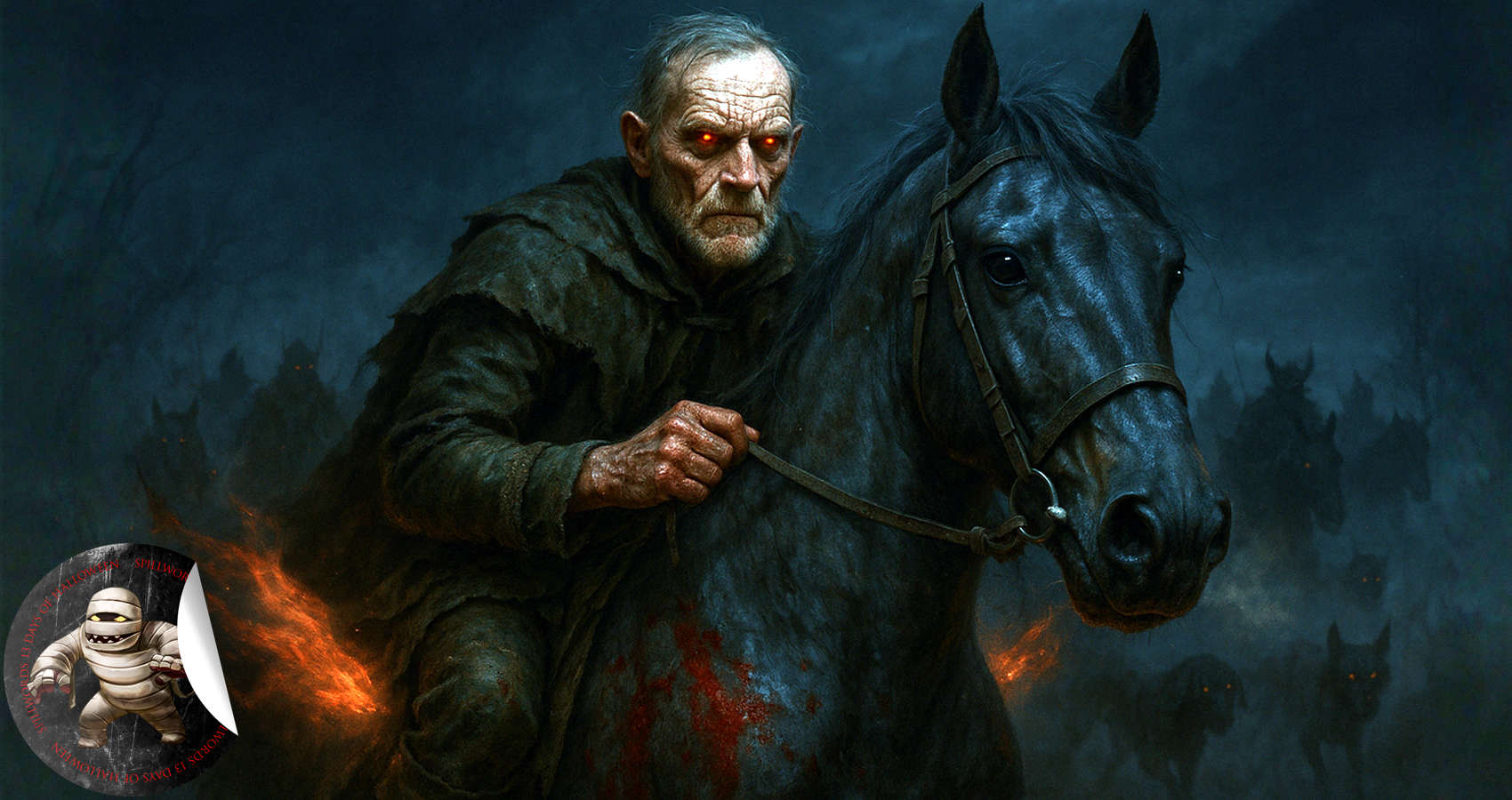
Harry the Nab and the Wild Hunt
written by: JPK
To the south east, the old coach road ran, through Worcestershire and onwards towards the distant sea. It wound and it wandered its way through green hills scarred with quarries where the red sandy stone was cut from the ground to build God’s churches and the houses of wealthy men.
Harry had trodden many roads. He had marched along roads in the midst of great companies of men, hidden in ambush in roadside ditches, he’d scouted along the edges of roads in search of one enemy or another. Harry was as weary of the road as he was of the battles and wars from which he drew his own name. Ten miles from the city of Birmingham, Harry Battle decided that this would be his last road.
“Here’s where I stay.” Said Harry, looking out at uncluttered hills, at woods that hid no enemies.
After twenty years in one army or another, Harry had no real trade but war, but he set himself to do the best he could with whatever skills he had.
He was no builder, but he knew how to set camp, and he had constructed many a stockade to strengthen one position or another. He found himself a nice defensible patch of land. The plot he chose was close enough to a stream to fetch fresh water but not so close as to turn boggy, close enough to the woods to fetch timber and firewood but not so close that he could not see what was coming before it got there.
He built his house from black poplar and caulked his walls with mud from the stream. It was warm and cosy and, if it looked a little like a fortification – well, he was used to that.
He was used to foraging and hunting for his food. He was used to looting too, but had decided that, if he was to settle here, that part of his life was best left behind. In any case, the place that he had chosen was running alive with rabbits and hares, there were deer in the woods, and berries, nuts, roots, and apples were to be found in plenty. He built a smokehouse near his new home to preserve the meat, having suffered through many a long, hungry winter on the edges of battle.
He had no head for commerce, but he had often picked over the valuables of the fallen and traded them for food and armaments. He headed to the nearest village with pelts and smoked meat and earned a pretty penny at the market, enough to take himself to the pub for a mug or two of ale.
Harry was a small man, wiry and scarred from a lifetime of fighting. His accent was strange for these parts, for he had come long ago from the north and still spoke with a Celtic lilt that stood out among the flat nasal tones of the locals.
Sadly, there are parts of this world where a small, scrawny stranger draws attention of the wrong sort from people of the worst sort.
The Thomson brothers were just such people.
“Yow ay from ‘ere.” Said the larger of the two, opening up a conversation that could lead to only one conclusion.
“Colin’s roit. Yow gorrer ‘ave ackers ter drink in ower gaff.” A pearl of wisdom, added to the discussion by his brother.
Harry had served in many lands. He had gossiped with Germans, argued with Arabs, bargained with Belgians, he had fond memories of his time in France. He had no idea, however, what it was the two large men who loomed above him now were saying, or even of the language in which they were saying it. Still, he had heard the same tone of voice all across continents.
He stood to speak to his two aggressors, tilting his head backwards to look up into their faces.
“Away wi’ ye now, lads. Let a man have a quiet…”
“Yow ay from ‘ere.”
The first brother emphasised his original point by swinging a ham-sized fist in Harry’s direction. It was a hard and damaging blow and, had it connected, would have knocked him across the room, through the door, and into the yard beyond.
Had it connected, the pigs in the yard would have flown to the top of the church steeple to sing with the birds and the angels. It would have been a day for miracles.
Harry gave a little dip, like a fine lady’s curtsy, and passed beneath the big man’s arm. His own smaller arm he extended rapidly upwards so that the heel of his hand made hard contact with the exposed right jaw, which rammed sharply closed, causing Colin’s teeth to snip neatly through the end of his tongue. This, to Harry’s regret, landed in his own half-finished mug of beer.
Colin would, no doubt, have howled with agony at his loss had the force of the blow not continued, twisting his head sidewards and continuing upwards to rattle his brains and drop him to the floor unconscious.
“Yow cor do that to ower Col…”
The second brother, to whom Harry had not been formally introduced, caught the point of his left boot firmly in the groin and interrupted his sentence to fall to his hands and knees and vomit into the sawdust on the floor.
Harry turned towards the company in the room, ready to see if another assailant would step forth. There was a moment of silence before the chatter recommenced, and analysis of the finer points of the evening’s combat added interest to the conversation. The drinking continued.
The Landlord, wiping a mug on the tails of his apron, looked across the bar at Harry.
“Yow’ll be wantin a fresh pint. Er’s on the ‘owse. They twins tend ter do a lot more damage when ‘em pick a foight.”
***
This land was kind to Harry. After his brush with the Thompsons, he was treated with respect by his neighbours, and his ability as a hunter and preserver of meat was much valued, bringing him a modestly comfortable living.
Of course, the beasts that he hunted were not strictly his to hunt since the lands hereabouts were ceded by his majesty to one of his earls, who would ride through from time to time with his noble cohort and his fine pack of hunting dogs. But Harry was not greedy, he took no more than he needed for his nourishment and comfort. When the hunt rode through, he would steer well clear of their path, and would even drive boar, deer, and game animals towards them so that his Lordship and his Lordship’s guests would go home happy and fulfilled from a good day at the chase. After all, there was plenty here for everyone. He bought himself a decent horse and he roamed and hunted the land from Hagley to Lickey End, from Hopwood to Tardebigge, and came to know every square inch of it with his soldier’s eye. Harry the Nab, they called him, because there was no beast that could escape him once he set his mind to nabbing it.
Harry also came to speak the local language, mixing it with his softer Caledonian tones. He was greeted in the streets by his neighbours, even the Thompson brothers met him with a nod, Colin lisping greetingth with his tipless tongue. His opinion was sought, and his company was welcome in the pub.
And it was in the pub that Harry set eyes on the love of his life. Grace, the landlord’s daughter, was nineteen, old for a spinster, it is true, but her father adored her. He would not countenance the suit of any man who was not worthy, and in his eyes no man was worthy.
Grace, for her part, was fascinated by the little man. Yes, he was sixteen years her senior, but by the time he was her age, he had already travelled the world. Yes, he carried scars, but they were the scars of experience won with bravery. When he spoke to her, he spoke courteously and modestly of far-off things and the skies of other realms. He did not try to touch her or pinch her as she squeezed past with jugs of ale or plates of food, but stepped aside with a little bow to allow her space. It was with her full and delighted agreement that Harry determined to speak to her father.
“Now I ay saying no. Yam’s a good man, and our Gracie could do worse.” The Gaffer said. “But ‘er’s special, see? Any man who wants to wed ‘er needs to prove imsel first.”
“How do I prove myself?”
“Buggered if I know, that’s for you to find out.”
The conversation was paused. The door was not closed, but to open it wide, Harry needed to prove his worth.
He thought of all the things that would make a man worthwhile. Wealth, piety, honesty, courage, modesty.
Harry was not badly off these days, though in this world, real wealth was the province of his Lordship the Earl and his noble cousins, it rarely went alongside honesty and seemed to leave no room for modesty.
Piety for a man like Harry was a thing out of reach. He had seen too many pious souls sent to meet their maker on the battlefield, too much fighting in the name of a God that each side cleverly claimed as its own. He had neither the will nor the wit to be a pious man.
Courage he had, as a tool of his trade. Courage was a spade or a sword, a knife or a plough. To be used when needed, then cleaned and put away for the next time.
Harry was used to the quick decisions needed on the field of battle or when the chase was up. How to show himself to be a man of worth was something that he would need to ponder. Sometimes things take time.
***
The Earl of Plymouth, for it was he who owned and hunted the land for many miles around, was puzzled. On the one hand, fine huntsman though he was, he had never had such good hunting as he had these days. Deer seemed to form orderly queues to cross the path of his horses at just the right time, the boar made their way to convenient clearings where they gave themselves up to their fate. His larders overflowed with venison and wild pork.
And yet he heard rumours amongst his servants and vassals of a skilled and cunning poacher on his land. A man whose skills surpassed his own, who plied his trade freely in village markets across the county.
The Earl was neither a greedy nor a jealous man, after all, he had made a bargain with his Lord that provided him with everything that he had ever wanted or needed. He did not, within reason, resent what his people took from the land, after all, they worked each day to increase his wealth and influence. But he was curious about this hunter, indeed, he saw in him an opportunity.
The bargain that he had made with his Lord, a bargain struck in the morning of his youth when the twilight seemed far away, weighed heavily on him as the days and years went past. The Earl had riches, he had many children, his long life had been a happy one, full of hunts and hunt balls, wine and women, song and celebration.
By the terms of this bargain, he would reach the agreed span of his life, the three score years and ten that was promised to all men but given to few, with health and riches and all that his heart desired. After that, he would pay to the devil, for Lucifer was the lord with whom he had struck his deal, ten years for every one that he had lived, serving as his huntsman. He would bring to him the flesh of the beast that he needed to feed the hungry mouths of his demonic vassals and the souls of wicked men to feed the furnaces of hell.
The Earl had seen those furnaces with his own eyes. The entry to that dark realm lay to the north of his own lands, not ten miles from his home.
Hell’s opening, Halesowen as it was called in these parts, was shunned and avoided by those who lived in the surrounding lands, but he had passed through it, had entered his master’s domain and signed a contract with his own blood, sealed it with wax melted on dark obsidian hobs.
Now that contract had fallen due and the Earl saw seven hundred years of servitude stretching ahead of him. But the devil loved a bargain, and he was always willing to make a better one. The Earl decided that it was time for him to meet Harry the Nab.
***
In the bar room of the Cock Inn the visit of the Earl of Plymouth gave rise to considerable discussion. Not that his Lordship had not previously graced the village or its establishments with his presence, though such an occurrence was not common and would, in its own right, have been worthy of comment.
On this occasion, however, the excitement arose from the fact that a peer of his majesty’s realm had asked after the newest inhabitant of the village of Rubery, and had asked after him not by his given name, but by the nickname that he had been given during his short tenure in these parts.
“Where might I find ‘Harry the Nab?’” He said to the gaffer.
Such an enquiry did not, in the opinion of the regulars, bode well.
“Him’ll be ‘bout his business, my Lord, ‘im drops in ‘ere from time to time.” The gaffer was a cautious man, he gave away as little as would not cause offense.
“He is to attend upon me at Tardebigge. Noon, this coming Monday. Please be sure that he is aware of my wish in this matter.”
Harry, in the shadows at the far end of the room, was aware of this great man’s wish. Great men had often made their wishes plain to him. Sometimes those wishes had led to glorious victories, sometimes to loss and defeat. Generally, the wishes of great men were fulfilled by the sacrifice of those who were merely good men. That was the way of the world.
Be that as it may, the wishes of such great men were not to be denied. Come Monday, Harry saddled up his horse and set out attend upon his Lordship.
The great house at Tardebigge, built out of hard red stone quarried from the Lickey hills, was a far cry from the wooden stockade in which Harry had made his home, but he was accustomed to such places. He had seen them in their splendour or their ruin, he had attacked them and defended them, fought to protect them, or burned them to the ground.
He had never, until this day, been entertained by the master of such a house. The Earl was a fine and considerate host.
“Harry the Nab.” He said, waving away a servant and filling two jugs by his own hand. “It seems an incongruous name. How may I call you?”
“Harry, My Lord, Harry Battle is my given name.”
“I think, Harry Battle, that you have done me a service from time to time. I have had some fine hunting in my lands of late. So, I hear have you.”
Harry held his tongue in reply.
“I’d call us even.” The Earl dismissed the matter. “I am in your debt, and you in mine, a good bargain. Shall we make another?”
“My Lord?”
“I’m forgetting my manners, first, we must break bread together. Eat freely and without obligation.”
Cautious and courteous, Harry inclined his head at the invitation. He had had some dealings, in his long years of travel, with the old ones. He knew that with them, the taking of food and drink might raise up a debt that was best avoided.
He looked more closely at the Earl. A handsome man, it was true, who bore his years well. But to Harry’s eyes, he showed no sign of kinship with the fair folk. Perhaps he had simply chosen a curious form of words.
“Thank ye, My Lord.”
Harry put his thoughts to one side and joined his host at table. Just another mystery in a day of mysteries.
They lunched simply and well on bread and cheese and cold meats, in deference to the time of day, they mixed their ale with water, and at the end of their meal, both were well fed and clear-headed.
The Earl stood, signalling Harry to join him, and they left the table to the servants, walking out across the well-tended garden.
“I have a contract.” Said Harry’s host. “To provide my master with the services of a huntsman.”
“Your master, the King, my Lord?”
A king, certainly, though not the one you have in mind. You see, I serve two masters…”
***
Harry’s had much to ponder as he rode home. His thoughts were awhirl, not from the small beer that he had consumed with his fine meal but from the offer that had been made to him by his noble host.
The compensations that the Earl had offered to him had been great, more than enough to tempt a man of Harry’s humble origins. They were set out for him in dark ink on a fine piece of vellum which he carried now in the breast pocket of his coat, next to his heart.
Health and wealth and lengthy life,
the woman you love to take for your wife,
land without rent to build you a home,
children aplenty to carry your name.
Thus read the first part of the contract. His dark majesty liked a rhyme, it seemed, even if it wasn’t a good one.
Harry considered these terms.
He had been a soldier for twenty years, cheated death on so many occasions that his fair share of luck had been used up fifty times over. The old grey reaper must be whetting his scythe in anticipation of the day when he would harvest the life of Harry Battle. Harry liked the idea of keeping him waiting for many years yet.
He thought of Grace and how he would dearly love to make her his wife. A wealthy wife, at that with a fine home in which to raise a family. His own home was fine to him, and rent-free to boot, though humble enough. But the land on which it stood belonged to the Earl and could be bestowed or taken back at his whim.
Of course, he doubted that the gaffer would see a contract with the Devil as evidence of his worth as son-in-law, but such contracts were private. By the time payment was due, the old man would have gone to his grave, happy that the daughter he loved was the prosperous mother of many children.
The contract was short, setting out in its doggerel rhyme the responsibilities that would fall to its obligant. To provide the flesh of beasts to nourish the demons of hell, to provide the souls of wicked men that would feed the flames those demons stoked. Harry had hunted men and beasts all his life, he had sent his share of souls to their fate. Some to heaven, more, he guessed, to perdition. He had no qualms about accepting this part of the bargain.
It was the last two lines that most gave him pause for thought:
No definite time to this service allot,
for our contract will hold ‘til your name be forgot.
For the contract had promised children. Those children would beget their own children, whose descendants would carry on Harry Battle’s name for many years. Hundreds of years, thousands, perhaps.
As he entered his home, he took the deed of contract from his pocket. The Earl of Plymouth had provided him with a quill from one of the swans that graced his lake, and he sharpened it to a point with his knife. With the same knife, he cut a line across the pad of his left thumb, a tiny wound, far less significant than many that he had suffered.
The devil was a cunning old boy, and Harry was happy to have spotted the twist in the tail of their bargain, but Harry went by another name, a name that would be forgotten in no more than a generation or two.
Dipping the quill into his fresh blood, he signed the contract in the name of ‘Harry the nab’ and thereby bound himself to the service of the Devil.
***
The devil keeps his bargains, for good or ill. The old Earl died the following year and was buried in the house of Christ. In his will, he granted land in perpetuity to Harry and his descendants.
Harry prospered and built a fine house. The gaffer recognised that his daughter could live a good life with a man that she loved and gave his consent for Grace to become Harry Battle’s wife. The two raised a large family and lived to see their grandchildren grow up, marry, and have children of their own.
But the devil always gets his due, and he does like a rhyme, even a bad rhyme. In the schools and the streets of these parts, in the fields and the playgrounds, the children sing a song. At first, the song was put into their heads by the devil’s imps, but then it grew and carried on in hopscotch and skipping games.
Lock the doors and stay inside.
Shut the shutters, don’t look out.
Harry the Nab is on the ride,
blind dogs howl and hunters shout
his coal eyed horse leads Hell’s own ranks
wings on its heels and blood on its flanks.
The moon is dark in pitch black skies,
Out in the night time the Wild Hunt flies,
to fill the board at the Devil’s feast
with heedless man and hapless beast.
Poet or parson, soldier or squire,
flesh for his plate and souls for his fire.
As long as the children carry on singing of Harry the nab, Harry will continue to ride at the head of the wild hunt and to bring before his master the flesh of beasts and the souls of wicked men.

- Harry the Nab and the Wild Hunt - October 20, 2025
- Flatlands - August 27, 2024
- The Last Sacrament - May 31, 2024