

The Barn Ghost
written by: Vivek Subramanian
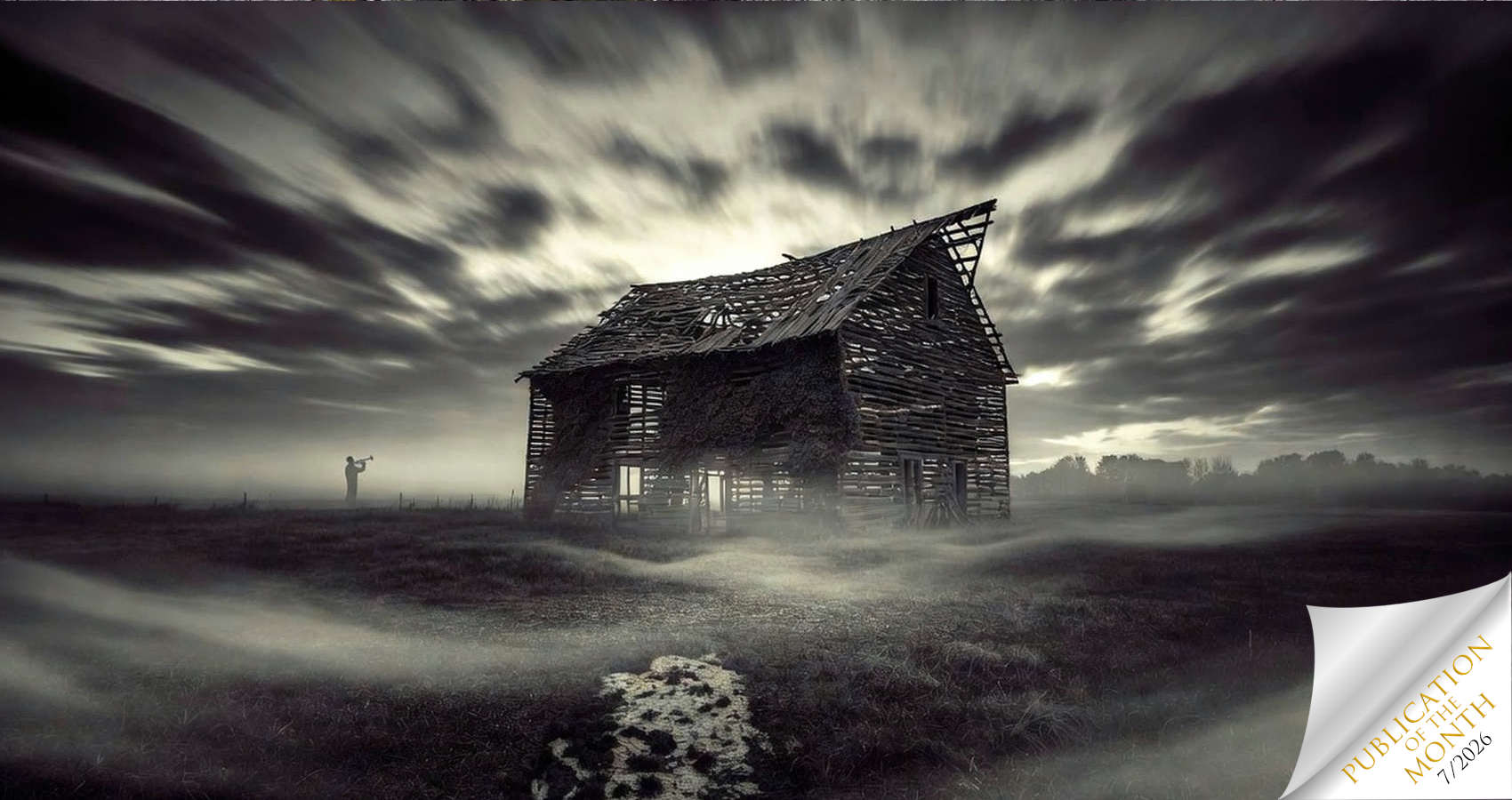
The first thing people noticed about the barn was that it never fully went dark.
Even after midnight, when the pine woods swallowed the last of the county road and the fields turned black as flooded earth, something pale held itself around the structure—a residue, not quite light, as though the dark itself was reluctant to touch it.
The tobacco barn stood half a mile behind Pearl Whitaker’s farmhouse in Halifax County, North Carolina. Around it: dead fields, willow trees that had stopped trying, kudzu climbing the wood like something practicing patience. The roof had caved in partly. One full side had come down after a storm years back, and nobody went to look. Pearl hadn’t walked out there since Raymond died. She wasn’t sure she could anymore. Wasn’t sure she wanted to.
Children said ghosts lived there. Adults said worse and then went quiet.
Pearl was eighty-six years old. She’d stopped caring what lived anywhere.
That November, she sat in her bedroom beside the table lamp whose bulb she kept meaning to replace. The wallpaper behind her had peeled in long strips, exposing gray plaster and a darker stain beneath that she’d been looking at for eight years, since Raymond died before he could get to it. The wall looked like diseased skin. It had begun to seem like company.
The room smelled of medicine and damp wood and something older beneath those—the house’s own smell, built up over fifty years, something she’d stopped noticing until she started dying into it.
Across the hall, the television murmured to nobody.
Pearl rubbed her knees with both hands, working at the swelling, and listened to the rain come down.
Then the trumpet started.
Low at first. A sound moving through the wet fields like an animal that had forgotten how to walk straight.
She closed her eyes.
Lord, she thought. That fool.
Jazz had never sounded joyful to her, no matter what people said about it. It sounded like men wandering around in the dark, too proud to ask for directions, playing the wanting itself because they couldn’t find the thing they wanted. Restless. She’d said that to Silas once, years ago, and he’d looked at her a long moment before saying, Yeah. That’s exactly right. Like she’d diagnosed something.
Silas Reed. The county had names for him now—drunk, madman, graveyard musician, the Barn Ghost—most of them meant to diminish, the way a county diminishes what it can’t absorb. Pearl remembered him young. Tall. Sharp-eyed. Beautiful in the specific way that trouble is beautiful, which is to say you see it and you feel something, and you don’t stop walking toward it anyway.
He’d played in clubs from Durham to Raleigh through the seventies, battered trumpet and a face that already looked hunted. Whatever followed him back to Halifax, he hadn’t left it behind. He came home to nothing—no wife, no children, no fixed address—and the county, which had run out of sympathy for men who didn’t make it elsewhere, filed him somewhere between eccentric and cautionary tale and moved on.
The trumpet stopped.
Knocking at the front door.
Pearl hauled herself upright. “Come in if you ain’t dead.”
The door opened, and Silas stepped in out of the rain carrying two paper grocery bags, his coat soaked dark, his gray beard beaded with water. His eyes still had that fever behind them. Sixty-some years old now and still carrying something he’d never put down.
“You forgot your medicine again,” he said.
“I lived before medicine.”
“You also had cartilage then.”
He took the bags to the kitchen without waiting for permission—he hadn’t waited for permission in the two years he’d been helping her, since her sons stopped coming regularly. One in Charlotte doing banking, one in Atlanta selling software, both of them good at sending money. Money was easier to mail than guilt. She’d stopped saying that out loud because she’d found it made her mean, and she was trying, at eighty-six, to be something other than mean. Hadn’t gotten there yet.
She watched Silas move around the kitchen—opening cabinets with a familiarity that had taken him months to earn and that she’d never quite acknowledged giving him—and thought about how strange it was that the person who knew where she kept her blood pressure medication was a man she’d barely spoken to before Raymond died.
“You eating?” he asked.
“I ain’t hungry.”
“You ain’t hungry since Reagan was president.”
He put soup on. She lowered herself into the kitchen chair and listened to the rain work on the roof.
“You sleeping in that barn again?”
He shrugged. “Camper gets cold.”
“That place ain’t right.”
“Neither am I.” He said it lightly, the way you say a true thing when you’re trying to make it sound like a joke.
Pearl looked at the back of his neck while he stirred. She’d known him for forty years and had never once thought of him as hers to worry about. Now she worried about him every day, and she resented it, not because she didn’t want to, but because she was old and tired and there wasn’t much room left in her for new things to sit.
“You hear about the Turner boy?” she said.
He went still. “The one on—”
“Found in the tool shed yesterday. Nineteen years old.”
A long quiet. Rain against the window. The soup starting to smell like something.
“Folks saying drugs,” Pearl said.
“Folks always say drugs when they don’t understand sadness.”
He said it to the pot, not to her. She watched his hand on the wooden spoon, the way it wasn’t quite steady.
“You drinking again?”
“A little.”
“How much little?”
“Enough to get by.”
“You gonna die in that barn.”
He turned and looked at her directly for the first time since he’d walked in.
“Everybody dies somewhere, Pearl.”
But the way he said it was wrong. Too flat. Too ready.
She didn’t sleep well that night after he left.
Around one in the morning, the trumpet started again.
Not from the barn. From outside the house.
Pearl lay in the dark and listened to it drift across the porch—two slow notes, a pause, two more, something that moved like a question being asked without expectation of an answer. She got up and went to the window and pulled back the curtain, and there was nothing out there but rain and the dark field and the faint pale shape of the barn in the distance.
But the music continued..
She stood there in her robe listening to it and did not go back to sleep.
In the morning, she found the footprints beneath the porch overhang where the rain hadn’t reached. Long and narrow. Bare feet, pressed deep into the soft earth like whoever it was had been standing there a while. Not children’s feet.
When Silas arrived with coffee, she showed him.
He crouched beside the steps and looked at them without saying anything. Rain had already started working at the edges.
“Probably kids,” he said.
“These ain’t children’s feet.”
He stood up slowly. His expression had something closed in it that she didn’t like.
“You know something,” she said.
“No.”
“Silas.”
“That barn attracts people sometimes.” He was looking toward the fields. “Lost ones.”
“Don’t start that mess.”
But he wasn’t performing anything. That was the thing about Silas—he’d been strange her entire life, and she knew the difference between his nonsense and his seriousness. This was serious.
“There’s things around here folks don’t talk about,” he said.
“Because they’re foolish things.”
“Maybe.” A pause. “Maybe not.”
By afternoon, the county had more rumors. A teenager saw lights in the old cemetery near the woods. Someone else heard trumpet music there past midnight. Pastor Caldwell gave a Wednesday sermon about darkness and doors, speaking with the confidence of a thirty-four-year-old man who’d read about suffering but hadn’t yet been introduced to it.
Pearl despised Caldwell. Had since he arrived from Greensboro six years ago with his pressed shirts and his certainty. But she sat in the third pew because she was eighty-six and didn’t have the energy to find a new church, and also because she liked singing.
After service, Susan Harper caught her near the parking lot.
“You think Silas is involved in all this?”
Pearl lit a cigarette. She was supposed to have stopped.
“Involved in what.”
“That strange business. Animals near the river. The lights.”
“Susan. This county has meth, opioids, two suicides this year, and a sheriff’s department that owes half its budget to civil forfeiture. But y’all are worried about trumpet music.”
Susan looked down. “He ain’t natural.”
“He’s lonely. There’s a difference.”
But driving home, she found herself thinking about a girl—this was maybe twenty years ago, she couldn’t pin it closer—who’d gone missing near the tobacco fields for four days. Sixteen years old. Found walking the highway barefoot, not knowing which direction she was going. She wouldn’t speak afterward. For months, she cried at the sound of any music at all, any music, and then one day she and her family moved to Goldsboro, and that was the end of it.
The sheriff had said drugs. The county had agreed and moved on.
Southern towns were good at burial. Not of bodies. Of facts.
That Friday, Pearl and Silas drove into town through low fog. Near the courthouse square, they passed a cluster of teenagers outside the liquor store. One of them was mimicking a trumpet player—puffed cheeks, exaggerated swaying—while the others laughed. They were watching Silas through the windshield.
Silas drove without reacting. But his jaw was tight.
“You know them?” Pearl asked.
“Everybody knows everybody.”
“That ain’t what I asked.”
He said nothing for a minute. The windshield wipers moved back and forth.
“Used to be places around here a man couldn’t go after dark,” he said finally. “Clubs in Durham, they’d let me play all night and then point me to the side door when I needed the bathroom. Folks loved jazz as long as they didn’t have to get too close to the people making it.”
Pearl looked out the window at the courthouse, the monument they’d argued over removing for fifteen years, the dollar store that had replaced the hardware store Raymond used to go to.
She didn’t answer him. The South had trained her in certain silences. She wasn’t proud of it. But she was too old to pretend she’d been braver than she was.
That evening, Silas stayed past dark. They drank coffee at the kitchen table while the night came down hard outside.
“Why haven’t you ever left?” she asked.
“Left what.”
“This county. Halifax. All of it.”
He smiled in the tired way he had. “You think ghosts stay attached to cities?”
“There you go.”
“I’m serious, Pearl.” He leaned forward. “You ever notice how some places hold pain?”
“Every place holds pain.”
“No. I mean, hold it. Like water in a jar.” He looked toward the dark window. “That barn was built on ground where prisoners worked after the Civil War. Workers slept out there during harvest every season for thirty years. One winter, a fire broke out, and two men died inside. Nobody got them out in time.”
Pearl stared at him. “I never heard that.”
“County records on it disappeared. My grandfather told me. His father was there—got out, but he never stopped talking about the ones who didn’t.”
The kitchen was very quiet.
Then from somewhere in the fields—distant, moving through the rain—came the sound of a trumpet.
They both heard it at the same moment and both went still.
Pearl looked at Silas.
He was looking at his own hands on the table. His trumpet was in the corner of the room, where he’d left it when he came in.
The music continued. Three notes, low and slow, and then a pause, and then three more.
“You hear that,” Pearl said.
“Yes.”
“But you’re—”
“Yes.” He stood up so fast the chair scraped back. His face had gone the color of old ash. “Nobody should be out there.”
He grabbed his flashlight. She tried to stop him with his name, but he was already out the door and into the rain, and she stood on the porch and watched the flashlight beam cut through the dark toward the barn, growing smaller, and then the fog swallowed it, and there was nothing.
She stayed awake until the sunlight.
The deputies found him in the barn at first light. He was sitting beside an old wooden chair, his trumpet across his lap, his eyes open but not quite present, the way someone looks when they’ve come back from somewhere they’re not sure was real.
They brought him to the farmhouse wrapped in a blanket they’d found in the squad car.
Pearl put water on.
“You remember anything?” she asked.
“Not much.”
“You were talking.”
He looked up.
“In your sleep. Out there. One of the deputies heard you.”
“What was I saying?”
She’d asked the deputy. He’d been reluctant. “He said it sounded like names,” Pearl told Silas. “He couldn’t make them out.”
Silas stared at the floor for a long time.
She looked at his feet. Bare, mud-caked—mud that went up past the ankles, dark and deep, like he’d walked a long distance through wet ground.
He hadn’t been wearing shoes when they found him.
He didn’t play for a week after that. The trumpet sat in the corner of her living room because neither of them talked about him taking it back.
Then the other things started.
A dog turned up near the riverbank, and Pearl didn’t ask for details because the way people’s faces looked when they talked about it told her enough. Church windows went out one night, all four of them, and nobody heard glass breaking. A child in town told her mother there was a man who stood outside her window playing music, and the mother called the sheriff, and the sheriff went to look and found nothing.
Pastor Caldwell organized prayer circles. Rumors accumulated the way they do in small places—fast, shapeless, pointed at whoever the county had already decided to be suspicious of.
The sheriff came to the farmhouse. He sat in her kitchen and turned his hat in his hands.
“You think Reed’s dangerous?”
Pearl looked at him for a long moment. He was a decent man, Jim Purvis—not a bad sheriff, just a limited one, shaped by the county that had made him. “You think a lonely musician is responsible for everything that scares you around here, Jim?”
He sighed. “People are scared.”
“People are always scared. Doesn’t make them right.”
After he left, she sat at the kitchen table for a long time. The truth was, she didn’t know what she thought anymore. She’d known Silas Reed for forty years—known him the way you know someone you’ve never quite paid full attention to, present at the edges of her life like a tree at the far end of a yard. She thought she understood his strangeness. Now she wasn’t sure she’d ever understood anything about him.
At two in the morning, she woke to light moving across her ceiling. She went to the window.
Lantern light in the fields. Near the barn.
And then—two trumpets.
She knew his sound the way she knew her dead husband’s footstep. One of them was Silas.
The other was something that had learned trumpet from the ground up, or had been playing since before anyone now living was born—a low, patient sound that had no hurry in it at all.
They played together for maybe five minutes. Pearl stood at the window in her nightgown with her hand pressed to the glass and she felt something she had not expected to feel, which was grief—not fear, not the Gothic alarm she might have anticipated, but a grief so old and so large that it seemed to come from the house itself, from the county, from the two men who had died in a fire a hundred and fifty years ago and been buried in the county’s forgetting.
Then one of the sounds stopped.
A scream followed—human, ragged, not from pain but from something deeper than pain.
Pearl held the wall.
Twenty minutes later, the lights arrived.
They found Silas unconscious on the barn floor beside the old chair. No lantern. No second musician. No sign of anyone else having been there.
But on the floor beneath him, cut into the wood over and over in long, careful strokes, the same words:
LET US IN
LET US IN
LET US IN
The county sent him to Raleigh for a psychiatric evaluation. A week, then two. Pearl drove up once on a Tuesday, took the highway she hadn’t driven in years, and sat with him in a room that smelled of industrial cleaning fluid and artificial light.
He looked smaller. That was the thing she kept coming back to—how much space a person takes up is apparently a matter of where they are.
“They think I’m crazy,” he said.
“You are crazy.”
He smiled. Then the smile went somewhere else.
“There was somebody else in that barn, Pearl.”
“You were drunk.”
“No.”
“You were dreaming.”
“No.” He leaned toward her as far as the table between them allowed. “I heard them. I heard all two of them. They were playing.” His voice was very quiet. “They’ve been waiting a long time to be heard by somebody who could hear them.”
Pearl drove home through November dark and sat in her kitchen without turning on a light. She had not believed in ghosts since she was a girl. She had not believed in much since Raymond died, if she was being honest with herself—not in the pastor’s God, not in the county’s promises, not in her sons’ voices on the phone.
But she believed in Silas Reed. She had always believed in Silas Reed, even when she thought she was just tolerating him.
And for the first time in longer than she could remember, she was afraid—not of the barn, not of what was in it, but of what it meant that those men had been waiting a hundred and fifty years, and the only person who’d been able to hear them was a drunk trumpet player the county had been trying to dismiss his entire life.
Silas died in January.
Heart failure, officially. Alcohol, unofficially. The county buried him with the particular efficiency it reserved for people it had never known what to do with while they were alive.
Pastor Caldwell preached about troubled souls finding rest.
Pearl sat in the second row and looked at the casket and thought about all the things she had never said to him, which is different from the things you wished you’d said, because wishing implies you know what the words would have been.
She didn’t know. That was the honest truth. She didn’t know what she’d wanted to say to Silas Reed except that she was glad he had existed, and that the county had been wrong about him, and that in forty years of existing at the edge of her life, he had been—without either of them ever saying so—something close to what mattered.
She didn’t say any of that at the service. She sat and listened to Caldwell, and then she drove home.
Developers came in the spring and tore the barn down in an afternoon. Bulldozers made quick work of what had stood for a century. They cleared the ground and put up survey stakes, and that was the end of it.
Except it wasn’t.
Drivers reported hearing trumpet music near the empty field after midnight. Two separate drivers, weeks apart, who didn’t know each other, who described the same thing: two instruments, one sharp and familiar, the other older and lower and patient as a river.
Animals wouldn’t go near the property.
And on certain nights in late fall, when the fog came down low across Halifax County and the pines disappeared into it, and the road went dark, Pearl would sit on her porch wrapped in Raymond’s old coat, and she would listen—not waiting, exactly, but not not waiting either—and sometimes she heard it.
Two trumpets in conversation out beyond the tree line. One of them she knew.
She didn’t know if they were mourning or celebrating or if there was, finally, a difference.
The earth under Halifax County had been holding its grief for a hundred and fifty years.
It seemed to her that it had earned the right to let it out in whatever sound it chose.
She stayed on the porch until she got cold.
Then she went inside and turned off the light.

- The Barn Ghost - July 2, 2026
- Second Voice - March 31, 2026
- The Bite - November 8, 2025