

A Rare Case
written by: Aleksandra Velikova
Dedicated to the 2026 Olympics
How many cities had he already seen—across Europe, Asia, America—impossible to count. All so different. In each of them, even the silence of the night had its own sound. Somewhere the ocean waves swallowed the space with their grandeur; somewhere lonely night birds cried mournfully; somewhere the voices of people could be heard—indistinct, distant, as if from other worlds.
He opened the window. The February air hung in the darkness like a blind fog, thick and damp. Tomorrow, it would all be over. The future was unclear, as though the next day were a cliff’s edge. Either you leap across, or you fall to the very bottom. Every victory he had won in recent years lay on his shoulders like a stone. It seemed that this weight could not be lifted. Figure skating was a sport with no right to error—an entire life contained within four minutes.
The hotel room was at once bright and faceless. Each detail, ordinary on its own, caught the eye as though something about it were wrong: a lamp too bright, a chair too large, a painting on the wall too ornate. Probably his brain was simply overloaded; he needed rest. But would he manage it? Was sleep even possible? He had slept badly for several nights in a row, and this one would hardly be an exception. Anxiety, fear, and exhaustion mingled together, penetrating to the very depths of his thoughts, until at last—releasing him for only a moment—they allowed sleep to seize him.
When he opened his eyes, a man was sitting in the chair opposite the bed. A middle-aged man, thin, dressed in some dark clothing, wearing delicate spectacles, with a somewhat birdlike face—calm and attentive.
“Is this a dream?” His voice came out utterly strained. He could not even tell whether he had said it aloud or not. Did that matter in a dream? He raised himself on one elbow, trying to look at the man more closely.
“Of course it’s a dream,” the man replied in an entirely matter-of-fact tone.
“And what is it about?” The conversation had begun so implausibly that such a question did not even seem strange to him.
“You choose that yourself—what it is about,” the man answered just as quietly and confidently, surprised by nothing.
“Who are ‘you’?”
“People.”
“Then who are you?” The exchanges were becoming increasingly peculiar, yet he even felt a flicker of curiosity about what else his fevered mind might invent.
“I am a Messenger.”
“So I chose a dream about a messenger, is that it?”
“It would seem so.” The man looked at him through his spectacles, and his gaze even struck him as benevolent.
“Excellent. Just what I was missing.”
“Irony is a good thing. But I have little time,” the man said, still without irritation and not even hurrying, despite complaining about time.
“Right, of course. A messenger must deliver a message, mustn’t he?” He still tried to joke, to make the dream less frightening. The plausibility of the hotel room—the sweatshirt left on the chair, his suitcase with skates by the wall—did not so much frighten him as unsettle him: as though, through the dream, a fragment of reality were slipping away, depriving him of his last strength.
“Quite right,” the man nodded in affirmation and leaned slightly towards him. “I have come for your talent.”
“What?” He braced himself on his other elbow as well, leaning forward.
“Talent can be bought and sold. People say ‘he’s run dry’ when a talented musician suddenly stops writing music, or a writer—novels. Do you think that happens just like that? Of course not. Everything has its price. Your extraordinary sporting gift as well.”
“I need nothing,” the answer was obvious. He looked at the Messenger and understood that he knew it perfectly well.
“I understand. Believe me, we do not appear to just anyone. I know you well, and I am not offering you anything material. But you can protect someone. A person you love more than anyone in the world.”
“And do you think that person would like it if I lost my talent? After all, it is not only the meaning of my life.”
“This is not about what someone may like. Believe me, the price is far higher. I need not name it, do I?”
“I want to hear it.”
“Very well. It’s about your mother’s health. Not many are given the chance to save those they love. Most simply have nothing to pay with, so they are of no interest to us.”
“That sounds cynical.”
“That’s just life.”
The room was very quiet. No sounds at all. None. It seemed to him he could hear only the beating of his own heart; never before had his dreams been so detailed. So plausible and absurd at the same time. A strand of hair that had fallen onto his forehead trembled in rhythm with his pulse.
“So tomorrow it will all be over?”
Only a nod of the head.
“Tomorrow—and forever?”
The man sighed and looked him straight in the eyes.
“When people lose their gift, they usually cease to be people. But the one who remains a human being sometimes receives his talent back. However, that is not for me to decide.”
“And what will become of me?” His voice was quiet again. The dream seemed to be beginning to fall apart, yet in those final moments it felt terrifyingly real. As though tomorrow’s failure had already become inevitable.
“I do not know. People are unpredictable. And we do not control them. I answer only for genius; everything else is in your hands. Unfortunately, you will not remember anything from our conversation. But you can simply remain yourself.”
“I understand.”
Everything might be decided now. This very minute—not tomorrow. So much effort spent, so many hopes and promises—to himself, to others, to the whole world. Could one lose all that in a single instant? But could one even think about the price when it concerned the one you loved?
“I agree.”
“Well then, good. We have an agreement. I shall count to three—and you will fall asleep. For real.”
“One.”
“Two.”
“Three.”
Three-three-three-three—the alarm clock rang. A gloomy winter morning seeped into the room together with its trill. It spread across the wall in a pale patch of light, dripped like rain upon the metal shutters. Some heaviness in his chest would not let him breathe; fragments of a dream, dissolving in the moments of morning.
For Messengers, there is always a free place from which to observe how destinies are decided. How an agreement is fulfilled. Often these places are ordinary—homes, government buildings—but sometimes they are curious ones: concert halls, stages, or, as now, sporting arenas. These, the Messenger loved more than all the rest. Much is forgiven to artists. Composers are cherished for past merits. And only in sport is everything at stake every single time. Yet the competition must be an important one. Best of all—the most important in a lifetime. Then the price is higher. Otherwise, nothing will work.
He watched the athletes from the final warm-up with some bewilderment. For a moment, it even seemed to him that Messengers must have visited almost all of them the previous night: the skaters were making mistakes, skating far worse than usual. Yet not quite badly enough. Not enough for those losses to be exchanged for anything. Most likely, they had simply been overwhelmed by nerves. It happens.
At his protégé, the Messenger looked, holding his breath. Though in truth, so did everyone around him. They were waiting for a genius. Waiting for a champion. The Messenger—the only one who knew the outcome—and yet he too felt anxious. How many such bargains had he concluded already? It was time he stopped worrying; it was unprofessional. If only those to whom he came the night before remembered any of it! But they never did. There he was—the young man to whom he had appeared during the night. Standing with his arms folded before him, gathering strength—and knowing nothing. A tightness stirred in the Messenger’s chest. Perhaps it was time to stop making such deals. There were quieter positions one could take.
A fall. The spectators flinch. Another fall. The spectators murmur. Almost nothing works. The spectators shout throughout the entire programme. No one knows the price of this failure. Not this boy, the athlete. Not the person he has saved. Not anyone around them.
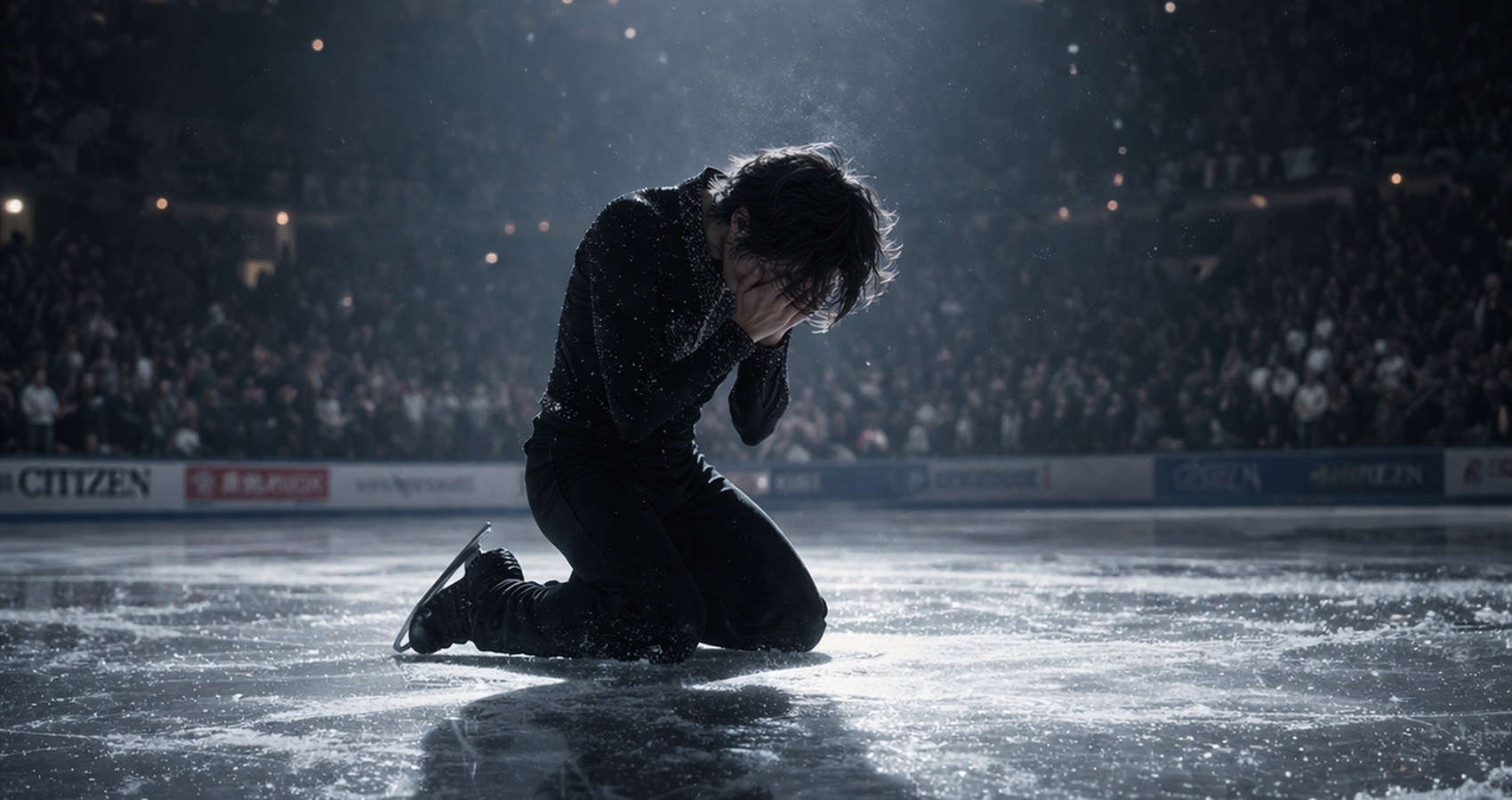
A solitary figure on the ice covers his face with his hands. For the first time in his life, the Messenger too wishes to cover his eyes with his palms. To cry out: “He is not to blame! It had to be so!” But of course, he is not permitted such things. Nearby, girls are weeping. The stunned spectators cannot recover themselves. The champion is announced. The Messenger waits tensely—he needs to see how his protégé will endure this defeat; much depends on it.
He goes to the one who has won instead of him. Embraces him. Excellent. Says something to him—probably congratulating him, as a friend. Can such a thing be? What could be more wonderful! The hall is in raptures. Yet they seem not even to understand what is happening. For something like that, perhaps the gift might even be returned. In the Messenger’s lifetime, such a thing has never yet happened. But then a day like today has never happened either.
For moments like these, it is worth living. Or whatever it is called for them—for Messengers.
People do not usually attend exhibition performances with the same excitement as competitions—but today the place is full. The champions and the leaders will skate here. And the one who, in a single moment, lost everything. Yet the spectators want to see him no less than before. Out of love—of course, to support him—without a doubt. But also to check: how is he? Crushed? Capable of anything, only a few days after such a resounding fiasco? After all, sport is above all a spectacle. Something primitive remains in it, something bloodthirsty. Sometimes here, as in a circus, deadly feats are met with the same curiosity as spectacular falls.
She has come here from the other side of the world. She has supported the defeated athlete for many years. She follows his career. She even runs a blog dedicated to him—small, but quite successful. What happened shook her to the very depths of her soul. Like a personal tragedy. Like an irreparable loss. She cried the whole night, and in the morning, the waiter at breakfast in the hotel did not recognise her, though before that he had always greeted her kindly and, without asking her name, ticked her off on the list of guests. Today she will see him again—simply see that he is alive and well. And that is enough. The love of true fans is unconditional, like the love of parents. Points, medals, titles—none of that matters to her.
She watches the other athletes through tears. It seems she simply cannot stop these streams of salt water. Will he truly be able to come out and skate as before?
He steps onto the ice. It is not the final performance, yet the spectators roar as though they have been waiting only for him. And not in vain. He is the same magnificent athlete. The same beautiful jumps, the same energy, the same untameable drive. He is all right. He is as good as ever. Her tears flow even more strongly. But now, it seems, they are tears of relief.
The deal has been annulled, but in such cases, the fee is not returned – the winner takes everything: both the gift and the life saved. Well then. Next month, the Messenger will have to tighten his belt. In any case, it is time to change jobs. Instead of the rightful annoyance, he feels an inexplicable satisfaction. So it has happened to him as well—the return of a gift occurs only once in a Messenger’s career. If it happens at all.

- A Rare Case - June 4, 2026