

A Thing of Beauty
written by: Ginny Swart
I always looked forward to Wednesday afternoons, when things were quiet in the office, and I could stroll through the city’s Art Gallery. The guards always recognized me and tipped their foreheads, but they never chatted to me, the way they do with other visitors. That suited me, for the best way to appreciate something is to concentrate without interruption. I cannot understand why most of the people who visit the Gallery walk past some of the finest works with barely a glance, chatting to their companions. They’d be better off feeding the pigeons in the park.
My favourite room, just past the African Gallery, was the small French Salon where the Impressionists were hung, where it was a relief to enjoy such light-hearted and colourful sophisticates.
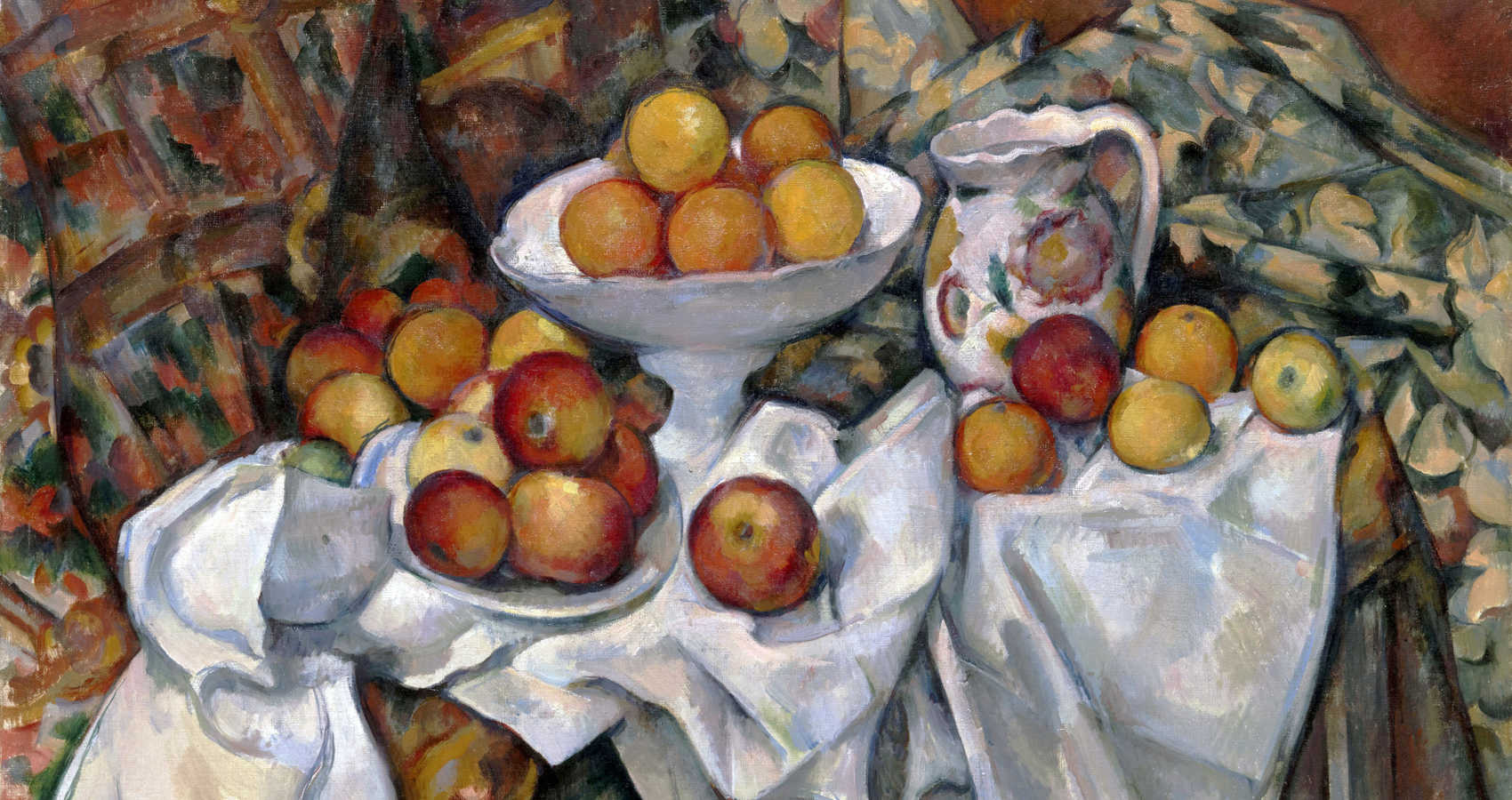
The little river scene by Monet was delightful, as were the Degas ballet sketches. But the Cezanne was my favourite – the perfectly composed ‘Still Life with Oranges’ with wonderfully brilliant, glowing colours. It was similar to the one hanging in the Art Institute of Chicago, which I’ve seen, of course, but always thought ours was the better of the two.
I walked out of the gallery each Wednesday a happier man. Even my wife remarked on my lightened mood.
This feeling never lasted beyond breakfast the following day. My work in administration was becoming increasingly tedious, and I was just marking time before I retired the following year. Thirty-seven years under the same roof, however senior the job, will dull the most enthusiastic fellow.
This feeling of discontent increased when I had to put in a brief appearance at one of those official parties one is obliged to attend.
As I drove there, my thoughts turned to my retirement, due three years later. As a senior Council employee, I could expect a fairly good pension. My wife and I would be ‘comfortable’. But comfortable does not mean one can buy works of art, and I have always loved beautiful things.
Councillor Heard’s house was far too big, and his furnishings were horribly ostentatious, but hanging in his sitting room, he had some very nice pieces. A beautiful hunting scene by Munnings, and a couple of delicate floral studies from the Dutch School. Prominence was given to a signed and numbered print of one of Picasso’s bullfighting series, and the message was clear- Councillor Heard could afford a Picasso.
Almost lost in the small cloakroom off the entrance hall was a small, delicate Bonnard. Badly lit, in a nasty, narrow frame, it cried out for someone to appreciate it. I was gripped with an overwhelming desire to own something truly lovely like this. How unfair that, just because a man is wealthy, he can buy an exquisite painting and invite his friends to admire his own good taste. Or rather, they are simply admiring his money and what it can buy.
Whereas, if I had a genuine Bonnard, I would treasure it. I’d make sure it was correctly framed and hung. I would place my chair in such a way that whenever I raised my eyes from my book, I would be able to see it and enrich my soul.
Perhaps that is when the first thin smoke of an idea drifted into my mind.
I probably wouldn’t have done anything really, but the following week I glanced in the window of Marriott and Son, Picture Framers, and stopped abruptly. One of the three framed prints in the window was of the Cézanne, which hung in the Gallery.
In that moment, I made my decision.
During my lunch break the following day, I bought the same print from a gift shop some distance from my work, and lying in bed that night, planned the moves needed to remove the Cézanne from its frame and replace it with my copy.
How much time would I have?
I knew the guards were pretty slack and often went off to tea in a group, leaving the big halls empty for half an hour at a time.
The next time I strolled through the Gallery, I waited until I was alone in the French Salon, took out a folding rule, and made a quick measurement of the inside of the frame. The print I’d bought was almost the same size, and once home, I cut it to the exact measurements and pasted it onto a piece of hardboard.
The following Wednesday, I couldn’t concentrate on my work, for thinking about what I planned to do that afternoon. So much depended on my timing and the guard going off for tea.
In the event, it couldn’t have been easier.
A small notice in the passage said “Security training for all Gallery attendants takes place from 2-5pm today. Any inconvenience is regretted.”
Security training. How appropriate!
The French room was deserted. It took me less than a minute to slice the canvas from its gilt surround, take the copy from a plastic bag, and slip it up behind the frame.
The original, with the canvas rather fragile and stiff, I slid neatly into my briefcase. At the door, I looked back casually, and noticed to my horror that the copy reflected slightly when viewed from an angle. Anyone with half an eye would see immediately that it was a cheap print.
But the deed was done.
At home, I took my briefcase into the garage and opened it. As I smoothed out the canvas, it seemed to illuminate the whole dingy room, and I felt a responding glow through my whole body.
Cezanne’s “Still Life with Oranges” was utterly beautiful, and now it was mine.
It was only five days later that a sharp- eyed tourist from Germany noticed the print, and spoke to the guard about it.
“If the original is being cleaned, there should be a notice to that effect!” he said angrily, and the guard called the curator. The theft of the Cézanne became a reality.
There was a suitably large article on the front page of the local paper, claiming it had been the most valuable work of art in the Gallery. A policeman stated that it had probably left the country in a plain brown wrapper and would soon be hanging on some unscrupulous collector’s wall. The young curator was interviewed, wringing his hands and calling for the art thief to return it like an honest citizen.
The supervisor who’d arranged for all the guards to go off duty for training was rapped over the knuckles, and after a week the story faded completely from the public mind. The Cézanne was replaced with an indifferent Toulouse-Lautrec, which I happen to know was of doubtful provenance.
Life at the Gallery went on.
Naturally, I couldn’t hang my Cézanne as it deserved.
I allowed myself one Saturday afternoon a month in the garage. I chose the day my wife went to visit our married daughter, waited until she had left, and then propped it against the wall, placed my folding chair in front of it, and gloried in my treasure. Sometimes I’d read my newspaper in front of it, just to enjoy glancing up and seeing it anew.
I was a very contented fellow.
My wife unwittingly helped to make everything perfect one day, when she invited me to a rummage sale in aid of the animal shelter. I couldn’t think quickly enough of a reason not to accompany her, so I strolled around the tables of unwanted junk, trying not to catch a stallholder’s eye as I waited for my wife.
One woman was not to be put off.
“See anything you like?” she called cheerily, “Remember, it’s in aid of animals. Don’t be shy! Make me an offer.”
I was about to decline with a smile when I saw a frame. Gilded, with superb ornate mouldings, and one glance told me it was the correct size for my Cezanne. I bought it for her asking price, and couldn’t wait to get back to the garage to see the effect.
It was perfect. But of course, I couldn’t hang it in our sitting room.
When the time came for me to retire, I tried to forestall all the traditional nonsense: speeches, tributes, those awful gifts bought with money collected from the staff… a lot of hypocritical hogwash in my opinion. One’s staff only came for the sherry. They’d rather have gone home early than listen to a lot of rubbish being talked. But my wife was pleased and bought a new dress for the occasion.
A crowd assembled in the boardroom to enjoy the free snacks and drinks, and when the Mayor arrived, someone clinked on their glass, and we all stood politely waiting for the curator and myself to go through the motions demanded by the occasion.
He was a young man, very talented at his job but not a very good public speaker.
Reading from notes in a hand which shook slightly as he spoke, he rehashed my long career in the Gallery. I too had started as a junior curator, and he took his listeners through my various triumphs as writer of art textbooks, my television programme as an art expert, and finally the number of artworks I, as Gallery Director, had been responsible for acquiring for our gallery.
“And a little bird told us, Director, that your favourite work of all was the Cézanne still life, am I right? The one you acquired for us in London? We all know what a blow this was to you – to all of us here- when it was stolen last year. So we had a whip- round and would like you to accept this with our best wishes for a very happy retirement.”
He triumphantly produced a print of my Cézanne, identical to the one I’d bought for my little escapade and as cheaply framed as I’d seen it in Marriott’s window the year before.
They took my stunned expression as one of appreciation, I suppose.
I gave them a few well-chosen words about how I would treasure it forever in memory of the happy hours I had spent in the Gallery, sadly, all too few in recent years, given my responsibilities within the administration. My wife said later it all went rather well.
A few nights after this, she and I were together in our sitting room, listening to a very pretty little Prelude by Debussy. I was just gazing at my beautiful Cézanne, now in its rightful place on the wall opposite me. We were interrupted by a knock on the door.
My wife returned, smiling hesitantly, with Councillor Heard in tow.
“Ah, Geoffrey old man, sorry I wasn’t able to make your little do the other night,” he boomed, “Business out of town, y’know. I thought I’d pop round and congratulate you on your retirement.”
He sat down heavily in an armchair next to me, and his eye immediately fell on my Cézanne.
“Good Lord!” he breathed, “That’s something! Where did you get that?”
“A retirement gift from my colleagues,” I said briefly. “Nice, isn’t it. Of course, it’s only a print.”
“Well, of course! But that’s a really good frame. Worth something, that frame is.”
“Yes, I was extremely lucky. I picked it up for a song, and it makes all the difference. The frame really brings out the colours.”
He got up and stared intently at the painting. I watched him, not daring to breathe while he studied it.
“Could have fooled me,” he said at last. “It’s an excellent copy. They’ve somehow managed to reproduce the actual brushstrokes.”
“Yes, it’s a process they’ve developed in Singapore, I believe,” I said. “Those wily Orientals. And of course, the frame helps it along.”
I’m really very happy as a retired person. I read a lot. And every time I glance up, I see my beautiful Cézanne glowing at me, hanging in just the right light, and I enrich my soul.

- A Thing of Beauty - May 7, 2026
- The Stepmother - January 11, 2026
- Spotlight On Writers – Ginny Swart - June 28, 2025