

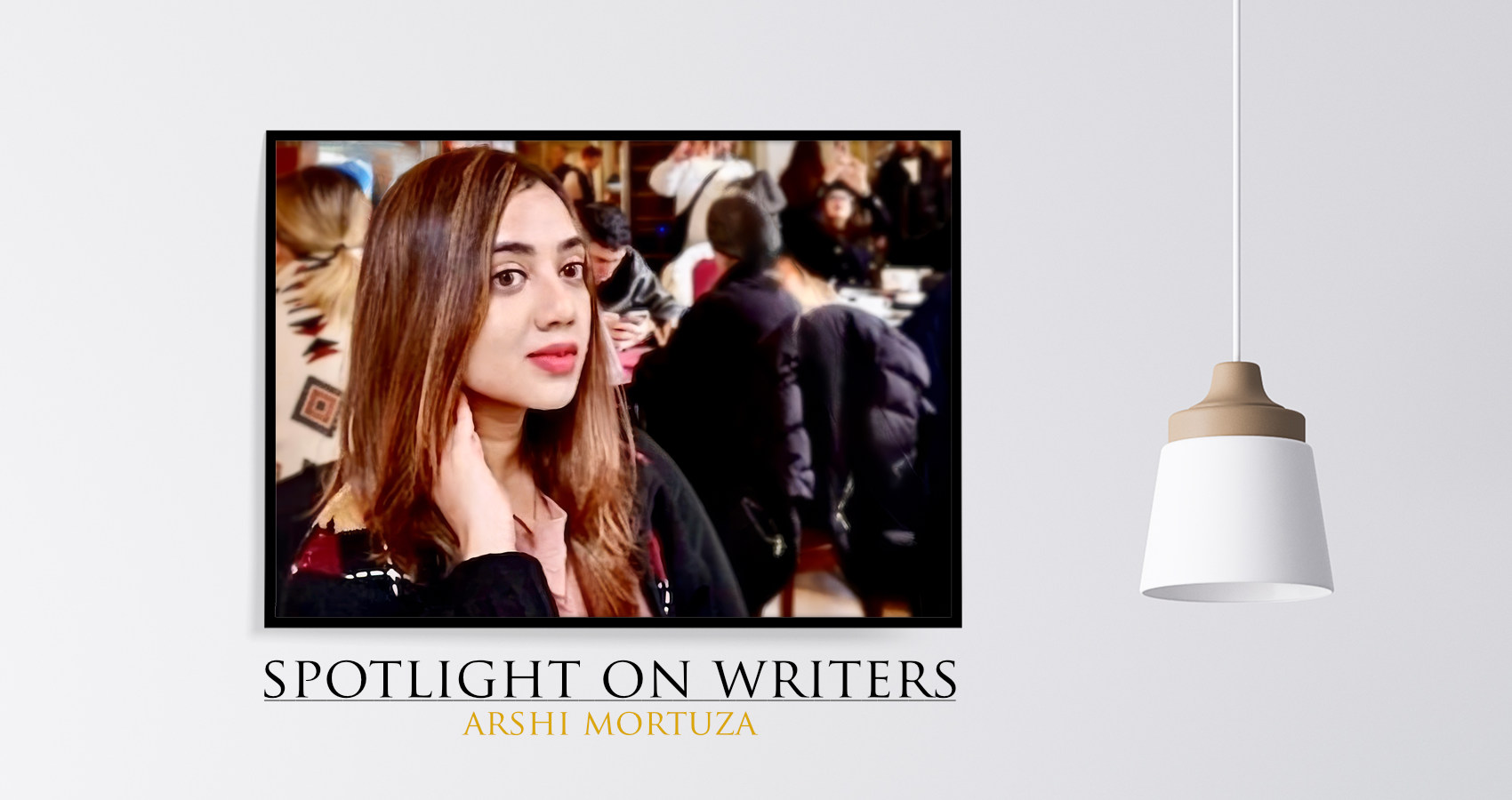
Spotlight On Writers
Arshi Mortuza
- Where do you originate from?
I am originally from Dhaka, Bangladesh, though I’ve lived in seven different countries throughout my life. In my twenty-nine years, the longest I’ve stayed in one place is five years — in Canada, where I currently live. Because of that, the idea of “home” has always felt a little split for me.
As a teenager, I found the constant moving quite difficult. It often felt unstable and frustrating, and I envied people with lifelong friends, familiar streets, and a strong sense of rootedness. But now, in my late twenties, I’ve started to see that experience differently.
Growing up with a diplomat mother gave me a life shaped by movement, cultural overlap, and constant reinvention — something that feels especially meaningful within a South Asian context.
- What do you cherish most about the place you call home?
This is always a question that makes me zone out a little when people ask about “home.” I think living such a nomadic life meant I had to learn to find home in memories rather than in a fixed place, so the concept has always felt a little abstract.
That said, I think I should start practicing calling Canada home since I recently bought my first home here and became a Permanent Resident, haha.
What I love about Canada, and Toronto in particular, is its openness: the way people from entirely different cultures, histories, and languages coexist while still being encouraged to remain themselves. Having traveled extensively, I’ve come to really value places where diversity feels natural rather than performative, and Toronto has often felt that way to me.
- What ignites your creativity?
This might sound a bit cliché, but I’ve never really shied away from saying it: a lot of my creativity is ignited by pain.
I tend to fictionalize moments that stay with me, whether they feel deeply painful or even almost ironically so. For instance, if I notice something like someone cheating on their partner (!!!), or I witness emotional unfairness in a situation where I have no real way to intervene, those moments tend to linger and may become the seed of a short story.
For my poetry in particular, it is more personal, though it is also shaped by my academic background. I studied literature for six years — completing a bachelor’s and two master’s degrees — and I’ve always been drawn to mythology, psychology, and history, often researching them out of pure curiosity. Those interests sometimes merge into my work as literary or feminist retellings.
My first book, One Minute Past Midnight (2022), contains poems written between the ages of about 16 and 24, many of which reimagine fairy tales in a feminist way. It is, in part, about the disillusionment that comes when childhood narratives meet reality.
My second book, Pressed Flower (2026), includes work written between the ages of 25 and 28. It feels more inward-facing and reflective, holding thoughts I often couldn’t articulate aloud at the time. Poetry, for me, became a way to metabolize those unspoken truths.
Across both books, a recurring thread is the experience of navigating the world as a woman — particularly a woman of color — and also as someone who has lived with mental health struggles, and the emotional residue that can come with that.
- Do you have a favorite word, and could you incorporate it into a poetic phrase?
Yes, I do, and it’s also an experience I really love: petrichor, which refers to the smell of earth after rain.
I once went through some very private emotions, which I once again turned into writing. That piece eventually became a poem titled ‘Petrichor,’ which appears in my book Pressed Flower and was also published by Borderless Journal.
Here it is:
PETRICHOR
“When it rains, it pours,” they say.
I think of the droplets on the blades –
Rainwater on grass, I mean.
You were not rain, per se.
In my skies, the faintest gray.
Shall I open that floodgate?
I prepared for your arrival
Like one would before a hurricane,
But you were a drizzle, at best.
Lucky for you, I was dry earth –
A distorted sense of self-worth,
Soaking up beads of bare minimum.
I guess only a few can make it pour when they rain.
You were just a fleeting cloud — a phantom pain
Is what I’ll call your lingering scent.
A projected petrichor.
But in my heart, I’ll always know
That it was my storm, not yours.
- What is your pet peeve?
I have quite a few, to be honest. I think I’m fairly type A, so certain things tend to get under my skin more than others.
Bad hygiene is an obvious one, but I’m also quite particular about order. If I’ve just cleaned or arranged something and someone comes in and rearranges it without needing to, it unsettles me more than it probably should.
I also don’t cope very well with sudden changes in plans. I like a sense of structure, and too much unpredictability can feel overwhelming.
In social settings, I’m sensitive to personal space, so people standing too close to me can make me uncomfortable. I also find conversations difficult when they become one-sided — either when someone completely holds court without curiosity about others, or when someone interrogates me without any balance or mutual exchange.
On a broader level, I really don’t like lazy or offensive humour that relies on stereotypes or punches down. I prefer conversations and people that feel thoughtful and self-aware.
- How would you describe the essence of Arshi Mortuza?
I think the essence of me is sensitivity — to my own emotions and to other people’s experiences. I feel things quite deeply, sometimes more than I know what to do with, but that sensitivity is also where a lot of my creativity and empathy comes from.
On the surface, I’m pretty simple in the ways that matter: I love small comforts, sunshine, iced lattes, and anything soft — by which I specifically mean FLOOF. My idea of a perfect day is something calm and ordinary in the best way, where a bit of unexpected inspiration hits, and I can stop everything just to write something down before it disappears.
I do have a slightly more guarded side — not entirely by accident, but as a form of self-protection I learned early on. I’m still working on loosening that instinct, but it’s part of how I move through the world while staying open to it.

- Spotlight On Writers – Arshi Mortuza - May 30, 2026
- Attachments - May 6, 2026
- Dracula’s Bride Rants - February 28, 2025