

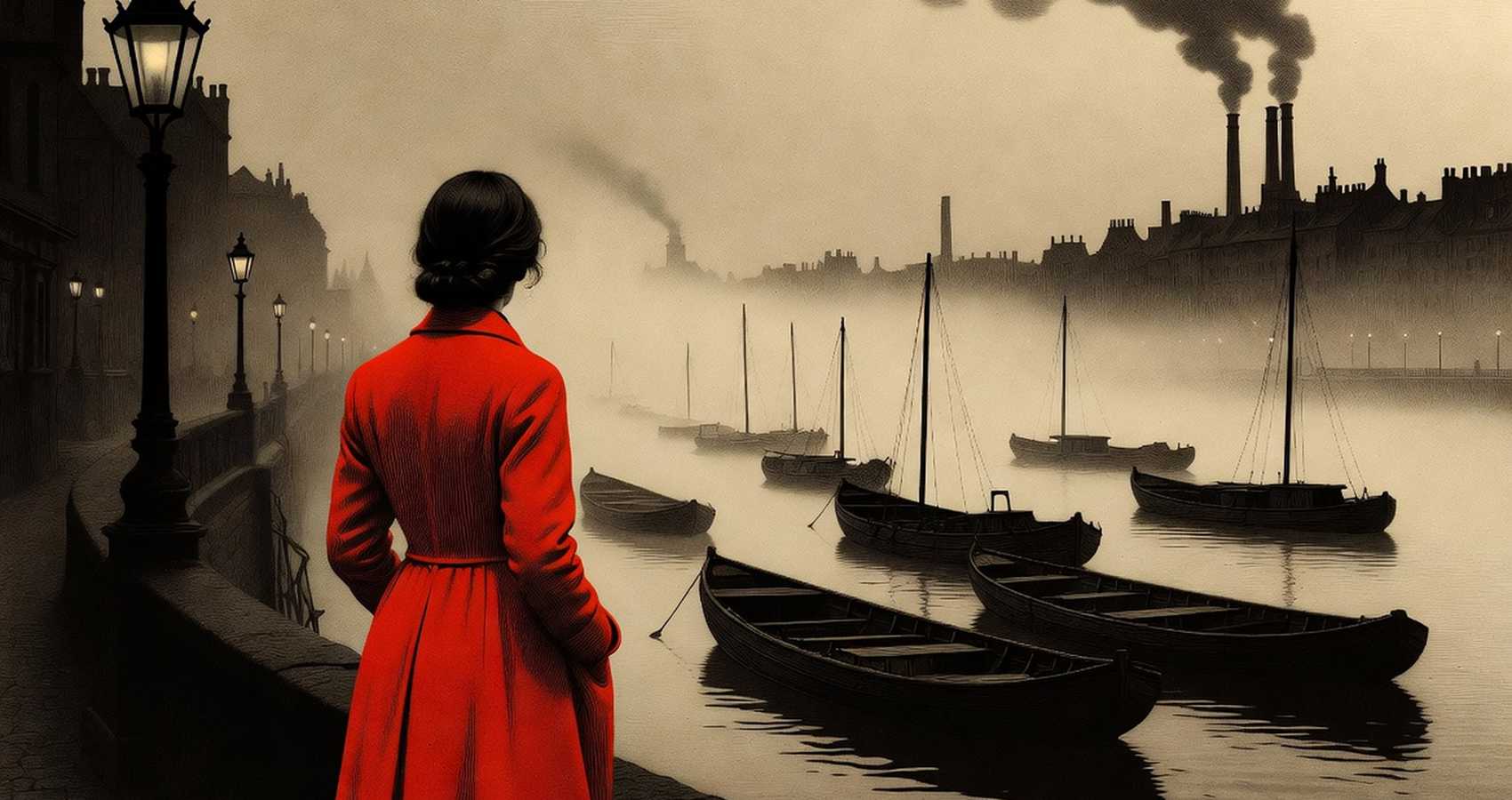
Nine Barges
written by: Ellen Townsend
On Saturday lunchtime, the library had the regular crowd: mothers with toddlers and Jo, back again, with her book: a hardback of Victorian engravings. The librarians all knew her by name; but didn’t know her true motives for being there. When she flicked through the book, a new building was within the monochrome engravings; she stopped. “What the—”
Her lodgings were close and she strode at speed, oblivious to the biting wind. Her partner, Nick, was about to leave when she gently thrust the engraving under his nose.
“What am I looking at?” he said.
“This,” Jo pointed. She couldn’t remember the last time she was so excited.
“What’s this?”
“An intersection of three streets nearby. This building is odd.”
“So?”
“I’m checking it out. Coming?”
She paced the named streets; Nick jogged alongside. “What’s the rush?” he said. A new alleyway had appeared. Before she had time to think, she bolted down it with Nick in tow. A market square bustled with people in costume. Jo noticed Nick covering his nose at the odours of herring and manure.
“Newspapers,” she said. A man in a flat cap and braces pushed a cart of The Daily News, November 1885.
“Historical drama,” said Nick.
No director steered them away. A man on the street opposite bellowed, “eel pies, tuppence each.” He wore a grey cloth cap and coat so big it looked like he’d found it on a park bench. What would it be like to feel his bony arms and gnarled hands, to see if he was as real as she was?
“Where are we?” said Nick, pulling threads on the hem of his hoodie. It was unsettling to see him without his usual cockiness. Horses’ hooves clattered by with plumes on harnesses. Nick hovered, gormless. She pulled him out of the way; if you got trampled on, no one would care. A woman in a shawl met Jo’s eyes; she usually avoided eye contact, but she searched the woman’s capillary-lined face.
“Let’s go home,” said Nick.
“I’ve not finished yet. You could retrace steps.”
“This place is weird,” Nick frowned at his blank phone. “We should go.”
“I’ve said I’m not ready.” A sharp wind chilled her, and she tightened her red coat.
As they walked, Jo reflected on their relationship. Twenty-eight, they had met six months previously at a school reunion, although their paths had never crossed while at school. When Jo, at age seven, went into foster care, she also started school. She didn’t know how much to tell Nick about her past and whether she could trust him.
A dim alleyway carried dank smells of open drains; Nick retched and coughed. “It’s foul,” he covered his nose with his hoodie. Stone steps led to an embankment. From here, you could see the barges on the Thames’s opaque waters. The skyline of chimneys with black smoke and the odours of rotting fish seemed so familiar to her, as though she had stood there before.
“You, okay?”
Realising she’d been staring into space, she placed her numb fingers in the deep pockets of her red coat. The coat had been a treat for herself. Its bright colour lifted her mood. Nick joked about losing her in a crowd.
A sign ahead read Books.
“Not another library,” said Nick.
“A shop. I’m going in.”
She loosened her red coat, slumped in an armchair, while the clerk scratched a quill pen on parchment. It was so soporific. Warm and sleepy; it was like everything was at once both snug and threatening, safe and not safe.
A tap on her arm jolted her.
“It’ll be dark soon,” Nick said.
She dragged herself outside and tightened her red coat. Gas lamps created a pocket of light where a boy lingered, watching them, then blended into shadows, leaving her tranced until a man bumped into her. “I beg your pardon Miss, I didn’t see you there. Truly sorry, I am.” A mix of body odour and coal dust touched a memory she could not place, like the edges of a dream.
“We should head back,” Nick said, chewing his nail. With the light dimmed, doorways were clouded in gloom.
“I might stay here tonight,” she said.
“Is this a joke?” Nick stopped walking.
“No.”
“You’re making me worried.”
“I’ll be okay.”
“Where will you sleep?”
“I don’t know.”
“Hang on, how long for?
“I’m not sure.”
“A night or a month?”
“I haven’t decided.”
“What about your waitressing job?”
“I don’t know.”
“What about us?”
“I’m sorry. I must do this.”
“What’s going on?”
“It’s complicated.”
“You’re not telling me.”
Should she stay? She wanted to but what if she couldn’t get back?
“Tell me.”
She walked on.
A teenage boy stood by a crate with eels slithering. His solemn eyes met hers and she hoped they might help her decide what to do.
“Tell me.”
When they reached a sign, Watchmaker, Nick had already opened the door and stepped in. Cabinets contained mantel clocks, but pocket watches lay scattered on tables.
“Good afternoon, Sir and Madam. Would you care to see our fine clocks?” A man in his forties lifted a ring of keys. Nick smiled to himself and, in a matter of seconds, although it seemed longer for her, he had grabbed a pocket watch and strode out of the shop. Outside, he was waiting for her; then took off. She started running, too, and bolted into a poorly lit street. Stayed near to walls. Waiting. Listening. Shouts of “thief, thief,” were coming after her, dogs barking. She set off. Flying down alleyways. Feet slamming the pavement. Running on. Tearing through lanes until the cries quietened. Darting behind shrubbery, she crouched, breathless.
“Jo?” Nick’s voice. Rustling in the foliage, twigs snapping. “I’m so glad you’re alright; I was worried.”
“I’m too mad to speak to you.”
“I’m so sorry, I didn’t plan to take anything, it just happened.”
“Rubbish excuse. I saw your smile.”
“At least we can rent a flat together now.”
“No way. Shh.” Two men were arguing, dogs barking. They waited until the noise dimmed.
“We have the money.”
“Stealing? You’d better not have messed things up for me.”
“What things?”
“Staying here.”
“What’s going on; I must know.”
“You —”
“Stop, thief!” a policeman blew his whistle. She set off running. More cries chased her. She dived through the lanes. Breathless until she reached the market square. Skidded down the alleyway. Staggered into the neon lights. The metropolis.
A police siren blared, and she covered her ears. Nick appeared, his curls in matted clumps.
“I got lost. Let’s go for a curry. I’m starving,” he said as though nothing had happened.
“I’ve got things to do. I need to be alone.”
“I’m so sorry about the watch; it was stupid. I want to be with you. Can I call you tomorrow?” He reached for her, but she turned away; he hovered before disappearing into the crowd of late-night shoppers.
***
She slid off her red coat at her lodgings; it fell with a soft thud, goosebumps appearing without its heavy warmth. But it was too bright; too many eyes followed it. She knew someone who’d be happy to use it: her foster mother; “I love this coat,” she’d sighed. Jo ferreted in her wardrobe for her grey anorak. She paused and pulled at a loose thread on her sweater. She could still stay home in the warm; she didn’t have to go.
The West End had taken on a flashy demeanour of glitzy lights and noise. A large metal gate now blocked access to the entrance of the alleyway. She tried to open it, then shook it until her hands were raw. After kicking it hard, she fell to the ground. The sky was livid grey; the drum of the city beat around her.
***
At her lodgings, she edged under her bed to the sagging wooden slats and pulled out a shoebox. Two thick rubber bands secured it; she shook out photos of her in blue school uniform, swinging a book bag. Underneath, a black-and-white photograph of her wearing a cream dress with her mother holding her, 1864 scribbled on the back. She had her arm around her mother’s neck, the soft feel of her velvet coat. She remembered watching her twist her hair into a chignon, stick pins in her hat. A week later, at her aunt and uncle’s house, she’d played upstairs with her cousins until she knocked a candle over and set fire to her aunt’s pillow. They quickly extinguished the flames, but her parents soon left. When she stood by the Thames with them and asked to go on a barge, they said no. Memories flooded back. The odours of rotting fish and tar. The barges. Nine. Clutching the photo. Sneaking off towards the river. Down the alleyway.
***
“What are your options right now?” her foster mother, Lynne, used to say to her. Jo stayed with Lynne until eighteen. When she visited her, the house smelt of lemon disinfectant and burnt bacon, and there were new children running around. “There’s a place for you at the table, Jo,” Lynne always said and gave her such a warm hug she didn’t want to stop. A flush crept up her neck. If she had just left without explaining, they would wonder where she was. Nick chewing his nails and worrying about her. She found some paper, took a deep breath, and wrote.
***
The book of engravings lay heavy on her thighs, and the pages fell open on London Bridge. She still did not know what to do. Should she go back? Better to risk it than regret not trying.
***
When Nick called at Jo’s lodgings the following evening to collect some items for her, the pavements glistened with ice. He went in because Jo had left the door unlocked. Everything was quiet. An envelope with Nick’s name on sat propped beside Jo’s bed on top of two library books. Her bed held an empty shoebox, a card addressed to her foster mother, Lynne, and her red coat.

- Nine Barges - April 29, 2026
- Olfactory Apothecary - January 28, 2026
- The Best View - October 12, 2025