

The Sunflowers on Fifty-Sixth
written by: Claire Farnsworth
Sam let the screen door slam shut behind him, rattling on its loose, rusty hinges. He lifted one hand and shielded his eyes, the other holding a rectangular case tucked under one arm.
The only other life that seemed to stir was that of the few, nervous crickets that buzzed under the porch, making music in an unstable world. The sun had just begun to set, coloring the sky with rosy orange and pink, and lighting the dusky treeline with gentle fire. It was always a comfort that nature never ceased to be beautiful, even through all the recent ugliness and chaos of the world.
Sam sighed. No one was out tonight. It was the three-month anniversary of the Event. The town-wide curfew was not for a few more hours, but today everyone was turning their faces away, looking to grieve in solitude.
It was October now, and the leaves were changing.
The town was small, and his neighborhood was smaller, houses clustered together like shabby, gossiping companions. A few were entirely abandoned and falling to pieces. There had been a fire a few weeks ago, and a whole block several houses down was burned to the ground. The air still smelled of smoke, and black streaks of soot licked up the sidewalk.
Sam contemplated going over to see if he could scavenge one of the abandoned houses for hinges to repair the loose screen door. He decided to go the next morning. It was most likely already picked clean, but that wasn’t his only reason. People could be dangerous at night, especially if they thought you were going to take something they needed.
Sam winced, rubbing his leg with one hand. His rheumatism was getting worse with the colder weather, and he felt its effects today in full.
He limped across the porch to set the case down on the coffee table next to the porch swing. He carefully opened the suitcase-like leather box to reveal a portable record player. He was lucky to have it, music was a rare commodity now. Only old technology that didn’t use circuits still worked after the EMP. But the record player was battery-operated, and he didn’t know if he’d be able to find more, for batteries had become another precious resource.
Sam gently lifted the thin, fragile needle, and the air suddenly hummed with a whirring sound as the turntable began to spin. He carefully swiveled the needle and set it on the steadily turning black disc, and static filled the air, popping, until the first jangly chord of an acoustic guitar slowly wound its way through the silence. It was Bob Marley’s “Redemption Song.”
Sam turned the volume up on the record player as high as it would go, and then sat back on the grey, splintery porch swing, his mind filled with the days before and all the questions that everyone in the world must be asking.
After the EMP, everyone’s phones were dead, most cars were out of commission, using almost any electronics was out of the question, only non-perishable foods had kept without refrigeration, and factories certainly weren’t canning any more. There was no way to contact relatives living out of state, and with the winter rapidly approaching, a low, grey cloud of fear hung over the autumn landscape. The scavenger groups moving through towns hadn’t become violent yet, but who knew what would happen next? There was no way to keep in touch with the outside world.
Sam looked thoughtfully out over the land. The fire had blackened many of the surrounding yards, but the woods nearby were still intact. His neighborhood was lucky in that they had a firewood source, and perhaps if there was enough to sustain the town through the winter, there was still hope for the next year. He still had boxes of old seed packets in his basement from when his wife, Rosa, had been in her gardening phase. If the neighborhood could grow a communal garden, there would be at least some fresh food again.
Sam took a deep breath of the crisp, smoke-tinged air, missing Rosa and her warm presence. His old bones creaked in tandem with the hinges of the swing as he gently pushed it with his feet. One of his trouser knees had a hole, he noted. Rosa had loved sewing. She would sit in the kitchen window seat, lit by sunshine, with quilt patches scattered around her like a flock of vibrant birds. He would read the news, and she would sew, and they would both laugh and talk about the state of the world.
No one drank coffee anymore.
Tinny strains of the music wound peacefully through the air, made especially loud by the absence of traffic noise. “But my hand was made strong, by the hand of the Almighty, we forward in this generation…”
His thoughts drifted to the children, now growing up in a world so starkly unlike anything before. It would be a new sort of dark age for them, for they had known technology. The hand that had dealt the power of progress had been cut off in an instant.
Sam still remembered the Event and that cold stab of fear he’d felt run through him in vivid detail. The TV had blinked once and then died, becoming nothing but a great, black eye staring back sightlessly. The electricity went out in that same second, traffic noise ceased, and it was like the entire world flatlined in one moment of terrifying, soundless white noise. Rosa had been convinced that it was nothing but a power outage, but Sam had had a terrible sense that it was something more. He went to call the power company- the old landline phone that they kept in the house was dead.
All it took was an atomic bomb set off in the atmosphere, and everything was gone.
It had not been that moment of technological death that specifically destroyed so much, but the days after, of struggles and starvation and cold, of illnesses and expired medicine, of families being trapped apart from one another. The Event was a moment in time, a rift, but also an ongoing scar.
But perhaps the children’s memories of this despairing time would fade, and he had hope that the new generation could someday rebuild the world. They would tell their own children stories of the first few terrifying years when the world had stopped in its tracks. And maybe, just maybe, they would tell jokes about that time, to lend a gentler world to their children.
A door suddenly slammed in a house nearby, and Sam sat up straighter, his silver hair softly ruffled by the breeze. A boy in his early teens came storming down his porch steps, loose-limbed and awkward and angry.
Sam smiled.
The boy walked ramrod-straight with his hands stuffed into the pocket of his too-loose hoodie, over the soot-scorched earth, and onto the empty driveway, coming up to Sam’s house. He jogged up the few steps, and Sam nodded smilingly at him, making room for the boy to sit beside him on the porch swing.
The boy shook his head and leaned tensely against the porch railing, his eyes trained on his dirty, torn Converse, his hands tight fists in his hoodie. His face was pale and hollow, and Sam’s heart hurt at the way the boy’s shoulder blades stuck out like wings. His eyes and ears were too big for his face, and his hair looked like he’d combed it last week, tousled and curling off the back of his neck. The golden light cast by the waning sun’s last rays cut across the boy’s face, lighting his eyes a brilliant hazel, and softening the dark shadows under his eyes.
“Is everything ok?” Sam asked quietly.
“No! Nothing’s ok. Aren’t you as sick of it as I am!?” the boy burst out suddenly, jerking his head up to meet Sam’s eyes with a fiery gaze. “I get it, I get that nothing can be the same. But sometimes I can’t stand the hiding and fear and hoarding, all the while this pressure pressing down on our heads. All we can do is survive, but when is everything going to be really ok again?”
He turned and kicked at the railing in a burst of frustration. It creaked ominously under the sudden onslaught. “Why did it have to happen now? I didn’t even get a chance to live in the same world as everyone else!” He punctuated the last word with another, fiercer kick to the railing. The post cracked, and then splintered, tearing free from the porch and dangling off the railing by a singular, rusty nail. The boy stumbled back, his face crumpled, his hands pale and shaking. “I’m sorry, I can’t do anything right.”
Sam smiled gently, and patted the seat beside him. The boy flopped down, setting them both to wildly rocking. Sam laughed, grabbing the wooden arm of the swing to steady himself.
“It’s alright, that post was rotten clear through. I’ve been meaning to replace it anyway.” He leaned over and looked into the boy’s hesitant eyes. “And I think that you’re doing better than you know. Helping your mother and father pick up the pieces after the end of the technological world, and taking care of your sick little sister? No one’s done this part of history before, and your parents wouldn’t be able to make it without you.”
The boy sat back and sighed, closing his eyes in the dusky light and resting his head on the back of the swing, his dark hair gently curling over his forehead. The porch swing creaked in the breeze, crickets chirped, and Bob Marley continued to sing plaintively from the record player. The old man and the boy sat and listened in peaceful stillness, until the record reached “Have no fear for atomic energy.” The boy choked out a laugh and sat up, turning to Sam with an incredulous look on his face.
“Really?!”
Sam gave him a lopsided grin and leaned over to switch the record player off. “It was one of my favorite songs when I was your age, it’s not my fault that that particular lyric aged badly.”
The teenage boy raised an eyebrow dryly. “How old are you?”
Sam laughed, showing his white teeth, fine laugh lines crinkling around his pale blue, sun-bleached eyes. “Let’s just say I was in my twenties when that song came out and leave it at that.” He sobered suddenly. “But Bob Marley has a point, really. The EMP only traps us if we let it.”
The boy sighed, frustration seeming to leak out of him, and stared off into the distance wistfully. “I just – I hate seeing my little sister look so thin. I hate seeing my parents sneak their rations onto my plate when they think I’m not looking. I-” the boy laughed bitterly. “I was playing Minecraft when the Event happened, you know? Of all the stupid things. And now-” He trailed off, waving a despairing hand before him at the empty streets.
Sam watched the boy’s profile against the dwindling rays of sun, all blurred edges and sorrowful eyes that had seen too much for his age.
There were so many what-ifs. What if they had known the Event was coming? But no one had known. Or if they did, no one had thought to tell them.
“Do you remember the old truck graveyard that used to be behind the tire shop on Fifty-six?” he asked suddenly.
The boy looked at him skeptically. “Yeah, why?”
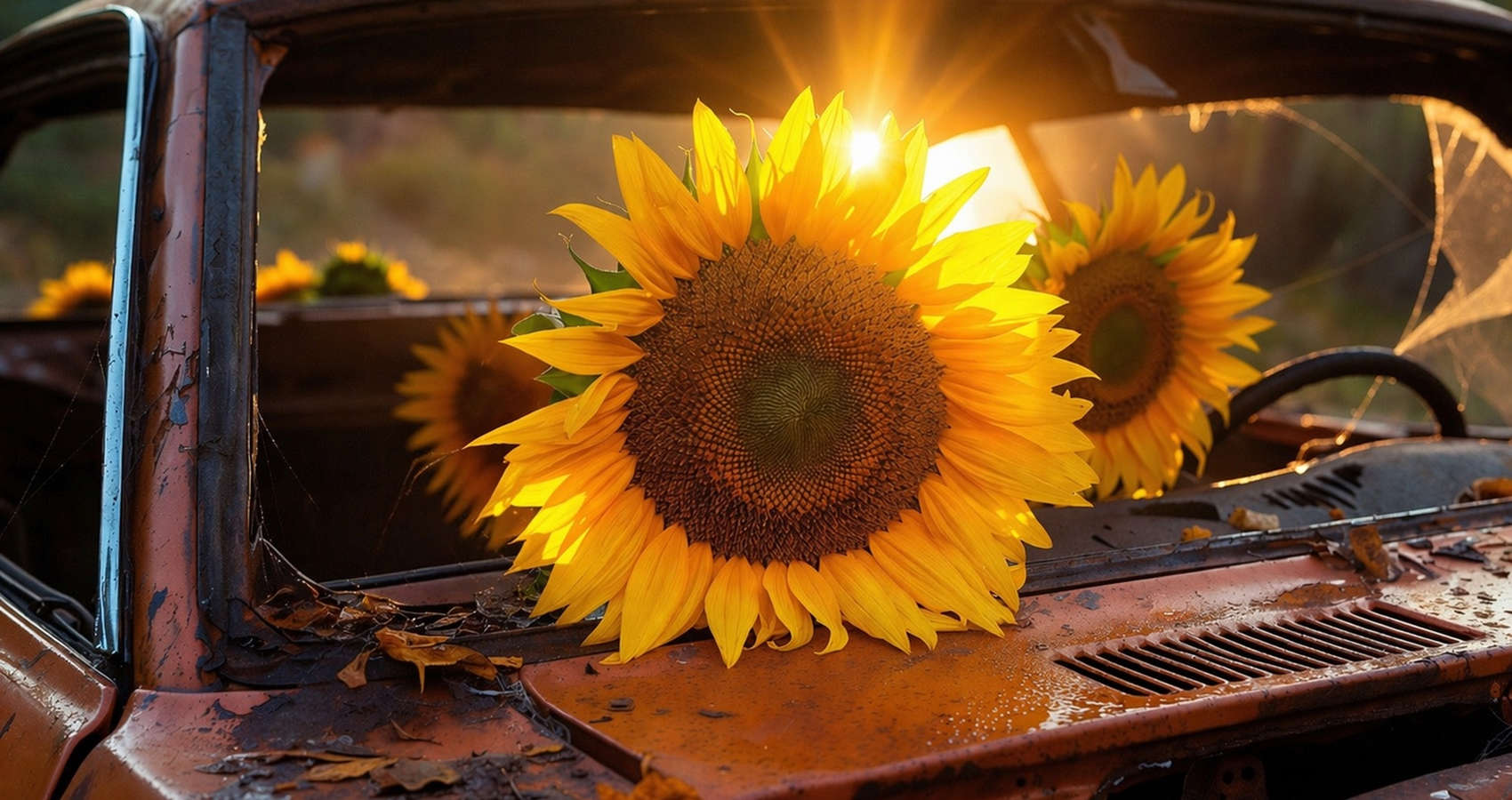
“Remember how those great, bright sunflowers grew up all through those Mustang skeletons, and in the old Ford truckbeds, so tall and strong, with their faces upturned towards the sunlight. It was like all the hope of the world sitting on the back of the old and gone, and looking all the more beautiful for it.”
The boy was quiet, and Sam thought he understood what he meant. He looked from Sam’s eyes to the lonely, silent houses before them, seemingly lost in thought. The record player sat voiceless and still.
Sam slapped one callused hand against the knee of his dirty, worn trousers, and stiffly clambered to his feet, the swing creaking back and forth as the boy’s feet just grazed the porch. He held out one hand to the boy, even though they were both aware that he didn’t need help up in the physical sense.
“What do you say I dig out some good ol’ gospel records and set up camp in the front yard. You light a fire in the firepit, there’s nothing left of the yard to catch fire anyhow, and I’ll see if I can rustle up some grub.”
The boy’s eyes brightened, although you could tell he didn’t want to let any ‘juvenile’ excitement show.
“Could I-,” he hesitated. “Could I invite some of the neighbors? They’ll come out if they know there’s food.”
Food was the defining factor of everyone’s existence these days.
Sam nodded proudly, and went to go rummage for supplies inside the house. He paused momentarily with one hand holding the screen door open, glancing over his shoulder, and smiling to himself as the boy flipped the record to the other side. The trees around the porch shivered in the breeze, and umber leaves gently drifted down around them, painted gold by the waning sunlight.
The boy looked up earnestly, noting the crooked door with quick eyes. “I saw your door was loose the other day. If you can find me a screwdriver later, I’ll fix your screen door for you. The broken post, too.”
***
It was dark out, but they had a fire going, and clusters of people huddled around the blaze with their ragged jackets pulled tight against the autumn chill. Groups of children ran joyfully, screaming into the darkness, laughing and whooping while their parents worriedly motioned them away from getting too close to the fire. Others still sat eating from their tin cans of food that they had heated up over the fire, savoring the precious warm meal.
Burning wood crackled and popped in the firepit, sending hot sparks into the cool night air. The moon was only a waning sliver of light set high over the treetops and roofs, but the stars shone like colder sparks in the dark sky. Adults whispered quietly among each other, occasional small bursts of laughter unfurling into the night, something even rarer in this new world. The children around them laughed and shrieked as if nothing had ever changed, and the teenagers sat together with their eyes fixed seriously on the stars.
The record player sat on the porch, turning and turning, the strains of “It is Well’ reminiscent of a stained glass world. The record cracked and popped with static and scratches and age in the chilly night air, as the precious battery faded and the last wavering notes drifted into the dark…
NOTE FROM THE AUTHOR:
This short story was inspired in part by the book One Second After by William R. Forstchen.

- The Sunflowers on Fifty-Sixth - April 26, 2026
- Jealous of Skateboarders - November 23, 2025