

I Held My Breath
written by: Bill Tope
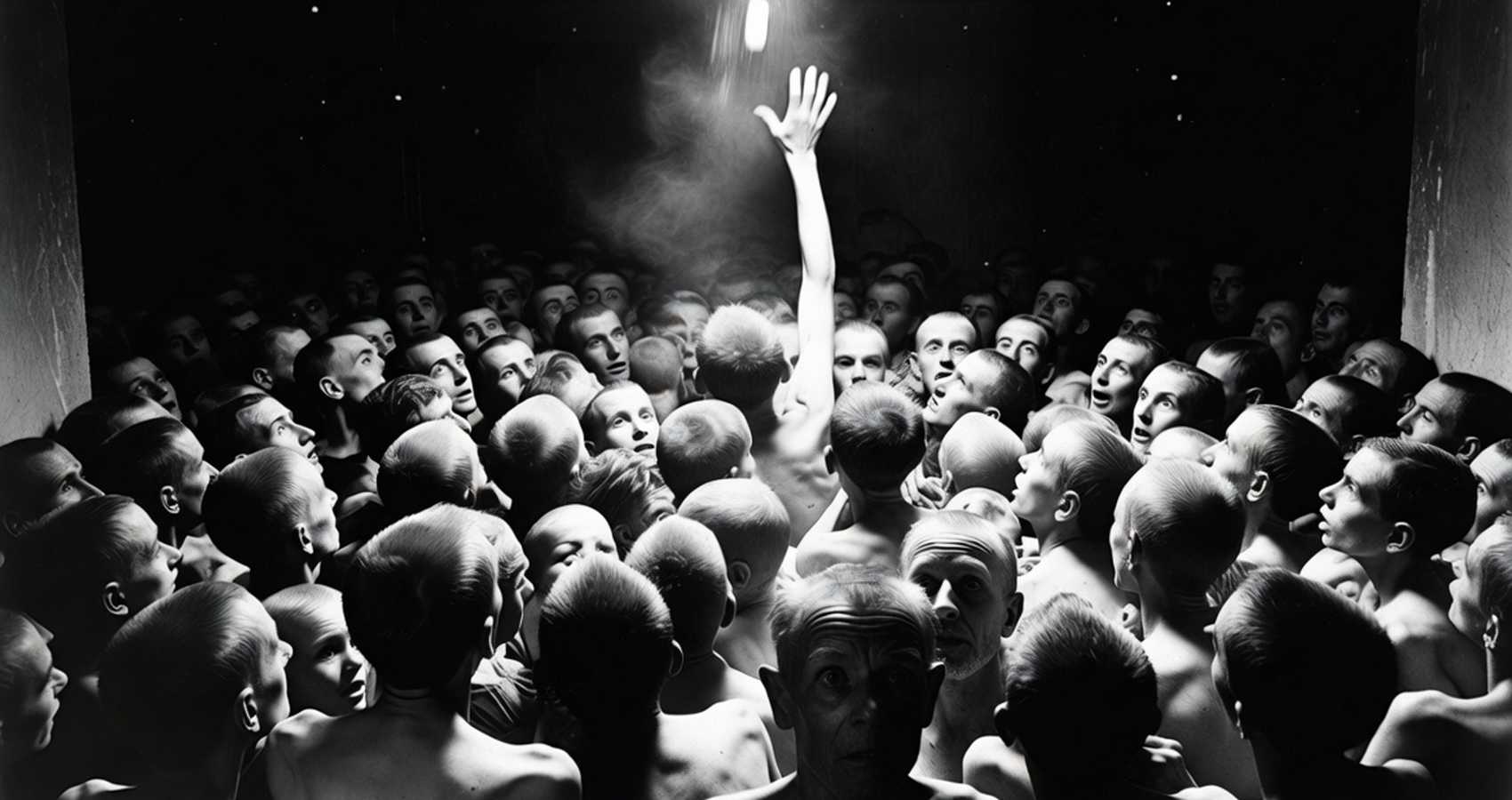
We had been crowded into a long, plain, low-ceilinged room the size of a small pastoral church. Cement walls and floor. The soldiers had confiscated all our clothes, our shoes, and what jewelry and personal effects that had remained with us. Most of it had long ago been bartered away for food or clean water or other privileges scarce in the Warsaw ghetto, from which we had all come.
We were completely naked: the men, the women, even the little children. Our heads had been shaved. A gauche rumor had it that the Huns stuffed their pillows and mattresses with our hair. The room was entirely vacant but for the stark human bodies; our pale white flesh was the color of a fish’s belly, and we were stuffed into the room like oysters into a turkey. Our bodies smelled from perspiration and the filth that had accumulated on the trip by train from the Polish capital, as well as from the mental stress of our imminent deaths. We were told, in various languages, German, Polish, and Yiddish, that before we could get our uniforms and be fed and given accommodations, we must undergo delousing. Some of us, our confidence vested in the authority of our captors, took this statement at face value.
We had all been shipped to the death camp—Todeslager—like cattle to the slaughter, in chained box cars, with no food or water. With scarcely enough room to breathe. Once or twice, a plane flying overhead had strafed the train with machine gun fire. Perhaps our own brave pilots, flying air raids for the Allies.
There were amongst us no youths or middle-aged men and women; they had all been absorbed prior to departure from the ghetto into the vast slave labor network the Huns operated. Only the crippled, the sick, the feeble, and the old, like myself, were here, save for the very young, who weren’t hardy enough for slave labor. Curiously, in the rare case of identical twins, they were taken elsewhere as well. We didn’t know what became of them.
We were in Treblinka. It was June 1943, and the rumor was that the camp would be closed soon. I had been there a matter of only a few days. My wife hadn’t been as lucky as I. She died of starvation and medical neglect at the ghetto in Warsaw shortly before we were harvested and shipped to Treblinka. This was following the uprising, when the pace of everything became greatly accelerated. We were told we were being transported “East for resettlement.” Perhaps after all, Rachela had been the lucky one.
Prior to departure, we were fed jam and bread–for some of us our first meal in days–and encouraged to pack bags. Our luggage was then seized by the Germans before the trains even departed the station. We had no room to lie, sit, or even turn around. We were like the kippers that were packed in oil or mustard, and that the inmates in labor camps—the Arbeitslager—got from the Red Cross. At Treblinka, we never received our kippers.
As we came into the “train station” at the camp, most prisoners didn’t recognize the station for the mock-up that it was. Fake ticket windows, faux baggage carts, and even a clock with painted-on numbers greeted an unassuming group of doomed prisoners. Most prisoners were executed immediately upon arrival, but for some reason, our fate was delayed for almost a week. Even killing machines require maintenance, I suppose.
There were nothing but rumors flying throughout the compound: I heard it whispered that the German women made lamp shades with our skin. Other gossip said that grisly artifacts were constructed by tradesmen from our denuded bones. Some of the old men stared with concern up at an aperture in the ceiling, about a foot and a half over our heads. That, they said, was where the Germans would deposit the Zyklon B, the poison they would gas us with. Where they got their information, again, I never learned.
The Commandant, addressing us prisoners upon our arrival only days before, had bragged that superior German industry had created many wonderful things. This was perhaps the example he had in mind when he said that. He had seemed very proud. One of the relatively younger of the men with us had been a helper, removing the bodies from the chamber after the gas had dissipated. Even in this group, every prisoner would be murdered and replaced with new arrivals every few weeks, with the exception of specific individuals, usually from the Hofjuden. They were kept alive because of their technical expertise, which was considered essential to running the camp. In fact, one’s destiny was often denoted by the color of a striped band on their uniform—red given to short-term workers in the killing and sorting areas, blue to the unloading group, and yellow to the skilled workers, like electricians or engineers.
This man, who said his name was Carl, said he had worn a red stripe; his job had been to spring into action after everyone was dead. He told us all about how the death procedures worked. The poison—prussic acid—he said, worked fast. There would be a rattling over our heads, in the chute that the poison was fed into. Someone, he said with a grotesque grin, always tried to keep the pellet from descending. But fall it always did. For his labors, he had received an extra crust of Brot, and his life.
We waited. And waited. Suddenly, there was a loud clattering overhead, in the chute. The pellet of Zyklon B was descending. A tall man, as if acting a part in a play, attempted to prevent the pellet from falling, where it would crack open and then dissipate in a cloud of murderous vapor. His hand slipped. Suddenly, a large white pellet crashed to the floor, burst open, and a deadly diaphanous mist rose up. Someone spontaneously giggled. A woman cried out. The lethal “showers” had begun.
I held my breath.

- I Held My Breath - April 13, 2026
- Paying it Forward - December 23, 2025
- Practice - August 11, 2025