

Odeon
written by: Adelino Carbonera
Publius Terentius was awakened from his afternoon rest by a deep rumble: he did not know whether it came from his stomach or from the sky. The air was motionless, a hot shroud that oppressed the room. He had the water cascades in the courtyard opened: the gurgling that poured from the stone masks did not really cool the air, but simulated a breeze that deceived the senses.
It was not long before a servant announced the arrival of Titus Cornelius, director of Claudian’s Odeon. He entered without much ceremony, visibly agitated.
“A problem, Publius. A problem that threatens to ruin your play tonight.”
Terentius lifted himself slightly on his cushions. “Which one of mine?”
“The Punisher of Himself.”
“Irony of fate. And what is it about?”
Cornelius wiped the sweat from his forehead.
“A man has taken over the pulvinar. He has begun shouting fierce satires, against the rulers, the citizens… even against the writers.”
Terentius gave a weary smile.
“So what? Before evening, he will have lost his voice.”
“I don’t think so. For before him, a public has gathered. Not men, not citizens: a whole flock of sheep.”
Terentius laughed. “Sheep? An Odeon filled with animals? And how did the man react?”
“I don’t know. But I fear he is taking himself too seriously. You yourself once wrote that man prefers difficulty and embarrassment over peace. Well, he is proving it.”
The poet roused himself, stroking his chin.
“In my comedy, the protagonist punishes himself. Here, this man exposes himself to an audience that cannot comprehend his drama. It would be comic, if it were not already tragic.”
Then he added, almost speaking to himself:
“Men are no different from beasts. Cunning as serpents, fierce as wolves, or meek as sheep. Their only illusion is believing they can distinguish between good and evil.”
Cornelius fixed him with imploring eyes. “Only you can resolve this madness. Come.”
Thus, Terentius, frail and slight, was carried to the Odeon on a litter.
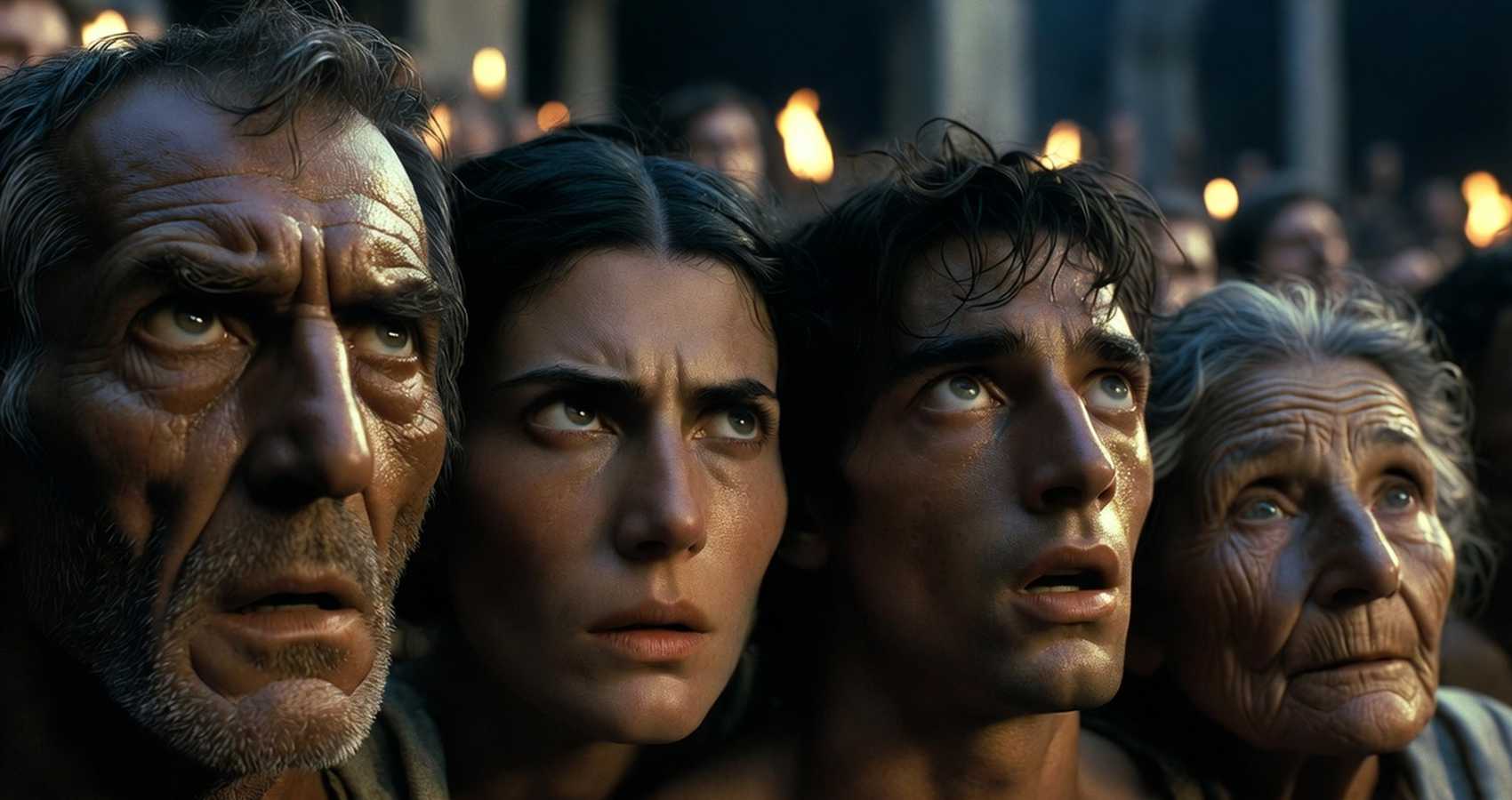
When they arrived, they witnessed a startling spectacle: the audience was cheering, laughing. They were no longer sheep, but real people. Women, elders, children, all intent on applauding.
“For all the gods… what has happened?!” exclaimed Titus Cornelius, his eyes wide open.
Terentius watched, smiling. “There are thoughts of which we are aware and others that remain hidden, until they are summoned by that power which lies dormant in the spirit of man.”
Cornelius shook his head, incredulous.
“You cannot think I wanted all this.”
“Then how do you explain it? You are responsible here.”
“It is a spell, a curse! This is no ordinary audience, and that man… what is he saying now?”
Terentius scanned the restless crowd. “Perhaps it is not he who controls the words. Have you ever thought that the power of the stage lies not so much in who stands upon it, but in those who listen?”
“What you are seeing,” continued Terentius, “is the reflection of what festers in the heart of men. It is not magic.”
“And what should we do now?” asked Cornelius, unease creeping into his voice.
“We do not stop him,” replied Terentius. “We let him go to the end. As in my comedy The Punisher of Himself, it will be he, in the end, who chooses his own fate. And besides, we cannot deprive the spectators of this moment of truth.”
Cornelius nodded, hesitant.
On stage, the impromptu orator was laughing. Then, as if following a script, he tore his tunic from his body, revealing flesh covered in scars and sores.
“Look at me! I am the Punisher of Myself!” he shouted, and with a sudden gesture seized a knife.
A cry passed through the theatre, but no one moved: the crowd, already outside itself, awaited catharsis.
The knife fell. The man collapsed to the ground, gasping.
And then the inexplicable occurred: the people in the stands began to bleat. Not weeping, not shouting: they bleated like sheep. An unnatural chorus that made the tiers of stone vibrate.
Cornelius covered his face, horrified. “What abomination is this?”
Terentius, instead, remained motionless. His eyes gleamed with a light that no longer belonged to daily life.
“Do not stop them, Titus. They have seen. They have understood. They will not go back.”
“And what will become of us?”
The poet looked at him one last time.
“Us? We are already inside the play. Only we did not know it.”
And while the audience continued to bleat, blending the human sound with the animal, the Odeon seemed to transform into a delirious ark. A wind rose, mugging like a torrent in flood.
The curtain of evening fell upon blood, laughter, and bleating.
And no one could any longer tell who was man and who was beast.

- Odeon - April 30, 2026
- The Proposal - February 2, 2026
- James II - August 8, 2025