

One Soul Blues
written by: Richard Wall
Frankie ran blindly into Camber Lane, head bowed against the rain storm that lashed the cobblestones, his coat clinging to him like a wet second skin. He had missed his bus and had ducked into the alley because he thought it was a shortcut.
Gathering speed, his left foot splashed into a puddle that hid the gap left by a missing cobblestone. Frankie staggered and bounced against the plate-glass window of the shop tucked between a Turkish café and a tattoo studio. He limped to the shelter of the doorway, tested his weight on his left foot, and diagnosed it as uninjured.
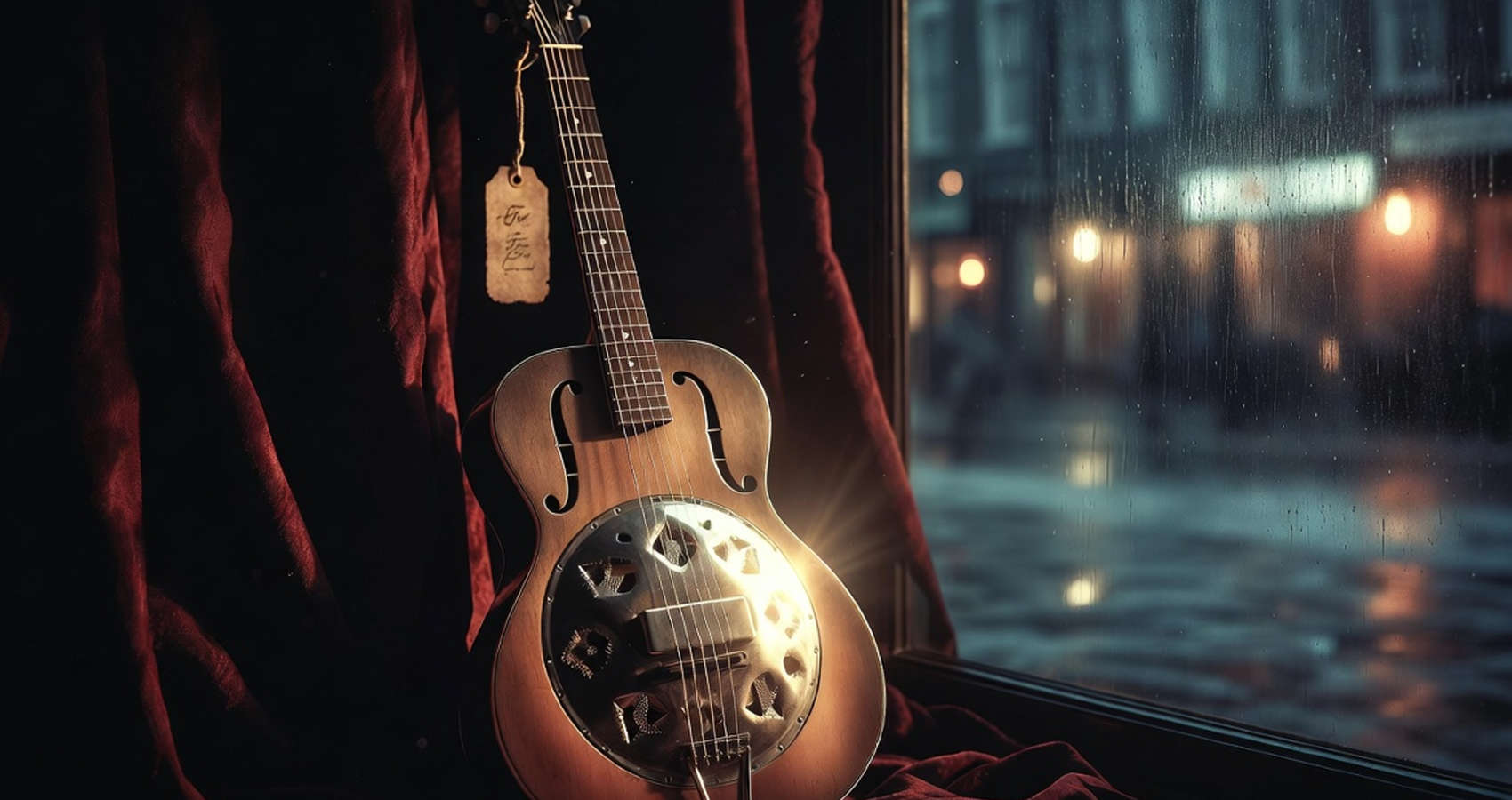
He looked around. There was no sign on the door, no light beyond a weak yellow bulb somewhere inside. Frankie was about to jog on when he glanced into the front window. Propped on a scrap of velvet, the colour of dried blood was a National resonator guitar, tarnished but gleaming faintly.
A scrap of paper hung from the headstock: For Sale – One Soul, No Less.
Frankie stared, rain dripping from his hair onto the cracked tiles of the doorway. The closest he’d been to a National was the one on the cover of his Dad’s Dire Straits album, Brothers in Arms. He’d certainly never seen one close up.
He had pawned his own cheap Takamine months ago, and in the quiet of his flat, the absence of music was an ache like a tooth he couldn’t reach.
Without thinking, Frankie pushed the door open. The bell sighed instead of ringing, as if the shop exhaled after a long, lonely night.
Inside, the air smelled of dust, polish, tobacco, and something metallic, faint and intangible, like a memory pressing against metal.
Shelves leaned under the weight of forgotten things: a cracked photograph of a woman whose eyes seemed alive, a compass that never pointed north, an accordion folded like a sleeping bird. Behind the counter sat an old man in a waistcoat that might once have been elegant. His hair was smoke-gray, his skin the color of dry parchment. His eyes, sharp and silvered, settled on Frankie without a flicker of surprise.
“Evening,” Frankie said, pointing toward the window. “How much for the guitar?”
The man’s voice was low, dry, like the scraping of a match along stone. “It’s written on the label.”
Frankie laughed, half-nervous, half-embarrassed. “I saw that. ‘One soul, no less.’ Cute. What does that mean?”
“Exactly what it says,” the man replied, tilting his head. “No more. No less.”
Frankie waited for the punchline, the smirk, the wink. None came. Only the soft shiver of rain against the window.
The man gestured toward the guitar. “Pick her up. Play her.”
Frankie hesitated, but something in the curve of the resonator, the slight gleam beneath the tarnish, called to a part of him he wasn’t aware of. He walked over, lifted the guitar, and carried it back to an old wooden chair next to the counter.
Frankie sat, ran his hands over the curves, felt the cold bite of metal. It was heavier than he expected, but it felt solid, alive.
The strings looked new, and when he strummed all six, his heart was lost forever. The National was tuned to Open D and sang the chord so pure it made his chest ache, as though the city itself were listening.
Frankie’s muscle memory took over. He played a slow twelve-bar blues, nothing fancy, nothing rehearsed, just the bones of something he had lost years ago. The first chord pulled something from the air; the second drew it closer. By the third, the shop seemed to breathe with him.
Dust floated lazily, catching the faint light. The old man watched, still as stone, but Frankie felt the weight of the moment settle like lead in his stomach.
***
When he stopped, silence pressed down on the room. The old man’s lips curved into the faintest smile. “She likes you,” he said.
“She likes me?” Frankie said, throat dry.
“Oh yes,” said the man. “She’s going to remember you.”
“I don’t understand.”
“She remembers the hands that shaped her sound. Most people strum once and hear nothing. You… you gave her a heartbeat.”
Frankie laughed nervously, then fingered the label. “And the soul thing? Do I sign something? Give something up?”
The man shook his head. “No contracts. No tricks. Music always demands a price. She’ll take what she’s owed.”
Frankie touched the strings again. The note was warmer this time, almost human. Something stirred inside him. For the first time in years, he could feel the music, full and heavy, like a pulse he had forgotten.
“I’ll think about it,” he said.
The man smiled. “I know.”
The next morning, Frankie woke in his flat to the faint echo of a blues riff, a residual memory in Open D, audible above the incessant siren cacophony of London traffic.
Beyond the grime-streaked window, the Thames wound grey beneath a sky so low it seemed to press down on the rooftops. Frankie’s hands itched for the guitar. He thought of Camber Lane, the shop, the old man, and the pull he knew he could not resist.
He returned that night. Half-surprised that the shop was still there, half expecting it to have been a dream.
The man stood behind the counter like he had been there all night. He smiled when Frankie walked in, nodding as he watched him lift the guitar.
As his hand closed around the neck, Frankie felt the first tremor of understanding. The National felt different, like it was reacting to his touch, like it knew Frankie was going to take it, and it was looking forward to what was to come. It was clearly no ordinary instrument, and Frankie shivered with a frisson of part excitement, part fear.
“And I can just walk out of here?” he said.
The man nodded. “I’ll get the case for it.”
Frankie took it home. And that night, he played until the early hours. Played until his fingers bled. Sang old, familiar songs until his throat cracked.
As he played, fragments of memories swirled like a shaken snow globe; the echo of his father’s laughter, the shape of his first love’s hand, the nights of small triumphs and tiny failures. When the blizzard settled, they were gone. But still he played, and as he played the music grew, wild and radiant, like the city itself had begun to answer him.
In the days that followed, Frankie’s life began to change. He quit his job to spend the days playing on street corners, unaware that the notes lingered longer than they should, some catching strangers in the alleys, making them pause and remember something they had lost.
When he played at home, his flat filled with shadows that moved to the rhythm of the strings. Time itself seemed to bend: nights stretched into weeks, days condensed into hours.
Every chord he struck felt like it brought forth life, and yet sometimes, in the early hours of darkness, the feeling would come to him that the diminishing reverberations of every fading note carried with it another part of himself. That this was the quiet, invisible toll of the bargain.
Then he would wake up, the feeling long since evaporated, and Frankie would reach for the National.
Soon, it seemed that the infrastructure of the city itself responded to his playing. Neon signs flickered in sync with the rhythm of his music. Night buses paused mid-motion, passengers leaning forward as if drawn by an invisible hand.
Busking outside a tube station, Frankie noticed strange reflections in a large puddle. The usual procession of upside-down passers-by was replaced by individual cameos: a boy laughing on Holloway Road, a woman in red on a train platform, a pub alive with strangers who felt like family. Each cameo was vaguely familiar yet beyond the horizon of his memory.
He touched the water’s surface with his shoe, and the reflections wavered, dissolving like smoke. The guitar shifted in his hands, as the pieces of his life he thought recognised seemed to scatter into the city.
And Frankie kept on playing. The music carries fragments of his past and weaves them into the city’s memory.
The toll was subtle but persistent. Memories blurred: corners of his childhood home, the faces of old friends, the faint scent of someone he had loved.
Each night, when he cleaned the National and placed it in its case, Frankie knew that he’d given up another piece of himself, and yet, through it all, he understood that the music required this trade.
The fragments were both loss and gift, somehow scattering parts of him into London itself, invisible yet eternal.
One night, Frankie played on the embankment. Fog curled around bridges, tugging at lamplight. A boat glided silently upstream, passengers frozen in mid-motion, eyes glazed, as if caught in a spell. The water shimmered, pulsing with his melody. He realized then that the city, the river, the fog, even the rain, had begun to respond to him, to the music born of a soul bargain he barely understood.
He hadn’t been to Camber Lane since he picked up the National. When he returned weeks later, the shop was empty, the front window streaked with window cleaner.
That night in his flat, he played cross-legged on the floor amidst the flotsam of takeaway cartons and crushed beer cans and surrounded by towers of pizza boxes and disembowelled rubbish sacks spilling their guts across the flat, Frankie’s last memory was the night he walked into the shop.
He could feel the push against the door spring, hear the faint sigh of a bell, the creak of a wooden floor, the old man’s smile, the weight of the National.
A scrap of paper hanging from the headstock: For Sale – One Soul, No Less.

- On Days Like These - July 18, 2026
- One Soul Blues - April 12, 2026
- Broken Halo Blues - December 13, 2025