

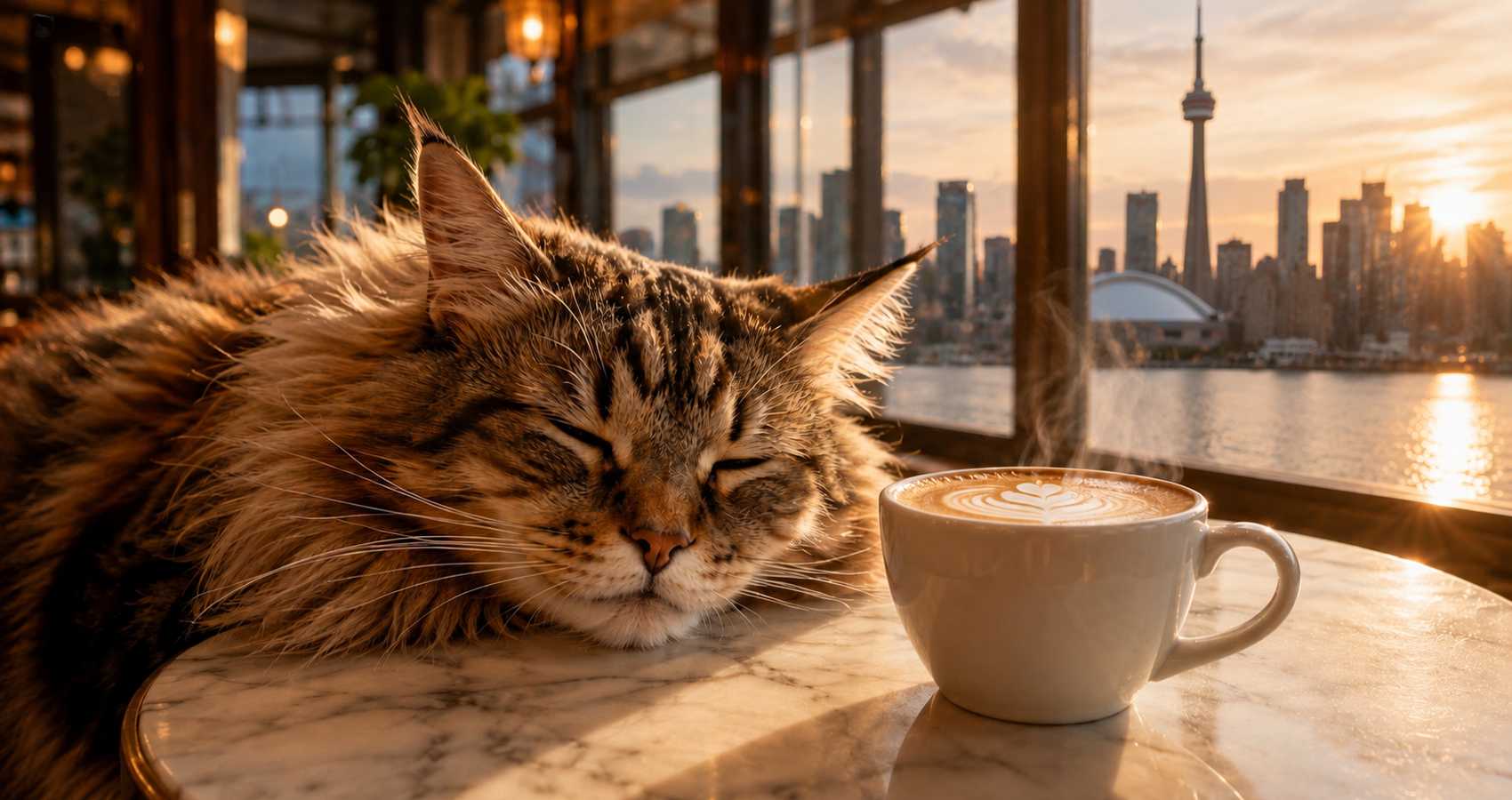
Toby, the Café Cat
written by: Sunil Sharma
Schopenhauer!
I walk into the coffee-house to discover the great pessimist sitting there; distant, a tad disdainful; surveying humanity with that classic expression of severity; the gaunt face bereft of smile, having a haunted look.
Same side whiskers, tufts of unruly grey hair; sunken cheeks; the penetrating gaze that can unsettle the viewer.
I whistle softly, seeing this likeness.
Never expecting this kind of strange experience.
The doppelganger—dressed in a tweed jacket and denim jeans—glances at the glass doors, whenever they open, then looks away quickly, drumming the marble table-top with bony fingers, disappointment writ large in those blue eyes.
A lonely figure, radiating a certain existential sadness—the tribe of such habitués, often seen in cafes.
I go to the customary window-seat with an elevated view of the busy harbour and the streetcars that pass by frequently.
It is a hobby that keeps you occupied in between your appointments; or, while waiting for a latecomer of a friend, or feeling idle and nothing better to do, you drop in the coffee-house to be a part of the general circulation, in order to retain sanity and resist anonymity, in a sprawling city of a million strangers.
It works.
To become an element of the social fabric; hear the noise; chatter; see the crowds; to come alive, a delicious sensation that a rented flat cannot guarantee on long, dull days and longer nights, when the moon plays truant and dark clouds threaten rain or ice and snow and the only sound is the clock ticking on the yellow wall—those dreaded hours—for an insomniac staring at the dark contours of the neighbourhood, eagerly waiting for the dawn to break in a riot of pale-red scarlets.
Cafes are the natural choices, the preferred sanctuaries, for the isolated.
They go for the warmth and intimacy these public places exude. For the reassuring familiarity. Conversations. Laughter. And, a quiet spot for some reflection.
A vibrant space, well-lit, gleaming, for a hungry soul.
I come to this particular café to watch the flow of life.
The play of light-n-shadows on the jagged rooftops; distant crested waves in the lake; undulating streets; milling crowds of commuters; the morning-n-evening rush hours, observed from this vantage point, heart of the city.
Interesting hobby— to witness the rhythms of the urban hubs; aloof, yet a part of the general movement.
The folks being transported from one end to another, living packages in numerous colours, moods, and poses. Montage of a cosmopolitan community live-streaming before you.
Rich lessons in heritage and geography.
The trams are urban history on wheels. Quaint trains—narrow tracks, innards of the megapolis; tiny stations that dot the streets—offer varieties of traditions and skin tones; the cosmopolitan culture on the move.
I can go on watching trams, vehicles, and people, without getting bored by the tediousness of the repetitive details; cyclical traffic grids, the monotony of waiting in snarls, the banality of such metro scenes—evolving, in the process, into a peripheral part of the mobile mosaic.
The sun is up.
Climbing out of the cumulus clouds, it brings cheer to a dismal day.
The place is quiet. The faint hum of the coffee machine can be heard in the background.
I order caffé latte and look around for new faces of the day, like a Parisian artist keen for new subjects for their studies, or a post-modern flaneur observing folks during the afternoon walks, along the boulevards.
Just then materializes a new customer walking on all fours and with a tufty tail, wagging merrily.
Thrilling! This addition.
The cat appears from nowhere, stops and looks around, ambles towards “Schopenhauer”, leaps on the glass table with a mild thud, without disturbing the coffee cup; purrs and plops down in a languid pose as if owning the very spot.
The fat tabby carries the standard M-marking on the forehead and stripes around eyes, legs, and back—lending a dash of mystery to the setting.
Schopenhauer does not wince at the nimble intruder.
He smiles and strokes the cat that closes one eye in pleasure and emits a long and guttural “me-ow-ooo”, the feline equivalent of bliss, the way it sounds to my ears.
The old man returns to the newspaper.
His side of the table holds a battered leather briefcase and a magazine, apart from the newspaper he is reading—or pretends to read, simultaneously keeping an eye on the glass door for any movement there. Seems to be waiting for some special person—this sense I get by watching his body language and eyes that dart at any slightest sound of the doors; doors that hold a promise of delivering the expected source of joy for those waiting in a restaurant.
The cat purrs, but the old man is back to the paper, solving a puzzle, as he fills in blanks with an old fountain pen, peering over the bifocals.
The cat stretches and looks at the guys in front of the house.
Purrs for one long minute.
The old man strokes the arched back with his left hand, while staring at the entrance.
The cat purrs another meow.
The man smiles broadly, a grandfatherly smile that lights up the hollow face, and turns the cadaver into a breathing human.
The interspecies friendship, pure and heart-warming, out in the open for you to admire.
Back in a Tokyo cat café, along with our Japanese host and two British friends, keen to see such a pricey place and meet the pampered denizens there, two years ago. It was calming! The group sketched the cats and absorbed the energy, spatial, and feline. They called it conversations of higher order.
“Who is this cat?” I ask.
“Oh! a regular client. Our favourite one,” says the waiter, a thin student with big brown eyes. “He loves sauntering in and out. Customers love him.”
“Is it?” The surprise, evident. “A cat? Wow!”
The cat does not care and strolls around, checking a plant kept in the middle of the polished floor.
The lunch crowd has already thinned out. A few guys remain. Toying with their mugs; some staring at the sky, maybe hoping for a flying saucer or a green alien ship floating for their benefit.
Interesting cast of characters!
“An exciting addition to our café!” declares a booming voice.
I am back from my studies.
The ever-friendly cashier-owner, a Romanian, shouts across the counter, checking the cash in the till.
We often exchange a brief “hi! how you doing?” over the counter as he punches the bills.
He wears small spectacles that slide off an aquiline nose.
“What is that, dear Andrei? Your new talisman?”
He clears his throat. “They say Toby is an angel.”
“What?!”
“Yes, dragul meu. An angel who appears whenever people feel sad. Have seen these interactions many times. Unbelievable but true! He appears from nowhere, moves around, and disappears once the mission is completed. As simple as that. Of course, stuff for the faithful only. Not for the cynics who doubt about the functioning of the cosmos!”
He laughs. I smile.
Repeat of Alice-moment.
I look at the balding Andrei, expecting more details, but a sudden phone call keeps him engaged.
Toby looks up at me…and yawns a big y-a-w—n–n!
And winks!
This, no ordinary cat!
Toby can be the next internet sensation.
I observe the other customers.
A white man—middle-aged, bearded— with an open screen of a laptop, coffee mug nearby; lost in thoughts; typing something; pausing, thinking, and typing again, then looking out of the window for long, as if in a trance.
A black woman, young, scrolling the phone; in lonely orbit, occupying the sofa seat, near the hearth; texting with dainty fingers, sipping coffee slowly.
Four Asian teens, loud and chattering, in the corner.
A van driver from Punjab, eating muffins hurriedly.
Three elderly Arabs speaking in their tongue, happy, animated in their group, playing cards, at the rear of the hall.
“Toby is our lucky mascot,” says the waiter.
“How?”
“He brings happiness to us through every visit…”
”…and more clients,” adds Andrei, resuming conversation after finishing the call. “We are getting more guys coming to Coffee-Break just to have a look at Toby.”
“He is an Instagram star,” says the waiter. “Popular with the young ones.”
That explains the buzz.
I look again at the Schopenhauer-figure and the cat, now huddled on the table.
“Toby understands grief and removes the unsaid pain by his mere presence,” Andrei says with the authority of an expert.
Toby, as if on cue, purrs and dives down on the wooden floor and walks towards the middle of the floor, and sprawls beside the rubber plant.
The teens are hooked by Toby.
One of them takes a picture—the cat, one eye open; half-grin buried in his whiskers—and shouts, “To our star. Take a selfie, Richard! We shall post the pics on Instagram.”
Richard says, “OK.”
That keeps them busy for ten minutes. The cat readily obliges. It is becoming more fascinating by the minute; the cat being the main actor leading the action and conversation. Animating the entire space. Even the ones revolving in their own orbits take note and grin.
“You reading Arthur?”
I spin around, left side, at the source of the gruff voice.
Schopenhauer stands beside me.
I smile the smile—small, curved at the corners—reserved for utter strangers; a welcoming-but-not-inviting kind of civic smile.
He points towards the leather-bound edition, eyes sparkling with joy.
I nod in agreement.
The old man asks, “On the Suffering of the World? Rare, these days, somebody reading this illuminating book!”
“Yes. I love old Arthur. He provides deep insights into the human condition. Especially, suffering, pain, and pleasure in an irrational world. An absurd world. Questions that confront humans with a conscience. Why suffering? Pain? Cruelty? You get some comfort reading old Arthur in a new-millennia context and find him relevant to your age and questions, questions that others cannot handle with poise.”
He looks impressed by the explanation. Like a teacher happy with the correct answer in a silent class.
“You, a professor or something?” He peers at me for any facial clues.
“No, Sir. I am not that smart. Only an ordinary reader coming from a well-read family. A reader in quest of some fundamental answers to the civilizational woes that keep on plaguing humanity in every age.”
He chuckles. “Well said! No worries, bud! These days, even the exalted professors do not read beyond their syllabi. Ha! You are a disappearing species as a serious reader.”
I smile, more naturally, this time.
“Right, bud,” I say. “Reading is no longer in vogue. Such moral poverty of an AI-directed era!”
He nods. “Perfect!”
“You, a professor?” I ask him.
“Not that smart either! Another ordinary reader in search of truths that should hold in an age when nothing seems to hold except lies told as truths.”
“Excellent!” I exclaim.
Here is somebody real smart and articulate.
“Well said, Sir,” I tell him. “Twenty-first century in a nutshell for the dumb!”
We chuckle.
“We are family!” I exclaim. “Thanks to Ole Arthur!”
Toby looks at us and emits a short “Meow”.
The man looks at the old edition the way a collector looks at an antique piece; tender and caressing; a longing informed by a deep desire to own it, the coveted object—the eyes linger on the crinkled leather jacket; embossed letterings; the famous visage staring back at the viewers with that famous stern look!
“Bought it from a street vendor in New Delhi, years ago.” I confide. “A steal! Nobody wanted to buy that treasure lying neglected on the top of a pile of old textbooks. The vendor happily parted with a “good-choice” compliment.”
The man feels the surface of the book with the right-hand fingers reverentially and exhales a long “Hmm-mm!”—the “aura” of a collectible, as they say.
An act of ecstasy, common to antique hunters.
“We share a common love for the grim philosopher.” He says with a broad grin. “Delighted to meet you!”
“Same here.”
“May I join you?” He asks, more relaxed now, the unsaid kinship book lovers share with each other in unlikely venues.
I point towards the empty seat. “Be my guest, bud!”
“Thanks, bud. Give me a second.”
He goes back to collect his stuff and ambles to my table, flops down, and emits another soft “hmm”; his signature tune, I guess.
We feel like old pals; our new alliance sealed by a long-forgotten philosopher.
“John here.”
“Arvind.”
We shake hands; his grip firm, warm, and intimate.
“Nice meeting you, Arvind.”
“Same here, John.”
“Arthur must be happy to see two of his loyal readers united in a Canadian café, of all the places, em.”
I grin. “True! We keep him alive.”
We sip coffee, one sip at a time. He holds the black coffee in his mouth, savors the content, rolls it over, and then gulps it down; his Adam’s apple moving up-n-down a veiny throat.
We sit in silence, each sizing up the other, without being intrusive.
“Cafes can bring strangers together,” I tell him.
“And turn them into friends.”
“Maybe that is the job of fine books, uniting people over coffee.”
He agrees.
“You bear an uncanny resemblance…”
“…to Schopenhauer.” He chuckles. The eyes crinkle up with mirth, reminding you of Santa.
“Yes, bud.”
“Well, Arvind, many people say that.”
“For once, John, I thought the German had returned from the dead and was waiting for his devotee, the moment I saw you sitting there. It was rather eerie!”
This time, John roars. “Who knows? I might be old Arthur waking up on this day of the year 2026, just to meet you.”
We smile at the possibility of such an idea; the resurrection of an author in a different timeline.
Toby stirs again and moves around, tail erect, purring softly to the world.
“Well,” John says, “I am here to tell you about Toby.”
“Toby, the cat!”
“Yes, Toby, the cat.” He pauses and then: “Here is a secret. Toby is a sentinel being.”
“Tell me, bud. All ears for this tale.”
Slowly, in measured tones, he narrates the “how” of it.
John, in his voice:
Here I was waiting…
Waiting for my son, who had come to meet me in this very café, after six years, despite us living in the same city for more than two decades, some twenty-five minutes away from my flat.
I want to meet you, Son, I had insisted on the phone. Something to share with you, something very urgent, I told him, pleading desperately, hoping he would not say no to the meeting.
Luckily, he agreed this time, moved by my frail voice and desperate pleadings.
He turned up finally, after having cancelled two earlier meetings, citing emergencies, and making me feel horribly miserable.
Why does an emergency happen whenever dad calls? —that is a mystery, still unresolved to me, dear Arvind.
Anyway, I was there, sitting in that chair, facing my son, who had grown bald and slightly obese, distracted and cold as usual.
We exchanged greetings.
He looked tense.
“Jim?” I asked, a rush of parental concern in my voice. “You okay, my boy?”
“Everything OK, dad.” His voice was businesslike, impersonal, coming from a remote place, a far-off place I could not fathom.
“Good to hear that, kid!”
I inquired about the grandkids and their schools, his wife, their jobs.
We sipped coffee.
He took five calls during those rushed fifteen minutes.
“Busy?” I asked.
He nodded, absent-minded.
“Son, I won’t detain you for long, dear. Just wanted to tell you about something very important…”
He got another call, as if on a clue. “I have to take this call.” And went out in the corner. I sipped the coffee and watched his back.
He came back. “Sorry, dad! Have to rush to the office. Some emergency!”
I mumbled, OK.
“You meet me here only, tomorrow, dad, same time. I will sure drop in for a long chat,” he said, almost running. “Anything urgent, text.”
He was gone!
Just like that—vanished in a second!
I sat still, feeling crushed.
…Here, his eyes moist, his voice slightly trembles. John reminds me, at this moment, of an old mother deserted on a dark, cold night in a plaza, the outskirts of Mumbai, going viral. The sadness, infectious, heartbreaking. He regains composure and continues the conversation…
I sat speechless for long. Badly wanted to share with him that I had got only six months to live in a lonely one-room apartment.
Wanted to show my son the medical reports, and discuss my deep fears…of dying in my late 60s, in a room, away from family and a few surviving friends; in a gloomy hospital.
The clock ticking fast for me.
Alone. Scared. Diminished. But he was not there listening to my farewell fears.
He almost ran away on a lame excuse!
My heart sank.
The terror of being alone on a crowded planet overpowered me.
I wanted to request my son to grant my last wish, a simple request.
To meet my grandkids one last time, if he were truly listening…
“Sorry to hear this, John!”
He says nothing, only blinks.
We remain quiet for long.
“It is tough! I understand,” I say.
He nods slightly, still lost in the memory of that painful moment.
“So, you wait daily for your son here, hoping against hope…”
He smiles. “Yeah. Hoping that he might turn up one day, my boy, for his dying dad.”
“What about Toby?”
“I was coming to that point. That memorable day, broken, waiting, I was about to leave, when the furry animal leapt on the table and winked at me…”
“Who? Toby?”
“Yes,” recounts John. “Surprising, is it not? A cat landing on the table, out of nowhere!”
I am amused by the detail.
“I look at the creature, and I am like, what is he doing here? Momentarily stunned. Then…”
“…then?”
“Well, the cat winks and purrs. I smile through my tears. Toby wags his tail and extends his paw. I shake his hand with my right one. We become instant pals.”
“I get the background,” I say. “It is an extraordinary story. A tale that needs to be broadcast further in a cruel world.”
We take tiny sips of the coffee.
He pauses for a minute and then says: “Since then, I come here every day, waiting for Godot. And happy to meet Toby in the process. He plays with me and then moves around, greeting others who are broken or sad, very sad inside. Now, with pain somewhat lessened, these visits are more for Toby than for my wayward and forgetful son.”
“I see. Toby is indeed an angel who brought you back from the brink that day.”
“Universe speaks in mysterious ways, Arvind. Toby is a miracle worker. His timing is perfect. He comes at that critical point, when you need him the most, alone, battered, at your lowest, melting fast. He arrives and alters moods and vibes. I have seen these encounters happen here, on many occasions. Toby can transform you completely by looking up into the depths of your eyes during the darkest hour when you are adrift in a sea.”
I am moved by the warmth of this testimony and the incredible generosity of Toby.
Feel lucky, having run into the cat in the café.
“Arvind…”
“Yes…”
“One more thing. Now it does not matter much. My son coming or not. What matters is the presence of Toby, meeting him here, playing with him. He is the real reason for my staying on for an hour or so in this outlet. I often talk to Toby, and he listens, innocent eyes clamped on my face…”
His voice chokes. The withered face no longer looks sallow, becoming alive, human.
I hold his hand in mine.
“Toby is the greatest gift to folks like me!” He sobs. “He is a great healer for the broken!”
I squeeze his gnarled hand.
“Arthur was right,” John says, finally composed. “You summed him so well. Indeed, suffering is universal. Pain is an inevitable part of existence. You cannot escape both. Happiness is but limited. Accept the condition and move on. This perspective gives strength and calmness to face the gathering storms. Find your way forward in the chaos. I did that with his help. I am very grateful to the animal.”
“Absolutely. This self-awareness about suffering in a godless world is crucial for survival, your ticket to clarity.”
“And living meaningfully in a transactional world that suddenly makes no sense,” John says with conviction. “You make peace with that crumbling system and regain inner composure, a necessity, for survival. Toby provides that anchor.”
Toby wags his tail and emits another “meow”.
“This chap,” John says with a chuckle, “He knows a lot better about suffering than most of us. Toby, I am told by a local, was abused and abandoned outside a warehouse on a freezing night. He somehow survived the cold, dark, and found his way…into our hearts.”
I look at the cat, busy with the inspection of the area.
“The most endearing thing, Arvind, is that he follows you once he senses sadness or grief around you. A real marvel, this fine instinct in him. Sometimes, looking at Toby, I get this sense, he is like, touched by the spirit of the German philosopher.”
Another relevant revelation.
“Or,” I say with a chuckle, “He is Schopenhauer among the cats.”
John laughs loudly, shaking both sides.
“Thanks, Arvind, for listening to my story. People have lost patience. They have no time for others.”
“No worries. Any time, friend. Sharing the pain lessens it. We are here for each other.”
We talk for a few minutes more, then I get up, promising to meet John daily—I meant to keep up the promise till the last day of his earthly journey under the watch of Ol’ Arthur, our patriarch.
As I start moving out—after paying the bill and a quick bye at the counter—I find Toby with his orange face, gleefully following me to the doors, a new friend in a bustling Toronto…

- Toby, the Café Cat - June 21, 2026
- Great Lyrics Travel with You for a Lifetime - July 17, 2025
- Home - September 5, 2020